Mandatory severance pay by length of job tenure in the G7, Australia, New Zealand, Ireland, Scandinavia, Greece and Spain

There are a wide differences across the OECD in mandatory severance pay in the event of a layoff.

image

Source: Labor Market Regulation – Doing Business – World Bank Group.

Severance pay makes it more expensive to fire and therefore more expensive to hire. This means fewer job vacancies will be created but they will last longer.

The presence of mandatory severance pay  could increase or reduce the unemployment rate but unemployment durations will increase because it takes longer to find a suitable job match among the fewer available vacancies.

Mandating severance pay does not make the job match inherently more profitable. It just redistributes some of the surplus from the job match to the end when it is terminated.

Employers and jobseekers may agree to severance pay where investments in firm specific and job specific human capital for the job is profitable.

Severance pay in these circumstances gives the employer and more reasons to invest in specific human capital. The promise to pay severance pay will make the employer hesitate to lay them off. The employer will instead retain them over a slack period or redeploy them within the company rather than pay them out. This pre-commitment encourages investment in  firm specific and job specific human capital by both sides more secure, which makes the job match more profitable overall for both sides.

Of course, if it was possible to negotiate completely around severance pay mandated by law, there would be no effects on hiring, firing and unemployment durations. All it would mean is take-home pay would be less but in the event of a layoff, these employees would get that this wage reduction back as a lump sum.

Official and legal fees of starting a new business in OECD countries, World Bank Doing Business rankings, 2016

In some countries, the official and legal fees of setting up a business are trivial but in other countries they start to mount up.

image

Source: Data from the Doing Business Project – World Bank Group.

Paid-in minimum capital (% of income per capita) required to start a business in OECD countries

The most mystifying bureaucratic rule I have come across is in Western Europe. A number of these countries require entrepreneurs deposit a minimum sum of money in a bank or before a notary up to a month before registration and 3 months after incorporation. If they cannot do this, they cannot start their business lawfully.

image

Source: Historical Data – Doing Business- World Bank Group.

I am mystified as to what this regulation is designed to do other than make it difficult to start a new business. It is a private commercial matter as to whether trade credit is extended to new businesses. That indeed is one of the challenges facing every entrepreneur: discovering who are reliable business partners or not.

One of the functions of banks is to issue letters of credit. These vouch for the financial strength of a customer when seeking new business or export markets.

Ease of doing business in Europe, World Bank Doing Business 2016 rankings

For a rich country, Luxembourg is a pretty crappy place to do business – worse than Greece. Mostly due to terrible rankings for the Luxembourg legal system. Italy is not much better.

image

Source: Ranking of economies – Doing Business – World Bank Group.

Software piracy by country

@jacindaardern wrong to say Australia is last place to follow in race relations

From 1965 onwards, 1/3rd of terrestrial Australia – 2.5 million sq kms of land – was returned to indigenous owners, with half of that since the Native Title decision in 1993. Tasmania pioneered aboriginal land rights with the Cape Barron Island Act 1912.

Source: Jon Altman, The political ecology and political economy of the Indigenous land titling ‘revolution’ in Australia, March 2014 Māori Law Review.

New Zealand extinguished native title twice in its history with the 2nd of these takings of Māori land by the last Labour government with the foreshore and seabed legislation. In her op-ed today, has Jacinda Ardern forgotten why the Māori party came into being?

Unlike New Zealand, Australia welcomed migrants from a wide range of ethnicities after the Second World War. It abolished the White Australia policy in the 1960s along with any discrimination in its Constitution against aboriginals.

Australia takes 8 times as many refugees as New Zealand on a per capita basis.

This redress of indigenous grievances was done out of the generosity of the Australian heart. Aboriginals are a tiny minority in Australia with little independent political pull.

@paul1kirby why does @OECD claim that Indians trust their judicial system so much?

For a country riddled with corruption, Indians report the surprising amount of confidence in their courts despite the corruption in those courts as well.

image

Source: Index of Economic Freedom.

image

Source: Doing Business in India – World Bank Group.

@OwenJones84 @K_Niemietz Venezuelan, Chilean and Chinese index of economic freedom rankings 2016

image

Source: Index of Economic Freedom: Promoting Economic Opportunity and Prosperity by Country.

A bizarre Finnish amateur racing car practice for redistributing winning

Much more than a high minimum wage – Puerto Rican, Mexican and U.S. Doing Business rankings 2015

Having a high minimum wage is the least of the problems that the US territory of Porto Rico has when you consider reasons from its recent sovereign default. It owes about US$70 billion. It is a terrible place to do do business – worse than Mexico! Mexicans find it easier to export to the USA!

image 

Source: Doing Business Project – World Bank Group.

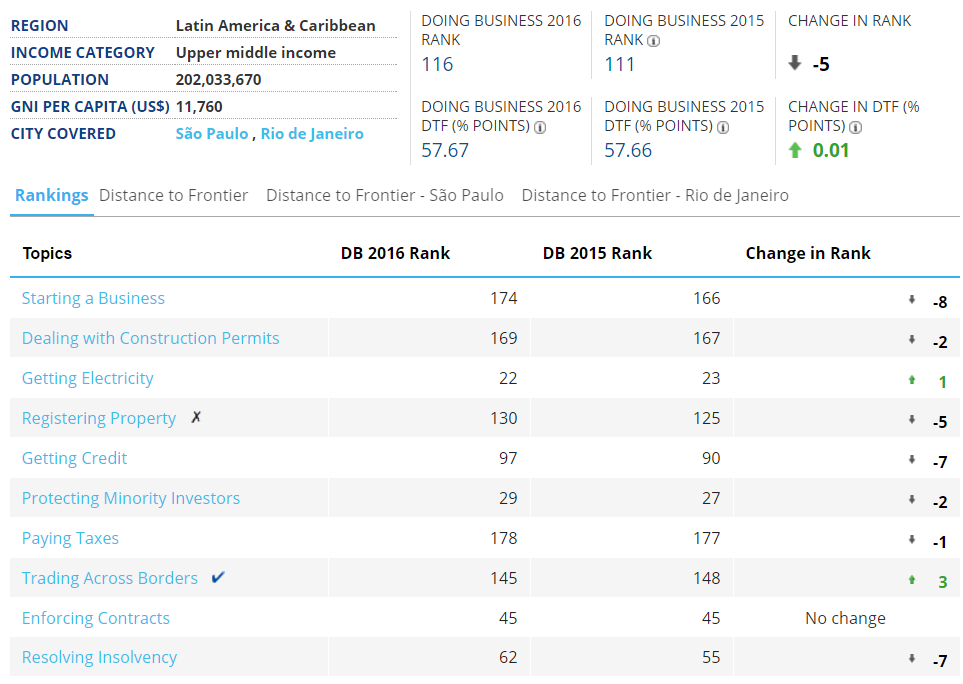
@OwenJones84 @K_Niemietz Ease of Doing Business in Latin America and the Caribbean – World Bank rankings

image

Source: World Bank Doing Business Database 2015.

@GreenpeaceUK thinks these wind turbines are a pretty sight

The Return Of Australian Indigenous Land to 2013

David Friedman explains incentive incompatibility and comparative institutional analysis

Source: Hidden Order: Chapter 20.

Carbon trading, fisheries quotas & deregulatory takings @cjsbishop @franks_lawyer

Like carbon trading permits, an individual transferable quota (ITQ) to a fish catch can be construed as a exclusive, perpetual right. An individual transferable quota (ITQ) is an allocated privilege to land a specified portion of the annual fish catch.

Fisheries regulators consider ITQ quota shares not to be property, but to convey a privilege to catch an amount of fish or shellfish in a given year that can be renewed or revoked. ITQs are quota shares may represent a different resource quantity every year as the total allocated catch may vary from year to year. Nonetheless, the ability to sell or lease ITQ shares implies a more enduring, if not permanent, fishing access privilege.

No one has yet successfully argued that the ability to adjust and modify an ITQ program constitutes grounds for a regulatory taking in the USA.

The Australian courts have found that fishing entitlements, although similar in terms of the privileges conferred, are not the common law property right of profit á prendre. They are a statutory entitlement. A profit á prendre is a right to take part of the soil, minerals, natural produce including fish and wild animals. The person does not own the thing gathered whilst it is on the land, but has a right to gather it.

Compensation for modification and extinguishment of these rights depends on whether there is compensation payable under applicable legislation or on whether the plaintiffs can rely on constitutional guarantees of acquisition of property on just terms. The courts have clearly indicated that fishing entitlements are rights created by government as means of regulating the fishing industry and are thus governed by the legislation that created them.

By annulling that legislation, the entitlement no longer exists. By modifying the legislation, the entitlement is redefined. Statutory licences are ‘inherently susceptible’ to modification or extinguishment.

See ‘ITQs and Property Rights A review of Australian case law’ by Sevaly Sen, Barry Kaufmann and Gerry Geen Fisheries Economics, Research and Management Pty. Ltd. Australia

Deregulatory takings is another name for reducing the size of carbon trading permits and individually transferable fisheries quotas. There is a large literature on deregulatory takings and regulatory contracts in the USA.

In electric power generation deregulation, ‘Stranded Costs’ represents the existing investments in infrastructure for the incumbent utility which may become redundant in a competitive environment. Stranded costs can also be defined as any investment that will be less valuable under competition than under regulation. Stranded costs are another name for the transitional gains trap.

Given there are no constitutional protections against regulatory takings, it would be ironic that there were constitutional protections against deregulatory takings.

It would be even more ironic that the viability of carbon trading is undermined by the unwillingness of the environmental movement to accept investor certainty over individually tradable quotas to a fishery catch. High-handed reductions of fisheries quotas set the stage for the same in carbon trading. Given that sovereign risk, the business community and investors will be less willing to support the regime been established in the first place.

Previous Older Entries Next Newer Entries

Bassett, Brash & Hide

Celebrating humanity's flourishing through the spread of capitalism and the rule of law

Truth on the Market

Scholarly commentary on law, economics, and more

The Undercover Historian

Beatrice Cherrier's blog

Matua Kahurangi

Celebrating humanity's flourishing through the spread of capitalism and the rule of law

Temple of Sociology

Celebrating humanity's flourishing through the spread of capitalism and the rule of law

Velvet Glove, Iron Fist

Celebrating humanity's flourishing through the spread of capitalism and the rule of law

Why Evolution Is True

Why Evolution is True is a blog written by Jerry Coyne, centered on evolution and biology but also dealing with diverse topics like politics, culture, and cats.

Down to Earth Kiwi

Celebrating humanity's flourishing through the spread of capitalism and the rule of law

NoTricksZone

Celebrating humanity's flourishing through the spread of capitalism and the rule of law

Homepaddock

A rural perspective with a blue tint by Ele Ludemann

Kiwiblog

DPF's Kiwiblog - Fomenting Happy Mischief since 2003

The Dangerous Economist

Celebrating humanity's flourishing through the spread of capitalism and the rule of law

Watts Up With That?

The world's most viewed site on global warming and climate change

The Logical Place

Tim Harding's writings on rationality, informal logic and skepticism

Doc's Books

A window into Doc Freiberger's library

The Risk-Monger

Let's examine hard decisions!

Uneasy Money

Commentary on monetary policy in the spirit of R. G. Hawtrey

Barrie Saunders

Thoughts on public policy and the media

Liberty Scott

Celebrating humanity's flourishing through the spread of capitalism and the rule of law

Point of Order

Politics and the economy

James Bowden's Blog

A blog (primarily) on Canadian and Commonwealth political history and institutions

Science Matters

Reading between the lines, and underneath the hype.

Peter Winsley

Economics, and such stuff as dreams are made on

A Venerable Puzzle

"The British constitution has always been puzzling, and always will be." --Queen Elizabeth II

The Antiplanner

Celebrating humanity's flourishing through the spread of capitalism and the rule of law

Bet On It

Celebrating humanity's flourishing through the spread of capitalism and the rule of law

History of Sorts

WORLD WAR II, MUSIC, HISTORY, HOLOCAUST

Roger Pielke Jr.

Undisciplined scholar, recovering academic

Offsetting Behaviour

Celebrating humanity's flourishing through the spread of capitalism and the rule of law

JONATHAN TURLEY

Res ipsa loquitur - The thing itself speaks

Conversable Economist

In Hume’s spirit, I will attempt to serve as an ambassador from my world of economics, and help in “finding topics of conversation fit for the entertainment of rational creatures.”

The Victorian Commons

Researching the House of Commons, 1832-1868

The History of Parliament

Articles and research from the History of Parliament Trust

Books & Boots

Reflections on books and art

Legal History Miscellany

Posts on the History of Law, Crime, and Justice

Sex, Drugs and Economics

Celebrating humanity's flourishing through the spread of capitalism and the rule of law

European Royal History

Exploring the Monarchs of Europe

Tallbloke's Talkshop

Cutting edge science you can dice with

Marginal REVOLUTION

Small Steps Toward A Much Better World

NOT A LOT OF PEOPLE KNOW THAT

“We do not believe any group of men adequate enough or wise enough to operate without scrutiny or without criticism. We know that the only way to avoid error is to detect it, that the only way to detect it is to be free to inquire. We know that in secrecy error undetected will flourish and subvert”. - J Robert Oppenheimer.

STOP THESE THINGS

The truth about the great wind power fraud - we're not here to debate the wind industry, we're here to destroy it.

Lindsay Mitchell

Celebrating humanity's flourishing through the spread of capitalism and the rule of law

Alt-M

Celebrating humanity's flourishing through the spread of capitalism and the rule of law

croaking cassandra

Economics, public policy, monetary policy, financial regulation, with a New Zealand perspective

The Grumpy Economist

Celebrating humanity's flourishing through the spread of capitalism and the rule of law

International Liberty

Restraining Government in America and Around the World