Why Do Governments Enact Price Controls?
03 Jul 2016 Leave a comment
in applied price theory, economics of regulation, law and economics, property rights Tags: price controls
Dara Ó Briain – A Catholic & Protestant Mixed Marriage
20 Jun 2016 Leave a comment
in economics, economics of love and marriage, economics of religion, property rights Tags: Ireland
HT: Donal McChaffery
Repugnant markets and the demand and supply for counterfeit legal ivory
17 Jun 2016 Leave a comment
in applied price theory, economics of crime, entrepreneurship, law and economics, property rights Tags: black markets, counterfeit goods, economics of prohibition, endangered species, offsetting the, unintended consequences
A huge legal sale of ivory in 2008 backfired. Instead of crashing the price of ivory and undermining poaching, poaching exploded in East Africa. It increased by 65%.
The international trade in ivory was banned in 1989. In 2008, China and Japan were allowed to pay $15m for 107 tonnes of ivory from elephants that died naturally in four African nations.

Source: Study finds global legalization trial escalates elephant poaching | Berkeley News.
Hsiang and Sekar this week found that this legal sale of ivory was followed by “an abrupt, significant, permanent, robust and geographically widespread increase” in ivory poaching. They were right to conclude that the legal sale provided a cover for poached ivory.
The economic intuition was that if we allow the sale of some legal ivory in Japan and China, then there would be fewer people left to purchase it illegally. We found that that intuition was incorrect. The black market for ivory responded to the announcement of a legal sale as an opportunity to smuggle even more ivory.
The legal sale of ivory created new demand for ivory in China, where it no longer had the stigma of an illicit product. The presence of legal ivory provided cover for smugglers trying to peddle illegal ivory sourced from poachers.
As illegal ivory can now masquerade as legal ivory in China, transporting and selling illicit ivory has gotten easier and cheaper, which can boost illegal production even though prices are falling.
Ivory is a repugnant market. Many friends will be revolted by you having ivory products.
The presence of legal ivory made it possible for counterfeit legal ivory to be passed off as legal ivory and therefore your friends will not reject you. This is a real and striking example of a unintended consequence. The solution to poaching is property rights.
High US drug prices as a good shot public good @RobinHoodTax
08 Jun 2016 Leave a comment
in applied price theory, comparative institutional analysis, health economics, law and economics, politics - USA, property rights Tags: best shot public goods, creative destruction, drug prices, game theory, good shot public goods, military alliances, NATO, patterns and copyrights, Warsaw Pact, weakest link public goods, World War I
Much is made of the fact that drug prices are lower in Canada and Western Europe as compared to the USA. Indeed, day trips are made across the Canadian border to buy cheaper drugs as compared to the local pharmacy pricin in a US city.

Instead of what is always the relevant public policy question. What would happen in the USA if attempts were made to seriously reduce the price of drugs. The answer is obvious, the incentive to create new drugs would be severely diminished. There are no free lunches in public policy.

Bringing in new drug to the market is a seriously expensive business these days. That is before you consider the commercial risk of inventing a drug that isn’t much better than its competitors.
Of course, you can always be leapfrogged by another drug company brining on a better drug not long after you have brought yours to market. None of this is getting any cheaper.

Innovation by specific drug company is a form of public good production known as best shot public goods. Under a best-shot rule, the socially available amount is the maximum of the individual quantities. There is is a single prize of overwhelming social importance, such as a major drug breakthrough, with any individual’s effort having a chance of securing the prize.
A specialty drug for a year costs more, on average, than most household incomes wpo.st/0y_q0 https://t.co/uss6ikgkYk—
carolyn johnson (@Carolynyjohnson) November 20, 2015
The amount to be produced of a best shot public good depends on the best contribution rather than the usual situation of any contribution is interchangeable. Another example is a large number of people shooting at an incoming missile. The best shot counts, all the others don’t matter.
High drug prices in the USA could be the price of the weakest shot or weakest link public good. Weakest shot public good is where the socially available amount is the minimum of the quantities individually provided. One example a weakest link public goods are military alliances where the success of the alliance depends upon everyone contributing
In the weakest shot or weakest link theory of public good production, the free riding countries of Europe will bring the whole show down by not making their contribution to drug research by buying at good prices from the US pharmaceutical companies.
Perhaps a better way to look at drug innovation is a good shot public good. Someone has to make a reasonable contribution; that has to be the USA because it is such a large market. Without access to good prices in the USA, there wouldn’t be enough of an incentive for drug innovation.
Military alliances such as NATO and the Warsaw Pact probably are examples of good shot public goods. They depend on a number of large countries making their contribution but I always leaned towards the crucial best shot contribution of the USA and former USSR .
In the case of the start of World War I, Triple Entente against Germany was a weaker shot public good. Its defensive wall depended on the strength of the weakest country defending i.e. the unfortified Belgian border (in both wars). The Tripartite Alliance was a best shot public good depending on the strength of Germany’s attack for ultimate success or failure.
#MorganFoundation wants frontal attack on NIMBYs
03 Jun 2016 Leave a comment
in economics, economics of bureaucracy, economics of regulation, income redistribution, law and economics, property rights, Public Choice, public economics, rentseeking Tags: congestion charges, housing affordability, land supply, NIMBYs, RMA, road pricing, zoning

Morgan Foundation wants the National party-led government to take on NIMBYs not only with more high-rises and urban intensification but congestion charges too! There is only so much courage you can expect in one term of government. Relaxing the Auckland urban limit, which will hopefully cause housing prices to stop rising in Auckland was not enough.
No softly softly catchy monkey here. No concept of winning the battles you can win.
Paper Towns- Fake Places Made to Catch Copyright Thieves
02 Jun 2016 Leave a comment
in entrepreneurship, industrial organisation, law and economics, property rights, survivor principle Tags: entrepreneurial alertness, maps, patents and copyrights
Kowloon: City of anarchy
22 May 2016 Leave a comment
in economics of crime, international economics, International law, law and economics, property rights Tags: Hong Kong


Patents, Prizes, and Subsidies
20 May 2016 Leave a comment
in applied price theory, applied welfare economics, comparative institutional analysis, economics of regulation, entrepreneurship, law and economics, property rights Tags: patents and copyright
Saving Ocean Fisheries with Property Rights
17 May 2016 Leave a comment
in applied price theory, comparative institutional analysis, economics of regulation, environmental economics, fisheries economics, industrial organisation, international economics, law and economics, privatisation, property rights Tags: common property, economics of fisheries, individual transferable quotas, tragedy of the commons
Songs that sound the same: “Do Ya Think I’m Sexy” and “Taj Mahal”
15 May 2016 Leave a comment
in economics of media and culture, Music, property rights Tags: patents and copyrights
Songs that sound the same? “My Sweet Lord” and “He’s So Fine”
14 May 2016 Leave a comment
in economics, economics of media and culture, Music, property rights Tags: patents and copyrights
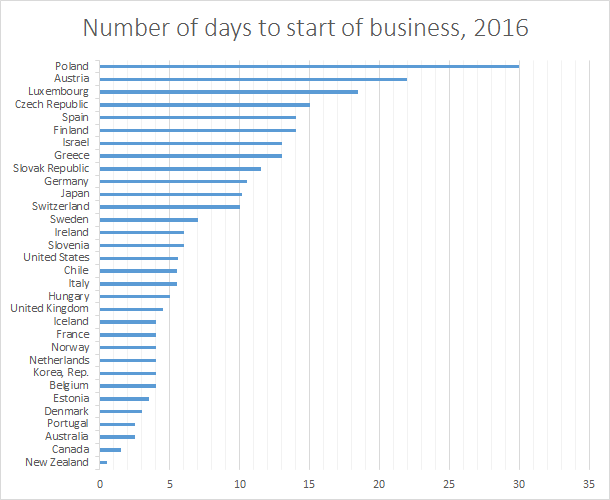
Numbers of days needed to start a business in high income countries
11 May 2016 Leave a comment
in economics of regulation, industrial organisation, law and economics, property rights Tags: barriers to entry, doing business
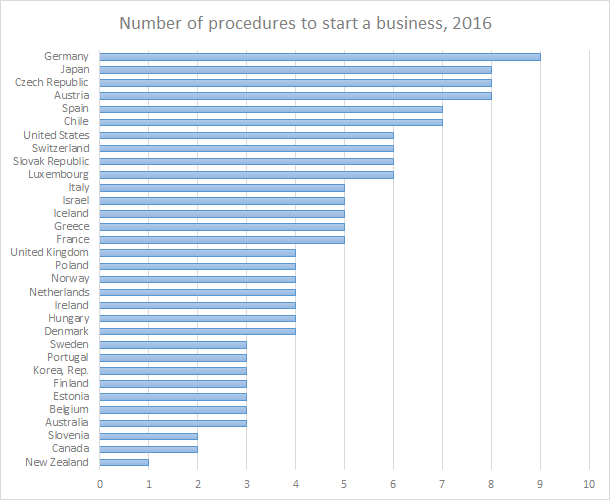
Number of procedures required to start a business in high income countries
10 May 2016 Leave a comment
in economics of regulation, entrepreneurship, industrial organisation, law and economics, property rights Tags: barriers to entry, doing business
Trekonomics: The Final Frontier (w/ Manu Saadia)
09 May 2016 Leave a comment
in applied price theory, applied welfare economics, Austrian economics, comparative institutional analysis, constitutional political economy, development economics, economics of regulation, environmental economics, history of economic thought, industrial organisation, international economics, law and economics, property rights Tags: star trek


Recent Comments