The Coase Theorem
08 May 2016 Leave a comment
in applied price theory, applied welfare economics, Austrian economics, comparative institutional analysis, constitutional political economy, economics of regulation, environmental economics, history of economic thought, industrial organisation, law and economics, property rights, Ronald Coase Tags: Coase theorem
Recycling Dumpster Diving: A "Victimless" Crime?
06 May 2016 Leave a comment
in applied price theory, economics of crime, environmental economics, law and economics, property rights Tags: recycling

“Each week my family separates our recyclables from our regular trash. The former are put in our blue bin and are placed out on the curb for pickup on Wednesday mornings.
Last Tuesday night, I walked to Westwood Village to attend a dinner when I saw two individuals diving into all of my neighbours’ recycling bins (which were on the street curb) to extract the recyclables.
These "entrepreneurs" had a large truck filled with plastic bottles and aluminium cans that they were clearly loading up to take to a place to collect the recyclables fees. Is this a crime?
I view it as an economic crime for the following reason. The only reason this "trash treasure" was easy to access in the blue bins on the street was because the well meaning law abiding citizens wasted their time sorting their trash and kindly placing it outside.
Our tax dollars goes to the unionized guys who drive the recyclable trucks to pick this stuff up. If there is nothing to pick up, because the pirates have stolen the treasure, then recyclable trucks are losing $ as they are bringing in no revenue. So, this operating profit loss is just a transfer from the city to the pirates. My tax dollars and my time are being used to transfer $ to pirates.
The environment is no cleaner and is likely to dirtier because of the duplication of transportation (the recycling truck and the dirty private pirate trucks). I saw the same thing in Berkeley. What is to be done? A green cop shooting tranquilizer darts?”
Source: Environmental and Urban Economics: Recycling Dumpster Diving: A "Victimless" Crime?
The cost of starting a business in Europe and North America
18 Apr 2016 Leave a comment
in economics of regulation, industrial organisation, law and economics, politics - USA, property rights Tags: barriers to entry, Belgium, British economy, Canada, Denmark, doing business, France, Germany, Greece, Italy, Portugal, Spain
These measures including the full cost of starting a business. Not only are official fees included, the opportunity cost of the waiting times for various permits are issued are added as well.
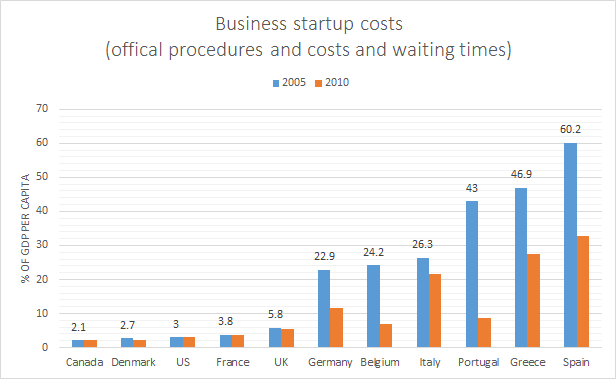
Source: Markus Poschke, Entry regulation: Still costly | VOX, CEPR’s Policy Portal (2011).
Note: The value of time is set to a business day’s output per day of waiting time at 22 business days per month.
Water Policies for People, by David Zetland
18 Apr 2016 Leave a comment
in economics, economics of regulation, environmental economics, industrial organisation, law and economics, privatisation, property rights, survivor principle Tags: Economics of water
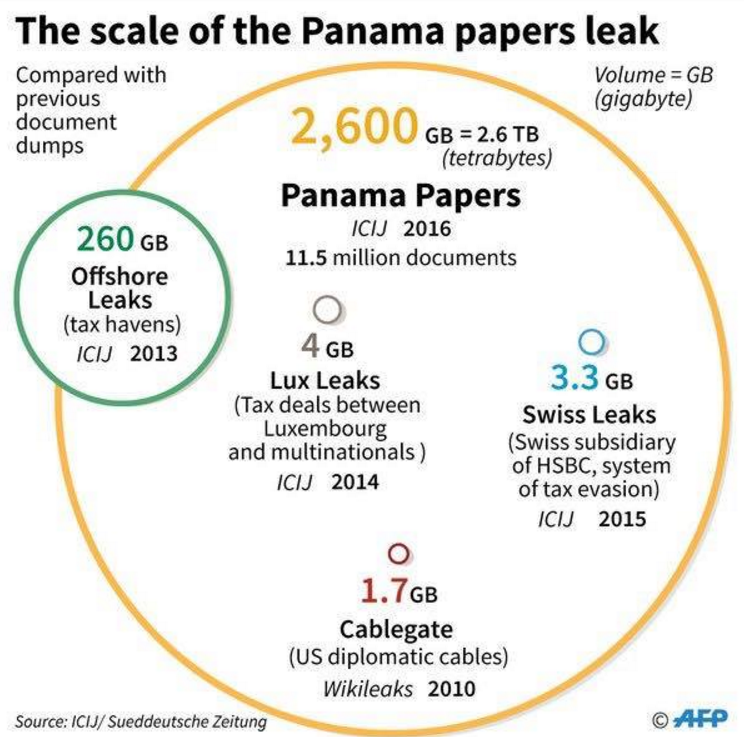
The scale of the #Panamapapers leak
16 Apr 2016 Leave a comment
in economics of crime, law and economics, property rights, public economics Tags: conspiracy theories, tax havens
Forever Contemporary – The Economics of Ronald Coase | Free book from Institute of Economic Affairs
11 Apr 2016 Leave a comment
in history of economic thought, industrial organisation, law and economics, property rights, Ronald Coase, theory of the firm
Summary:
- R. H. Coase (1910–2013), a leading modern figure in the classical liberal tradition, was awarded the Nobel Prize in Economics in 1991 for his analysis of the significance of transaction costs and property rights for the functioning of the economy.
- Before Coase’s work in the 1930s, there was no real understanding of the relation between the theory of the firm and the theory of markets. Coase showed that the size and structure of firms, and the location of the border between internal exchange within the firm and external exchange through markets, are systematically related to the costs of transactions.
- These transaction costs, which Coase termed ‘costs of using the price mechanism’, include search and information costs (those involved in finding business partners, rather than having to produce your own inputs), bargaining costs (which rise sharply with the number of contractual partners) and enforcement costs (which, in the absence of a strong and effective legal framework, depend largely on trust in partners). When these costs alter dramatically, for example, as a result of introducing innovative technology, we can expect substantial alterations in firm and market structures.
- Coase was a pioneer in the modern analysis of environmental issues. He showed that, with clear property rights and low transactions costs, private solutions to many environmental problems can be achieved without government regulation. Such solutions were logically independent of the initial distribution of property rights. This is highly relevant to a number of modern economic problems which the government currently handles badly, such as land-use planning.
- His work has had a profound effect on later generations of economists, several of whom themselves won Nobel Prizes. His work on environmental issues, for example, influenced another Nobel Prizewinner in Elinor Ostrom, whose work focused on how common pool resources could be used effectively with minimal government intervention. This is especially relevant to debates about environmental and ecological degradation in forestry, fishing and game animal resources – perhaps particularly in developing economies.
- Similarly his work on the firm led to the development of the ‘New Industrial Economics’, now associated with Oliver Williamson, which has changed our understanding of issues of economic governance. This is relevant to current concerns over corporate social responsibility.
- Coase’s editorship of the Journal of Law and Economics over many years did much to stimulate economic analysis of legal institutions, an innovation which has had a major influence on public policy, particularly in the US. It has fed, for instance, into recommendations for accident compensation.
- Coase’s insights have challenged economists’ assumptions about the nature of public goods, which he demonstrated could often be provided more effectively by various forms of private initiative. He also illuminated such varied topics as the allocation of spectrum bandwith, the regulation of financial institutions and water resource management.
- Methodologically, Coase was opposed to ‘blackboard economics’ which relied on theory or econometric analysis at the expense of more practical investigation. He favoured careful examination of case studies and the history of industries when analysing economic policy issues.
- His work retains considerable significance in the twenty-first century. Coase’s analysis of China’s economic advance, published shortly before his death, sheds light on its future prospects, while his transaction cost approach can be argued to explain the new phenomenon of the ‘sharing’ economy which is reshaping businesses and employment. Furthermore his work should continue to be at the forefront of debates surrounding regulation, broadcasting and the environment. If policymakers and the economists who advise them ignore Coase, they are in danger of perpetuating policies which may work ‘in theory’ but do not work effectively in practice.
Source: Forever Contemporary – The Economics of Ronald Coase | Institute of Economic Affairs
@JulieAnneGenter tax havens underwrite The Great Escape from extreme poverty in developing countries
08 Apr 2016 Leave a comment
in applied price theory, constitutional political economy, development economics, economic history, economics of bureaucracy, economics of crime, growth disasters, growth miracles, International law, law and economics, property rights, rentseeking
Tax havens and offshore financial centres are vital to the economic development of poor countries. There are plenty of countries, poor countries, where the ability to move funds offshore is fundamental to successful investment. That is missed in the reporting of the Panama Papers:
Consider the big names that have shown up so far on the list. With the notable exception of Iceland, these are not countries I would describe as “capitalist”: Russia, Pakistan, Iraq, Ukraine, Egypt. They’re countries where kleptocratic government officials amass money not through commerce, but through quasi-legal extortion, or siphoning off the till. This is an activity that has gone on long before capitalism, and probably before there was money.
Tax havens and offshore financial centres offer a way in which entrepreneurs can make an honest investment, secure a return and put it aside safely from the reach of the minister’s cousin who wants to muscle in once the business succeeded.
A major problem in poor countries is short time horizons for investment. Entrepreneurs must make their money quickly.
Many years ago there is a survey of entrepreneurs in Russia and Poland. It was in the early 1990s. Each was asked whether an investment project that doubled their money in two years was worth the risk. The Russian entrepreneurs mostly said no, the Polish entrepreneur said yes.
So insecure are the returns from investment in Russia at that time that the phenomenal returns were required before an investment was made. They would only invest if they could double the money in two years.
Many years ago, Mancur Olson wrote an insightful book about prosperity and dictatorships. He introduced the concept of rights intensive production.
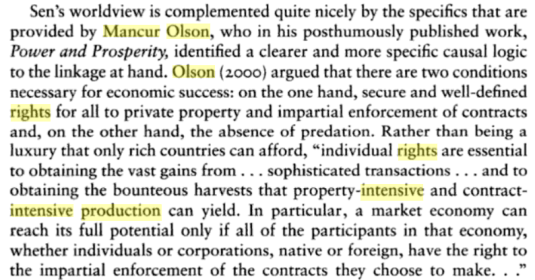
As countries become more and more developed, investment horizons lengthen and depends more and more upon the enforcement of contract and property rights in a tolerably honest way.
Instead of being the first entrepreneur to introduce the most basic technologies and profit handsomely, entrepreneurs are introducing a product upgrade or new product that is a minor improvement on current offerings. Such investments will take time to pay off.
In many developing countries, China as an example, property rights are insecure. One way to secure your investment is to take the proceeds offshore to a tax haven. If everything goes wrong, at least you got some nest egg overseas.
As many developing countries have corrupt politicians and dishonest courts, the way to secure gains from honest investments is to move some of the profits offshore. That is why tax havens are essential to poor countries growing richer.
One of the sources of Hong Kong prosperity was investors would deal with a Hong Kong-based company with the requisite political and economic links to China. They could enforce their contracts in China against their Hong Kong assets because the contract was based in Hong Kong under British law.
If the local legal system is inadequate, entrepreneurs well look overseas for mechanisms to force contracts and secure their returns on investments against confiscation.
How does the logic of gun free zones differ?
02 Apr 2016 Leave a comment
in economics of crime, law and economics, property rights Tags: expressive boating, gun control, gun free zones, rational rationality, war on terror

HT: David Spady
Externalities: When Is a Potato Chip Not Just a Potato Chip?
24 Mar 2016 Leave a comment
in applied price theory, applied welfare economics, industrial organisation, law and economics, property rights Tags: externalities
It takes three to have an externality.
@mattyglesias on why greedy drug companies are heroes
20 Mar 2016 Leave a comment
in economics of regulation, health economics, law and economics, politics - New Zealand, politics - USA, property rights Tags: avoiding difficult choices, drug lags, generic drugs, intellectual monopolies, invisible graveyard, patents and copyrights

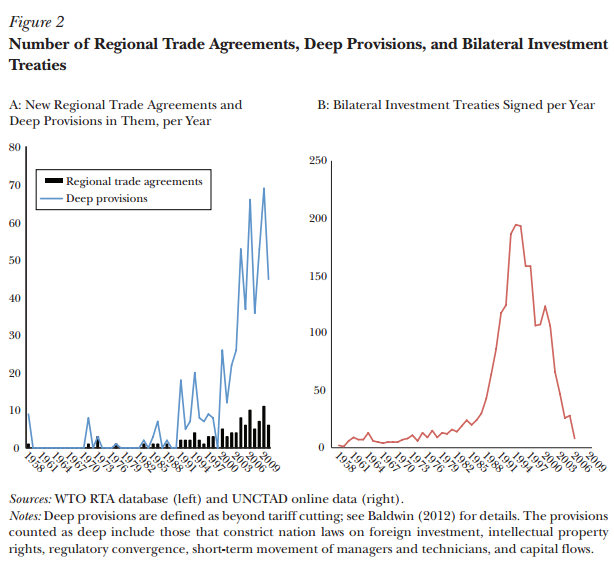
The explosion of lead in the saddlebags of trade agreements @KennedyGraham @DavidShearerMP #TPPANoWay
16 Mar 2016 Leave a comment
in economics of bureaucracy, international economic law, international economics, law and economics, politics - New Zealand, property rights, Public Choice, rentseeking Tags: crony capitalism, customs unions, free trade agreements, international investment law, investor state dispute settlement, preferential trading agreements
Solution aversion and the anti-science Left
11 Mar 2016 1 Comment
in applied price theory, applied welfare economics, comparative institutional analysis, constitutional political economy, economics of regulation, energy economics, environmental economics, global warming, health economics, law and economics, politics - Australia, politics - New Zealand, politics - USA, property rights, Public Choice Tags: antiscience left, climate alarmism, geo-engineering, GMOs, growth of knowledge, gun control, motivated reasoning, nuclear power, political persuasion, solar power, solution aversion, wind power
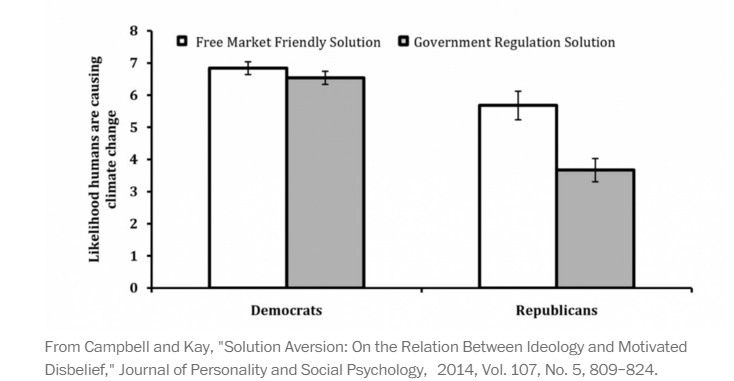
Climate science is the latest manifestation of solution aversion: denying a problem because it has a costly solution. The Right does this on climate science, the Left does it on gun control, GMOs, and plenty more. Cass Sunstein explains:
It is often said that people who don’t want to solve the problem of climate change reject the underlying science, and hence don’t think there’s any problem to solve.
But consider a different possibility: Because they reject the proposed solution, they dismiss the science. If this is right, our whole picture of the politics of climate change is off.
Some psychologists wasted grant money on lab experiments to show that people that think the solution to a problem is costly tend to rubbish every aspect of the argument. Any politician will tell you you do not concede anything. Sunstein again:
Campbell and Kay asked the participants whether they agreed with the IPCC. And in both, about 80 percent of Democrats did agree; the policy solutions made no difference.
Republicans, in contrast, were far more likely to agree with the IPCC when the proposed solution didn’t involve regulatory restrictions…
Here, then, is powerful evidence that many people (of course not all) who purport to be skeptical about climate science are motivated by their hostility to costly regulation.
The Left is equally prone to motivated readings. For example, it was found that those on the left are much more concerned about home invasions when gun control can reduce them rather than increase them.

The Left picks and chooses which scientific consensus as it accepts. The overwhelming consensus among researchers is biotech crops are safe for humans and the environment. This is a conclusion that is rejected by the very environmentalist organisations that loudly insist on the policy relevance of the scientific consensus on global warming.
Previously the precautionary principle was used to introduce doubt when there was no doubt. But when climate science turned in their favour, environmentalists wanted public policy to be based on the latest science.
The Right is welcoming of the science of nuclear energy or geo-engineering. The Left rejects it point-blank. Their refusal to consider nuclear energy as a solution to global warming is a classic example of solution aversion. Let he who is without sin cast the first stone.
Monopolies and patents can breed deadweight loss and market inefficiencies
11 Mar 2016 Leave a comment
in applied price theory, applied welfare economics, comparative institutional analysis, law and economics, politics - Australia, politics - New Zealand, politics - USA, property rights Tags: intellectual monopolies, patents and copyright


Recent Comments