5 . The Inflationary Boom of the 1920s – Murray N Rothbard
15 Jul 2017 Leave a comment
in Austrian economics, business cycles, economic history, macroeconomics, monetary economics Tags: Austrian business cycle theory, monetary policy
Sticky Wages
03 Jun 2017 Leave a comment
in business cycles, job search and matching Tags: sticky wages
The fair-wage effort hypothesis is a theory of mass low-skilled unemployment
01 Jun 2017 Leave a comment
in business cycles, labour economics, labour supply, macroeconomics, personnel economics, unemployment Tags: efficiency wage, involuntary unemployment, living wage, mass unemployment, moral hazard
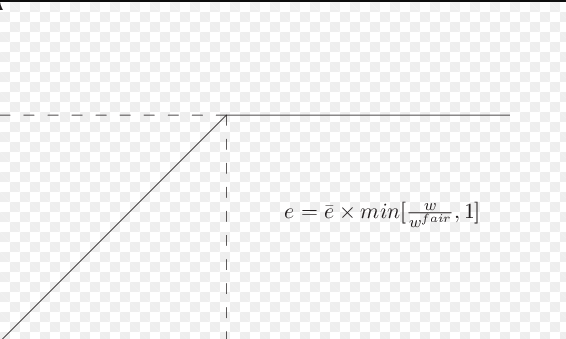
Living wage advocates make much of the demoralising effects of pay inequality on workplace productivity. In common with the efficiency wage hypothesis, this is another example of what Nozick (1974) called normative sociology; the study of what the causes of social problems ought to be. Again, living wage activists misconstrue what the fair-wage effort hypothesis was seeking to explain.
The fair-wage effort hypothesis aimed to fill gaps in the efficiency wage hypothesis by explaining why unemployment is so much higher among the lower skilled (Akerlof and Yellen 1988, 1990). Under the fair-wage effort hypothesis, workers slack off if paid less than they think they deserve:
The motivation for the fair wage-effort hypothesis is a simple observation concerning human behavior: when people do not get what they deserve, they try to get even (Akerlof and Yellen 1990, p. 256).
Lazear (1989, 1991) contends that employers too may want greater pay equity to temper over-competitiveness in teams. If pay and promotions in a team are linked to the relative performance of its members, large pay differentials may undermine co-operation and might encourage sabotage:
Very large pay spreads induce high effort, but they also create a work environment in the firm that is not very pleasant… individuals who are competing with one another can either seek to outperform others, or they can contribute to the failure of others. Such incentives can result in collusion (Dye, 1984) or in sabotage (Lazear, 1989). Thus, pay structure must strike a balance between providing incentives for effort and reducing the adverse consequences associated with this kind of industrial politics (Lazear and Shaw 2007, p. 95).
Lazear’s (1989, 1991) theory about the industrial politics arising from pay inequality stressed how sizable rewards to individual members of a team could lead to a lack of team play and lower team output. If the prizes were smaller for superior relative performance, the pay rise after a promotion or the annual performance bonus, there may be more teamwork (Lazear 1989, 1991). Akerlof and Yellen (1990) were correct in their insight that their hypothesis about fair-wage effort applies more to workers on lower wages with fewer chances of moving up promotion ladders and pay scales.
The fair-wage effort hypothesis is but another Keynesian macroeconomic theory of unemployment:
The hypothesis explains the existence of unemployment. Unemployment occurs when the fair wage w* exceeds the market-clearing wage. With natural specifications of the determination of w*, this hypothesis may explain why skill and unemployment are negatively correlated. In addition, it potentially explains wage differentials and labor market segmentation (Akerlof and Yellen 1990, p. 256).
The fair-wage effort hypothesis was developed as a descendant of the efficiency wage hypothesis because the latter cannot explain why wages are high for everyone working in high-paid industries:
All workers in better-paid industries tend to receive positive wage premia. That is, the wages of secretaries and engineers are highly correlated across industries. Ease of supervision and the magnitude of turnover costs might well be correlated across industries for a given occupation explaining, for example, why, say, skilled machinery operators receive positive wage premia in most industries. But there is no obvious reason why, say, secretaries, should be harder to supervise in the chemical industry where pay is high, than in the apparel industry where pay is low (Akerlof and Yellen 1988, p. 44).
The efficiency wage hypothesis also offered “no natural explanation” for why unemployment rates [JC1] are much higher among the lower-skilled (Akerlof and Yellen 1990). Skilled workers are probably more difficult to monitor than the unskilled so their unemployment rates should be higher than for the low-skilled as a worker discipline device but the contrary is the case (Akerlof and Yellen 1990).
The fair-wage effort hypothesis aimed to fill gaps in the efficiency wage theory of unemployment by explaining why low skilled unemployment is much higher both in recessions and in better times. Living wage activists must accept that their demands for workplace pay equity increase low-skilled unemployment under a Keynesian theory which they embrace with considerable enthusiasm.
If high wages are paid to the more skilled to attract the best applicants, demands for pay equity by their less skilled co-workers could price some of them out of the market leading to unemployment (Akerlof and Yellen 1988, 1990). In addition, pay equity norms are unlikely to respond quickly enough to fluctuations in aggregate demand so wages can be too high in recessions causing mass unemployment of the low skilled (Akerlof and Yellen 1988, 1990; Summers 1988). The unemployed cannot successfully offer to work for less than existing workers do in a recession because they cannot make a credible commitment to eschew fairness considerations once hired (Akerlof 2002).
An important premise of New Keynesian macroeconomics is demands for pay equity come at a price. At a price that is high enough for the efficiency wage and fair-wage effort hypotheses to be put as a comprehensive New Keynesian explanations of involuntary mass unemployment (Gordon 1990).
Both the efficiency wage hypothesis and the fair-wage effort hypothesis are attempts to flesh out a theory of extensive labour market dysfunction leading to mass unemployment. Living wage activists are using Keynesian theories of why wages are too high to argue for even higher wages.
An efficiency wage is a theory of persistent mass unemployment
31 May 2017 Leave a comment
in business cycles, labour economics, macroeconomics, personnel economics, unemployment Tags: efficiency wage, involuntary unemployment, living wage, moral hazard
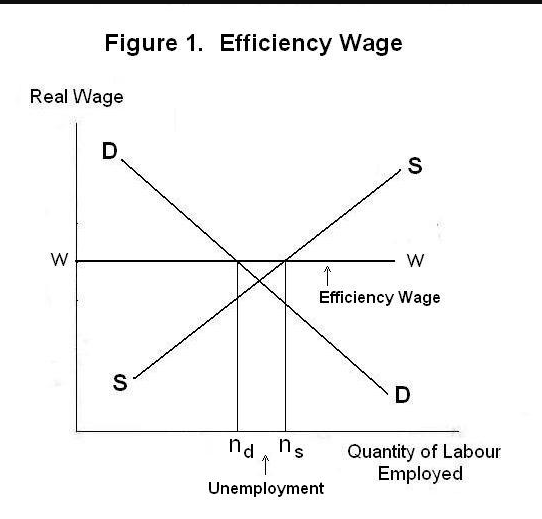
Shapiro and Stiglitz (1984) first put forward their theory of an efficiency wage to explain large-scale involuntary unemployment. It was the very real threat of a prolonged spell of unemployment (rather than a morale boosting pay rise) that motivated employees to put in more effort to keep their jobs:
To induce the worker not too shirk, the firm attempts to pay more the “going rate”; then, if the worker is caught shirking and is fired, he will pay a penalty. If it pays one firm to raise its wage, it pays all firms to raise their wages. When they all raise their wages, the incentive to shirk again disappears. But as all firms raise their wages, the demand for labour decreases, and unemployment results. With unemployment, even if all firms pay the same wage, a worker has an incentive not to shirk. For, if he is fired, an individual will not immediately obtain another job. The equilibrium unemployment rate must be sufficiently large that it pays the workers to work rather than take the risk of being caught shirking (Shapiro and Stiglitz 1984, p. 435).
The unemployed offer to work for less pay than existing employees but they are not hired because their labour productivity is not assured at this lower pay (Akerlof 1982, 1984; Katz 1986, 1988; Yellen 1984). There is involuntary mass unemployment because of the prevalence of efficiency wages:
If there is involuntary unemployment in an equilibrium situation, it must be that firms, for some reason or other, wish to pay more than the market-clearing wage. And that is the heart of any efficiency-wage theory (Akerlof 1984, p. 79).
Direct parallels were quickly drawn between the efficiency wage hypothesis as a worker discipline device eliciting greater effort and the old Marxist concept of the reserve army of the unemployed:
… it pays each firm to increase its wage to eliminate shirking. When all firms do this, the average wage rises and employment is reduced. In equilibrium, all firms pay a wage above the market clearing level, creating unemployment. Since jobs are scarce and rationed, the loss of a job can involve a lengthy spell of unemployment. The reserve army of the unemployed acts as a discipline device making shirking costly (Katz 1986, pp. 240-41).
It is misconceived for living wage activists to use a theory of lengthy unemployment to justify a large living wage rise but argue that there will be little unemployment because of the efficiency wage effects. This is the exact opposite of what the efficiency wage hypothesis is about. The leading Keynesian macroeconomists of their generation were striving to explain mass unemployment:
… the economists who developed the theory of efficiency wages (including Shapiro and Stiglitz, Akerlof and Yellen and Yellen) had no illusions that they were helping business firms to discover a new way to increase profits. The economists who developed efficiency wage theory were trying to explain persistent unemployment. Hence the title of Janet Yellen’s famous survey, Efficiency Wage Models of Unemployment.
The question that motivated efficiency wage theory was not why firms should raise wages but why firms don’t cut wages when they should. The answer they gave was that firms don’t cut wages despite unemployment because they fear that workers will respond to lower wages with reduced productivity …
In the original efficiency wage literature, there is no wishful thinking–no idea that we can have more of everything that we want without trade-offs. Instead of being desirable, the efficiency wage is a problem because lower wages would reduce unemployment and be better for the economy … the efficiency wage theorists took it for granted that to the extent that firms can increase profits by raising wages they have already done so (hence the persistent unemployment) (Tabarrok 2015).
Gordon was blunt about why efficiency wage arguments were popular and with whom
If any development in the microeconomics of labor markets could be called the “rage of the 80s,” it is efficiency wage theory, based on the hypothesis that worker productivity depends on the level of the real wage. When there is such a link between the wage rate and worker efficiency, firms may rationally pay a real wage rate that exceeds the market-clearing level. Firms may refuse to reduce the wage to hire members of a pool of unemployed workers who may be available at a lower wage, fearful that a reduction in real wages for existing workers may reduce productivity by more than the gain in lower wages (Gordon 1990, p. 1157).
Living wage activists have it the wrong way around about the social benefits of paying an efficiency wage. The efficiency wage hypothesis is a theory of why wages are too high and employment is too low (Akerlof 1982, 1984, 2002; Yellen 1984; Katz 1986, 1988; Stiglitz 2002). Living wage activists are using a well-respected theory of why wages are too high to argue that wages are too low.
Understanding the Great Depression
24 May 2017 1 Comment
in business cycles, economic history, great depression, macroeconomics, monetarism, monetary economics
The Continued Importance of Austrian Capital Theory
22 May 2017 Leave a comment
in Austrian economics, business cycles Tags: Austrian business cycle theory
Ed Prescott makes an excellent point in his last paragraph
16 May 2017 Leave a comment
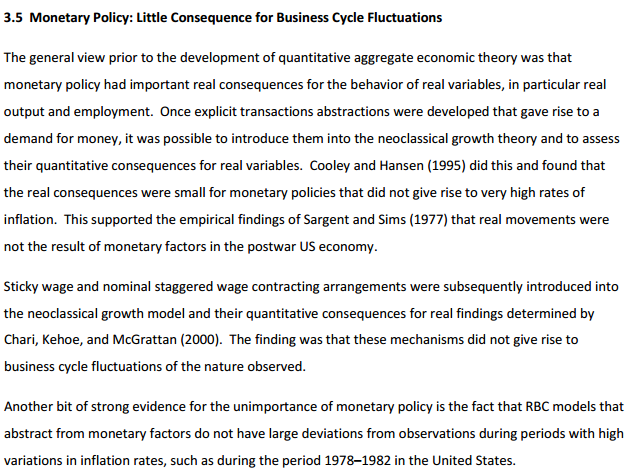
Source: RBC Methodology and the Development of Aggregate Economic Theory Edward C. Prescott, Federal Reserve Bank of Minneapolis Staff Report 527 February 2016.
Edward C Prescott on the EU, business cycles and European economic research
07 May 2017 Leave a comment
in budget deficits, business cycles, economic growth, Edward Prescott, macroeconomics Tags: real business cycle theory
Costs of Inflation: Price Confusion and Money Illusion
09 Apr 2017 Leave a comment
in business cycles, macroeconomics, monetary economics Tags: inflation rates, inflation tax
Business Cycles – Edward C. Prescott
25 Mar 2017 Leave a comment
in business cycles, development economics, economic growth, economic history, financial economics, fiscal policy, macroeconomics Tags: Edward Prescott, real business cycles
Sectoral shifts in labour demand and the business cycle
01 Mar 2017 Leave a comment
in business cycles, labour economics, macroeconomics Tags: real business cycles, sectoral shifts
Random sector-specific technology shocks
New technologies unfold daily, and consumer tastes change with rising incomes and the arrival of new products. Jobs will open in the expanding industries and disappear in the shrinking sectors. This chapter is about how these sectoral reallocations of labour can cause a recession or prolong existing recessions.
A quarter or more of unemployment rate fluctuations over the business cycle could be due to variations in the rate that labour demand shifts across sectors. These sectoral reallocations in labour demand do not arise from mismatches between entrepreneurial forecasts and actual consumer demand. The higher unemployment rate is not due to a bunching of technological upgrades in a recession. The above average number of sectoral shifts in labour demand is an independent cause of a temporarily higher natural rate of unemployment.
To a significant extent, observed fluctuations in the unemployment rate can be fluctuations in the natural rate of unemployment rather than deviations from that natural rate due, for example, to aggregate demand shocks. There will always be some unemployment. There will be new labour force entrants looking for jobs and workers who are between jobs.
The natural rate of unemployment is a long-run level of unemployment that cannot be altered by monetary policy. The natural rate of unemployment depends on the flexibility of wage contracts and labour market institutions, variations in labour demand and supply in individual markets, demographic change, the mobility of workers, unemployment benefits, the cost of gathering information about vacancies and available labour, labour market regulation and random variations in the rate of reallocation of jobs across industries and regions as technology advances and consumer tastes change.
Sectoral shifts and delayed recoveries in employment
Some years can see relatively uniform growth in labour demand across sectors. Other times can see more dramatic sectoral shifts in labour demand arise out of technological progress and changes in consumer demand.
Instead of significant but steady amounts of unemployment because of labour reallocations across sectors, these job reallocations can vary significantly from one year to the next. The natural rate of unemployment can be higher in these intervals because more job seekers are undertaking the more time-consuming process of searching for jobs in new industries and/or occupations, are relocating or are undertaking retraining.
Sectoral shifts in labour demand has a randomness about them because the size, pace and diffusion of technological advances across firms and industries is uneven (Andolfatto and MacDonald 1998, 2004). The implications of technological progress for jobs has a further randomness because new technologies can displace existing jobs and create new jobs or renovate and update current equipment and employee skills (Mortensen and Pissarides 1998).
As a new technology diffuses, productivity will grow faster in the sectors that are adopting the new technology. During this implementation phase, which is slow, costly and may require considerable learning, there will be reorganisations to capitalise on the impending productivity gains.
New technologies differ in the size of the improvement over existing methods and designs and in the difficulty of adopting the new methods. There will be lower growth in years where new technologies offer comparatively minor or less broadly applicable improvements on existing methods.
Learning consumes resources, and attempts to learn a new technology through innovation or imitation diverts the resources of firms and workers away from production (Andolfatto and MacDonald 1998, 2004). This unevenness in the pace and sectoral diffusion of technological progress will introduce unevenness in the rate of labour reallocation across sectors.
With both growing and shrinking sectors, employment may stagnate or fall for a time because the unemployed are searching for new jobs in different industries and perhaps in new occupations or are retraining. A revival in growth in output and productivity in conjunction with initially poor employment growth is possible and has the attributes of a delayed recovery in employment (Andolfatto and MacDonald 2004). Cross-sector job searches and the redirection of careers is a longer process than job search in the same industries and occupations. Job migration is more time consuming than the more traditional process of layoffs and rehiring by the same employer or in the same industry and occupation.
Labour reallocation and mismatch unemployment
During periods of more intensive or above-average sectoral reallocation of labour demand, a mismatch can arise between the skills and experience of the workers who have exited the shrinking sectors and the immediate requirements of the expanding sectors. More workers than average can be moving into new sectors. Some of these job seekers may not be immediately viable candidates for the available jobs and may exert little downward pressure on wages.
There can be mismatch unemployment because the skills and locations of job seekers can be poorly matched with the locations of vacancies. Some local labour markets will have more workers than jobs. Others will have shortages. Job finding can depend on the rate at which the unemployed can retrain or move to locations with unfilled jobs, the rate at which jobs open in different locations and the rate at which workers vacate jobs in places with ready replacements (Shimer 2007).
A New Zealand candidate for frequent sectoral shifts in labour demand is terms of trade shocks. Grimes (2006) found that half the variance in GDP growth rate over a 45-year period is explained by the level and volatility of the terms of trade. He found that the terms of trade have been high and remarkably stable since the early 1990s, and since the early 1990s, New Zealand has also experienced an unusually long period with high GDP growth and low GDP volatility.
Responding to aggregate versus sectoral shocks
Recessions mix cyclical and structural changes in labour demand. The aggregate demand and sectoral shift explanations have different implications for the role of monetary and fiscal policy in moderating cyclical unemployment fluctuations.
Cyclical unemployment is a reversible response to lulls in aggregate demand. At the start of a recession, there is a general decline in demand, with few industries creating jobs to replace those that are lost. As a recession ends, the unemployed are recalled by old employers or find new jobs in those industries as demand renews. Monetary and fiscal policy can aim to smooth these temporary job losses.
Job losses from structural changes in employment and technology are permanent. The sectoral location of jobs has changed. Workers must switch to new industries, sectors and locations or learn new skills. A role for public policy is to facilitate this process of reallocation to new jobs and retraining.
Much of the higher unemployment during the 1970s stagflation could have been due to a burst in sectoral shifts in labour demand. The 1973 and 1979 oil price shocks are common examples of real shocks that required lasting changes in the sectoral distribution of consumer demand, production and employment. The more energy-intensive industries had to adapt to the suddenly much higher oil prices.
Adding to this 1970s global restructuring in labour demand was the widespread introduction and adaptation of computer technologies. Bessen (2003) and Samaniego (2006) link the 1970s productivity slowdown to the widespread adoption of information technology.
Major economy-wide reorganisations were required because of the incompatibility of substantial accumulations of plant level expertise with many existing technologies with the incoming technologies. A major new technology can initially reduce measured productivity because of plant-level learning costs, the obsolescence of old technologies and skills, the time and resources diverted to develop and introduce the many complimentary innovations that implement a major new technology and the reallocation of labour to new industries.
These technological upheavals of a grand scale can cause a temporary spike in the natural rate of unemployment. Bessen (2003) estimated that, from 1974 to 1983, annual technology adoption costs spiked from 3% to 7% of output, explaining most of the 1970s productivity slowdown. It was decades later before the initially contractionary effects of major new technologies were well understood.
Summary
There is no reason to believe that the distribution of employment across sectors and industries will change at an even pace through time. If there are an above average number of sectoral shifts in labour demand, such as in the 1970s, there can be a significant increase in the natural unemployment rate while workers find new jobs, retrain and relocate. An above average number of sectoral shifts in labour demand during the current recession could delay the recovery. These sectoral shifts are difficult to forecast.
Econ Duel: Does Fiscal Policy Work?
23 Dec 2016 Leave a comment
in business cycles, fiscal policy, monetary economics Tags: fiscal stimulus
 Utopia, you are standing in it!
Recent Comments