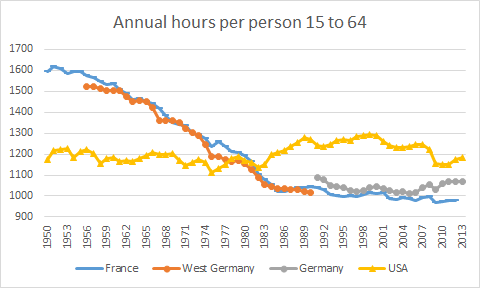
Annual hours worked, USA, West Germany, Germany and France, 1950-2013

Max Roser tweeted this chart today showing that French and Germans work far fewer hours than Americans. His measure is annual hours worked divided by the number of persons engaged. Max Roser’s starter shows that French and German annual hours worked in a steady decline since 1950.

My measure below is annual hours worked per American, French, West Germany and German aged 15 to 64. My data shows a different picture. There are stable hours worked per working age American. European hours per worked per working age European fell rapidly up until 1986 or so and then stabilised. Each set of data, my data and Max Roser’s data, requires its own explanation. My explanation is the sharp rises in taxes Europe in the 1970s and 80s.

image

Source:OECD StatExtract and The Conference Board Total Economy Database, January 2014.

Each set of data, my data and Max Roser’s data, requires its own explanation. My explanation is the sharp rises in taxes net welfare state transfers in Europe in the 1970s and 80s.

image

Source: caramcdaniel.com

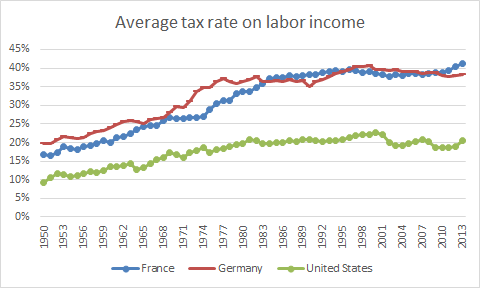
As an illustration, average tax rates on American labour incomes doubled between 1950 in 1980 and then was stable. Labour supply started recover  after this point in time as well.

Average tax rates on French and German labour income more than doubled between 1950 to about 1990 and then stopped rising by much after that. At the same time, the fall in hours worked per working age  German and French stopped. The average tax rate by that time in Europe was twice that of the USA.

Robert Lucas on the irrelevance of income redistribution to the Great Enrichment

Robert Lucas limitless potential of increasing production

Image

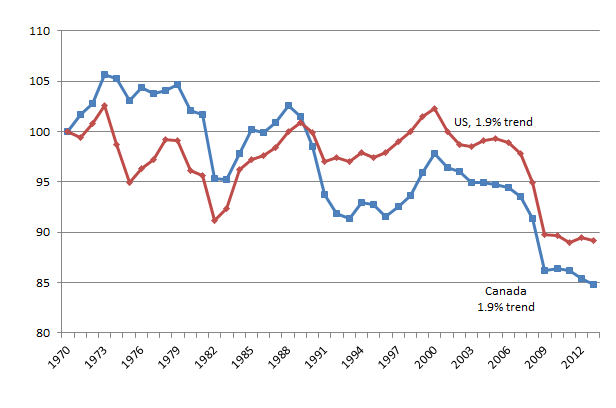
Real GDP per Canadian and American aged 15-64, 2013 price level, updated 2005 EKS PPP, detrended, 1970-2013

Figure 1: Real GDP per Canadian and American aged 15-64, converted to 2013 price level, updated 2005 EKS purchasing power parities, detrended 1.9%, 1970-2013, base 1970

image

Source: Computed from OECD Stat Extract and The Conference Board, Total Database, January 2014, http://www.conference-board.org/economics

A flat line means growth at the trend rate of 1.9%; a falling line means below trend rate of growth ; a rise in line means above trend rate of growth. Canada appears to have mostly been falling behind the USA.

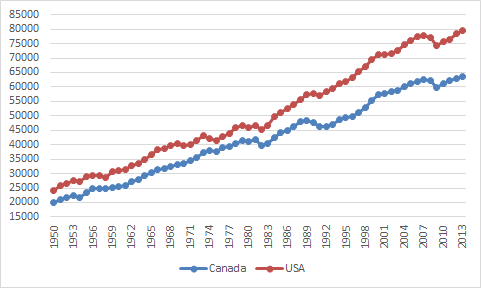
Figure 2: Real GDP per Canadian and American aged 15-64, converted to 2013 price level, updated 2005 EKS purchasing power parities, 1950-2013

image

Source: Computed from OECD Stat Extract and The Conference Board, Total Database, January 2014, http://www.conference-board.org/economics.

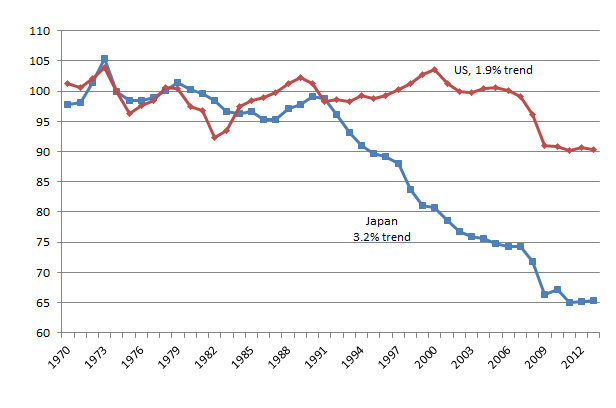
Real GDP per Japanese and American aged 15-64, 2013 price level, updated 2005 EKS PPP, detrended, 1970-2013

image

Source: Computed from OECD StatExtract and The Conference Board, Total Database, January 2014, http://www.conference-board.org/economics.

Note: When the line is flat, the economy is growing at its trend growth rate. A falling line means below trend growth; a rising line means of above trend growth. Detrended with values used by Edward Prescott.

The Japanese decline after 1992 are the Lost Decades. Japan recently returned to its 3.2% trend growth rate of the 1970s and 1980s for working age Japanese.

It could be argued that Japan is now on a permanently lower growth rate that implies no further catch up with the USA.

How can New Zealand blamed distance for its woes when international technology diffusion is speeding up

The Great Escape compared to the threat of global warming

Diego Comin — Why New Technologies Do Not Make Poor Countries Rich

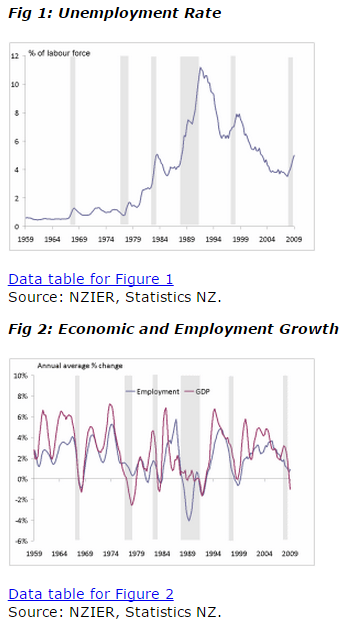
Recent New Zealand economic growth

Trans-Tasman trends in real equivalised mean household income since 1982

Real household mean incomes rose during Rogernomics; fell during the deep recession at the beginning of the early 1990s; then rose strongly until 2009 and the onset of the Global Financial Crisis.

A very British recovery

Image

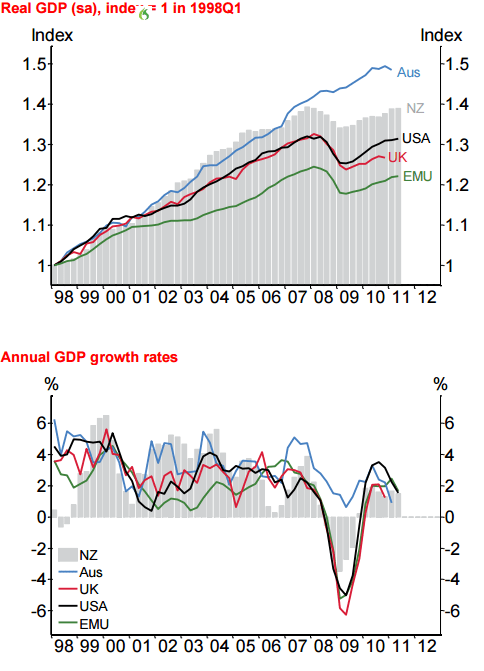
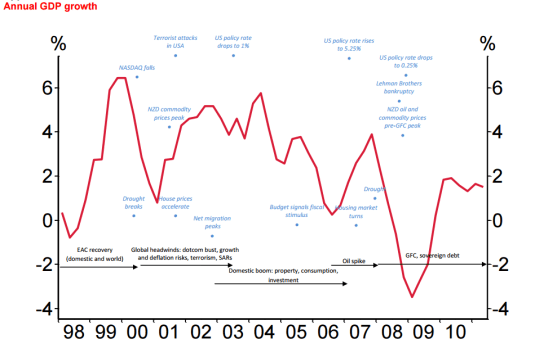
Recent New Zealand economic growth compared

Via Reserve Bank of New Zealand

The impact of drought on the 1998 mild New Zealand recession

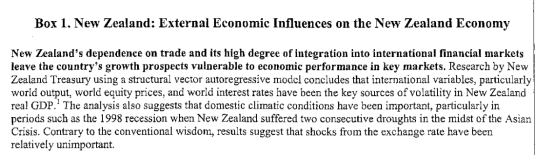
Reserve Bank of New Zealand has these conclusions about the contribution of drought to the business cycle in the late 1990s in New Zealand and in particular the mild 1998 recession:

a back-of-the-envelope estimate of the impact of the drought-induced fall in supply would suggest a contribution from the agricultural sector to production GDP for the March quarter of 1998 of around -0.4 percentage points out of the total 1 per cent fall in production GDP. In the June quarter of 1998, the contribution from these sectors was close to zero.

Figure 27:

0096149_files/business-cycle-developments-since-1996-for-submission-to-monetary-policy-review-final-version-placed-on-web-27.jpg


In 1998, agricultural and hunting industry contributed per cent of real GDP. . That included the production of livestock, wool, dairy, horticulture, and crops, as well as the provision of agricultural contracting services and hunting. In the same year, the primary food manufacturing industry contributed 3 per cent of GDP. This category covers the processing of meat and dairy products for export and local markets.

Blaming droughts on Rogernomics? Droughts and the New Zealand real business cycle

While feuding on another blog about the ups and downs of the New Zealand economy since the 1970s, I pointed out that a long economic boom followed the Ruth RichardsonMother of all Budgets” in 1991:

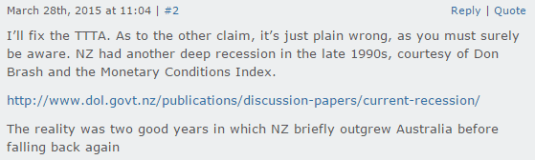
My interlocutor quickly replied to blame Rogernomics, in particular, inflation targeting and its administration by Don Brash for a severe recession in New Zealand in 1998:

The mild recession in New Zealand in 1998 was a result of the combination of two severe droughts and the effects of the Asian financial crisis.

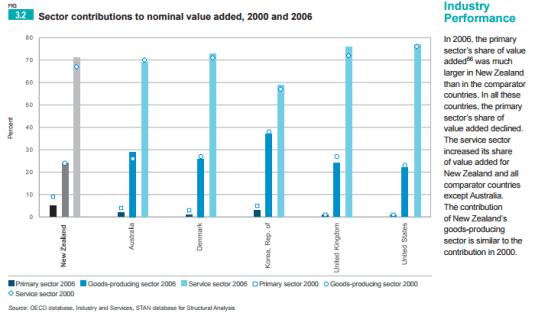
Drought is a major factor in the New Zealand business cycle because of the large size of the farming sector. Indeed, the ups and downs of a monopoly dairy exporter that accounts for 7% of GDP, Fonterra, are so central that a single dirty pipe at a milk factory that put the quality of its milk exports in question lead the Treasury to revise its economic forecasts for that year.

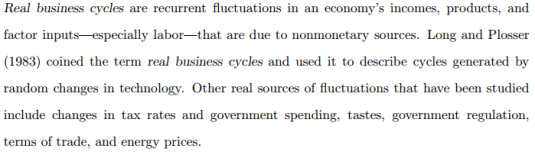
There is growing evidence that a substantial part of business cycle volatility can be explained by real business cycle theory (RBC). RBC claims that a good majority of economic volatility is caused by changes on the supply side: tax and regulatory changes, bad weather in farm economies, spikes in oil prices and technology shocks. Real business cycle models have enjoyed success in replicating most of the observed characteristics of, for example, U.S. aggregate economic activity.

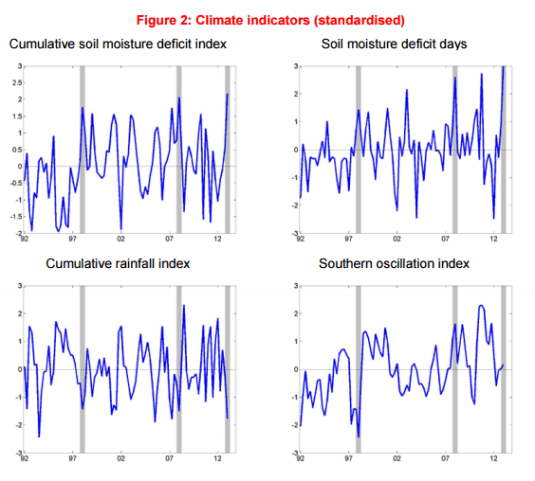
Over the last 15 years, a number of papers at the Treasury and Reserve Bank of New Zealand have explored the role of droughts in the New Zealand business cycle, such as the drought in 1997.

The 1998 recession was preceded by a severe drought that may have knocked a half percentage point off GDP or more. As the Treasury explained in 2008:

Given the importance of the primary sector in New Zealand, climatic conditions have always been a significant driver of GDP volatility in New Zealand. There is strong evidence that the 1998 drought triggered or precipitated the onset of the last recession in the late-90s.

In 2008, the dry conditions in New Zealand led the Treasury to revise its forecasts as follows:

current dry conditions are likely to trim GDP growth by around 0.5% for the 2008 calendar year.  

In 2013, the Reserve Bank made similar pessimistic forecasts about the implications of drought for economic prospects. New Zealand was suffering its worst drought in decades:

It was simply mistaken to blame the 1998 recession in New Zealand as the spawn of Rogernomics. There was a drought, a big one, big enough drought to shake the New Zealand business cycle in a country with a large farming sector.

The most important aspect of monetary strategy is timing

The simplest statement to make about the lags in monetary policy is they are long and variable. This simple statement is also the key insight to understanding the actual implementation of monetary policy. Hence, how many months or years in advance must a central bank forecast to achieve its monetary goals? In 1994, the Economist said:

But [central banks] cannot afford to wait until inflation is actually rising before they act. Monetary policy does not change the speed of the economy instantly: it can take 18 months or more for a rise in interest rates to have its full impact on inflation. The target of policy ought therefore to be future not current inflation, in order to prevent a surge in 1996. The earlier interest rates are raised, the better the chances of engineering a smooth slowdown to a sustainable rate of growth before slack in the economy is exhausted.

Economists differ about the length of those lags. Uncertainty about the average length of those lags and the variability of those lags makes discretion most difficult. Activist policy can improve welfare only if the information about economic structure and economists’ ability to forecast is sufficiently accurate.

Early_sample

Friedman is the most famous and persuasive critic of Keynesianism on the grounds of lags. He has two main arguments: first, that there are “long and variable lags” between the identification of a problem and the effects of the designed remedy; second, that activist policy often itself becomes a source of instability since policy itself becomes a variable that the market must guess.

Friedman’s critique does not depend on the quantity theory of money. Keynesian policies do not necessarily follow even if the Keynesian theory of the business cycle were conclusively proved.

It must also be demonstrated that the government has the ability and willingness of the government to act as the theory prescribes. We are therefore further assuming that central banks have the incentive to stabilise the economy. If the government lacks the information required to stabilise the economy, issues of public choice incentives become fully redundant. Incentives to pursue an objective do not matter if the objective itself is unattainable.

Competing visions of central banking

Economics: A Million Mutinies Now, Part Two - feat. image

The competing visions of central banks over monetary policy have been defined by Franco Modiglani and Milton Friedman respectively. Modiglani considers the Keynesian vision of macroeconomic policy to be:

a market economy is subject to fluctuations which need to be corrected, can be corrected, and therefore should be corrected.

The Keynesian claim implies that central banks have sufficient knowledge of the structure of the economy to be able to choose the policy mix appropriate to a given set of circumstances. It is possible to target unemployment, interest rates and inflation in such a way that they can be maintained (and hence made predictable) by constant adjustment of policy instruments to new shocks.

The Keynesian approach assumes that the economy can slip into recessions for all sorts of reasons (Barro 1989). Business fluctuations result from shocks to aggregate demand. The principal source of these shocks are expectations induced shifts in investment demand. The role of the central bank is to make prompt, frequent policy responses to counteract this instability.

The task of government is to discover the particular monetary and fiscal polices which can eliminate shocks emanating from the private sector. A key finding of recent macroeconomic research is that anticipated monetary policy has very different effects to unanticipated monetary policy.

The Keynesian vision thus presuppose that government can foresee shocks which are invisible to the private sector but at the same time it is unable to reveal this advance information in a credible way and hence defusing the shock because it is no longer unanticipated. In addition, the counter cyclical monetary policies of governments must themselves be unforeseeable by private agents, but at the same time systematically related to the state of the economy (Lucas and Sargent 1979)

Of course, the Keynesian view of central banking is also premised on a goodwill theory of government. Governments pursue policies that are in the public interest. That is a public interest that is well-defined and is free of conflicts over income distribution, electoral success and power the could lead policy-makers to pursue goals other than full employment, stable prices and efficiency. Thus, if the latest forecast is a recession, additional stimulus is the usual prescription. However, since most Keynesian economists accept the permanent income and natural rate hypotheses, more stimulus implies less later at some unknown time.

Friedman’s vision of central banking is far more circumspect:

The central problem is not designing a highly sensitive [monetary] instrument that offsets instability introduced by other factors[in the economy], but preventing monetary arrangements becoming a primary source of instability (Milton Friedman 1959).

Friedman considers that a key element in the case for policy discretion is whether the sufficient information is available that can be used to reduce variability and assist the economy’s adjustment the unforeseen. A well intentioned policy-maker will destabilise if he is mislead by incomplete or incorrect information.

From the monetarist standpoint, price stability can be approximately attained under a well chosen and predictable monetary policy rule. Under this view, the unemployment and interest rates are unpredictable and can manipulated only at a prohibitive cost. The Keynesian and monetarist views are mutually incompatible and lead to very different policy recommendations (Lucas 1981).
Previous Older Entries Next Newer Entries

Bassett, Brash & Hide

Celebrating humanity's flourishing through the spread of capitalism and the rule of law

Truth on the Market

Scholarly commentary on law, economics, and more

The Undercover Historian

Beatrice Cherrier's blog

Matua Kahurangi

Celebrating humanity's flourishing through the spread of capitalism and the rule of law

Temple of Sociology

Celebrating humanity's flourishing through the spread of capitalism and the rule of law

Velvet Glove, Iron Fist

Celebrating humanity's flourishing through the spread of capitalism and the rule of law

Why Evolution Is True

Why Evolution is True is a blog written by Jerry Coyne, centered on evolution and biology but also dealing with diverse topics like politics, culture, and cats.

Down to Earth Kiwi

Celebrating humanity's flourishing through the spread of capitalism and the rule of law

NoTricksZone

Celebrating humanity's flourishing through the spread of capitalism and the rule of law

Homepaddock

A rural perspective with a blue tint by Ele Ludemann

Kiwiblog

DPF's Kiwiblog - Fomenting Happy Mischief since 2003

The Dangerous Economist

Celebrating humanity's flourishing through the spread of capitalism and the rule of law

Watts Up With That?

The world's most viewed site on global warming and climate change

The Logical Place

Tim Harding's writings on rationality, informal logic and skepticism

Doc's Books

A window into Doc Freiberger's library

The Risk-Monger

Let's examine hard decisions!

Uneasy Money

Commentary on monetary policy in the spirit of R. G. Hawtrey

Barrie Saunders

Thoughts on public policy and the media

Liberty Scott

Celebrating humanity's flourishing through the spread of capitalism and the rule of law

Point of Order

Politics and the economy

James Bowden's Blog

A blog (primarily) on Canadian and Commonwealth political history and institutions

Science Matters

Reading between the lines, and underneath the hype.

Peter Winsley

Economics, and such stuff as dreams are made on

A Venerable Puzzle

"The British constitution has always been puzzling, and always will be." --Queen Elizabeth II

The Antiplanner

Celebrating humanity's flourishing through the spread of capitalism and the rule of law

Bet On It

Celebrating humanity's flourishing through the spread of capitalism and the rule of law

History of Sorts

WORLD WAR II, MUSIC, HISTORY, HOLOCAUST

Roger Pielke Jr.

Undisciplined scholar, recovering academic

Offsetting Behaviour

Celebrating humanity's flourishing through the spread of capitalism and the rule of law

JONATHAN TURLEY

Res ipsa loquitur - The thing itself speaks

Conversable Economist

Celebrating humanity's flourishing through the spread of capitalism and the rule of law

The Victorian Commons

Researching the House of Commons, 1832-1868

The History of Parliament

Articles and research from the History of Parliament Trust

Books & Boots

Reflections on books and art

Legal History Miscellany

Posts on the History of Law, Crime, and Justice

Sex, Drugs and Economics

Celebrating humanity's flourishing through the spread of capitalism and the rule of law

European Royal History

Exploring the Monarchs of Europe

Tallbloke's Talkshop

Cutting edge science you can dice with

Marginal REVOLUTION

Small Steps Toward A Much Better World

NOT A LOT OF PEOPLE KNOW THAT

“We do not believe any group of men adequate enough or wise enough to operate without scrutiny or without criticism. We know that the only way to avoid error is to detect it, that the only way to detect it is to be free to inquire. We know that in secrecy error undetected will flourish and subvert”. - J Robert Oppenheimer.

STOP THESE THINGS

The truth about the great wind power fraud - we're not here to debate the wind industry, we're here to destroy it.

Lindsay Mitchell

Celebrating humanity's flourishing through the spread of capitalism and the rule of law

Alt-M

Celebrating humanity's flourishing through the spread of capitalism and the rule of law

croaking cassandra

Economics, public policy, monetary policy, financial regulation, with a New Zealand perspective

The Grumpy Economist

Celebrating humanity's flourishing through the spread of capitalism and the rule of law

International Liberty

Restraining Government in America and Around the World