Is it time to pack our belongings and head to Argentina, where Javier Milei is dramatically improving economic policy and cultural attitudes? I’m joking, but also not joking. The reason I’m not joking is that there’s a very depressing scenario for America’s near-term economic outlook. It involves these six potential developments. Thanks in part to […]
Class-warfare tax policy is always a bad idea. Economists generally don’t like class-warfare policies because it is foolish to impose high marginal tax rates on productive behaviors such as investment and entrepreneurship. Politicians should not like class-warfare policies because of the negative impact on jobs and wages for ordinary people as well as the potential negative […]
I’m a big fan of tax migration. I cheer when productive people escape high-tax states or high-tax nations. And when the geese with the golden eggs fly away, it thwarts the plans of greedy politicians. The latest example of this is the exodus of billionaires – worried about a wealth tax – from California (the […]
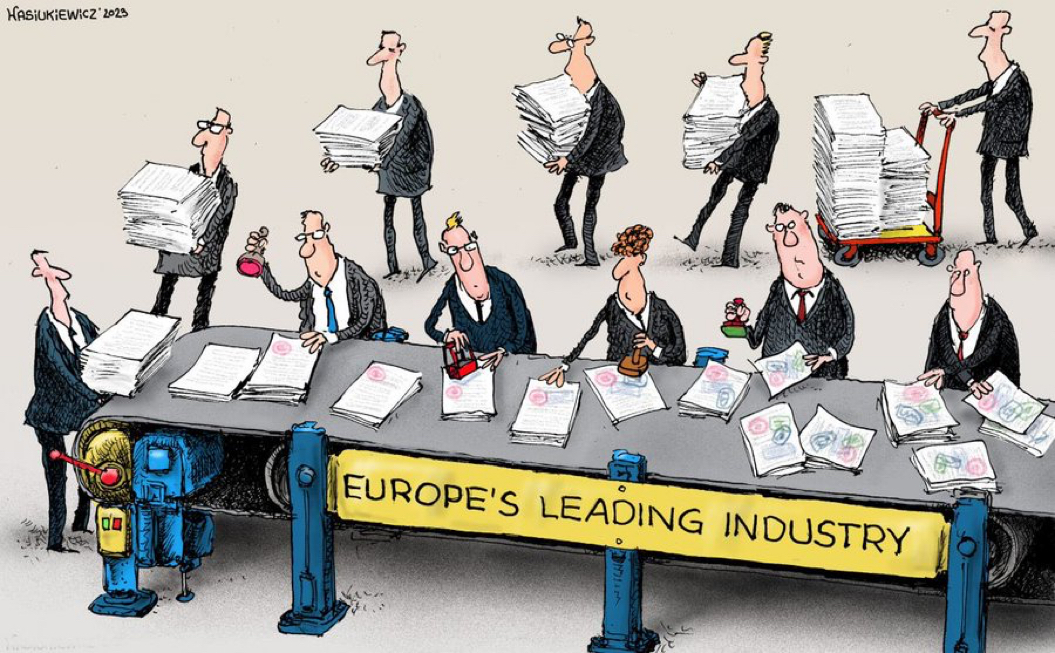
The good news is that Europe has a lot of economic freedom by world standards. Especially Western Europe. The bad news is that economic freedom has been declining in Western Europe. To make matters worse, Europe has a big demographic problem, with a growing number of older people over time who have been promised benefits […]
Below is my column in the California Post and New York Post on the exodus of wealthy taxpayers from the state as Democrats seek to trap them with a retroactive wealth tax. They are engineering a type of reverse Gold Rush as up to a trillion dollars leave the state with a line of U-Hauls […]
Based on a video from the Center for Freedom and Prosperity back in 2010, as well a video from Johan Norberg I shared in 2016, there’s a lot to learn by looking at Swedish economic history. Here’s a more recent video that also looks at that nation’s economic track record. You’ll notice a similar message […]
The death tax presumably is the most destructive tax on a per-dollar-collected basis, but I suspect the capital gains tax is in second place. Like the death tax, the capital gains tax is pure double taxation, thus exacerbating the tax code’s bias against saving and investment. And the capital gains tax is particularly foolish since […]
Olivier Blanchard writes: The French are not lazy. They just enjoy leisure more than most (no irony here) And this is perfectly fine: As productivity increases, it is perfectly reasonable to take it partly as more leisure (fewer hours per week, earlier retirement age), and only partly in income. He has follow-up points and clarifications…
Unless you’re a policy wonk, I realize “exciting” may not be the right word to describe new developments in public-finance economics. For nerds, however, three economists at the Joint Committee on Taxation have some important new research on the Laffer Curve. The study, authored by Rachel Moore, Brandon Pecoraro, and David Splinter, concludes that the […]
“Fiscal dominance” refers to a situation where government debt grows so large that the nation’s central bank feels that it has little choice except to focus on making sure the government does not default–even if it means a surge of inflation. Janet Yellen described the issue and risks of fiscal dominance concisely in her comments…
As explained in my four-part series (here, here, here, and here) and in this clip from a recent interview, Javier Milei’s first two years have been amazingly successful. There are two points in the interview that deserve emphasis. First, Javier Milei’s libertarian policies already have been extremely beneficial for the Argentine economy. Inflation has dramatically […]
If you want to know why I’m pessimistic about Europe (particularly compared to the U.S.), this chart is a good example. It shows that many European nations have enormous long-run liabilities for their Social Security systems. It’s an understatement to observe that Spain, Austria, and Italy have very grim fiscal futures. Keep in mind that […]
I have a five-part series (here, here, here, here, and here) explaining that demographic decline will lead to fiscal crisis. The main takeaway is that entitlement programs are a ticking time bomb, and I castigate politicians who want to kick the can down the road (or make a bad situation even worse). This is a global problem, not merely an American problem, as […]
Media have reported that there may be a debate between Nicola Willis and Ruth Richardson over fiscal policy. I thought it would be useful to lay out what I see as the key fiscal problem, and put context around it. Now I’m not unbiased here. Nicola I regard as a long standing friend. We were…
Eric Crampton writes – StatsNZ has put up its year-end accounts for the government, split out across functional areas. Their data goes back to 2009 in the main table; I’m sure earlier data’s available somewhere in Infoshare. But sticking with the Excel sheet they’ve provided, we can lob in June-year population statistics and June quarter […]
Why Evolution is True is a blog written by Jerry Coyne, centered on evolution and biology but also dealing with diverse topics like politics, culture, and cats.
“We do not believe any group of men adequate enough or wise enough to operate without scrutiny or without criticism. We know that the only way to avoid error is to detect it, that the only way to detect it is to be free to inquire. We know that in secrecy error undetected will flourish and subvert”. - J Robert Oppenheimer.




 Utopia, you are standing in it!
Recent Comments