What Is Ricardian Equivalence?
23 May 2018 1 Comment
in budget deficits, fiscal policy, macroeconomics Tags: Ricardian equivalence
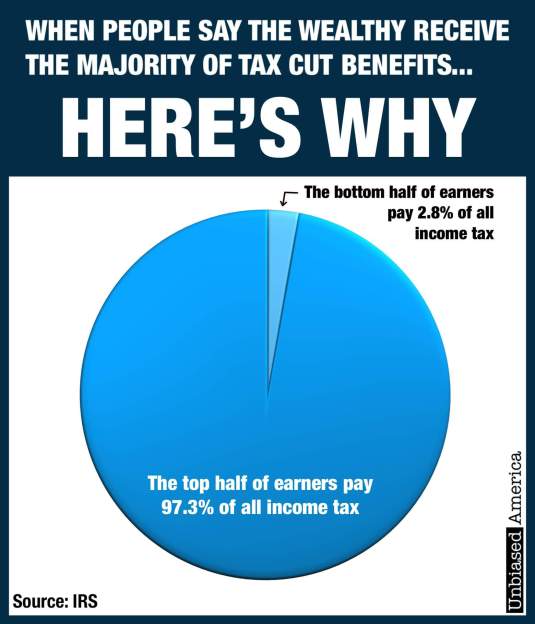
Wouldn’t hold much hope for investors in a hedge fund founded by Steve Keen to put other’s money where his mouth is all the time
28 Apr 2018 Leave a comment
in business cycles, entrepreneurship, Euro crisis, financial economics, fiscal policy, global financial crisis (GFC), macroeconomics, monetary economics Tags: active investing, monetary cranks, revealed preference
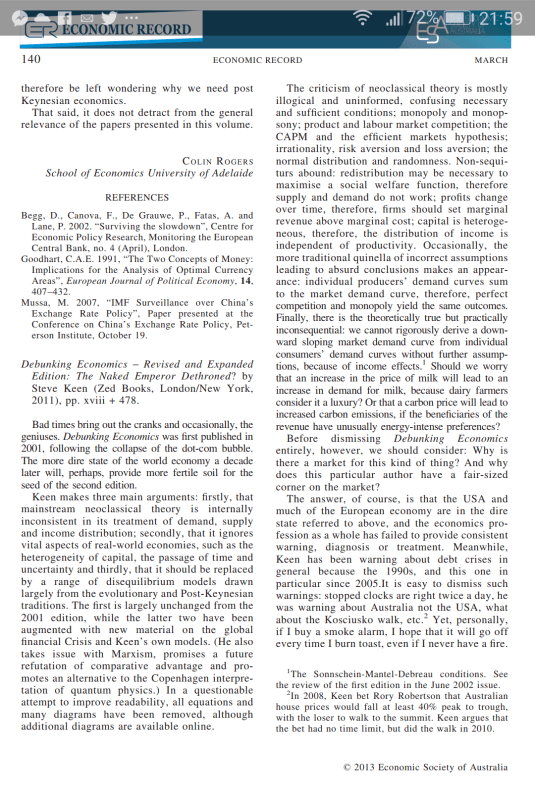
Thomas Sargent v. @AnnPettifor on macroeconomics before the #GFC
24 Apr 2018 Leave a comment
in budget deficits, business cycles, fiscal policy, global financial crisis (GFC), great depression, great recession, macroeconomics, monetary economics, Public Choice Tags: monetary cranks, Thomas Sargent
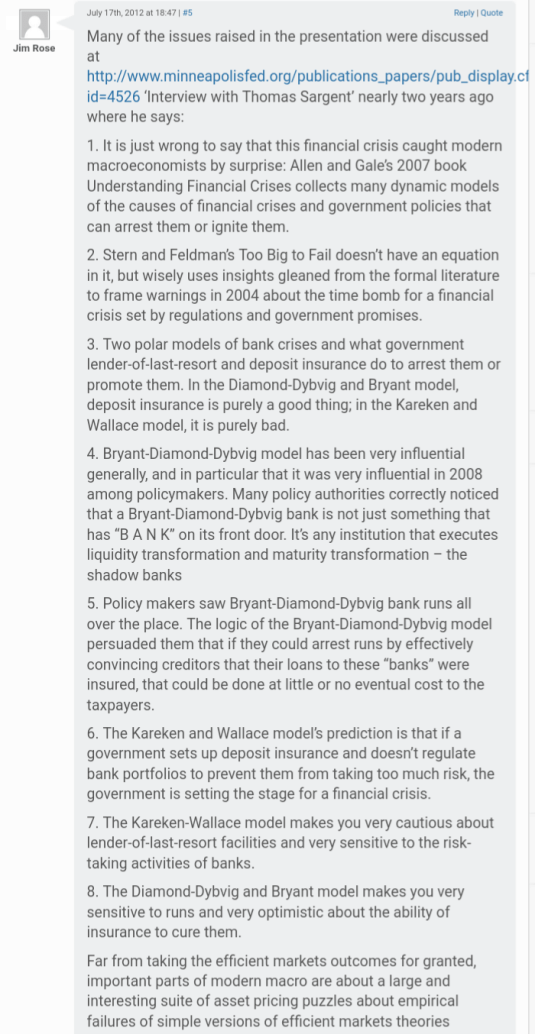
Why libertarianism is a marginal idea and not a universal value | Steven Pinker
10 Mar 2018 Leave a comment
in applied price theory, development economics, economic history, fiscal policy, growth disasters, growth miracles, income redistribution, Public Choice, public economics Tags: Director's Law, growth of government, Steven Pinker, Wagner's Law
The new corporate tax landscape
19 Dec 2017 Leave a comment
in fiscal policy, politics - New Zealand, politics - USA, public economics Tags: company tax
How much saved by raising the superannuation eligibility age to 67?@Taxpayersunion
15 Dec 2017 Leave a comment
in fiscal policy, politics - New Zealand
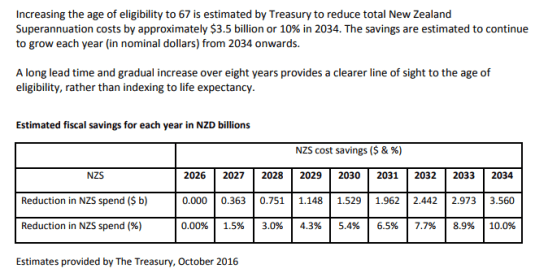
Source: 2016 Review of Retirement Income Policies, Retirement Commissioner.
Game of Theories: The Great Recession
06 Dec 2017 Leave a comment
in budget deficits, business cycles, Euro crisis, fiscal policy, global financial crisis (GFC), great recession, macroeconomics, Public Choice, rentseeking
Brexit will lower company tax rates everywhere
17 Oct 2017 1 Comment
in fiscal policy, politics - New Zealand, public economics
Brexit will turn the British Isles into one great big offshore tax haven. The post-referendum plans for a 15% company tax rate (and the Australian plans for a 25% company tax rate) will put pressure on New Zealand to follow suit.
A common argument against a much lower company tax in New Zealand is the clipping of the ticket argument. A lower company tax rate in New Zealand is said to mean no more than the higher after-tax dividends are taxed at a higher tax rate in the home country of the foreign investor. Less company tax is paid in New Zealand but more tax is paid back home for no net gain to the investor.
The 12 ½% Irish company tax rate attracted investment
The strongest evidence against this is the Irish were relentlessly bullied by the rest of the European Union over its 12 ½% company tax. The other EU finance ministers rightly feared a loss of investment to Ireland. This 12.5% rate applied initially to exports, then manufacturing and then trading profits. The fiscal bounty of the Celtic Tiger years allowed the Irish to finesse these complaints based on EU laws about fiscal discrimination by phasing their 32% general company tax rate down to 12 ½ %.
Our Minister of Finance certainly would not welcome the plans (Senate permitting) for a 25% company tax rate in Australia by 2026. Rather than rubbing his hands in anticipation of more tax revenues on dividends repatriated from New Zealand subsidiaries in Australia, Mr. English will worry about loss of domestic and offshore investment to a more competitive neighbouring tax jurisdiction.
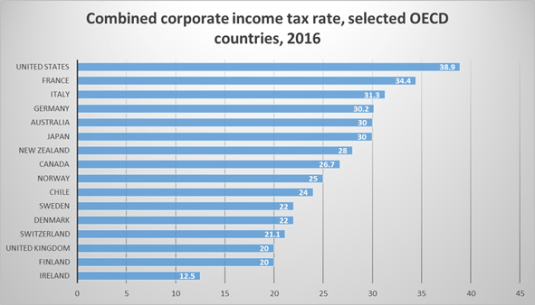
Source: OECD Stat.
The first big country low company tax rate
The British already have the lowest company tax of any major economy with the 20% company tax rate that started on 1 April 2016 (see graphic). This rate will fall to 19% on 1 April 2017, and 17% on 1 April 2020. Brexit will take that rate down to 15% at a date to be determined.
No Minister of Finance welcomes the prospect of a leading world economy and Europe’s key financial centre having by far the 2nd lowest company tax rate of any developed economy by 2020. They will worry about lost investment rather than expect a higher local tax take.
High company tax rates lower wages
Too many people mistakenly believe that company taxes are paid by shareholders through lower dividends. With capital highly mobile across borders, countries with high company tax rates attract less investment because of the lower after-tax returns relative to competing destinations.
This capital flight means lower wages in high company tax jurisdictions because their workers have less capital to work with. A lower company tax means higher wages because of more investment.
Even the USA is under pressure
The US got away with a very much above average company tax rate (38%) because its economy is so large relative to the rest of the world but it too is under pressure from footloose capital and corporate inversions. The US company tax system is so full of holes that if all tax loopholes were closed, its federal company tax rate could be cut from 35% to 9% with no net loss of revenue.
Leading US tax economist Laurence Kotlikoff estimated that this tax reform would increase wages by 8%, output by 6%, and the amount of capital invested by 17%. Australian Treasury modelling found that a 10-percentage point cut in their company tax rate would increase wages by 1.4% to 3%.
The race is on
The British company tax rate is now well below anywhere else bar one. That will force other countries, other big economies, to reconsider their position. New Zealand should not be left behind in harvesting the large wage increases that flow from a much lower company tax rate.
Facts About Taxes: Michael Keane
12 Oct 2017 Leave a comment
in applied price theory, fiscal policy, human capital, labour economics, labour supply, macroeconomics Tags: taxation and labour supply
Is Growth of Government Inevitable? | Sam Peltzman
12 Oct 2017 Leave a comment
in applied price theory, economic history, fiscal policy, macroeconomics, Public Choice, public economics, Sam Peltzman Tags: Director's Law, growth of government
 Utopia, you are standing in it!
Recent Comments