The three lags on monetary policy

There are large uncertainties about the size and timing of responses to changes in monetary policy. There is a close and regular relationship between the quantity of money and nominal income and prices over the years. However, the same relation is much looser from month to month, quarter to quarter and even year to year. Monetary changes take time to affect the economy and this time delay is itself highly variable. The lags on monetary policy are three in all:

  1. The lag between the need for action and the recognition of this need (the recognition lag)

  2. The lag between recognition and the taking of action (the legislation lag)

  3. the lag between action and its effects (the implementation lag)

These delays mean that is it difficult to ascertain whether the effects of monetary policy changes in the recent past have finished taking effect.

Secondly, it is difficult to ascertain when proposed changes in monetary policy will take effect. Thirdly, feedbacks must be assessed. The magnitude of the monetary adjustment necessary to deal with the problem at hand is never obvious.

It is common for a central bank to act incrementally. The central bank makes small adjustments to monetary conditions over time as more information is available on the state of the economy and forecasts are updated.

Most discussions on monetary policy focus on the implementation lag. This lag depends on the fundamental characteristics of the economy.

A long and variable implementation lag means that it is difficult for central banks to ascertain what is happening now or forecast what will happen. Central banks may stimulate the economy after it is well on the way to recovery and tighten monetary policy when the economy is already going into a recession.

In his classic A Program for Monetary Stability, published in 1959, Milton Friedman summarised his empirical findings on length and variability of the lags on monetary policy:

on the average of 18 cycles, peaks in the rate of change in the stock of money tend to preceded peaks in general business by about 16 months and troughs in the rate of change in the stock of money to precede troughs in general business by about 12 months. For individual cycles, the recorded lead has varied between 6 and 29 months at peaks and between 4 and 22 months at troughs.

With lags as variable as those estimated by Friedman, it is difficult to see how any policy maker could know which direction to adjust his policy, much less the precise magnitude needed. Long lags greatly complicate good forecasting. A forecaster cannot know what the state of the economy will be when his policy takes effect.

Many Keynesians, Friedman notes, advocate “leaning against the wind.” By this they mean, in some sense, that the monetary (and fiscal) authorities should try to balance out the private sector’s excesses rather than passively hope that it adjusts on its own.

Friedman tested the Fed’s success at leaning “against the wind” by checking whether the rate of money growth has truly been lower during expansions and higher during contractions. He admits that this method of grading he Fed’s performance is open to criticism, but decides to go ahead and see what turns up. He finds that Fed has – for the periods surveyed – been unsuccessful.

By this criterion, for eight peacetime reference cycles from March 1919 to April 1958. Actual policy was in the ‘right’ direction in 155 months, in the ‘wrong’ direction in 226 months; so actual policy was ‘better’ than the [constant 4% rate of money growth] rule in 41% of the months.

Nor is the objection that the inter-war period biased his study is good since Friedman found that:

For the period after World War II alone, the results were only slightly more favourable to actual policy according to this criterion: policy was in the ‘right’ direction in 71 months, in the ‘wrong’ direct in 79 months, so actual policy was better than the rule in 47% of the months. [2]

One of the best ways to parry a metaphor is with another metaphor. Keynesians have a host of metaphors in their rhetorical arsenal; one frequently voiced is that a wise government should “lean against the wind” when choosing policy. Friedman counters:

We seldom know which way the economic wind is blowing until several months after the event, yet to be effective, we need to know which way the wind is going to be blowing when the measures we take now will be effective, itself a variable date that may be a half year or a year or two from now. Leaning today against next year’s wind is hardly an easy task in the present state of meteorology.

By scrutinising the practice of monetary policy over the decades, Friedman manages to produce objections that both Keynesians and non-Keynesians must take seriously. A key part of any response to Friedman rests on the ability of forecasters to do their jobs with tolerable accuracy.

The most important aspect of monetary strategy is timing

The simplest statement to make about the lags in monetary policy is they are long and variable. This simple statement is also the key insight to understanding the actual implementation of monetary policy. Hence, how many months or years in advance must a central bank forecast to achieve its monetary goals? In 1994, the Economist said:

But [central banks] cannot afford to wait until inflation is actually rising before they act. Monetary policy does not change the speed of the economy instantly: it can take 18 months or more for a rise in interest rates to have its full impact on inflation. The target of policy ought therefore to be future not current inflation, in order to prevent a surge in 1996. The earlier interest rates are raised, the better the chances of engineering a smooth slowdown to a sustainable rate of growth before slack in the economy is exhausted.

Economists differ about the length of those lags. Uncertainty about the average length of those lags and the variability of those lags makes discretion most difficult. Activist policy can improve welfare only if the information about economic structure and economists’ ability to forecast is sufficiently accurate.

Early_sample

Friedman is the most famous and persuasive critic of Keynesianism on the grounds of lags. He has two main arguments: first, that there are “long and variable lags” between the identification of a problem and the effects of the designed remedy; second, that activist policy often itself becomes a source of instability since policy itself becomes a variable that the market must guess.

Friedman’s critique does not depend on the quantity theory of money. Keynesian policies do not necessarily follow even if the Keynesian theory of the business cycle were conclusively proved.

It must also be demonstrated that the government has the ability and willingness of the government to act as the theory prescribes. We are therefore further assuming that central banks have the incentive to stabilise the economy. If the government lacks the information required to stabilise the economy, issues of public choice incentives become fully redundant. Incentives to pursue an objective do not matter if the objective itself is unattainable.

Competing visions of central banking

Economics: A Million Mutinies Now, Part Two - feat. image

The competing visions of central banks over monetary policy have been defined by Franco Modiglani and Milton Friedman respectively. Modiglani considers the Keynesian vision of macroeconomic policy to be:

a market economy is subject to fluctuations which need to be corrected, can be corrected, and therefore should be corrected.

The Keynesian claim implies that central banks have sufficient knowledge of the structure of the economy to be able to choose the policy mix appropriate to a given set of circumstances. It is possible to target unemployment, interest rates and inflation in such a way that they can be maintained (and hence made predictable) by constant adjustment of policy instruments to new shocks.

The Keynesian approach assumes that the economy can slip into recessions for all sorts of reasons (Barro 1989). Business fluctuations result from shocks to aggregate demand. The principal source of these shocks are expectations induced shifts in investment demand. The role of the central bank is to make prompt, frequent policy responses to counteract this instability.

The task of government is to discover the particular monetary and fiscal polices which can eliminate shocks emanating from the private sector. A key finding of recent macroeconomic research is that anticipated monetary policy has very different effects to unanticipated monetary policy.

The Keynesian vision thus presuppose that government can foresee shocks which are invisible to the private sector but at the same time it is unable to reveal this advance information in a credible way and hence defusing the shock because it is no longer unanticipated. In addition, the counter cyclical monetary policies of governments must themselves be unforeseeable by private agents, but at the same time systematically related to the state of the economy (Lucas and Sargent 1979)

Of course, the Keynesian view of central banking is also premised on a goodwill theory of government. Governments pursue policies that are in the public interest. That is a public interest that is well-defined and is free of conflicts over income distribution, electoral success and power the could lead policy-makers to pursue goals other than full employment, stable prices and efficiency. Thus, if the latest forecast is a recession, additional stimulus is the usual prescription. However, since most Keynesian economists accept the permanent income and natural rate hypotheses, more stimulus implies less later at some unknown time.

Friedman’s vision of central banking is far more circumspect:

The central problem is not designing a highly sensitive [monetary] instrument that offsets instability introduced by other factors[in the economy], but preventing monetary arrangements becoming a primary source of instability (Milton Friedman 1959).

Friedman considers that a key element in the case for policy discretion is whether the sufficient information is available that can be used to reduce variability and assist the economy’s adjustment the unforeseen. A well intentioned policy-maker will destabilise if he is mislead by incomplete or incorrect information.

From the monetarist standpoint, price stability can be approximately attained under a well chosen and predictable monetary policy rule. Under this view, the unemployment and interest rates are unpredictable and can manipulated only at a prohibitive cost. The Keynesian and monetarist views are mutually incompatible and lead to very different policy recommendations (Lucas 1981).

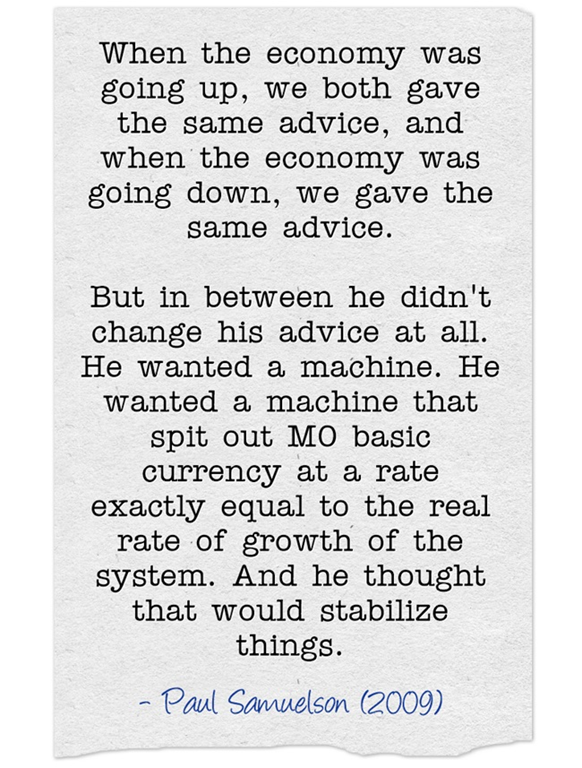
Paul Samuelson on where he disagreed with Milton Friedman on macroeconomic policy

Paul Samuelson on where he disagreed with Milton Friedman

via Samuelson vs. Friedman, David Henderson | EconLog | Library of Economics and Liberty and An Interview With Paul Samuelson, Part One — The Atlantic.

After reading the annual reports of the Fed, Milton Friedman noticed the following pattern

Milton Friedman reading fed annual reports

.

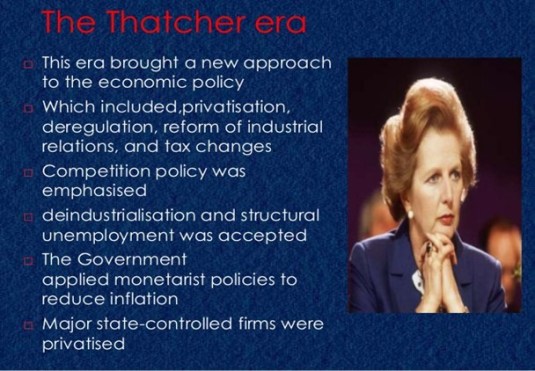
The timing of major economic reform programmes

There are plenty of critics of deregulation, albeit enough for them are smart enough to realise they cannot restore the lost monopolies and high marginal tax rates on the middle-class. They admit in their hearts that deregulation and other economic reforms worked as did inflation targeting.

The common force behind economic reform from 1980 onwards was the growing deadweight welfare losses of the pre-1980s status quo.The pressure for reform came from the rising burden that increases in taxes and regulation placed on economic growth as evidenced by the 1970s productivity slowdown and stagflation.
George Stigler argued that ideas about economic reform need to wait for a market. As Stigler noted, when their day comes, economists seem to be the leaders of public opinion. But when the views of economists are not so congenial to the current requirements of special interest groups, these economists are left to be the writers of letters to the editor in provincial newspapers and run angry blogs.
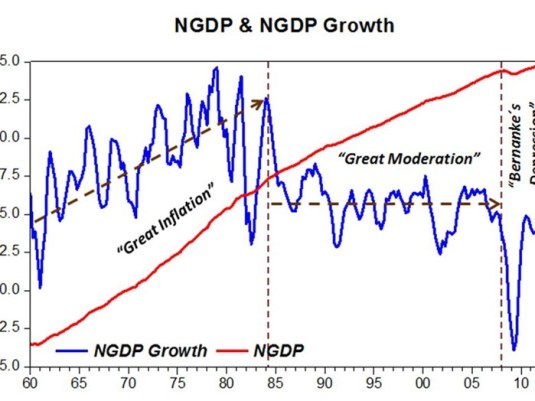
Post-1980 trends in taxes, spending, and regulation in New Zealand and abroad reflect demographic shifts, more efficient taxes, more efficient spending, a shift in the political influence from the taxed to the subsidised, shifts in political influence among taxed groups, and shifts in political influence among the subsidised groups (Becker and Mulligan 1998, 2003).

The common forces behind economic reform across the OECD area have subtle implications for the size of the reform dividend for New Zealand

  • The deadweight losses of taxes, income transfers and regulation are a constraint on inefficient policies (Becker 1983, 1985; Peltzman 1989).
  • This deadweight loss is the difference between winner’s gains less the loser’s losses from a tax or regulation-induced change in output. Changes in behaviour due to taxes and regulation reduce output and investment.
  • Policies that significantly cut the total wealth available for distribution by governments are avoided because they reduce the payoff from taxes and regulation relative to the germane counter-factual, which are other even costlier modes of income redistribution (Becker 1983, 1985).

Certainly, in New Zealand, the post-1984 economic reforms followed a good 10 years of economic stagnation and regular economic crises.

In the early 1980s, New Zealand’s economy was in trouble. The country had lost its guaranteed export market when Britain joined the European Economic Union in 1973. The oil crisis that year had also taken a toll.

The Labour Party Minister of Finance, Sir Roger Douglas, prior coming to office in 1984, wrote a book called There’s Gotta Be A Better Way.
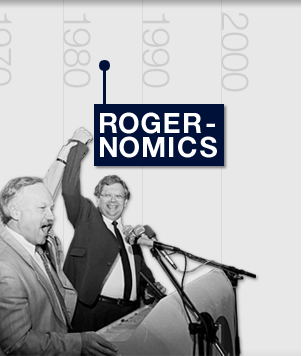
The rising deadweight cost of taxes and regulation due to technological change, and the dissipation of wealth through rising cost structures progressively enfeebled the subsidised groups, allowing others to win the initiative after the 1970s in many countries including New Zealand.

The Labour Government radically reduced the size and role of the state. It corporatised and restructured government departments, often in preparation for privatisation, and sold some state assets to private investors. It abolished many economic controls and removed farming subsidies.

The additional political pressure that the winners had to exert to keep the same dollar gain from income redistribution had to overcome rising pressure from the losers to escape their escalating losses.

Eventually, the fight was no longer worthwhile relative to the alternatives. Taxed, regulated and subsidised groups can find common ground in wealth enhancing policies and an encompassing interest in mitigating any reduction in wealth from income redistribution policies.
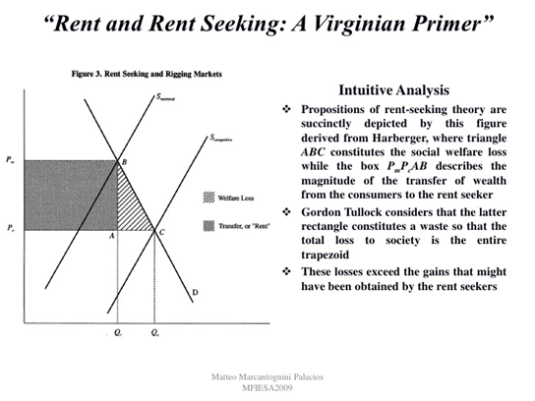
One barrier to reform is the transitional gains trap. The capitalisation of rents from taxi licenses is a classic example of the transitional gains trap.

Those who purchase the medallions from the owners at the time of initial regulation will pay the market rate for them and therefore will not receive any special rents.  Yet, they will fight to prevent the taxi medallion system from being eliminated, since these owners will be harmed by such elimination.  Thus, the city will be stuck with an inefficient medallion system that will be difficult to eliminate.

Eliminating the medallion program will harm existing taxis, many of whom did not lobby for the system in the first place and do not receive super competitive profits. The resources used in establishing the regulation or other programmes are lost forever.
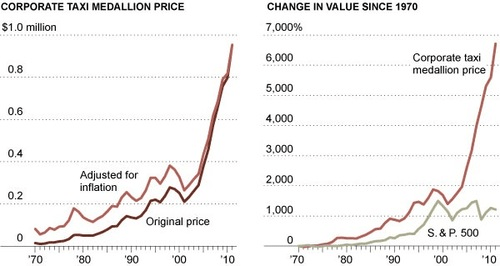
Termination of a particular regulation or subsidies will nonetheless cause large capital losses for the incumbents. This will motivate incumbents to oppose reforms that jeopardise the income stream that has been previously capitalised (Tullock 1975; McCormick et al. 1984; Tollison and Wagner 1991). Any resources wasted in fighting economic reform must be deducted from the net gains from economic reform.

The literature on the transitional gains trap suggested that economic reform does not necessarily make society better off (Tullock 1975; McCormick et al. 1984; Tollison and Wagner 1991). The rent-seeking costs of the original privileges are capitalised and are lost forever. They are not regained by reform. The transitional gains trap is just a subset of a more general phenomenon indicating that deregulation can never replicate the status quo ante.

Too often it is assumed that deregulation can replicate the status quo ante. The prevailing model of deregulation is essentially a nirvana model, in that the gains from deregulation can essentially be had without cost. Further rent-seeking costs are incurred in lobbying for and against proposed reforms and these too are lost to forever.

The standard analysis of deregulation too easily treats reform as a return to the status quo ante. Fred McChesney observed

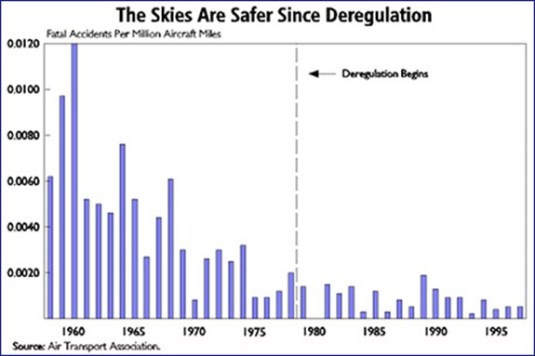
The airline industry of 1999 is not the airline industry of 1978 minus the Civil Aeronautics Board.

The wealth lost in rent seeking is not recovered, or even recoverable by deregulation. Production possibilities have been irretrievably diminished (McCormick et al. 1984; Tollison and Wagner 1991).

Reform is not a free lunch. To the extent that specialised resources were involved in the rent seeking–resources that could have been devoted to amassing specific capital in producing the regulated good–the deregulated relative price must be higher than the pre-regulation or competitive price. The abstract of the relevant article by Tollison and Wagner is as follows:

This paper applies the theory of rent seeking to argue that economic reform, in the sense of correcting past deformities in the economy, does not pay from a social point of view. Economic reform, at best, should focus on the prevention of future deformities.

The analysis is developed in terms of the example of monopoly, but its applicability extends to any example of economic reform. The general principle underlying the analysis is that reform is not a free lunch, all the more so when the costs of the reformer and the resistance of the object of reform are taken into account.

Despite this, new institutions arise when social groups notice opportunities for new gains which are impossible to realise under the prevailing institutional arrangements (Diana Thomas 2009). The chances that new institutional frameworks may develop increase when these alternative technological opportunities and export markets become available.

Reform is more likely when the net benefits of reform become large because there is plenty left over for credible compensation of the losers who could block change (Acemoglu and Robinson 2005; Acemoglu 2008). An example is if taxes or regulation causes cost padding or delay new technologies. Shedding these inefficiencies are potential benefits for all.
The political secret of the East Asian economic miracles was the focus on export led industrialisation. Because the new industries were exporting rather than entering and competing with domestic suppliers to home markets, these domestic special interest groups had no reason to lobby against the establishment of these export industries and otherwise blocked both their entry and the adoption of new technologies. The social change is much more subtle. The local industry is simply had to pay more for contract as the export industries grew and bid away their labour force with higher pay.
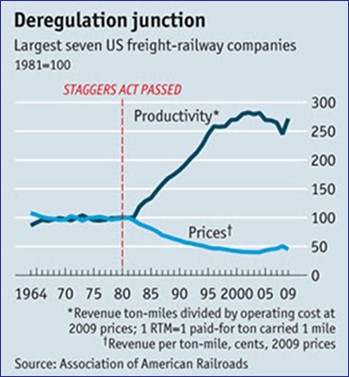
Successful subsidised groups are often coalitions of sub-sets of producers, consumers, employees and input suppliers and deregulation is always a possibility if some members can benefit from joining another coalition (Peltzman 1976, 1989). A surprising number of incumbents of regulated and state-owned industries were unprofitable – some close to bankruptcy – because of rising cost structures, the growing losses from mandated services and erosion of rents through non-price competition with existing firms. They would have closed anyway but for bailouts.

The economic reforms that picked up pace around 1980 were a success as Andrei Shleifer’s paper
The Age of Milton Freedom begins

The last quarter century has witnessed remarkable progress of mankind. The world’s per capita inflation-adjusted income rose from $5400 in 1980 to $8500 in 2005.Schooling and life expectancy grew rapidly, while infant mortality and poverty fell just as fast.

Compared to 1980, many more countries in the world are democratic today. The last quarter century also saw wide acceptance of free market policies in both rich and poor countries: from private ownership, to free trade, to responsible budgets, to lower taxes.
Milton Friedman on the impact of brute experience on central bankers

Image

Milton Friedman on pre-Keynesian macroeconomics

Image

Milton Friedman on the monetarist triumph

Image

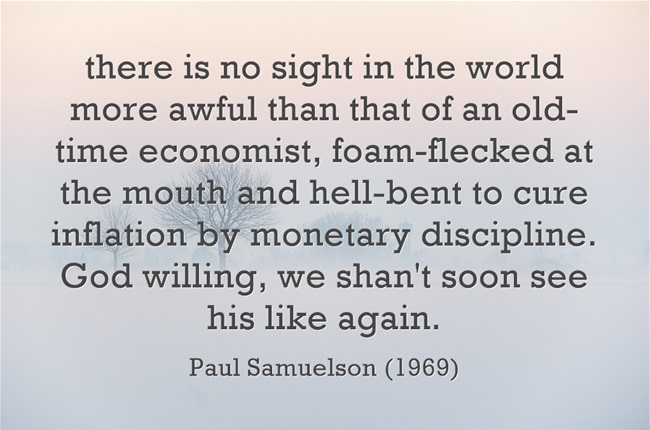
Paul Samuelson on inflation targeting

Paul Samuelson on inflation targeting

Image

Milton Friedman on how New Keynesian Macroeconomics is mostly monetarism

Image

Douglas Irwin on who anticipated the great depression

Image

The success of monetarism and the death of the correlation between monetary growth and inflation

The Velocity of Money

Monetarists blame fluctuations in inflation on excessively volatile growth in monetary aggregates. In 1982, Friedman defined monetarism in an essay on defining monetarism as follows:

Like many other monetarists, I have concluded that the most important thing is to keep monetary policy from doing harm.

We believe that a steady rate of monetary growth would promote economic stability and that a moderate rate of monetary growth would prevent inflation

The U.S. data supported this hypothesis about the volatility of monetary growth and inflationuntil 1982, but since 1983 monetary aggregates have been essentially uncorrelated with subsequent inflation in the U.S.

Levis Kochin pointed out in 1979 that a well designed monetary policy would lead to zero correlation between any measure of monetary policy and subsequent inflation. The reason for this is the correlation between any variable and a constant is zero.

If monetary growth is stable, say, a constant growth rate of 4% per year, as advocated by Milton Friedman, monetary growth will have no correlations with any variable:

Poole (1993, 1994) and Tanner (1993) also argue that one predictable consequence of optimal monetary policy is that the correlation between monetary policy instruments and policy goals will be driven to zero.

Poole further contends that it is obvious to any careful reader of Theil (1964) that optimally variable policy will give rise to a zero correlation between policy and goal variable…

In 1966 Alan Walters, a U.K. monetarist, observed:

If the [monetary] authority was perfectly successful then we should observe variations in the rate of change of the stock of money but not variations in the rate of change of income… [a]ssuming that the authority’s objective is to stabilize the growth of income.

Milton Friedman in 2003, wrote about how the Fed acquired a good thermostat:

The contrast between the periods before and after the middle of the 1980s is remarkable.

Before, it is like a chart of the temperature in a room without a thermostat in a location with very variable climate; after, it is like the temperature in the same room but with a reasonably good though not perfect thermostat, and one that is set to a gradually declining temperature.

Sometime around 1985, the Fed appears to have acquired the thermostat that it had been seeking the whole of its life…

Prior to the 1980s, the Fed got into trouble because it generated wide fluctuations in monetary growth per unit of output. Far from promoting price stability, it was itself a major source of instability as Chart 1 illustrates.

Yet since the mid ’80s, it has managed to control the money supply in such a way as to offset changes not only in output but also in velocity.

Nick Rowe explained the difficulty of causation and correlation under different policy regimes and Milton Friedman’s thermostat superbly as an econometric problem Nick Rowe:

If a house has a good thermostat, we should observe a strong negative correlation between the amount of oil burned in the furnace (M), and the outside temperature (V).

But we should observe no correlation between the amount of oil burned in the furnace (M) and the inside temperature (P). And we should observe no correlation between the outside temperature (V) and the inside temperature (P).

An econometrician, observing the data, concludes that the amount of oil burned had no effect on the inside temperature. Neither did the outside temperature. The only effect of burning oil seemed to be that it reduced the outside temperature. An increase in M will cause a decline in V, and have no effect on P.

A second econometrician, observing the same data, concludes that causality runs in the opposite direction. The only effect of an increase in outside temperature is to reduce the amount of oil burned. An increase in V will cause a decline in M, and have no effect on P.

But both agree that M and V are irrelevant for P. They switch off the furnace, and stop wasting their money on oil.

Subsequent work of Levis Kochin showed that if the effects of fluctuations in monetary aggregates were not precisely known then the optimal policy would produce negative correlations between monetary aggregates and inflation:

The negative correlation results from coefficient uncertainty because the less certain we are about the size of a multiplier, the more cautious we should be in the application of the associated policy instrument.

Therefore, although optimal policy leads to lack of correlation between the goal and control variables if the coefficient is known, it will lead to a negative relationship if there is coefficient uncertainty. The higher the uncertainty, the more cautious will be the optimal policy response. Also, if the control variable can’t be controlled perfectly then the correlation between the goal and the control variable becomes positive i.e., the control errors are random…

Uncertainty about the impact of a policy  will stay the hand of any bureaucrat , much less a central banker, as Kochin and his co-author explain:

Uncertainty should lead to less policy action by the policymakers. The less policymakers are informed about the relevant parameters, the less activist the policy should be. With poor information about the effects of policy, very active policy runs a higher danger of introducing unnecessary fluctuations in the economy.

What influence did Milton Friedman have on 1980s and 1990s Australian monetary policy?

The Hayek and Friedman Monday conferences on the ABC in 1976 and 1975 are still ruling the Australian policy roost, if some of the Left over Left in Australia are to be believed. Milton Friedman is said to have mesmerised several countries with a flying visit with his Svengali powers of persuasion.

When working at the next desk to a monetary policy section in the Australian Prime Minister’s Department in the late 1980s, I heard not a word of Friedman’s Svengali influence:

• The market determined interest rates, not the Reserve Bank was the mantra for several years. Joan Robinson would have been proud that her 1975 Monday conference was still holding the reins.

• Monetary policy was targeting the current account. Read Edwards’ biography of Keating and his extracts from very Keynesian Treasury briefings to Keating signed by David Morgan that reminded me of Keynesian macro101.

When as a commentator on a Treasury seminar paper in 1986, Peter Boxhall – fresh from the US and 1970s Chicago educated – suggested using monetary policy to reduce the inflation rate quickly to zero, David Morgan and Chris Higgins almost fell off their chairs. They had never heard of such radical ideas.

In their breathless protestations, neither were sufficiently in-tune with their Keynesian educations to remember the role of sticky wages or even the need for the monetary growth reductions to be gradual and, more importantly, credible as per Milton Freidman and as per Tom Sargent’s end of 4 big and two moderate inflations papers in the early 1980s.

I was far too junior to point to this gap in their analytical memories about the role of sticky wages, and I was having far too much fun watching the intellectual cream of Treasury senior management in full flight. (I read Friedman & Sargent much later).

The competing visions of stabilisation policy have been defined by Franco Modigliani and Milton Friedman

Previous Older Entries Next Newer Entries

Bassett, Brash & Hide

Celebrating humanity's flourishing through the spread of capitalism and the rule of law

Truth on the Market

Scholarly commentary on law, economics, and more

The Undercover Historian

Beatrice Cherrier's blog

Matua Kahurangi

Celebrating humanity's flourishing through the spread of capitalism and the rule of law

Temple of Sociology

Celebrating humanity's flourishing through the spread of capitalism and the rule of law

Velvet Glove, Iron Fist

Celebrating humanity's flourishing through the spread of capitalism and the rule of law

Why Evolution Is True

Why Evolution is True is a blog written by Jerry Coyne, centered on evolution and biology but also dealing with diverse topics like politics, culture, and cats.

Down to Earth Kiwi

Celebrating humanity's flourishing through the spread of capitalism and the rule of law

NoTricksZone

Celebrating humanity's flourishing through the spread of capitalism and the rule of law

Homepaddock

A rural perspective with a blue tint by Ele Ludemann

Kiwiblog

DPF's Kiwiblog - Fomenting Happy Mischief since 2003

The Dangerous Economist

Celebrating humanity's flourishing through the spread of capitalism and the rule of law

Watts Up With That?

The world's most viewed site on global warming and climate change

The Logical Place

Tim Harding's writings on rationality, informal logic and skepticism

Doc's Books

A window into Doc Freiberger's library

The Risk-Monger

Let's examine hard decisions!

Uneasy Money

Commentary on monetary policy in the spirit of R. G. Hawtrey

Barrie Saunders

Thoughts on public policy and the media

Liberty Scott

Celebrating humanity's flourishing through the spread of capitalism and the rule of law

Point of Order

Politics and the economy

James Bowden's Blog

A blog (primarily) on Canadian and Commonwealth political history and institutions

Science Matters

Reading between the lines, and underneath the hype.

Peter Winsley

Economics, and such stuff as dreams are made on

A Venerable Puzzle

"The British constitution has always been puzzling, and always will be." --Queen Elizabeth II

The Antiplanner

Celebrating humanity's flourishing through the spread of capitalism and the rule of law

Bet On It

Celebrating humanity's flourishing through the spread of capitalism and the rule of law

History of Sorts

WORLD WAR II, MUSIC, HISTORY, HOLOCAUST

Roger Pielke Jr.

Undisciplined scholar, recovering academic

Offsetting Behaviour

Celebrating humanity's flourishing through the spread of capitalism and the rule of law

JONATHAN TURLEY

Res ipsa loquitur - The thing itself speaks

Conversable Economist

Celebrating humanity's flourishing through the spread of capitalism and the rule of law

The Victorian Commons

Researching the House of Commons, 1832-1868

The History of Parliament

Articles and research from the History of Parliament Trust

Books & Boots

Reflections on books and art

Legal History Miscellany

Posts on the History of Law, Crime, and Justice

Sex, Drugs and Economics

Celebrating humanity's flourishing through the spread of capitalism and the rule of law

European Royal History

Exploring the Monarchs of Europe

Tallbloke's Talkshop

Cutting edge science you can dice with

Marginal REVOLUTION

Small Steps Toward A Much Better World

NOT A LOT OF PEOPLE KNOW THAT

“We do not believe any group of men adequate enough or wise enough to operate without scrutiny or without criticism. We know that the only way to avoid error is to detect it, that the only way to detect it is to be free to inquire. We know that in secrecy error undetected will flourish and subvert”. - J Robert Oppenheimer.

STOP THESE THINGS

The truth about the great wind power fraud - we're not here to debate the wind industry, we're here to destroy it.

Lindsay Mitchell

Celebrating humanity's flourishing through the spread of capitalism and the rule of law

Alt-M

Celebrating humanity's flourishing through the spread of capitalism and the rule of law

croaking cassandra

Economics, public policy, monetary policy, financial regulation, with a New Zealand perspective

The Grumpy Economist

Celebrating humanity's flourishing through the spread of capitalism and the rule of law

International Liberty

Restraining Government in America and Around the World