In the halcyon days of 2015-19, openings on the economics job market hovered at around 1900 per year. In 2020, Covid was a major shock, but the market bounced back quickly in 2021 and 2022. Since then, though, the market has clearly been in a funk. 2023, my job market year, saw a sudden dip […]
The evolution of the economics job market
The evolution of the economics job market
24 Sep 2025 Leave a comment
in economics of education, human capital, labour economics, labour supply, managerial economics, occupational choice, organisational economics, personnel economics
Same goes for performance management
05 Jul 2025 Leave a comment
in labour economics, labour supply, managerial economics, organisational economics, personnel economics

Public-Private-Partnerships?
02 Apr 2025 Leave a comment
in applied price theory, economic history, economics of bureaucracy, history of economic thought, industrial organisation, law and economics, managerial economics, organisational economics, politics - New Zealand, privatisation, property rights, Public Choice, public economics
New Zealand’s economic development has always been a partnership between the public and private sectors. Brian Easton writes – Public-Private-Partnerships (PPPs) have become fashionable again, partly because of the government’s ambitions to accelerate infrastructural development. There is, of course, an ideological element too, while some of the opposition to them is also ideological. PPPs […]
Public-Private-Partnerships?
Bosses Don’t Need a ‘What Did You Do’ Email. They’re Already Tracking You. (and how this might be related to Keynes’ theory of sticky wages)
27 Mar 2025 Leave a comment
in applied price theory, human capital, labour economics, labour supply, law and economics, macroeconomics, managerial economics, monetary economics, organisational economics, personnel economics, property rights, unemployment Tags: efficiency wage, wage rigidity
Elon Musk’s email to federal employees prompted angst, but lots of employers use technology for continuous feedback on worker performanceBy Natasha Khan and Ray A. Smith. Excerpts:”What did you do last week?The question that Elon Musk lobbed to federal workers in an email set off anger and angst from unions and employees. It also prompted…
Bosses Don’t Need a ‘What Did You Do’ Email. They’re Already Tracking You. (and how this might be related to Keynes’ theory of sticky wages)
Max Rashbrooke has been kidnapped again to be replaced by a neoliberal doppelganger
08 Mar 2025 Leave a comment
in applied price theory, comparative institutional analysis, economics of bureaucracy, industrial organisation, managerial economics, market efficiency, organisational economics, politics - New Zealand, Public Choice, public economics Tags: privatisation

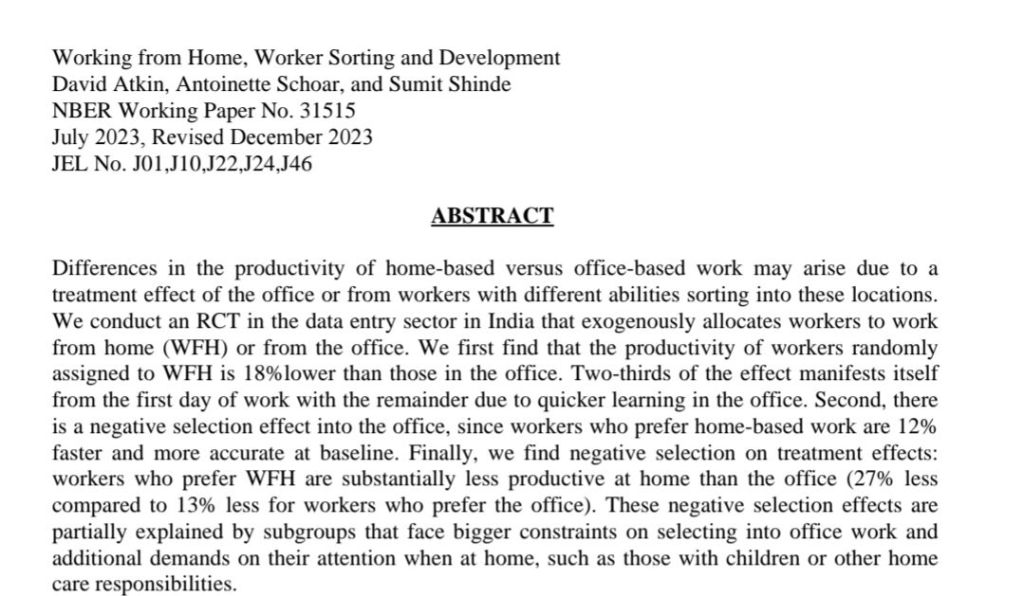
A negative productivity shock from working from home
08 Feb 2025 Leave a comment
in applied price theory, experimental economics, industrial organisation, labour economics, labour supply, managerial economics, occupational choice, organisational economics, personnel economics Tags: economics of pandemics
More on Business Dynamism
11 Dec 2024 Leave a comment
in applied price theory, economic history, economics of bureaucracy, economics of regulation, entrepreneurship, financial economics, income redistribution, industrial organisation, labour economics, labour supply, managerial economics, organisational economics, personnel economics, Public Choice, rentseeking, survivor principle, theory of the firm Tags: creative destruction, employment law

Over at the Geek Way, Andrew McAfee has created a startling visualization related to entrepreneurship in the US and EU. The Draghi Report on EU competitiveness is generating a small buzz among economists. One startling claim is thatthere is no EU company with a market capitalisation over EUR 100 billion that has been set up…
More on Business Dynamism
Creative destruction again
28 Sep 2024 Leave a comment
in applied price theory, industrial organisation, labour economics, labour supply, managerial economics, occupational choice, organisational economics, personnel economics Tags: creative destruction, economics of pandemics
Employers are reluctant to admit workers work because they are paid wages
09 Sep 2024 Leave a comment
in applied price theory, labour economics, labour supply, managerial economics, organisational economics, personnel economics

https://www.facebook.com/groups/774813624767808/permalink/829599789289191/?ref=share&mibextid=NSMWBT
Why Top CEOs Earn Big Paychecks
22 Aug 2024 Leave a comment
in applied price theory, economic history, economics of education, entrepreneurship, human capital, industrial organisation, labour economics, labour supply, liberalism, managerial economics, market efficiency, occupational choice, organisational economics, personnel economics, politics - USA, poverty and inequality, survivor principle Tags: CEO pay, superstar wages

CEO compensation at large firms is high, especially in comparison to average worker wages, sparking debates over income inequality. Critics argue that such pay packages are unfair and disproportionate to actual company performance. Proponents contend that high pay reflects productivity and is necessary to attract scarce top talent to large firms. Let’s go to the […]
Why Top CEOs Earn Big Paychecks
Good test
27 Jun 2024 Leave a comment
in managerial economics, organisational economics, personnel economics

The Huge Potential Benefits of Charter Schools
30 May 2024 Leave a comment
in economics of bureaucracy, economics of education, managerial economics, organisational economics, politics - New Zealand, Public Choice
Alwyn Poole writes – In New Zealand we have approximately 460 high schools. The gaps between the schools that produce the best results for students and those at the other end of the spectrum are enormous. In terms of the data for their leavers, the top 30 schools have an average of 87% of their […]
The Huge Potential Benefits of Charter Schools
30 May 2024 Leave a comment
in applied welfare economics, comparative institutional analysis, economics of information, managerial economics, organisational economics, personnel economics

Wage setting explained
23 May 2024 Leave a comment
in economics of education, economics of information, human capital, labour economics, labour supply, managerial economics, market efficiency, occupational choice, organisational economics, personnel economics

Charter Schools are a worthwhile addition to our school system – but ACT is mis-selling why they are Good and Labour is mis-selling why they are Bad.
22 May 2024 Leave a comment
in economics of bureaucracy, economics of education, managerial economics, organisational economics, personnel economics, politics - New Zealand, Public Choice
We know the old saying, “Never trust a politician”, and the Charter School debate is a good example of it. Charter Schools receive public funding, yet “are exempt from most statutory requirements of traditional public schools, including mandates around .. human capital management .. curriculum & instructional practices, and governance & management structures”. That’s a…
Charter Schools are a worthwhile addition to our school system – but ACT is mis-selling why they are Good and Labour is mis-selling why they are Bad.


Recent Comments