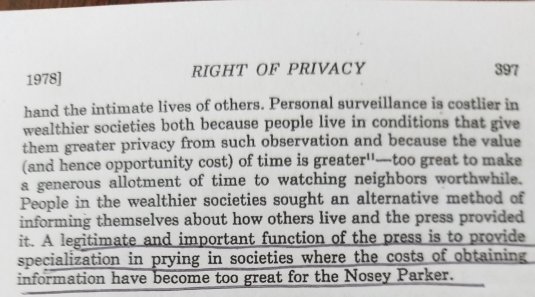
Richard Posner on a little known efficiency gain
23 Jan 2019 Leave a comment
in economics of information, law and economics, Richard Posner Tags: economics of privacy
The Palestinian Territories constitute the real “apartheid state”
23 Jan 2019 Leave a comment

The New York Times is rapidly becoming an anti-Israel paper. For every Bari Weiss op-ed (and there’s a good one today), there are several anti-Israeli articles, often filled with lies and misconceptions, like the piece below that appeared Friday. As CAMERA wrote after seeing Alexander’s article:
The New York Times‘s disproportionate focus on criticism of Israel, including its very existence, is hardly a new phenomenon, despite Alexander’s assertion to the contrary. In her op-ed, she argues: “Not so long ago, it was fairly rare to hear this perspective,” i.e., that Israel is committing “horrific human rights abuses” and “legalized discrimination.” (Her position seems to contradict Levy’s [Haaretz columnist Gideon Levy], who argued that “it’s getting more difficult” to publish such views.) In fact, CAMERA’s comprehensive study (“Indicting Israel: New York Times Coverage of the Palestinian-Israeli Conflict“) found that in the period from July 2011 through March 2012…
View original post 1,065 more words
David Friedman Takes on Hard Questions for Libertarians
23 Jan 2019 Leave a comment
in applied price theory, comparative institutional analysis, David Friedman, economics of crime, economics of education, economics of regulation, environmental economics, law and economics

Friedrich von Hayek and Jack High (S1007) – Full Video
23 Jan 2019 Leave a comment
in Austrian economics, comparative institutional analysis, constitutional political economy, F.A. Hayek, law and economics, Public Choice
David Friedman – Arguments Libertarians shouldn’t make
22 Jan 2019 Leave a comment
in comparative institutional analysis, constitutional political economy, David Friedman, law and economics, libertarianism
Grubby ‘Green’: Sierra Club Pockets $Millions Plugging Environment Wrecking Wind Projects
22 Jan 2019 Leave a comment

 Serious green goes to faux ‘green’ lobby groups peddling wind power.
The only way of explaining the push for subsidised wind and solar is money. And when we say money, we mean hundreds of billions of dollars of other people’s money.
In Australia alone, the Federal Government’s Large-Scale Renewable Energy Target will redirect over $60 billion in subsidies to wind and large-scale solar operators (all drawn from Australian power consumers and added to their power bills) over the life of that scheme.
Although, to use the term ‘scheme’ is to add varnish to one of the greatest scams in history.
Rocketing power prices and a grid on the brink of collapse are the only ‘dividends’ to be returned from the LRET, the largest single industry subsidy scheme in the history of the Commonwealth.
Australia’s obsession with chaotically intermittent wind and solar means not only spiralling retail power prices, but…
View original post 2,193 more words
Indoor air pollution kills thousands in India
22 Jan 2019 Leave a comment
in development economics, environmental economics Tags: India, indoor air pollution


Recent Comments