WHY does the CABIN CREW DIM the LIGHTS?
22 Jan 2019 Leave a comment
in transport economics Tags: Air safety
Past BBC interviewee on antisemitism gets jail term for antisemitic incitement
21 Jan 2019 Leave a comment

Long-time readers may recall that five years ago both BBC Two’s ‘Newsnight’ and BBC Radio 4’s ‘Today’ covered a story that was portrayed by the then ‘Newsnight’ presenter Jeremy Paxman as a ‘free speech’ issue:
“Now a French comedian has managed to short-circuit his country’s professed commitment to free speech. President Francois Holland, with support from both Right and Left, today encouraged local authorities to ban performances by Dieudonné M’bala-M’bala – usually known just as “Dieudonné”. It’s being done on grounds of public order because his alleged antisemitism has tested to destruction Voltaire’s supposed belief that ‘I disapprove of what you say, but I will defend to the death your right to say it.’ “
That ‘Newsnight’ report included an interview with a man introduced by Paxman as “the French writer and film-maker Alain Soral” and “a close friend of Monsieur Dieudonné” who “helped him popularise the infamous quenelle gesture”. BBC audiences were told nothing of Soral’s far-Right affiliations and record…
View original post 288 more words
How and why did we start collecting economics statistics (such as inflation, GDP etc.): Case of US
21 Jan 2019 Leave a comment

A really nice paper by Prof Hugh Rockoff of Rutgers Univ.
He discusses an area which is seldom discussed in economic research which is origins of statistics/data which help us understand the trends in an economy. How and why did we start collecting data on things like inflation, employment and output? He discusses the US case:
Although attempts to measure trends in prices, output, and employment can be traced back for centuries, in the main the origins of the U.S. federal statistics are to be found in bitter debates over economic policy, ultimately debates over the distribution of income, at the end of the nineteenth century and during the world wars and Great Depression. Participants in those debates hoped that statistics that were widely accepted as nonpolitical and accurate would prove that their grievances were just and provide support for the policies they advocated.
Economists – including luminaries such as…
View original post 91 more words
Another bad day at the office for New Keynesian macroeconomics
21 Jan 2019 Leave a comment
in business cycles, labour economics, labour supply, macroeconomics, monetary economics, unemployment Tags: New Keynesian macroeconomics

“Markets without Limits” Jason Brennan, Hayek Lecture Series
21 Jan 2019 Leave a comment
in applied price theory, Austrian economics, development economics, labour economics, labour supply, law and economics, property rights
‘News at Ten’ continues the BBC’s ‘blockade’ campaign
21 Jan 2019 Leave a comment
On January 15th the Hamas-run Gaza health ministry published an English language Facebook post in which – apparently this time in reaction to the delay of a transfer of cash from Qatar to Hamas – it claimed that “the fuel crisis in hospitals and primary care centers continues to hit critical levels”.
On January 17th the flagship BBC programme ‘News at Ten’ – aired on BBC One and the BBC News channel – ran an item that seemed to have been inspired by that Facebook post and further milked Mishal Husain’s December 2018 trip [see ‘related articles’ below] to the Gaza Strip.
Failing to clarify to viewers that the health ministry in the Gaza Strip is run by the terror group Hamas, presenter Huw Edwards introduced the report (from 23:49 here) as follows: [emphasis in italics in the original, emphasis in bold added]
Edwards: “Now the Palestinian…
View original post 1,510 more words
Review of “The Survivor: Bill Clinton in the White House” by John Harris
21 Jan 2019 Leave a comment
The Carbon Tax Shell Game
21 Jan 2019 Leave a comment


James Taylor explains current efforts to distract us with a tricky proposal. A ‘Revenue Neutral’ Carbon Tax Is a Costly Myth. Excerpts in italics with my bolds.
The Wall Street Journal, Washington Post, and other media outlets are reporting that a bipartisan group of top economic advisors has signed a statement supporting a carbon dioxide tax that returns all revenue to the American people. Prominent signatories include Alan Greenspan, Paul Volcker, and Ben Bernanke. Expect this to be a big messaging point in the weeks and months ahead for global warming activists.
More atmospheric carbon dioxide and gradually warming temperatures have brought net benefits to human health and welfare. Yet economists like Greenspan and Bernanke, who received appointments from Republican presidents, often make the argument that they are not scientists and they are merely crafting the best economic solution to a problem that most scientists say we need to…
View original post 636 more words
Women’s March leaders continue their evasion and antisemitism
21 Jan 2019 Leave a comment

The fact that I’ve posted so often on the Women’s March, Inc. (“WM”, the group headed by Perez, Bland, Mallory, and Sarsour) may make some readers think that I’m opposed to it or to its principles. But that is far from the truth, as I agree with nearly all the goals of the Women’s March, which to me boil down to providing all women with equal opportunities. And although the March has fractured along lines of the antisemitism of its leaders and the opposition of its leaders to anti-abortion views and groups, I still think there are unifying principles that all women (and I) should support: choice of abortion, access to birth control, an end to any discrimination based on gender (judged not by inequities in representation but by evidence of bias or barriers to entry), provisions for daycare and so on. (Yes, some religious women oppose abortion and birth…
View original post 1,442 more words
Another “Useful Idiot” Seeks to Prop Up Cuba’s Thuggish Regime by Regurgitating Propaganda
21 Jan 2019 Leave a comment

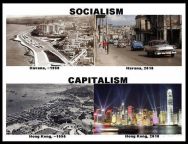
There’s a long and sordid history of people in Western nations acting as dupes and apologists for communism.
This is especially the case with the wretchedly impoverished totalitarian outpost 90 miles south of Florida.
- President Obama lauded aspects of Cuba’s totalitarian regime when he visited in 2016.
- Jeffrey Sachs ranked Cuba higher on development goals than the United States.
- Jimmy Carter (and Jeremy Corbyn, Justin Trudeau, etc) gushed about Fidel Castro when the long-time dictator died.
- Numerous vapid celebrities have helped turn the thuggish and racist Che Guevera into a pop icon.
Based on what he wrote for the opinion pages of the New York Times, Nicholas Kristof belongs on that list of “useful idiots.”
Cuba…in health care…does an impressive job that the United States could learn from. …an American infant is, by official statistics, almost 50 percent more likely to die than a Cuban infant. By my calculations, that means that…
View original post 1,513 more words
How to read authors of earlier times who expressed views or created characters that we find repugnant today
21 Jan 2019 Leave a comment
There has been a lot of debate about how—or whether—to read authors whose views (or language) may not comport with today’s mores. Morality evolves, usually for the better, leaving older books bearing attitudes or characters that we find repugnant.
The usual result is to either denigrate or ban these books, and such opprobrium has involved works like Huckleberry Finn, To Kill a Mockingbird, The Great Gatsby, Slaughterhouse-Five, and even The Color Purple. I’m not even mentioning the many books that are deemed verboten by various religions, such as The Satanic Verses. Go to the American Library Association’s Frequently Challenged Books webpage for a comprehensive list.
How do we deal with these books? Do we remove them from libraries, as Confederate statues are removed from campuses? Do we cease teaching them in classrooms—something that’s now happening with To Kill a Mockingbird? Or do we just decry them as…
View original post 875 more words
Which graphs will be the focus of activism for @oxfam @oxfamnz?
21 Jan 2019 Leave a comment
in development economics, economic history, growth miracles, health economics Tags: China, The Great Escape

Are Helicopter Parents Ruining a Generation?
21 Jan 2019 Leave a comment
in economics of education, health economics Tags: Helicopter parents


Recent Comments