Rise and Fall: Most Subscribed YouTube Stars of all Time (2005 – 2022)
07 Oct 2022 Leave a comment
in economic history, industrial organisation, survivor principle
Climate-Change ‘Solutions’ Way Worse Than the Problem
06 Oct 2022 Leave a comment

 Wonder Land: Democrats have wrecked the cities and the border. Why would climate policy be any different? Images: Zuma Press/Getty Images Composite: Mark Kelly Link to video is below
https://video-api.wsj.com/api-video/player/v3/iframe.html?guid=5D0A20A9-75C5-4506-B1B1-9EC96ABBBEE9
Jason De Sena Trennert writes at WSJ Opinion Climate-Change ‘Solutions’ That Are Worse Than the Problem. Excerpts in italics with my bolds and added images H/T John Ray (here)
The political assault on fossil fuels comes at the expense
of the poor, peace, and the environment.
If you can afford a Tesla, you probably find it hard to imagine that there are some 3.5 billion people on Earth who have no reasonably reliable access to electricity. Even less obvious may be the way rich countries’ pursuit of carbon neutrality at almost any cost limits economic opportunities for the world’s poor and poses serious geopolitical risks to the West.
Anyone on an investment committee has likely spent untold…
View original post 703 more words
Climate Change is Ordinary and Cyclical, Not Catastrophic and Irreversible
06 Oct 2022 Leave a comment
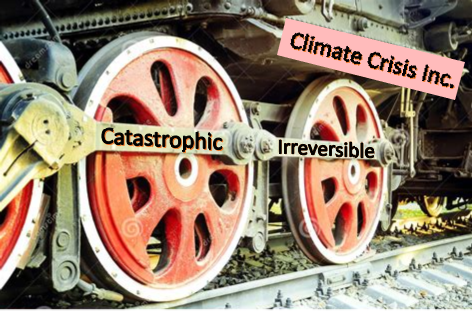 Michael Baume writes at Spectator Climate change policy: a greater risk than climate change?. Excerpts in italics with my bold. H/T John Ray
Pragmatism is belatedly beating carbon purity as the West seeks to survive the economic consequences of Russia’s monstrous Ukraine war. Only months after its Glasgow swearing of allegiance to the climate catechism that requires faith in scientifically untested computer-programmed prophesies, the West has seen the light – and the energy needed to power it.
- By grabbing at the vilified, carbon-emitting economic lifeline of fossil fuels,
- By rediscovering the energizing virtues of the spurned coal,
- By embracing the scorned fracking in a desperate search for gas,
- By re-opening the closed off-shore petroleum leases to keep industry working, and
- By preferring ‘dangerous’ nuclear power to winters of freezing in the dark,
A severe dose of reality has slowed the West’s race to economic destruction. The
View original post 912 more words
Where will the OCR be in 10 years?
06 Oct 2022 Leave a comment

I don’t want to comment extensively on yesterday’s Reserve Bank announcement. It may prove to be the right call (or not), but in the data hiatus – 2.5 months since the last CPI, two months since the latest HLFS – they are to some extent flying blind (New Zealand really needs more frequent and timely key official macro data), and it would have been better to have rescheduled the announcements (adding one) as suggested in my post the other day. And the very brief, almost passing, mention of having considered a 75 basis point increase – which would have made a lot of sense this time last year – highlights again just how non-transparent and non-accountable New Zealand’s MPC is, We don’t know whether, in the end, any of the members actually favoured a 75 basis point increase, or did the Committee just toy with the idea briefly so that…
View original post 911 more words
Football CEO dismissed for religious beliefs
06 Oct 2022 Leave a comment


The recently appointed new CEO of the Essendon Football Club in Victoria, Andrew Thorburn, has been pushed out of his job on account of views expressed by the church he belongs to and on whose board of management he sits. Those views, which even the club itself accepts were not stated personally by Mr Thorburn and which had to be found by scouring a database of sermons back to 2013, represent views on moral issues that have been shared by Christians, Muslims, Jews and many other religious believers for a long time. They are not “radical” or “hateful” or “bigoted”. It is arguable that the Club has breached Victorian anti-discrimination law.
View original post 2,029 more words
Part-time power
06 Oct 2022 Leave a comment
in energy economics, environmental economics, global warming Tags: celebrity technologies, solar power, wind power

Happy Birthday Dr. No
06 Oct 2022 Leave a comment


Today marks the 60th anniversary of the release of the first James Bond movie, Dr No. Although it was the 1st movie, it was the sixth of Fleming’s series, beginning with Casino Royale.
I am not going too much into the movie as such ,but more into some of the unknow aspects of Dr. No.
Ursula Andress’ dialogue was dubbed by voice artist Nikki Van der Zyl, who later dubbed her again in The Blue Max (1966), She (1965), and Casino Royale (1967). It was her task to re-create Andress’ voice, but give it only a mild accent. Andress’ singing voice is sometimes credited to Diana Coupland, but this was also Nikki. This confusion mainly arises because Ms. Coupland’s recording of the song was included on the original 1962 soundtrack album release for this movie. Andress and Eunice Gayson were dubbed by the same actress. Gayson’s real voice can be…
View original post 313 more words
Stephen Tierney: The Lord Advocate’s Reference: The Constitutional Significance of Referendums and Electoral Processes
05 Oct 2022 Leave a comment

 TheLord Advocate’s Referenceto the Supreme Court asks if the proposedScottish Independence Referendum Billrelates to reserved matters under the Scotland Act 1998. Core to the Lord Advocate’s case is the claim that thereferendum proposed by the draft bill would be ‘advisory’, ‘consultative’ or ‘non-binding’. If this is the case then it can be argued that the Draft Bill and the referendum it proposes to authorise would not ‘relate to’ the reserved matters of the Union and Parliament by virtue of having ‘no effect in all the circumstances’ – the test set by Scotland Act 1998 s.29(3).
In anearlier postI queried whether the referendum proposed by the Scottish Government could be said to have no ‘effect’ within the context of the United Kingdom constitution where constitutional conventions now seem to attach both to the holding of referendums and the implementation of their results. In this post…
View original post 1,176 more words
The constitutional causes and consequences of the Truss-Kwarteng budget crisis
05 Oct 2022 Leave a comment


Within weeks, Liz Truss’s premiership was plunged into economic and political turmoil due to Kwasi Kwarteng’s ‘mini budget’. But this crisis, suggestsMeg Russell, has distinctly constitutional roots. Building on Boris Johnson’s legacy, Truss chose to sideline expert officials and regulators, and shut out her own MPs. The consequences that have since befallen her are a compelling advertisement for respecting – and rebuilding – appropriate constitutional checks and balances.
The Conservative Party conference, indeed the entirety of Liz Truss’s new premiership, has been severely destabilised by the market reaction to Chancellor Kwasi Kwarteng’s ‘mini budget’. Far from securing Truss her desired reputation for acting on the energy crisis and boosting the economy, and a positive bounce in the polls, Kwarteng’s 23 September ‘fiscal event’ saw the pound plunge, lenders withdraw mortgage products, and Labour achieve record poll leads. Faced with a mass rebellion…
View original post 1,700 more words
A Case Study of Why Growth Trumps Inequality
05 Oct 2022 Leave a comment

There’s a new book by French economist Thomas Piketty, called “Capital in the Twenty-First Century,” that supposedly identifies the Achilles’ Heel of the market economy.
Piketty argues that the rate of return to capital is higher than the economy-wide growth rate and that this will lead to untenable inequality as the rich grab a larger and larger share of the pie.
The solution, he claims, is confiscatory tax rates.
I’m not impressed.
Garett Jones of George Mason University has a very good review that casts doubt on Piketty’s hypothesis, but I also think Margaret Thatcher pre-debunked (if I’m allowed to make up a word) Piketty in this classic video from the House of Commons.
Simply stated, if you care about those with lower incomes, your goal should be faster growth.
If the economy is more prosperous, that means a rising tide that will lift all boats.
Piketty’s class-warfare prescription…
View original post 602 more words
Finally?
05 Oct 2022 Leave a comment

Roy Morgan has That Woman’s power base beginning with a 2! having plunged from the figure 5 merely 23 and a half months ago?
Little comfort for Mr Luxon however as his number was lifted by a meager fraction of the margin of error! well short of the 40% he needs to be credible
The scariest bit for this person was the lift for the Melons to 12.5%, totally at odds with the deep socialist traits masked by their verdant camouflage.
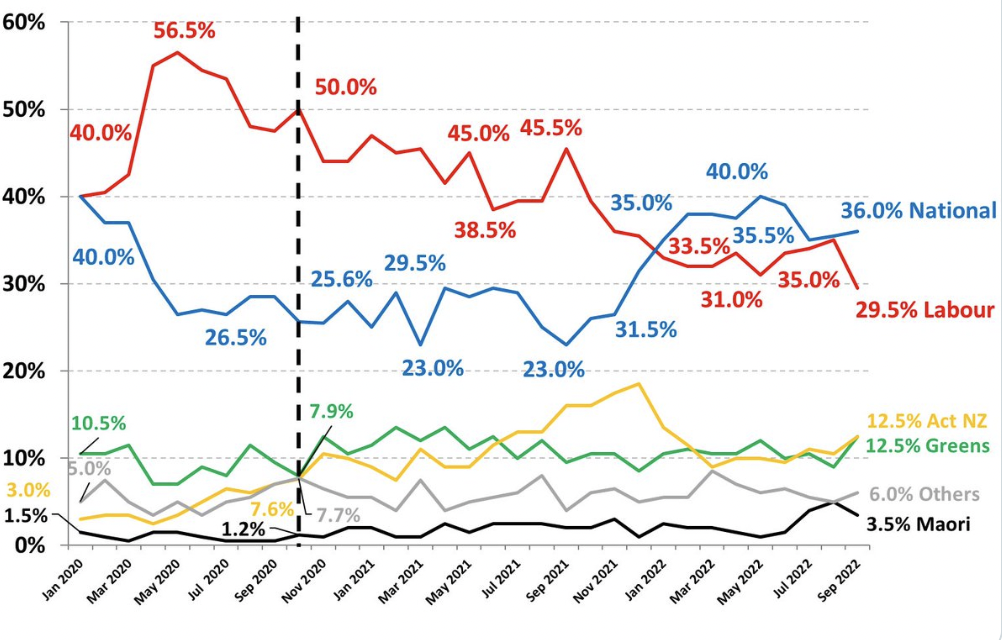
The best bits at the end with the old charlatan well within that margin of error figure, well embedded in the one% of the insane.
Was Roy Morgan once the mainstay of the left’s support? if that still holds then it really is bleak for the great saviour mob.
It is one thing “to keep their powder dry”, but “ARID” ( too dry to support vegetation?).
Greetings from Argentina – An Obamaesque Land of Crony Capitalism and a Warning to America
05 Oct 2022 Leave a comment
Welcome Instapundit readers. Thanks, Glenn.
After reading below about Argentina’s decline, several people have emailed to ask how Chile compares. Ask and ye shall receive. This post from last month shows shows Chile, Argentina, and Venezuela. Very powerful, which is why I gave the post such a grandiose title.
==============================
There’s been a lot of coverage of the recent decision by Standard & Poor to warn that the United States has a “negative” outlook.
As Joe Biden would say, BFD. I’m stunned that anyone would care, particularly since the rating agencies have zero credibility. These clowns completely missed Enron. They missed the collapse of Europe. They blew it on the financial crisis, especially with regard to the corrupt government-created mess at Fannie Mae and Freddie Mac.
The fact that one of the rating agencies belatedly warns that America is heading in the wrong direction should elicit only one response…
View original post 453 more words
Absolute Economic Liberty, Relative Economic Liberty, and the Never-Answered Question
05 Oct 2022 Leave a comment
As part of my recent presentation to IES Europe, here’s what I said (and what I’ve saidmany times before) about the relationship between economic policy and national prosperity.
My remarks focused in part on the difference between absolute economic liberty and relative economic liberty.
- The absolute level of economic liberty is the degree to which a nation relies on markets or statism (see, for instance, the Fraser Institute’s Economic Freedom of the World).
- The relative level of economic liberty is a measure of whether one country is more market-oriented than another country (basically a measure of national competitiveness).
Understanding these two concepts explains why it is possible to criticize nations in North America and Western Europe for having too much government while also recognizing that those same nations tend to have better policies than most countries in other parts of the world.
An obvious example is…
View original post 326 more words
The Amazing Hockey Stick of Economic Progress
05 Oct 2022 Leave a comment
Back in 2010, I shared a remarkable chart showing how quickly economic output doubles in a fast-growth economy, but it also showed how long it takes for GDP to expand if an economy only grows 1 percent or 2 percent per year.
My main message was that nations should follow good policy because:
…even modest differences in economic growth can have a big impact on relative prosperity with a couple of decades.
But what’s really astounding – in a bad way – is that there used to be no growth. I recently posted a remarkable video from Learn Liberty that showed how the world was mired in poverty for century after century until growth exploded around 1800.
Now Don Boudreaux has a similar must-watch video for Marginal Revolution University.
The moral of the story is that poverty is, or at least was, the natural state of humanity.
But then something…
View original post 158 more words
Once an export (and import) powerhouse
05 Oct 2022 Leave a comment
We’ve been having a bit of conversation at home – my son doing a NZ history paper at university and me reading yet another old book – about the line that pops up in almost any old book about the New Zealand economy, that New Zealand once (pre-war) had consistently the highest exports (and imports) per capita of any country.
It isn’t really a surprising statistic. All else equal, small countries tend to sell abroad a larger share of their output than large countries (there isn’t much market at home and the world, by contrast, is big). And rich and productive countries tend to do more per capita of every component of GDP. 80-100 years ago we were small and we were rich – on standard comparisons, inevitably limited as they are, among the two or three richest countries on the planet.
All else equal, we also know that countries…
View original post 611 more words


Recent Comments