Milton Friedman on the leads and lags in monetary policy
22 Aug 2022 Leave a comment
in business cycles, economic growth, fiscal policy, history of economic thought, macroeconomics, monetarism, monetary economics
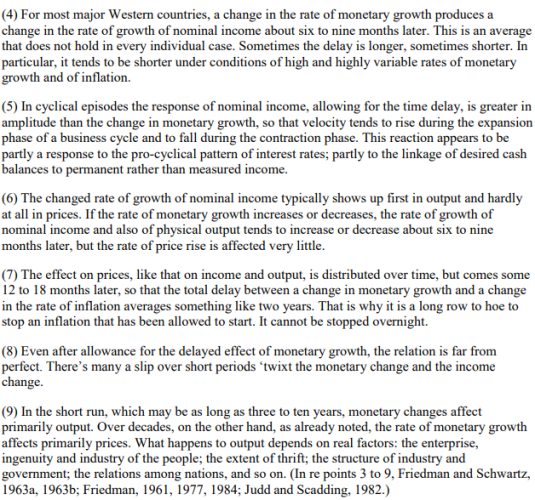
From The New Palgrave 1987
The Watergate myth: Why debunking matters
22 Aug 2022 Leave a comment

My recent post about the heroic-journalist myth of Watergate prompted a few blinkered, ahistoric observations.
Among was this comment, posted at Romenesko‘s feedback site:
“Who cares?” the comment reads. “Watergate was in the early 1970s. … Arguing the point now about what role a paper played almost 40 years later in a presidency that a significant number of people have no recollections of? Ya gotta admire those authors willing to tackle cutting-edge topics.”
So why does it matter? Why is addressing and debunking the heroic-journalist myth of Watergate — the notion that intrepid reporters for the Washington Post brought down Richard Nixon’s corrupt presidency — still important?
Several reasons present themselves, not the least of which is the vigor that characterizes the Watergate myth: It lives on in textbooks, in classrooms, in newsrooms. It’s a very robust myth, little-restrained in its reach and infiltration.
A hint of its reach…
View original post 377 more words
5 of the World’s Most Advanced guns
22 Aug 2022 Leave a comment
in defence economics, economics of crime, law and economics Tags: gun control
I Learned Norwegian in 2 Weeks Then Went on Live TV in Norway
22 Aug 2022 Leave a comment
in economics of education, economics of media and culture Tags: economics of languages, Norway
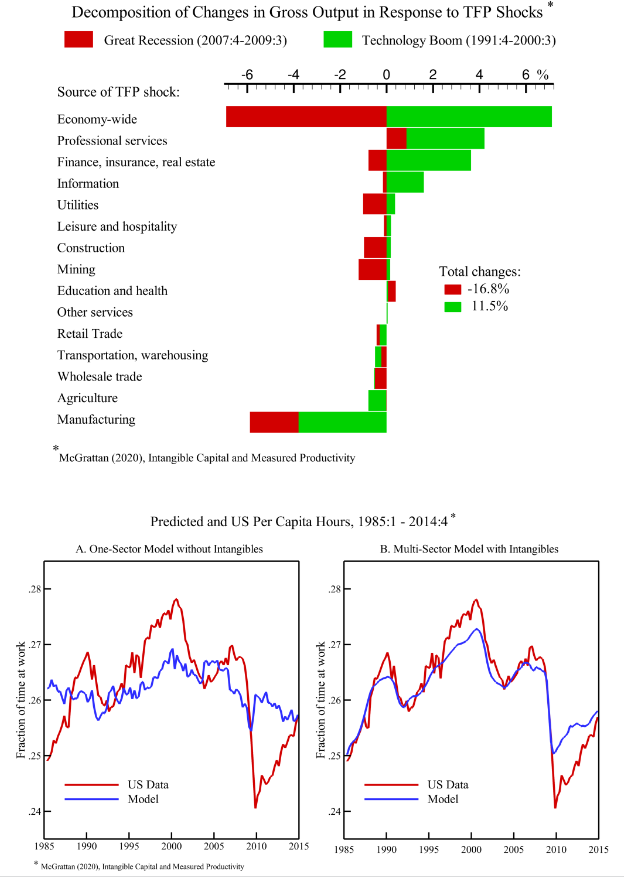
Productivity shocks, especially those affecting manufacturing firms, account for much of the decline in gross output during 2008-2009, not financial shocks
21 Aug 2022 Leave a comment
in business cycles, econometerics, economic growth, Edward Prescott, macroeconomics
After 40 Years Of Massive Subsidies Wind & Solar ‘Industries’ Still Begging For More
21 Aug 2022 Leave a comment


Back in 1983 the American Wind Industry Association claimed that solar and wind would be “competitive and self-supporting on a national level by the end of the decade if assisted by tax credits and augmented by federally sponsored R&D”. That was 39 years ago. Over that span of time, there has been no lack of assistance in the form of tax credits and federally sponsored R&D, along with a raft of punitive mandates and targets designed to cripple conventional generators and favour chaotically intermittent wind and solar.
Now, as then, bold claims from renewable energy rent seekers about wind and solar being truly competitive with nuclear, coal or gas turn to water as soon as talk turns to cutting subsidies to wind and solar.
With their 40th birthdays approaching, the wind and solar ‘industries’ are a pair of perpetual infants who – like Peter Pan – are determined to…
View original post 3,128 more words
Milton Friedman on inflation and fiscal policy
21 Aug 2022 Leave a comment
in business cycles, history of economic thought, macroeconomics, Milton Friedman, monetarism, monetary economics
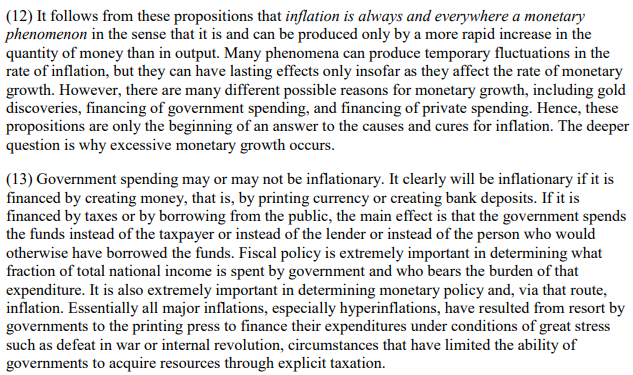
From The New Palgrave 1987
Energy Policy and Big-Government Tories
21 Aug 2022 Leave a comment

I don’t like big-government Republicans in the United States, so it naturally follows that I don’t like big-government Tories in the United Kingdom.
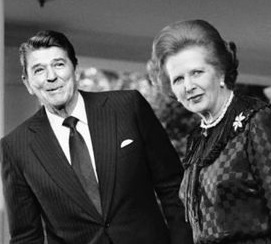 Indeed, I wrote just a few days ago about the new leadership race for the Conservative Party in the U.K. and wondered whether either of the candidates has what it takes to reverse Boris Johnson’s failedstatism.
I hope one of them is the reincarnation of Margaret Thatcher (just as I’ve been waiting decades for another Ronald Reagan).
We will find out relatively quickly. The race for Prime Minister will be decided next month and I will be very interested to see whether the winner fixes two very foolish energy policies.
The Wall Street Journal has a pair of excellent editorials this month.
On August 18, the paper opined about a bone-headed policy to cap energy bills.
Britain’s ruling Conservatives have imposed some awful energy…
View original post 462 more words
Portillo’s Hidden History of Britain – S01 E01 – Imber Village – The Wages Of War
21 Aug 2022 Leave a comment

In 1943, the village of Imber on Salisbury Plain began to be used as a Second World War training ground. The residents were ordered to leave by the War Office and, despite promises to the contrary, have never been allowed to return.
Andrew Doyle and Rowan Atkinson on Free Speech – Plus Jimmy Carr + updated to allow for Jerry Sadowitz
21 Aug 2022 Leave a comment
The comments made earlier remain relevant, but in the light of both the Jerry Sadowitz cancellation and proposed regulation of speech in the UK and elsewhere I have reposted this item once again.
Here is some additional relevant commentary re the Jerry Sadowitz issue. I have never seen Sadowitz, but what he says and does is controversial. However, nobody is compelled to see him. This incident serves to illustrate the free speech threats are multiplying.
As posted previously
I have decided to repost these previously posted item once again. My reason for doing this is the current furore over a joke made by Jimmy Carr.
Frankly, Carr’s humour does not appeal to me. Consequently I do not watch him. Therefore, nothing he says offends me.
Having watched the clip of Carr, see end of post below I have to say I did not find the item offensive. In fact the…
View original post 428 more words

The most feminist religion?
21 Aug 2022 Leave a comment
in discrimination, economics of religion, gender Tags: sex discrimination

Jordan B Peterson on Femsplainers
21 Aug 2022 Leave a comment
in applied price theory, discrimination, economic history, economics of education, economics of love and marriage, gender, health and safety, human capital, labour economics, law and economics, occupational choice, poverty and inequality Tags: evolutionary biology, evolutionary psychology, gender wage gap


Recent Comments