Countries With Highest Life Expectancy 1800-2100
14 Oct 2020 Leave a comment
in economic history, population economics Tags: life expectancies, The Great Escape
TEDxEast – Tyler Cowen – The Great Stagnation
14 Oct 2020 Leave a comment
in applied price theory, development economics, economic growth, economic history, economics of education, economics of regulation, energy economics, environmental economics, financial economics, growth miracles, human capital, income redistribution, industrial organisation, international economics, labour economics, labour supply, macroeconomics, poverty and inequality, Public Choice, rentseeking, transport economics Tags: creative destruction, The Great Enrichment
Pessimism bias and crime
13 Oct 2020 Leave a comment
in economics of crime, law and economics, politics - USA Tags: law and order, pessimism bias

The Rules of Logic Part 4: The Laws of Noncontradiction and Transitive Properties
13 Oct 2020 Leave a comment

The two most fundamental rules of logic are the Law of Noncontradiction and the Law of Transitive Properties. In fact, all of the other rules of logic stem from these two laws. Both laws are very simple and easy to understand, yet people frequently ignore or misuse them. Therefore I will attempt to explain how they actually work.
Law of Noncontradiction
This law simply states that something cannot be A and not A simultaneously. In other words, two mutually exclusive things cannot exist at the same time. So, for example, the Law of Noncontradiction tells us that it is impossible for both an immovable object and an unstoppable force to exist simultaneously, because each one cancels the other out. In other words, if there is an object that is truly immovable, then there cannot be an unstoppable force because this would contradict the properties of the immovable object. Conversely, if…
View original post 922 more words
“Segregated” events at the University of Chicago?
13 Oct 2020 Leave a comment

I’m a bit flummoxed by the following announcements of University-sponsored Zoom meetings emailed to us by our local Diversity and Inclusion Office.
Group Wellness Coaching for Students of ColorMonday, October 12: 6 – 8 p.m.
Zoom
Join the Office of Multicultural Student Affairs (OMSA) and UChicago Student Wellness for this opportunity to work through shared wellness concerns and experiences in an open and supportive environment. Students will design wellness action plans and set goals for enhancing well-being. The session will be led by health educator Cassidy Wade. It is open to students of color in the College, graduate divisions, and professional schools.Virtual Community for Black Women: Group Wellness Coaching
Thursday, October 15: 6 – 8 p.m.
Zoom
Join OMSA and UChicago Student Wellness for an opportunity to work through shared wellness concerns and experiences in an open and supportive environment. Students will design wellness action plans and set goals for…
View original post 510 more words
Fallout at the New York times over Bret Stephens’s criticism of the 1619 Project
13 Oct 2020 Leave a comment
The other day Bret Stephens wrote an op-ed at the New York Times in which he bucked one of the paper’s proudest achievements: the 1619 Project, designed to be at once journalism, history, and a curriculum for secondary schools. Stephens was unsparing in his criticism, saying that the Project has “failed” and has given critics of the newspaper a “gift”. I applauded him for his bravery, and predicted his demise at the paper.
Thinking about it, though, I realize that the paper would be extremely foolish to let Stephens go, for that would cause a huge public outcry. He’s an established conservative columnist, and if he got released for doing what he should have done—criticizing a project that, although run by his employer, had become a public issue—the paper would be accused even more than it is already for being biased and one-sided. I expect Stephen will stay.
Now I…
View original post 1,199 more words
Leaders Can Feel Licensed To Behave Badly When They Have Morally Upstanding Followers
13 Oct 2020 Leave a comment
Why They Trash Talk Sweden
13 Oct 2020 Leave a comment


Dan Hannan explains in his Washington Examiner article The better Sweden does on the coronavirus, the angrier they get. Excerpts in italics with my bolds.
My columns on Sweden’s laissez-faire approach to the coronavirus always provoke an angry response. But it is striking that, the better Sweden does, the angrier its critics become.
Like anti-Trumpers who couldn’t hide their annoyance at the success of the U.S. economy, or British Remainers who longed for a recession so as to be able to say “I told you so” about Brexit, lockdown enthusiasts determinedly screen out the good news.
They trot out three main arguments. First, they say, “You can’t compare us to Sweden. It has a low population density.” Second, they argue that “Sweden hasn’t succeeded; it has had more deaths per capita than neighboring countries.” Third, the claim that “Sweden has taken an economic hit as well — the…
View original post 664 more words
Catholic Forfeitures during the English Revolution: Parliament and the Role of Sequestration Agents
13 Oct 2020 Leave a comment

Ahead of Tuesday’sVirtual IHRParliaments, Politics and People seminar, we hear from Dr Eilish Gregory at the University of Reading. She will be responding to your questions about her research on Catholic Forfeitures during the English Revolution on Zoom between 5:15 p.m. and 6:30 p.m. on 20 October 2020. Details on how to join the discussion are available here or by contacting seminar@histparl.ac.uk.
This blog is based on Eilish’s full-length seminar paper, ‘Catholic Forfeitures during the English Revolution: Parliament and the Role of Sequestration Agents’, which is available here.
In November 1656, the Catholic delinquent William Blundell wrote to his nephew Thomas Selby, mentioning his recent dealings with the agent and lawyer Gilbert Crouch who was managing his sequestration affairs in London. Blundell’s estates in Little Crosby, Lancashire, were sequestered during the English Revolution because Blundell had fought for King Charles I against Parliament.

View original post 1,143 more words
Covid: The Big Picture in 7 Charts
13 Oct 2020 Leave a comment
Thanks to Swiss Policy Research for providing perspective on the coronavirus contagion in a few charts. Their article is Covid: The Big Picture in 7 Charts, updated to October 10, 2020. Excerpts in italics with my bolds.
1) Global covid “cases” and deaths vs. all-cause deaths
Chart number one shows global covid deaths by September in blue (about 1 million) versus global all-cause deaths in purple (about 40 million). The chart also shows the cumulative number of global covid “cases” (i.e. positive PCR tests) – the so-called “casedemic” on top of the pandemic.
In contrast, the UN expects that the political reaction to the pandemic may put the livelihood of up to 1.6 billion people at immediate risk and may, by the end of 2020, push an additional 130 million people “to the brink of starvation” and an additional 150 million children into poverty.
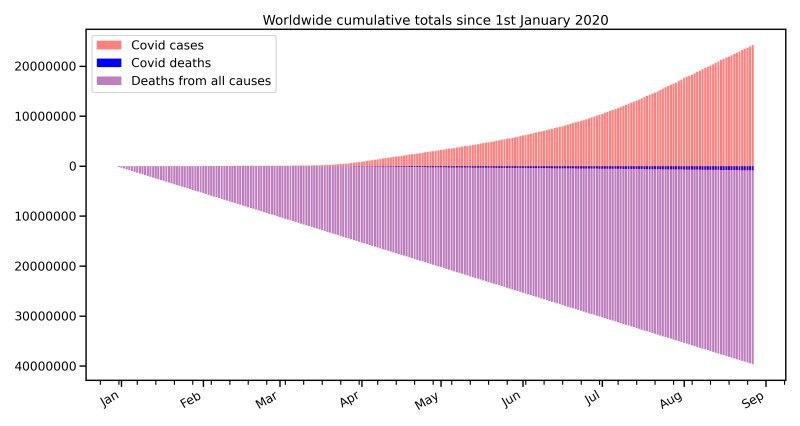 Global covid deaths and…
View original post 785 more words
Noam Chomsky on the Harper’s Letter and Cancel Culture
13 Oct 2020 Leave a comment
in discrimination, economics of education, liberalism, libertarianism, Marxist economics, politics - Australia, politics - New Zealand, politics - USA Tags: baby bust, free speech, political correctness, regressive left
John Gibson Gibson lockdown costs Plan B weekly webinar – 12/10/2020
13 Oct 2020 Leave a comment
in applied welfare economics, econometerics, economics of bureaucracy, health economics, law and economics, politics - New Zealand, Public Choice Tags: economics of pandemics
Operations Research and the Rise of Applied Game Theory – A Nobel for Milgrom and Wilson
13 Oct 2020 Leave a comment

Today’s Nobel Prize to Paul Milgrom and Robert Wilson is the capstone of an incredibly fruitful research line which began in the 1970s in a few small departments of Operations Research. Game theory, or the mathematical study of strategic interaction, dates back to work by Zermelo, Borel and von Neumann in the early 20th century. The famed book by von Neumann and Morganstern was published in 1944, and widely reviewed as one of the most important social scientific works of the century. And yet, it would be three decades before applications of game theory revolutionized antitrust, organizational policy, political theory, trade, finance, and more. Alongside the “credibility revolution” of causal econometrics, and to a lesser extent behavioral economics, applied game theory has been the most important development in economics in the past half century. The prize to Milgrom and Wilson is likely the final one that will go for early…
View original post 3,927 more words
Another reason to abolish Medsafe. Months lost duplicting far better resourced overseas drug safety agencies #COVID19
13 Oct 2020 Leave a comment
in applied welfare economics, economics of bureaucracy, economics of regulation, health economics, politics - New Zealand, Public Choice Tags: drug lags, economics of pandemics

Behind on my vaccination blogging
13 Oct 2020 Leave a comment
in health economics Tags: antivaccination movement, public goods, vaccines



Recent Comments