
A population bust in Korea
28 Dec 2019 Leave a comment
in labour economics, labour supply, population economics, Public Choice, public economics Tags: ageing society
I like maps
28 Dec 2019 Leave a comment
in economic history, International law Tags: economics of borders, maps


Another gender gap
28 Dec 2019 Leave a comment
in economics of crime, gender, law and economics Tags: gender gap, law and order


How Climate Talk Got Crazy
28 Dec 2019 Leave a comment


Dr. Arnd Bernaerts in a recent article provides the historical context necessary to get our bearings straight despite today’s overheated, bizarre media-drenched tirades.
As he explains, climate has always been particular and personal, not global or objective. And that has led us into our current impasse, unable to talk productively about weather and climate. It is as though we can not come to grips with the climate issue because our very language and terminology is itself a prior problem preventing any progress. In brief, the terms “weather” and “climate” are loaded with emotion, but not with clear, definitive scientific meaning. IOW plenty of connotation (heat) and very little denotation (light). Dr. Bernaerts faults scientists for failing to develop a rational framework for discovery and research, and instead opting for an actiivist agenda which benefits from the ambiguity and misrepresentation.
The article is Weather and climate are everyday slang words and…
View original post 793 more words
#OTD #globalwarming #climateemergency @Greenpeace @Greens
28 Dec 2019 Leave a comment
in cricket, economic history, energy economics, environmental economics, global warming, politics - Australia Tags: climate alarmists


Did Nordhaus ignore climate scientists?
27 Dec 2019 Leave a comment
in Alfred Marshall, applied welfare economics, econometerics, economics of education, energy economics, environmental economics, global warming Tags: climate alarmism

Could Priests Claim Sanctuary in Medieval England?
27 Dec 2019 Leave a comment

Posted by Sara M. Butler, 16 May 2019.
 A more familiar gang of medieval outlaws: Robin Hood, Will Scarlet, and Little John.
The Folvilles of Ashby-Folville (Leics.) played a key role in persuading me to devote my life to researching crime in medieval England. As an undergraduate, reading Edward Stones’ 1957 study of the infamous crime family opened my eyes to the medieval common law’s broad potential for manipulation and creative application of the laws.[1] For those of you unfamiliar with the family, their story comes across as a medieval rendering of Mario Puzo’s The Godfather, with a little bit of Butch Cassidy and the Sundance Kid thrown in for good measure. John de Folville, lord of Ashby-Folville, fathered seven sons. Only one of the seven, John the younger, led the typical life of the medieval gentry, obtaining appointments as commissioner of array and keeper of…
View original post 2,567 more words
Sky News Arabia blames Israel for Jewish exodus from Arab lands
27 Dec 2019 Leave a comment

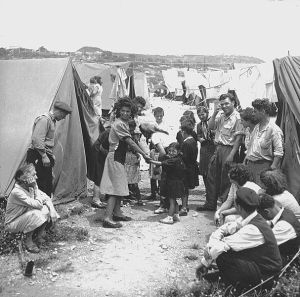 This is the fourth in a series of posts by CAMERA Arabic (part 1, part 2, part 3) showing how Arabic language news networks, including those affiliated with Western media outlets, frame the topic of Jews who originate from or live in the Middle East and North Africa, by attempting to distinguish between ‘loyal’ Jews and ‘treacherous’ Zionists. (All translations, emphasis and in-bracket remarks are by CAMERA Arabic unless otherwise specified. Almost all links lead to English websites, unless no reliable translation was found.)
In previous posts we sought to reveal how some Arabic-speaking journalists and commentators frame the existence (or more commonly, lack thereof) of Jewish communities in Arab states. Through an analysis of three news items, originating in Egypt and Tunisia, we demonstrated that they approached this volatile topic in the following ways:
- Labeling Jews from Arab states, in the pejorative, as “Zionists” or…
View original post 2,208 more words

The vanity and vulgar pride of intellectuals
27 Dec 2019 Leave a comment

Hoover Institution Senior Fellow Dr. Thomas Sowell published a book entitled Intellectuals and Society. In his book, Sowell examines a group of people who influence public policy, debates and other institutions. The talk Dr. Sowell gives in this video goes into elements of his book. It includes discussion of some of the personalities profiled in it along with a look at President Barack Obama.
Dr. Sowell also discusses environmentalists too as they are very much intellectuals in that they think they are the enlightened ones who know what is best for everyone else. The only difference is that environmentalists can back their words up with activism in order to make you do their bidding. Not only is the road to hell, as Dr. Sowell quips, paved with Ivy League degrees but hell on Earth is achieved by people thinking they know what is best for others.
Thomas Sowell Interview: “The Vision of the Anointed”
27 Dec 2019 Leave a comment
Think Tank host Ben Wattenberg converses one-on-one with author Thomas Sowell about his (then) new book, The Vision of the Anointed, which argues that the assumptions and beliefs of America’s liberal elite have created thirty years of disaster. This book can be seen as a precursor to Intellectuals and Society.
In his book, Sowell states: “Whether the issue has been overpopulation, Keynesian economics, criminal justice or natural resource exhaustion, a key assumption is that the public is so irrational that the superior wisdom of the anointed must be imposed to avert disaster. The anointed do not simply happen to have a disdain for the public. Such disdain is an integral part of their vision, for the central feature of that vision is preemption of the decisions of others.”


Recent Comments