A Guaranteed Minimum Income for New Zealand? The Treasury costings

The Treasury modelled a Guaranteed Minimum income (GMI) at the request of the Welfare Working Group in 2010. A GMI paying $300 per week – the mean benefit income among those on benefits – would cost $44.5 billion (model 1) or $52.6 billion if we extended it to super annuitants as a replacement for NZ Superannuation or old age pension (model 2). The former could be covered by a flat personal income tax rate of 45.4%; the latter, 48.6%.
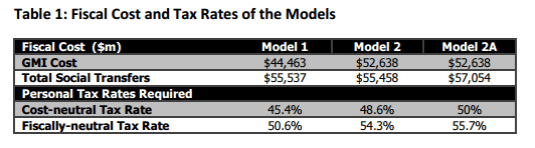
Full fiscal neutrality would require tax rates of 50.6% and 54.4% – the lower tax rates would be just enough to cover the transfers, but income tax revenues are currently also used to fund more than just transfers.

If we recognize that most parents are beneficiaries via Working for Families and compensate them for their loss with a $86 per child per week payment (model 3), we get a $57.1 billion fiscal cost and a personal tax rate of 50% (or 55.7% for fiscal neutrality).

Treasury noted that many beneficiaries (including the disabled, carers and sole parents) currently receive more than $300 per week and would be made financially worse off under a GMI scheme.

Treasury also warned about potential adverse labour supply responses to the necessary higher personal income tax rates. The large gap between company and personal tax rates would increase IRD’s enforcement costs.

In 1987, Finance Minister Roger Douglas announced a Guaranteed Minimum Family Income Scheme to accompany a new 22% flat income tax. The idea did not go ahead.

Richard Nixon also proposed a guaranteed minimum family income plan in 1969 to replace the Aid to Families with Dependent Children (AIDC) scheme at the behest of future Senator Daniel Patrick Moynihan. This was based on the negative income tax proposals of Milton Friedman and George Stigler. Nixon’s plan passed the House but not the Senate after 3 years of infighting.

The final outcome was the earned income tax credit (EITC) in 1975 that was expanded significantly in the 1990s to become the largest single federal income transfer programme. One attraction of the EITC is that because its benefits rise positively with earnings up to the phase-out point, so it can have a positive rather than negative effect on work incentives for workers on a low wage.
Low incomes don’t matter much to cell phone and smart phone access for teens

Image

Gordon Tullock on a key dynamic in the Arab spring

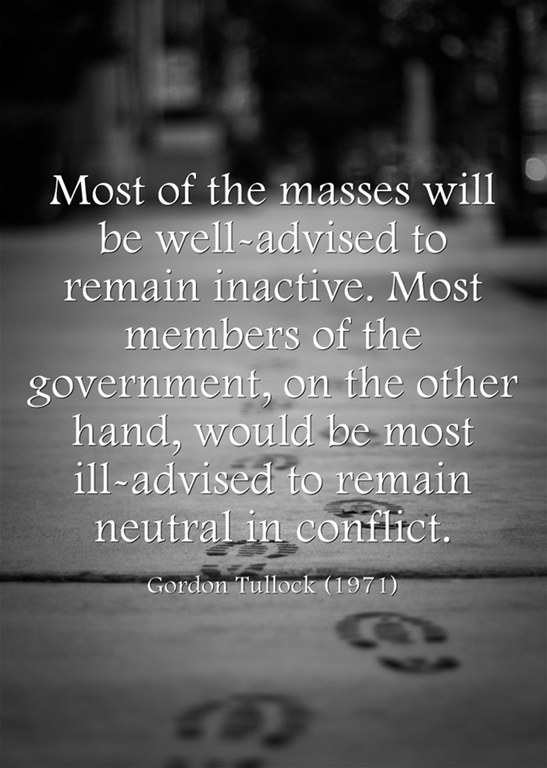
Gordon Tullock on remaining mutual

Image

Who has the smallest Anglo-Saxon welfare state of them all?

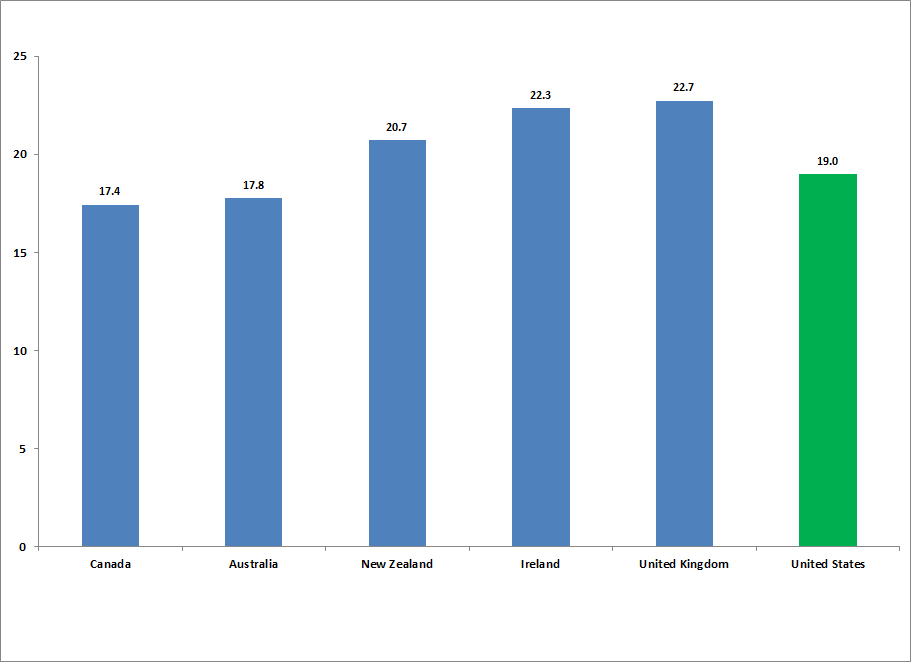
I have reanalysed data published by the Peterson Institute on the true levels of social expenditure across the industrialised countries for the Anglo-Saxon countries.

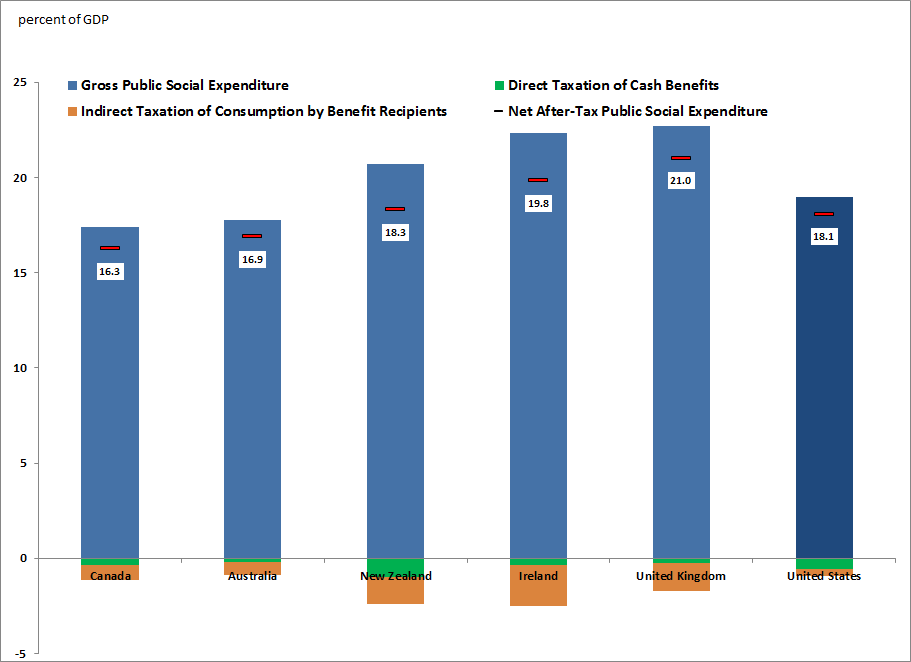
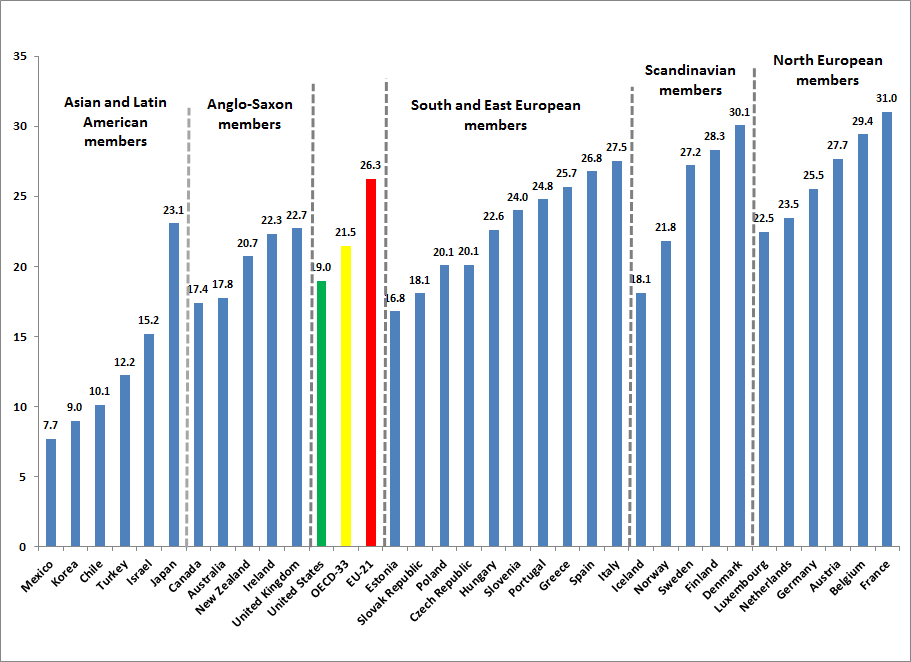
Figure 1: gross public social expenditures in OECD countries, 2011

image

Source: POLICY BRIEF 15-4: The True Levels of Government and Social Expenditures in Advanced Economies.

When you just look at gross public social expenditure, New Zealand is in the middle of the pack with the United Kingdom having the largest spending. There are not particularly large differences across social spending in the Anglo-Saxon welfare states.

Figure 2:  Gross public social expenditure and the effects of taxation in OECD countries, 2011

image

Source: POLICY BRIEF 15-4: The True Levels of Government and Social Expenditures in Advanced Economies.

There is not much change when you include the effects of taxation on consumption by benefit recipients.

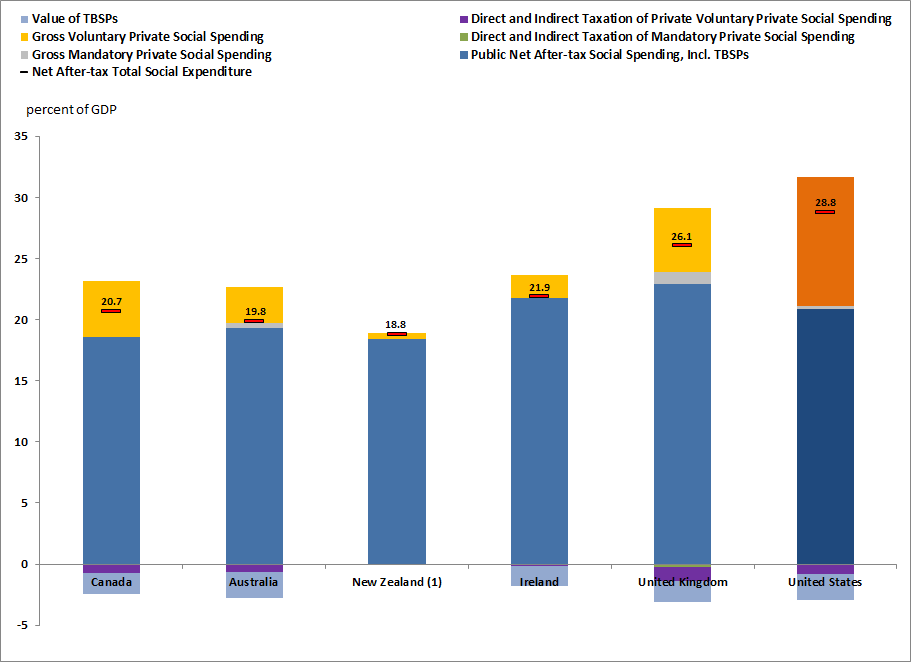
Figure 3: Net after-tax public and private social expenditure in OECD countries, 2011

image

Source: POLICY BRIEF 15-4: The True Levels of Government and Social Expenditures in Advanced Economies.

When private mandatory social spending is included, such as employer sponsored health cover, there is considerable change with United States leaping to the front and New Zealand dropping to the bottom. The USA has the largest and most expensive is health sector in the world so they are leaping of the front, either because healthcare is expensive in United States or people in the United States are not constrained by government rationing to spend less than they would prefer on their own healthcare. Let’s leave that war of ideas for another day.

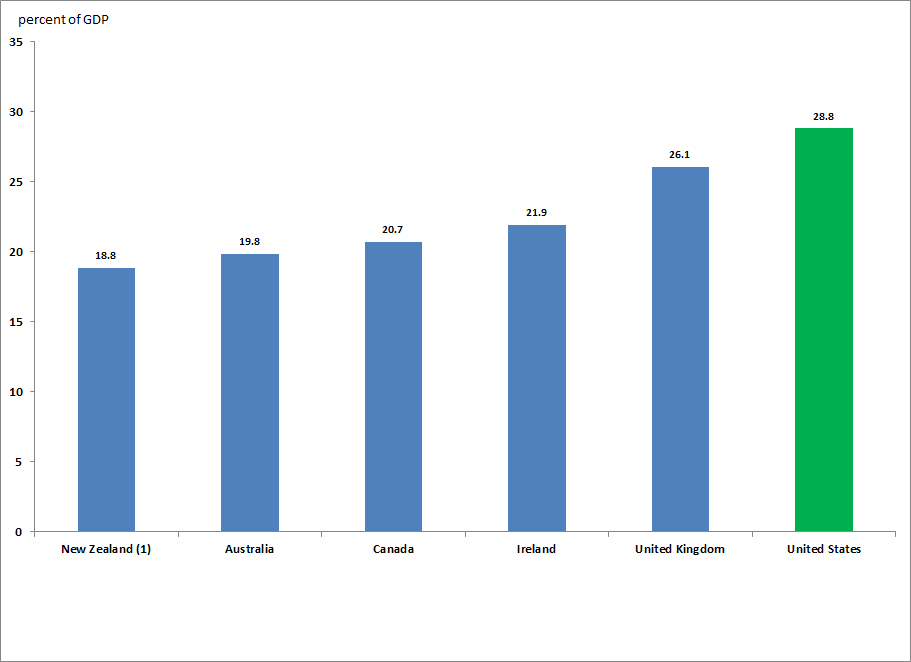
Figure 4: Net after-tax total social expenditures in OECD countries, 2011

image

Source: POLICY BRIEF 15-4: The True Levels of Government and Social Expenditures in Advanced Economies.

On the face of it, New Zealand has the smallest Anglo-Saxon welfare state while the United States has the largest. A more accurate measure of the relative sizes of these Anglo-Saxon welfare states would require the wisdom of Solomon in measuring waste and underfunding in the respective systems and more trust than you should have in services sector in purchasing power parity adjustments.

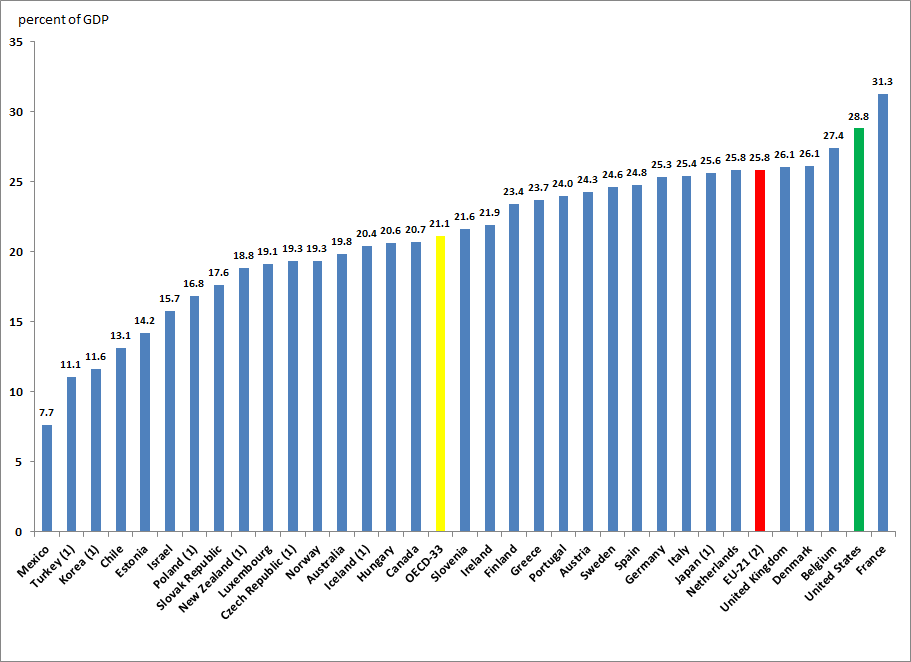
For those that are interested, the OECD-wide gross social spending and net after-tax total social spending are reproduced below in figures 5 and 6.

Figure 5: Net after-tax total social expenditures in OECD countries, 2011

image

Source: POLICY BRIEF 15-4: The True Levels of Government and Social Expenditures in Advanced Economies.

The Figure 5 data on the OECD wide welfare state sizes shows that when you add private spending, including social spending mandated by law, the US has the second largest OECD social safety net as Kirkegaard said in his  Peterson Institute paper:

Taking the full effects of tax systems and social spending from both private and public sources into account, the United States is seen to be devoting more resources toward social purposes than is generally acknowledged. In fact, only the French spend more than Americans, while the alleged welfare-addicted Scandinavians and Europeans spend less on average.

Figure 6: Gross public social expenditures in OECD countries, 2011

image

Source: POLICY BRIEF 15-4: The True Levels of Government and Social Expenditures in Advanced Economies.

Via The US welfare state and safety net are bigger than you think. But who are they helping? – AEI | Pethokoukis Blog » AEIdeas and POLICY BRIEF 15-4: The True Levels of Government and Social Expenditures in Advanced Economies

Gordon Tullock explains his theory of popular revolutions and palace coups

[I]n most revolutions, the people who overthrow the existing government were high officials in that government before the revolution.

If they were deeply depressed by the nature of the previous government’s policies, it seems unlikely that they could have given enough cooperation in those policies to have risen to high rank. People who hold high, but not supreme, rank in a despotism are less likely to be unhappy with the policy of that despotism than are people who are outside the government.

Thus, if we believed in the public good motivation of revolutions, we would anticipate that these high officials would be less likely than outsiders to attempt to overthrow the government.

From the private benefit theory of revolutions, however, the contrary deduction would be drawn. The largest profits from revolution are apt to come to those people who are (a) most likely to end up at the head of the government, and (b) most likely to be successful in overthrow of the existing government. They have the highest present discounted gain from the revolution and lowest present discounted cost.

Thus, from the private goods theory of revolution, we would anticipate senior officials who have a particularly good chance of success in overthrowing the government and a fair certainty of being at high rank in the new government, if they are successful, to be the most common type of revolutionaries.

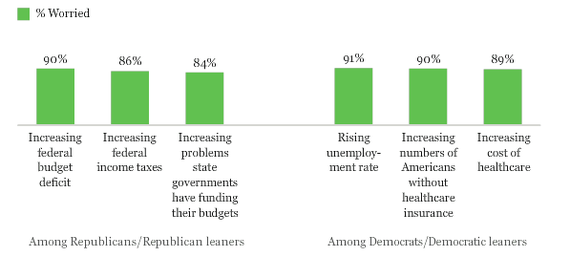
Partisan Politics and the Inequality Gap — Atlantic Mobile

image

HT: Partisan Politics and the Inequality Gap — The Atlantic.

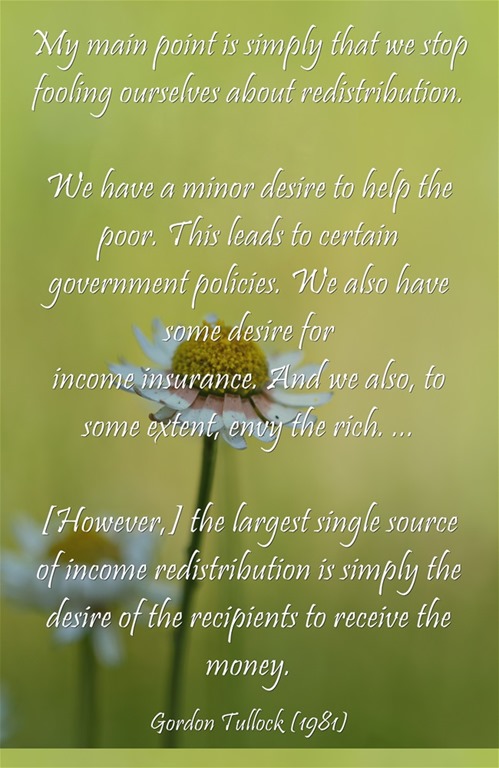
The rhetoric and reality of income redistribution

Gordon Tullock income redistribution motives My-main-point-is-simply

Image

NZ is in the middle of the pack in reducing poverty rates through redistribution

The figure shows pre-transfer and post-transfer poverty rates among OECD countries (mostly the advanced economies).  The former (pre-transfer) are the market-driven poverty rates, before the tax and transfer systems kick in.

Source: OECD, *Poverty thresholds: 50% of median income.

HT: International Poverty Comparisons: What Do They Tell Us about Causes? | Jared Bernstein | On the Economy.

Bias in the bias against inheriting riches

China’s richest lawmakers make America’s look straight up poor

The development economics of Confucius

In a country well governed, poverty is something to be ashamed of. In a country badly governed, wealth is something to be ashamed of.  - Confucius

Image

Americans are making a big mistake about health care funding – Vox

Almost everyone who has health insurance in the United States gets help from the government to afford it.

For the elderly, that’s Medicare. For the disabled and the poor, that’s Medicaid. For full-time workers it’s the tax subsidy for employer-provided health insurance.

via Americans are making a big mistake about health care – Vox.

Democrats are under more pressure from interest groups to pass policy

democrat interest groups

Image

Why does the Left in New Zealand support old age pensions for millionaires?

Pensioners

Michael Littlewood from the Retirement Policy and Research Centre has a commentary on redesigning NZ Superannuation. He says (and I agree) that we should not just look at one issue in isolation or just the cost.

He highlights eight key design features that should be agreed on. They are:

  • Universal or means-tested (I favour means-tested if the administrative costs of doing so are not prohibitive)
  • Age of entitlement (I favour increasing it and tying it to life expectancy)
  • Residency test – how long should someone live here to quality. The current threshold is ten years and I think it should be higher. It used to be 25 years.
  • The level. Currently is 43% of the net average wage for a single person. Set at 66% of  the after-tax national average wage for a couple.
  • How to revalue? Is indexed to both CPI and the average wage.
  • How to pay for it? Pay as you go and partially pre-funded. Should it be both? What should the mix be?
  • Payments to single people? Why does a married couple get less than two singles living together?
  • Overseas pensions? The rules for deducting overseas pensions are inconsistent

via Redesigning NZ Super | Kiwiblog.

I was walking back to the office with a mate who I will call the ecological socialist after a meeting with the government department responsible for income support to old age people in New Zealand.

We were both shaky our heads in utter disbelief. We couldn’t understand their idea of defending an old age pension that is free of any means test been paid to millionaires on the grounds of egalitarianism.

foodstampsphone.jpg

By coincidence, we are both Australians where the old age pension is means tested. We couldn’t understand in any way, shape or form the notion of paying old age pensions to rich people when that money could be used to increase the old age pension for those who we lived in ordinary circumstances all their lives and couldn’t save for their retirement.

The Great Enrichment since 1979 in the USA

Over the past one-, two-, and three-decade periods, both middle class and poor households have experienced noticeable gains in living standards. Their gains are slower than those experienced by middle-income families in the earlier post-war era, but the gains are well above zero.

In 1980, in-kind benefits and employer and government spending on health insurance accounted for just 6% of the after-tax incomes of households in the middle one-fifth of the distribution. By 2010 these in-kind income sources represented 17% of middle class households’ after-tax income

…The broadest and most accurate measures of household income are published by the CBO. CBO’s newest estimates confirm the long-term trend toward greater inequality, driven mainly by turbo-charged gains in market income at the very top of the distribution. The market incomes of the top 1% are extraordinarily cyclical, however. They soar in economic expansions and plunge in recessions. Income changes since 2007 fit this pattern.

What many observers miss, however, is the success of the nation’s tax and transfer systems in protecting low- and middle-income Americans against the full effects of a depressed economy.

via Gary Burtless

Previous Older Entries Next Newer Entries

Bassett, Brash & Hide

Celebrating humanity's flourishing through the spread of capitalism and the rule of law

Truth on the Market

Scholarly commentary on law, economics, and more

The Undercover Historian

Beatrice Cherrier's blog

Matua Kahurangi

Celebrating humanity's flourishing through the spread of capitalism and the rule of law

Temple of Sociology

Celebrating humanity's flourishing through the spread of capitalism and the rule of law

Velvet Glove, Iron Fist

Celebrating humanity's flourishing through the spread of capitalism and the rule of law

Why Evolution Is True

Why Evolution is True is a blog written by Jerry Coyne, centered on evolution and biology but also dealing with diverse topics like politics, culture, and cats.

Down to Earth Kiwi

Celebrating humanity's flourishing through the spread of capitalism and the rule of law

NoTricksZone

Celebrating humanity's flourishing through the spread of capitalism and the rule of law

Homepaddock

A rural perspective with a blue tint by Ele Ludemann

Kiwiblog

DPF's Kiwiblog - Fomenting Happy Mischief since 2003

The Dangerous Economist

Celebrating humanity's flourishing through the spread of capitalism and the rule of law

Watts Up With That?

The world's most viewed site on global warming and climate change

The Logical Place

Tim Harding's writings on rationality, informal logic and skepticism

Doc's Books

A window into Doc Freiberger's library

The Risk-Monger

Let's examine hard decisions!

Uneasy Money

Commentary on monetary policy in the spirit of R. G. Hawtrey

Barrie Saunders

Thoughts on public policy and the media

Liberty Scott

Celebrating humanity's flourishing through the spread of capitalism and the rule of law

Point of Order

Politics and the economy

James Bowden's Blog

A blog (primarily) on Canadian and Commonwealth political history and institutions

Science Matters

Reading between the lines, and underneath the hype.

Peter Winsley

Economics, and such stuff as dreams are made on

A Venerable Puzzle

"The British constitution has always been puzzling, and always will be." --Queen Elizabeth II

The Antiplanner

Celebrating humanity's flourishing through the spread of capitalism and the rule of law

Bet On It

Celebrating humanity's flourishing through the spread of capitalism and the rule of law

History of Sorts

WORLD WAR II, MUSIC, HISTORY, HOLOCAUST

Roger Pielke Jr.

Undisciplined scholar, recovering academic

Offsetting Behaviour

Celebrating humanity's flourishing through the spread of capitalism and the rule of law

JONATHAN TURLEY

Res ipsa loquitur - The thing itself speaks

Conversable Economist

In Hume’s spirit, I will attempt to serve as an ambassador from my world of economics, and help in “finding topics of conversation fit for the entertainment of rational creatures.”

The Victorian Commons

Researching the House of Commons, 1832-1868

The History of Parliament

Articles and research from the History of Parliament Trust

Books & Boots

Reflections on books and art

Legal History Miscellany

Posts on the History of Law, Crime, and Justice

Sex, Drugs and Economics

Celebrating humanity's flourishing through the spread of capitalism and the rule of law

European Royal History

Exploring the Monarchs of Europe

Tallbloke's Talkshop

Cutting edge science you can dice with

Marginal REVOLUTION

Small Steps Toward A Much Better World

NOT A LOT OF PEOPLE KNOW THAT

“We do not believe any group of men adequate enough or wise enough to operate without scrutiny or without criticism. We know that the only way to avoid error is to detect it, that the only way to detect it is to be free to inquire. We know that in secrecy error undetected will flourish and subvert”. - J Robert Oppenheimer.

STOP THESE THINGS

The truth about the great wind power fraud - we're not here to debate the wind industry, we're here to destroy it.

Lindsay Mitchell

Celebrating humanity's flourishing through the spread of capitalism and the rule of law

Alt-M

Celebrating humanity's flourishing through the spread of capitalism and the rule of law

croaking cassandra

Economics, public policy, monetary policy, financial regulation, with a New Zealand perspective

The Grumpy Economist

Celebrating humanity's flourishing through the spread of capitalism and the rule of law

International Liberty

Restraining Government in America and Around the World