What does the media and Left give top athletes a pass on their membership of the top 0.1%?
28 Jan 2015 Leave a comment
in human capital, income redistribution, labour economics, labour supply Tags: Left-wing hypocrisy, Leftover Left, media bias, superstars, top 1%
Richest queue in India (world perhaps) and cronyism at its best..
28 Jan 2015 Leave a comment
in growth disasters, growth miracles, politics - USA, Public Choice, rentseeking Tags: cronyism, India, President Obama, rent seeking


This picture is quite an interesting one. It shows India’s richest businessmen queuing to wait to meet US President Barack Obama patiently. It is ironical in many ways to see the rich and mighty queue like school children waiting for their score card or something. In many ways it is a score card of future where the chosen guys would either get to invest in US or be a partner of US money into India.
It clearly shows the power of politics. Those who keep talking of free markets and so on should see how politics dominates the game. At the end of the day, you have to get closer to the politique to see your empire grow.
But this is also an example of cronyism where business and politics get real close. Deals are signed amidst favorites and it is dubbed as competition. Most of cronyism happens behind the scenes and this is all…
View original post 55 more words
Whatever Happened To The Anti-War Movement? : NPR
28 Jan 2015 Leave a comment
in liberalism, Public Choice Tags: anti-war movements

the anti-war movement in America evaporated because Democrats — inspired to protest by their anti-Republican feelings — stopped protesting once the Democratic Party achieved success in Congress in 2006 and then in the White House in 2008.
“As president, Obama has maintained the occupation of Iraq and escalated the war in Afghanistan,” Heaney, an assistant professor of organizational studies and political science, said in a news release. “The anti-war movement should have been furious at Obama’s ‘betrayal’ and reinvigorated its protest activity.”
Instead, Heaney continued, “attendance at anti-war rallies declined precipitously and financial resources available to the movement have dissipated. The election of Obama appeared to be a demobilizing force on the anti-war movement, even in the face of his pro-war decisions.”
After 2008, the proportion of protesters who identified themselves as Democrats dropped from about 50% to roughly 20%. The rest identified with no party or, less often, a third party. The proportion of third-party activists grew over time.
Is surge pricing by Uber another name for overtime and weekend pay
28 Jan 2015 Leave a comment
in applied price theory, economics of media and culture, economics of regulation, Public Choice, rentseeking, transport economics Tags: barriers to entry, compensating differentials, peakload pricing, taxi regulation, Uber

Uber is in strife of late for charging more at peak times - Uber calls it surge pricing. We don’t object paying more for a meal at a restaurant at dinner time rather than at lunchtime but the same people object to paying more for the taxi late at night where the driver must risk the dangers of solitary night-time work and picking up strangers who might have had a few too many.

Under Uber’s now-national policy, price surging is capped during disasters and states of emergency at the fourth-highest nonemergency surge seen in the previous two months.

We all expect to pay more for air tickets at peak times, such as school holidays and Christmas. Indeed, one reason we are able to delay booking is we know seats will be available because they are selling at a premium for those who booked late. Others who make their plans early quite enjoy getting the cheaper for early bird bookings.

Is surge pricing another name for over time and night and weekend pay? Union contracts provide for overtime pay, if you work more than the specified 8 hours a day.
The Holidays Act in New Zealand provides that if an employee works at the weekends, they are paid at 150% of the normal rate; and double party on public holidays. Not many employees object of this wage premium for work in it inconvenient times. Cafes and restaurants routinely charge of 10-15% price premium on public holidays to cover this overtime pay.

As would be expected under the theory of compensating differentials, there are wage premiums for jobs where the worker must work at inconvenient or unsocial times, in jobs with a greater risk of injury, or otherwise work more unpleasant than the average.

Viscusi estimated the wage premium for hazardous jobs to be rather large in the United States:
The extra pay for job hazards, in effect, establishes the price employers must pay for an unsafe workplace.
Wage premiums paid to U.S. workers for risking injury are huge; they amount to about $245 billion annually (in 2004 dollars), more than 2 percent of the gross domestic product and 5 percent of total wages paid. These wage premiums give firms an incentive to invest in job safety because an employer who makes the workplace safer can reduce the wages he pays.
Those who don’t like Uber’s surge pricing can always hail a cab. As I remember from American TV programmes, at peak times, prospective customers on the side of the road hail cabs at peak times with several fingers raised to indicate how much more than the standard fare, they are willing to pay.

There is nothing new under the sun. Uber’s app allows you to do the price bidding for a taxi on your cellphone rather than out in the cold
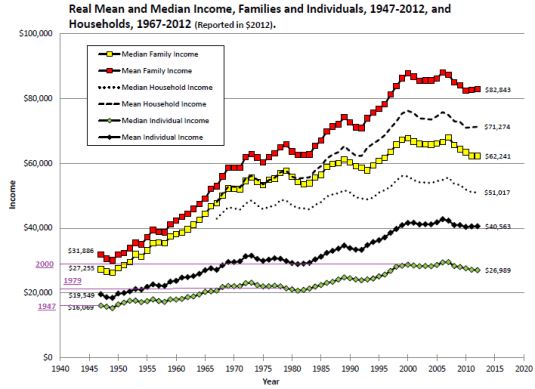
Postwar vs. New Gilded Age: How did the middle class do?
28 Jan 2015 Leave a comment
in applied welfare economics, economic growth, income redistribution, politics - USA, poverty and inequality Tags: middle class stagnation

Is the Electoral (Disqualification of Sentenced Prisoners) Amendment Act 2010 invalid as submitted today in the High Court?
27 Jan 2015 Leave a comment

Definition of an Activist | Coyote Blog
27 Jan 2015 Leave a comment
in occupational choice, Public Choice Tags: activists, do gooders, fascism of good intentions

Activist: A person who believes so strongly that a problem needs to be remedied that she dedicates substantial time to … getting other people to fix the problem. It used to be that activists sought voluntary help for their pet problem, and thus retained some semblance of honor.
However, our self-styled elite became frustrated at some point in the past that despite their Ivy League masters degrees in sociology, other people did not seem to respect their ideas nor were they particularly interested in the activist’s pet issues.
So activists sought out the double shortcut of spending their time not solving the problem themselves, and not convincing other people to help, but convincing the government it should compel others to fix the supposed problem.
This fascism of good intentions usually consists of government taking money from the populace to throw at the activist’s issue, but can also take the form of government-compelled labor and/or government limitations on choice.

Proof at last, that the moon landing was real
26 Jan 2015 Leave a comment
in economics of bureaucracy, politics - USA, technological progress Tags: conspiracy theorists, immigration, moon landing
Gordon Tullock on avoiding difficult decisions about saving lives – updated
24 Jan 2015 Leave a comment
in constitutional political economy, economics of bureaucracy, economics of regulation, Gordon Tullock, health and safety, health economics, income redistribution, James Buchanan, labour economics, Rawls and Nozick Tags: expressive voting, health and safety, James Buchanan, rational ignorance, rational irrationality, statistical life, veil of ignorance, veil of insignificance, veil of uncertainty

Gordon Tullock wrote a 1979 New York Law Review book about avoiding difficult choices. His review was of a book by Guido Calabresi and Philip Bobbitt called Tragic Choices which was about the rationing: the allocation of kidney dialysis machines (a “good”), military service in wartime (a “bad”), and entitlements to have children (a mixed blessing).
Tullock argued that we make a decision about how to allocate resources, how to distribute the resources, and then how to think about the previous two choices. People do not want to face up to the fact resources are scarce and they face limits on their powers.
To reduce the personal distress of making these tragic choices, Tullock observed that people often allocate and distribute resources in a different way so as to better conceal from themselves the unhappy choices they had to make even if this means the recipients of these choices are worse off and more lives are lost than if more open and honest choices were made up about there only being so much that can be done.
The Left over Left and union movement spends a lot of time pontificating about how we must not let economics influence health and safety policy rather than help frame public policy guidance on what must be done because scarcity of resources requires the valuation of life in everything from health, safety, and environmental regulations to road building. health budgeting is full of tragic choices about how much is spend to save so lives and where and for how long.
The Left over Left and the union movement deceive themselves and others into make futile gestures to make themselves feel good. These dilettantes cannot assume that they are safely behind a veil of insignificance. They have real influence on how public policy on health and safety are made.
A major driver of the opposition among the Left over Left and the union movement to the use of cost-benefit analysis and the valuation of statistical lives is its adoption makes people confront the tragic consequence of any of the choices available to them.
By saying how dare you value a statistical life does not change the fact that choices made without this knowledge will still have tragic consequences, and more lives may be lost because people want to conceal from themselves the difficult choices that they are making about others as voters and as policy-makers.
One of the purposes of John Rawls’ veil of ignorance and Buchanan and Tullock’s veil of uncertainty is that the basic social institutions be designed and agreed when we have abstracted from the grubby particulars of our own self-interest. Buchanan and Tullock explain the thought experiment this way
Agreement seems more likely on general rules for collective choice than on the later choices to be made within the confines of certain agreed-upon rules. …
Essential to the analysis is the presumption that the individual is uncertain as to what his own precise role will be in any one of the whole chain of later collective choices that will actually have to be made.
For this reason he is considered not to have a particular and distinguishable interest separate and apart from his fellows.
This is not to suggest that he will act contrary to own interest; but the individual will not find it advantageous to vote for rules that may promote sectional, class, or group interests because, by supposition, he is unable to predict the role that he will be playing in the actual collective decision-making process at any particular time in the future.
He cannot predict with any degree of certainty whether he is more likely to be in a winning or a losing coalition on any specific issue. Therefore, he will assume that occasionally he will be in one group and occasionally in the other.
His own self-interest will lead him to choose rules that will maximize the utility of an individual in a series of collective decisions with his own preferences on the separate issues being more or less randomly distributed.
Behind the veil of ignorance and the veil of uncertainty, we would all agree that resources are limited, including in the health sector and some drugs can’t be funded – choices must be made.
Once we go in front of the veil of ignorance and find out that we are the one missing out on that drug, naturally, our views will change. We agreed to these rules as fair for the distribution of basic social resources when, as John Rawls put it:
…no one knows his place in society, his class position or social status; nor does he know his fortune in the distribution of natural assets and abilities, his intelligence and strength, and the like.
Is always the case that someone just falls on the other side of any line in the sand. If you move that line, there is always another set of people who are just on the other side.

Paul Samuelson’s repeated predictions of the Soviet Union economy catching up with the USA
24 Jan 2015 1 Comment
in economic history, economics of bureaucracy, growth disasters, Marxist economics Tags: fall of communism, fall of the USSR, forecasting errors, Paul Samuelson, The fatal conceit, The pretence to knowledge
Paul Samuelson wrote in the 1961 edition of his famous economics textbook that GNP in the Soviet Union was about half that in the United States but the Soviet Union was growing faster.
Figure 1: Samuelson’s 1961 Forecast of Soviet catch up

Source: Levy and Peart (2006)
As a result, Soviet GNP would exceed that of the United States by as early as 1984 or perhaps by as late as 1997, depending on whether you were reading the early 1960s or later editions of Samuelson’s immensely popular textbook. In the 1980 edition there was little change in the analysis, though the two dates were delayed to 2002 and 2012
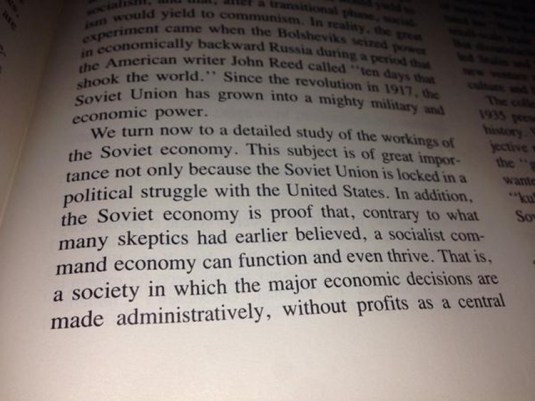
Samuelson predicted that the Soviet Union would catch up with the United States and kept predicting this until 1989 in every edition of his textbook of which there are at least 14. Levy and Peart were good enough to tabulate these predictions by Samuelsson of Soviet catch up with the USA over the editions of his textbook in the table below.
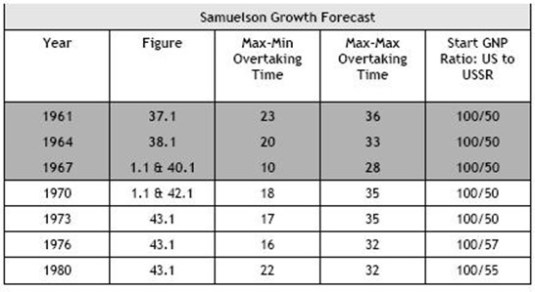
Source: Levy and Peart (2009)
Samuelson’s predictions of the Soviet Union catching up to and overtaking the United States were echoed in most other major economics textbooks of his time.
Plainly, they all got it wrong except for the Austrian economists, Eastern bloc émigrés and G. Warren Nutter.
From 1956 to 1961, Nutter undertook a massive study of the history of the economy of the Soviet Union and published The Growth of Industrial Production in the Soviet Union in 1962.
Nutter’s study concluded that Soviet economic growth over the first half of the 20th Century was indeed remarkable, and that there had been periods of growth spurts, but when the entire Soviet period was taken into consideration, Soviet growth lagged behind Western economies and Soviet economic capacity showed every sign of falling further behind rather than catching up with the West.
Nutter’s conclusions were certainly not welcomed by the Sovietologists of his time. As the fall of the Soviet Union revealed more realistic data, Nutter’s estimates of Soviet growth rates have been vindicated, and in fact, if anything Nutter overstated rather than understated Soviet economic performance.
Paul Craig Roberts found worse exaggeration with the Romanian economy in 1979. A World Bank report, Romania: The Industrialization of an Agrarian Economy under Socialist Planning, credited central planning with achieving a 9.8 annual rate of economic growth over the quarter century from 1950 to 1975. It should be added that in the 1970s, Romania was a western favourite because of its independent stance within the Eastern European bloc.
The World Bank did not realize that using these growth rates to project backward these growth figures on Romanian income per capita quickly produced a figure too low to sustain life. This mistake provoked the Wall Street Journal observation:
We have heard exaggerated claims made for central economic planning, but never that it resurrected a whole nation from the dead.
Samuelson never reflected in his later textbooks after 1989 about how wrong he was for many decades about Soviet economic performance. Few people, thank you for admitting that there you’re wrong – they are more likely to dance on the grave of your error.
In Paul Samuelson’s case, he had more reasons of most to learn from his failed predictions because as his predictions didn’t work out, he had to rewrite and update his book and charts predicting the USSR was going to overtake the USA in about 20 years.
Rather than the suspect that there something wrong with the Soviet economic system, Paul Samuelson looked for excuses – increasingly pathetic excuses. As Larry White explained:
In the seven editions of his textbook published from 1961 to 1980, Samuelson kept including a chart indicating that Soviet output was growing faster that U.S. output, and predicting a catch-up in about twenty-five years. He repeatedly had to move the predicted catch-up date forward from the previous edition because the gap had never actually begun to close. In several editions he blamed low realized Soviet growth on bad weather.
What is more puzzling is Samuelson did update his views on the merits of fiscal and monetary policy in stabilising the economy, and the effectiveness of each over the decades in light of experience and between the 1960s and 1980s. In the 1948 edition of his best-selling textbook, Economics, Samuelson wrote that:
few economists regard Federal Reserve monetary policy as a panacea for controlling the business cycle.
In 1967 Samuelson said that monetary policy had “an important influence” on total spending. His 1985 edition states;
“Money is the most powerful and useful tool that macroeconomic policymakers have,” adding that the Fed “is the most important factor” in making policy.
Samuelson’s 1967 edition said policymakers faced a trade-off between inflation and unemployment. His 1980 edition said there was less of a trade-off in the long run than in the short run. The 1985 edition, he said there is no long-run trade-off between unemployment and inflation.
Samuelson gave quite compelling reasons as to why Keynesianism declined:
- Keynesian macroeconomists and policymakers made the mistake of projecting the experience of the Great Depression onto the post-war era;
- it turned out that, contrary to what Keynes had said, monetary policy mattered a lot; and
- The final blow to Keynesianism was stagflation: There is nothing in Keynesian macroeconomics that would allow you to solve stagflation.
Samuelson did not learn in the same way from brute experience regarding the economics of socialism.
Via Why Were American Econ Textbooks So Pro-Soviet? Bryan Caplan | EconLog | Library of Economics and Liberty and Soviet Growth & American Textbooks.
The relationship between housing prices and the Wharton Land Use Index
24 Jan 2015 Leave a comment
in rentseeking, urban economics Tags: Edward Gleaser, green rent seeking, land supply, land use regulation, zoning

Note: the Wharton Land Use Index measures the restrictiveness of a metropolitan area’s land use regulations.

Hsieh and Moretti on Allocations across Cities
23 Jan 2015 Leave a comment
in applied price theory, applied welfare economics, economics of regulation, geography, law and economics, politics - New Zealand, politics - USA, rentseeking, urban economics Tags: agglomeration, green rent seeking, land supply, zoning
the implied cost of housing restrictions across the whole U.S., and Chang and Enrico find that aggregate output is lower by about 10-14% because of them.


Last post on the NBER growth session. Chang-Tai Hsieh (Chicago) and Enrico Moretti (Berkeley) presented a paper on wage dispersion across cities in the U.S. Wage dispersion (New Yorkers earn more than people in Cleveland) either represents compensation for living costs (housing in New York is more expensive than in Cleveland), a real difference in productivity (New Yorkers are more productive than Clevelanders), or some combination of the two.
What Chang and Enrico find is that the increase in wage dispersion across cities in the U.S. over the last thirty-ish years is due almost entirely to rising house prices in six cities: NY, DC, Boston, San Fran, San Jose, and Seattle. Wages have gone up rapidly in those cities, but that is basically just compensating their citizens for the higher costs of living.
Now, given the costs of living, the allocation of population across cities in the U.S. is…
View original post 274 more words


Recent Comments