The huge differences in the coverage of government failure versus market failure in 23 leading Principles of Economics – James Gwartney and Rosemarie Fike

23 leading Principles of Economics texts reveals huge differences in the coverage of government failure versus market failure

On average, the coverage of market failure in the 23 texts is nearly six times that of government failure.

As a result of the omission of public choice, many current students of economics are presented a naïve and largely fallacious view of government and the power of economics to explain the presence of debt financing, unfunded promises, special interest spending, and the institutional environment underlying economic growth and development.

Krugman’s textbook does not mention government failure at all!

Via Economicsone

Why do we have governments?

Ancient philosophers in general thought that it was to establish virtue or do good. Most modern public choice scholars are more modest in their evaluation of government.

We simply want government to provide those goods and services that people in fact want and that, for a variety of reasons, are hard to provide through the market.

Most people, for example, would like to have the poor taken care of by taxes on those better off. It is true they would have no objection if the poor were taken care of by voluntary contributions, but our experience seems to indicate that voluntary contributions don’t produce adequate funds for this purpose. Hence the use of the government to provide that particular service is generally approved. Of course, that does not prove that in general people are in favour of the exact quantity transferred or the methods used by the government.

There is a large literature on why certain types of things, sometimes called public goods, are provided by the market in a very inefficient way and will be provided in a better (although far from optimal) way by the government.

…We will just accept as a fact that there are a number of things which are better dealt with by the government. We will also accept as a fact that there are other things which are better dealt with by the market.

…In general, we want the government to give the citizens what they themselves want. That, indeed, is the point of democracy.

The smaller the government, the smaller the number of its voters. The smaller the number of voters, the more power each individual voter has. That’s one side of the argument.

On the other side, we have the fact that many government services are hard or impossible for small governmental units to provide.

These two arguments have to be set off against each other and since different government activities will turn out to have a different balance, having different governmental sizes is sensible.

… The existence of many small government units dealing with certain special problems has another advantage. Not only are these small governments more under the control of their voters in the sense that each individual voter’s preferences count for more than in the large government, their existence means that citizens may move from one to the other if they are dissatisfied.

Gordon Tullock

The New Federalist (1995)

New Zealand is not a federal state. I like federalism because a divided government is a weak government.

Greens as heirs of the 19th century Tory radicals

The Greens are no more than a reincarnation of the 19th century British Tory Radicals with their aristocratic sensibilities that combined strong support for centralised power with a paternalistic concern for the plight of the poor:

  • 19th century Tory radicals opposed the middle classes and the aesthetic ugliness they associated with an industrial economy; and
  • Like the 19th century Tory Radicals, today’s green gentry see the untamed middle classes as the true enemy.

Environmentalists have an aristocratic vision of a stratified, terraced society in which the knowing ones would order society for the rest of us.

Environmentalism offered the extraordinary opportunity to combine the qualities of virtue and selfishness

Many left-wingers thought they were expressing an entirely new and progressive philosophy as they mouthed the same prejudices as Trollope’s 19th century Tory squires: attacking any further expansion of industry and commerce as impossibly vulgar, because it was:

ecologically unfair to their pheasants and wild ducks.

Neither the failure of the environmental apocalypse to arrive nor the steady improvement in environmental conditions because of capitalism has dampened the ardour of those well-off enough to be eager to make hair-shirts for others to wear.

The 19th century Tory radical’s disdain for the habits of their inferiors remains undiminished in their 21st century heirs and successors.

True to its late 1960s origins, political environmentalism gravitates toward bureaucrats and hippies: toward a global, little-brother government that will keep the middle classes in line and toward a back-to-the-earth, peasant-like localism, imposed on others but presenting no threat to the inner city elites’ comfortable middle class lives.

Unlike most, green voters tend to be financially secure and comfortable enough to be able to put aside immediate self-interest when imposing their political opinions.

The rising Green vote is a product of increasing tertiary education. Green voters are typically tertiary educated or undergoing tertiary education.

Green votes are defined by what they studied at university: arts, society and culture, architecture and education. Professionally they tended to be consultants, or worked in the media, health or education. Theses jobs are heavily concentrated in tertiary disciplines that are focused on much more than just making money.

Greens are very well-paid inner-urban dwellers who make more use of public transport and have few religious convictions. They tend not to have children until their 30s, if at all, which makes them even richer and gives them lots more spare time to organise political activities and annoy the rest of us. Some of them still haunt campuses, churning out more arts graduates, but increasingly, green voters comprise a well-heeled professional group.

Greens are distinct from the typical Labor or National voter demographic but they support the the Green Party for social rather than economic reasons. Not unlike middle-class Catholics in the 1950s and 1960s who voted Labour.

How ironic that the green gentry—progressives against progress—turn out to be nothing more than nineteenth-century urbane conservatives. There is nothing new under the sun.

Big HT: http://www.city-journal.org/2010/20_3_american-liberalism.html

Richard Epstein “The Coming Meltdown in Labor Relations”

Those subservient press barons

Both political parties used television licensing and the threat of cable TV to manipulate Murdoch, Packer and the other press barons. They were victims of Fred McChesney’s concept of rent extraction:

  • Rent extraction is the politician’s pastime of threatening harmful legislation to extract political support and contributions from well-heeled private institutions.
  • Payments to politicians are often made not for political favours, but to avoid political disfavour, that is, as part of a system of political extortion or rent extraction.

Rent extraction is money for nothing – money paid in exchange for politicians’ inaction.

The politician is paid, not for rent creation, but for withholding legislative and regulatory action that would destroy existing private rents.

McChesney establishes the conditions under which of rent creation or extraction will occur. The relative attractiveness of the two strategies depends on the elasticities of demand and supply.

  • If demand is relatively inelastic, rent creation will occur; and
  • If supply is relatively inelastic, rent extraction will occur.

The existence of an organization or a large established firm lowers transaction costs for the politicians negotiating and collecting donations and support, making rent expropriation threats easier.

It is hard to extort rents from those with little in the way of organisation. A cost of being an established lobbying organisation or a large firm with high fixed costs is a greater potential for rent extraction.

The print and electronic media are ripe for rent extraction because of their immobile assets and heavy regulation.

Investors in heavily regulated capital intensive industries such as the mass media, digital and print, do not bite the hand the feeds them.

Little wonder that the media barons were honoured supplicants to whomever is in power in Canberra. They are soon Labor’s business mates whenever Labor was in power.

Threatening to allow cable TV was the big stick in every Australian government’s hand until the 1990s to extract support or at least subservience from the media.

Rupert Murdoch has unashamedly backed political winners, only to dump them when he was convinced that they were washed up or that his newspapers might be left stranded on the losing side of politics.

Murdoch’s see-sawing political stances are entirely pragmatic. He has always been prepared to back winners just before they win, and to shift allegiances on non-ideological grounds.

Milton Friedman explains Director’s Law of of Public Expenditure

Is the IPCC Government Approval Process Broken? | Robert Stavins

Robert Stavins, the Co-Coordinating Lead Author of Chapter 13, “International Cooperation:  Agreements and Instruments,” of Working Group III (Mitigation) of the Fifth Assessment Report of the Intergovernmental Panel on Climate Change (IPCC) has written a letter arguing the following:

  • If the IPCC is to continue to survey scholarship on international cooperation in future assessment reports, it should not put country representatives in the uncomfortable and fundamentally untenable position of reviewing text in order to give it their unanimous approval. 
  • In my view, with the current structure and norms, it will be exceptionally difficult, if not impossible, to produce a scientifically sound and complete version of text for the SPM on international cooperation that can survive the country approval process.
  • The general motivations for government revisions – from most (but not all) participating delegations – appeared to be quite clear in the plenary sessions.
  • These motivations were made explicit in the “contact groups,” which met behind closed doors in small groups with the lead authors on particularly challenging sections of the SPM.
  • In these contact groups, government representatives worked to suppress text that might jeopardize their negotiating stances in international negotiations under the United Nations Framework Convention on Climate Change (UNFCCC).
  • Nearly all delegates in the meeting demonstrated the same perspective and approach, namely that any text that was considered inconsistent with their interests and positions in multilateral negotiations was treated as unacceptable.

HT: Catallaxyfiles

Rod Croome’s unanticipated revolution

Back in 1986, an old University mate of mine, Rod Croome was very physically brave in his protesting for reforms to the Tasmanian state criminal law.

  • Rod even walked into a Tasmanian police station and confessed to abominations against the order of nature, as the Tasmanian criminal code called it.
  • The Police said they could not prosecute without the other party coming forward as the witness. The abominee did.
  • The Tasmanian Director of Public Prosecutions then declined to prosecute on public interest grounds. His discretion to not prosecute is absolute.

These days, Rod is campaigning for the equal right to marry. All inside one generation!

When Rod walked out of that police station rather disappointed at being a free man, I wonder if he anticipated how much change would happen regarding gay rights in his lifetime, much less in the next 5, 10, and 20-years.

A good explanation of this rapid social change is in Timur Kuran’s “Sparks and Prairie Fires: A Theory of Unanticipated Political Revolutions” and “Now Out of Never: The Element of Surprise in the East European Revolution of 1989“.

Kuran suggests that political revolutions and large shifts in political opinion will catch us by surprise again and again because of people’s readiness to conceal their true political preferences under perceived social pressure:

People who come to dislike their government are apt to hide their desire for change as long as the opposition seems weak.

Because of the preference falsification, a government that appears unshakeable might see its support crumble following a slight surge in the opposition’s apparent size, caused by events insignificant in and of themselves.

Kuran illustrated his bandwagon effect first with the fall of the Russian Czar in 1918. On the morning of the day that the Czar abdicated, he thought it was just another day at the office. But the regiment stationed in St. Petersburg to put down riots had been recently sent to the front. The raw recruits that replaced them melted away in the front of the rioters. The rest is history.

Then there is the Ayatollah Khomeini: two months before the Iranian Revolution, the main concern of his aides was his French visa was expiring; He needed a new country to seek refuge. Just before the Iranian Revolution of 1979, a CIA report characterised the Shah of Iran as an “island of stability.”

clip_image001

Yeltsin came to power after the coup attempt by hard-liners against Gorbachev because a KBG regiment sent to arrest Yeltsin mutinied against the orders of the hard-line coup leaders. Then everyone at the top of the military and security forces saw their main chance and switched sides. All popular revolutions against autocrats are ultimately palace revolutions, as I have argued before.

The loyalties of security forces are crucial in any political revolution. Within the security forces, a key concern is ending-up on the winning side in any show-down. Moving too early, too late or not at all have risks of their own when the time comes after a military coup to reward supporters and punish those that chose the wrong side, or even worse, sat on the side-lines waiting to see who would win.

Kuran argues that everyone has a different revolutionary threshold where they reveal their true beliefs, but even one individual shift to opposition leads to many others to come forward and defy the existing order. Small concessions only emboldens the ground-swell of revolution.

Those ready to oppose social intolerance or who are lukewarm in their intolerance keep their views private until a coincidence of factors gives them the courage to bring their views into the open. They find others share their views and there is a revolutionary bandwagon effect.

Plenty of people have had personal experiences of this in the 1980s and the 1990s when there were rapid changes in social and political attitudes about racism, sexism and gay rights.

A few political entrepreneurs such as Rod Croome had to stand up for what was right, and a surprisingly large number of others will quickly join the side pushing for social change.

clip_image002

In switching sides, these early movers and initial protestors encourage other hidden opponents of the established social and political order to switch. As knowledge of the opposition spreads and grows, the external cost of joining becomes lower.

clip_image003

In Crime Waves, Riots, and Revolutions, Alex Tabarrok makes the important related point that when the courts and police are over-crowded and over-whelmed, proportionately fewer criminals or protestors will be apprehended, convicted, and imprisoned or otherwise socially pressured to conform. This feedback effect from one decision to participate in crime or protest to the decisions of others to break the law or rebel can be highly significant.

Kuran argued that fear changes sides once the revolutionary bandwagon takes hold: genuine supporters of the old political or social older or the traditional social values falsify their publicly professed preferences, pretending that they support the new order.

These are late-switchers. Do not trust them.

These late switchers are opportunists who will as easily switch back or move on to support another coup or a counter-coup or a return to traditional values.

Kuran argued that the reason for the bloody purges among revolution movements after many takeovers is to find and route-out these late-switchers. Many are purged, rightly or wrongly, before they have a chance to betray the current leaders of the revolution or military coup.

There are plenty of Christian and family parties winning upper house seats in Australia and soon in the New Zealand House of Representatives. There are plenty of morally manoeuvrable politicians willing to switch to their side if they have enough votes.

Ministers of course have a whole range of dazzling qualities, including … um … well, including an enviable intellectual suppleness and moral manoeuvrability.

Sir Humphrey, The Death List

Addendum: don’t pretend it was just the old fogeys who were the social reactionaries back then in the 80s.

When a gay men’s club sought affiliation with the Tasmanian University Union’s Societies Council in 1983, a number of clubs spoke against it because they simply didn’t like gays. I was there representing a catholic college students club so I seconded the motion.

When the motion was put to the vote, it was carried on the voices with a lot of people not saying anything or mumbling against it.

The chairman of the meeting, who was a member of the Liberal club, wisely didn’t put the motion to a vote. He declared it carried and moved as quickly as possible to the next item of business in case there was a call for show of hands.

Anti-gay rhetoric was common among young people in the 1980s.

The case against industry policy in one photo

Industry policy is back in vogue in New Zealand:

  • The National Party-led Government is keen on smart specialisation.
  • The Labour Party wants a Manufacturing Upgrade targeting R&D and innovation.

The case against picking winners is the answer to the question in the picture of the weirdoes below.

One of the people in the photo won a competition on the radio that offered free company photos. That is how Microsoft could afford the photo. That photo became one of the most iconic photos in American business history.

I first saw this photo 12-14 years ago at a presentation, so who first designed the caption is lost in time.

The Case for Boring Courts and Very Bored Lawyers

The world would be a better place if law was the most boring occupation about.

Lawyers and the court room make for great TV drama, but if the outcome of most litigation was fairly predictable, we would all be better-off.

Ordinary people would not fear law suits or suing to uphold their rights if the law was simple. With the law clear-cut, every-one knows where they stand. People settle out of court. They do not misbehave in the first place because they know they will be liable and will have to pay.

Richard Epstein contents that

…greater judicial sophistication has not brought forth higher quality judgments, but rather the reverse

…An easy mistake for a modern judge to make is to assume that the tools he or she possesses are capable of being put to good ends, and that it is possible to tell which of the parties in a given case are the ‘good guys’ and which are the ‘bad guys’.

…Most of the cases that a judge sees are aberrations.

Yet it is a great mistake for a judge to assume that the rules a court creates only apply to the aberrational cases.

The legal rules will also govern the mundane cases that remain within the system, to be resolved without litigation.

The judge needs to fear that laying down an ideal rule for this one case in a thousand may unglue the system that works well for the other 999 cases.

We all bargain in the shadow of the courts and the law. Bargaining and the enforcement of contracts and property rights and the resolution of disputes would be a lot cheaper if we knew what would happen if we did not settle and went to court.

As an example of the simple rules he champions, Epstein proposed that the default divorce settlements be 50:50.

Epstein also supports employment at will as the default rule because "you’re fired, I quit" could not be simpler to understand and administer.

Everyone knows where they stand and a free to make more detailed marital or employment agreements if they wish. Many do: contractors and short-term routinely earn a premium over permanent employees with more job security.

The law attracts more than its share of reformers wanting to use the courts and judge-made law for political purposes.

If you want to reform the world, do what we ordinary people have to do: change your vote, write a mail to an MP, protest, donate to or even join a political party, or run for parliament.

Some lawyers think themselves above how ordinary people must resolve their differences in democracies: by trying to persuade each other and elections.

The great strength of democracy is a small group of concerned and thoughtful citizens can band together and change things by running for office and winning elections.

That is how new Australian parties such as the Labor Party, the Country Party, Democratic Labor Party, the Australian Democrats and the Greens changed Australia. One Nation even had its 15 minutes of fame with its 11 MPs. Australian state upper houses even have Christian, family and shooters parties and many independents. A middle-of-the-road Senate independent in South Australia nearly topped the poll.

All of these parties started in a living room full of angry, motivated people.

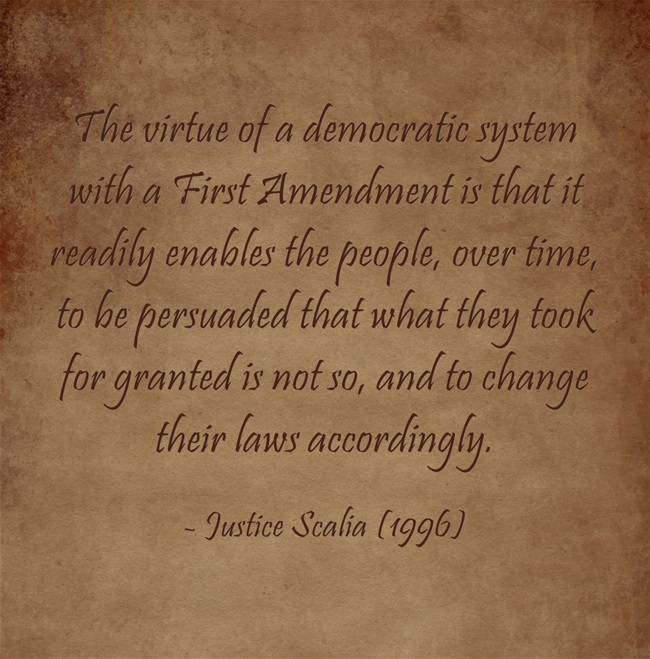
I agree with Antonin Scalia when he said that the purpose of the law is to slow the impassioned majority down:

Judges are sometimes called upon to be courageous, because they must sometimes stand up to what is generally supreme in a democracy: the popular will.

Their most significant roles, in our system, are to protect the individual criminal defendant against the occasional excesses of that popular will, and to preserve the checks and balances within our constitutional system that are precisely designed to inhibit swift and complete accomplishment of that popular will.

Those are tasks which, properly performed, may earn widespread respect and admiration in the long run, but — almost by definition — never in the particular case.

Democracy is government by checks and balance by putting the parties and branches of government in continual tension with each other – it is not trusting the specific people who are currently in power.

Stumbling and Mumbling: 12 alternative principles to Thomas Sargent’s

1. People have different motivations: wealth, power, pride, job satisfaction and so on. Incentive structures which suit one set of motives might not work for another.

2. Many things are true but not very significantly so.

3. Power matters: conventional economics under-states this.

4. Luck matters. The R-squareds in Mincer equations are generally low.

5. There is a great deal of ruin in a nation, and in an organization.

6. Individual rationality sometimes produces outcomes which are socially optimal as in Adam Smith’s invisible hand, and sometimes not.

7. Trade-offs between values are more common than politicians pretend, but are not ubiquitous.

8. Cognitive biases are everywhere.

9. Everything matters at the margin, but the margin might not be very extensive.

10. The social sciences are all about mechanisms. The question is: which ones work when and where? This means there are few if any universal laws in the social sciences; context matters.

11. Accurate economic forecasting is impossible. But time-varying risk premia might give us a little predictability.

12. Risk comes in many types. Reducing one type of it often means increasing exposure to another type.

Chris Dillow at Stumbling and Mumbling: 12 alternative principles.

What do Ross Perot and the Tea Party have in common?

Popular uprisings are common in US politics. Of late, there has been the Tea Party, Moveon.org and the anti-Iraq war movement.

Remember Ross Perot? He was a well-mannered, TV friendly version of the Tea Party. Perot won 19% of the presidential vote in 1992, and 8.4% in 1996.

Perot appealed to disaffected voters across the political spectrum who had grown weary of the two-party system. NAFTA played a role in Perot’s support, and Perot voters were relatively moderate on hot button social issues.

Perot siphoned votes nearly equally among Bush and Clinton in 1992, but of the voters who cited Bush’s broken "No New Taxes" pledge as "very important," two thirds voted for Clinton.

Attacking Perot as politically unrefined, arrogant and more than a little unstable did not do any good in 1992. Just made him fight harder and also belittled the concerns of his potential supporters thus turning them even more against the major party candidates.

The worst way to ask for someone’s vote is to belittle what troubles them and insult them personally to round things off.

Combining fiscal conservatism with social moderation was Clinton’s response to the Perot insurgency by the time of the 1996 election; adapt or lose office. Clinton was re-elected easily. This made him the first elected incumbent Democratic president to be re-elected since Roosevelt.

Obama’s opportunistic record on fighting global warming

Even in the US, where nothing can be done through legislation thanks to Republican delusionists.

The 2008 Republican Party presidential nominee supported cap-and-trade. McCain had a strong legislative record; he introduced a bill with Joe Lieberman to introduce carbon trading in 2003.

McCain has been one of the most outspoken members of Congress on the issue of climate change’ and he “managed to force the first real Senate vote on actually doing something about the largest environmental peril our species has yet faced.

McCain used a Senate parliamentary manoeuvre that forced a floor vote on the climate legislation. The McCain-Lieberman bill lost 43-55.

In 2007 he reintroduced his bill, with bipartisan co-sponsorship. Obama missed the June 2008 vote on McCain’s Climate Security Bill.

In a March 2008 speech, McCain called for a “successor to the Kyoto Treaty” and a cap-and-trade system “that delivers the necessary environmental impact in an economically responsible manner.”

McCain’s climate policy includes several target dates. By 2012, McCain said U.S. emissions should return to 2005 levels. By 2050, he says, the U.S. emissions should be 60 per cent below 1990 levels.

In January 2010, the Pew Research Center asked Americans to rank the importance of twenty-one issues. Climate change came in last.

After winning the fight over health care, another issue for which polling showed weak support, Obama moved on to the safer issue of financial regulatory reform.

There were 5 Republican senators who would have voted for cap and trade in April 2010: Lindsey Graham, Susan Collins, Olympia Snowe, Scott Brown, and George LeMieux. There were 57 Democrat Senators. It takes 60 votes to break a filibuster.

President Obama could have fought harder to get the Bill the House passed through the Senate but he did not.

Blame Obama, no one else. He is supposed to make change happen. He lacked the political skills to build coalitions even within his own party to deliver.

Many others, including McCain softened or reversed positions as voter support waned as the great recession deepened.

In Copenhagen’s final private negotiations, Obama, Brown, Sarko and Merkel sat down with He Yafei, the Chinese vice-minister of foreign affairs. There is a tape of this meeting at Der Spiegel. HT: The Guardian.

He Yafei was the smartest guy in the room – listen to the tape. Wen Jiabao refused to attend most of the negotiating sessions.

Given the choice of walking out and sitting down with a vice-minister, they chose humiliation. One response of Obama was:

It would be nice to negotiate with somebody who can make political decisions.

Rather than blaming vast right-wing conspiracies, using Google searches for “unemployment” and “global warming”, Kahn and Kotchen found that:

  • Recessions increase concerns about unemployment at the expense of public interest in climate change;
  • The decline in global-warming searches is larger in more Democratic leaning states; and
  • An increase in a state’s unemployment rate decreases in the probability that Americans think global warming is happening, and reduces the certainty of those who think it is.

The middle-of-the-road voters changed their priorities and their political leaders followed them.

It’s the peoples’ will, I am their leader, I must follow them. – Jim Hacker, The Greasy Pole

As Geoff Brennan has argued, CO2 reduction actions will be limited to modest unilateral reductions of a largely token character. There are many expressive voting concerns that politicians must balance to stay in office and the environment is but one of these. Once climate change policies start to actually become costly, expressive voting support for these policies will fall away, and it has.

Do monopoly concessions increase or decrease gambling?

Do monopoly concessions such as for casinos and the TAB increase or decrease gambling? Is the under-supply of output by a monopoly a good or a bad thing when the good itself is seen as a bad.

James Buchanan started his 1973 paper ‘A defence of organised crime?’ quoting Samuel Butler:

… we should try to make the self-interest of cads a little more coincident with that of decent people

Buchanan’s simple idea is that if a monopoly restricts the output of goods, a standard analytical result, then it must also restrict the output of bads! Buchanan end’s his paper with:

It is not from the public-spiritedness of the leaders of the Cosa Nostra that we should expect to get a reduction in the crime rate but from their regard for their own self-interests

The Cosa Nostra did have a reputation for running honest casinos and keeping crime down nearby.

If an illegal monopoly or cartel becomes competitive and barriers to entry are eliminated, in the long run, more illegal goods will be traded at the new equilibrium.

Should gambling outlets be public monopolies because they would be smaller, badly run and slow to innovate? The monopolisation of bads may shift us in the direction of social optimality. Buchanan, of course, adds that:

The analysis does nothing toward suggesting that enforcement agencies should not take maximum advantage of all technological developments in crime prevention, detection and control.

Tom Sargent’s 12 lessons from economics for public policy

Tom Sargent is a life-long Democrat who is old enough to remember when Democrats were fiscal conservatives.

At a graduation speech at Berkeley, Sargent listed these lessons:

    1. Many things that are desirable are not feasible.
    2. Individuals and communities face trade-offs.
    3. Other people have more information about their abilities, their efforts, and their preferences than you do.
    4. Everyone responds to incentives, including people you want to help. That is why social safety nets don’t always end up working as intended.
    5. There are trade-offs between equality and efficiency.
    6. In an equilibrium of a game or an economy, people are satisfied with their choices. That is why it is difficult for well-meaning outsiders to change things for better or worse.
    7. In the future, you too will respond to incentives. That is why there are some promises that you’d like to make but can’t. No one will believe those promises because they know that later it will not be in your interest to deliver. The lesson here is this: before you make a promise, think about whether you will want to keep it if and when your circumstances change. This is how you earn a reputation.
    8. Governments and voters respond to incentives too. That is why governments sometimes default on loans and other promises that they have made.
    9. It is feasible for one generation to shift costs to subsequent ones. That is what national government debts and the U.S. social security system do (but not the social security system of Singapore).
    10. When a government spends, its citizens eventually pay, either today or tomorrow, either through explicit taxes or implicit ones like inflation.
    11. Most people want other people to pay for public goods and government transfers (especially transfers to themselves).
    12. Because market prices aggregate traders’ information, it is difficult to forecast stock prices and interest rates and exchange rates

Previous Older Entries Next Newer Entries

Vincent Geloso

Econ Prof at George Mason University, Economic Historian, Québécois

Bassett, Brash & Hide

Celebrating humanity's flourishing through the spread of capitalism and the rule of law

Truth on the Market

Scholarly commentary on law, economics, and more

The Undercover Historian

Beatrice Cherrier's blog

Matua Kahurangi

Celebrating humanity's flourishing through the spread of capitalism and the rule of law

Temple of Sociology

Celebrating humanity's flourishing through the spread of capitalism and the rule of law

Velvet Glove, Iron Fist

Celebrating humanity's flourishing through the spread of capitalism and the rule of law

Why Evolution Is True

Why Evolution is True is a blog written by Jerry Coyne, centered on evolution and biology but also dealing with diverse topics like politics, culture, and cats.

Down to Earth Kiwi

Celebrating humanity's flourishing through the spread of capitalism and the rule of law

NoTricksZone

Celebrating humanity's flourishing through the spread of capitalism and the rule of law

Homepaddock

A rural perspective with a blue tint by Ele Ludemann

Kiwiblog

DPF's Kiwiblog - Fomenting Happy Mischief since 2003

The Dangerous Economist

Celebrating humanity's flourishing through the spread of capitalism and the rule of law

Watts Up With That?

The world's most viewed site on global warming and climate change

The Logical Place

Tim Harding's writings on rationality, informal logic and skepticism

Doc's Books

A window into Doc Freiberger's library

The Risk-Monger

Let's examine hard decisions!

Uneasy Money

Commentary on monetary policy in the spirit of R. G. Hawtrey

Barrie Saunders

Thoughts on public policy and the media

Liberty Scott

Celebrating humanity's flourishing through the spread of capitalism and the rule of law

Point of Order

Politics and the economy

James Bowden's Blog

A blog (primarily) on Canadian and Commonwealth political history and institutions

Science Matters

Reading between the lines, and underneath the hype.

Peter Winsley

Economics, and such stuff as dreams are made on

A Venerable Puzzle

"The British constitution has always been puzzling, and always will be." --Queen Elizabeth II

The Antiplanner

Celebrating humanity's flourishing through the spread of capitalism and the rule of law

Bet On It

Celebrating humanity's flourishing through the spread of capitalism and the rule of law

History of Sorts

WORLD WAR II, MUSIC, HISTORY, HOLOCAUST

Roger Pielke Jr.

Undisciplined scholar, recovering academic

Offsetting Behaviour

Celebrating humanity's flourishing through the spread of capitalism and the rule of law

JONATHAN TURLEY

Res ipsa loquitur - The thing itself speaks

Conversable Economist

In Hume’s spirit, I will attempt to serve as an ambassador from my world of economics, and help in “finding topics of conversation fit for the entertainment of rational creatures.”

The Victorian Commons

Researching the House of Commons, 1832-1868

The History of Parliament

Articles and research from the History of Parliament Trust

Books & Boots

Reflections on books and art

Legal History Miscellany

Posts on the History of Law, Crime, and Justice

Sex, Drugs and Economics

Celebrating humanity's flourishing through the spread of capitalism and the rule of law

European Royal History

Exploring the Monarchs of Europe

Tallbloke's Talkshop

Cutting edge science you can dice with

Marginal REVOLUTION

Small Steps Toward A Much Better World

NOT A LOT OF PEOPLE KNOW THAT

“We do not believe any group of men adequate enough or wise enough to operate without scrutiny or without criticism. We know that the only way to avoid error is to detect it, that the only way to detect it is to be free to inquire. We know that in secrecy error undetected will flourish and subvert”. - J Robert Oppenheimer.

STOP THESE THINGS

The truth about the great wind power fraud - we're not here to debate the wind industry, we're here to destroy it.

Lindsay Mitchell

Celebrating humanity's flourishing through the spread of capitalism and the rule of law

Alt-M

Celebrating humanity's flourishing through the spread of capitalism and the rule of law

croaking cassandra

Economics, public policy, monetary policy, financial regulation, with a New Zealand perspective

The Grumpy Economist

Celebrating humanity's flourishing through the spread of capitalism and the rule of law