Chinese tax residents bought 321 Auckland properties (29.5 per cent of the total); Australian tax residents purchased 312 Auckland properties (28.6 per cent).

Celebrating humanity's flourishing through the spread of capitalism and the rule of law
10 May 2016 Leave a comment
in economics of regulation, politics - New Zealand, Public Choice, rentseeking Tags: antiforeign bias, housing affordability, land supplied, rational irrationality
Chinese tax residents bought 321 Auckland properties (29.5 per cent of the total); Australian tax residents purchased 312 Auckland properties (28.6 per cent).
09 May 2016 Leave a comment
in applied price theory, applied welfare economics, politics - New Zealand, politics - USA, public economics, rentseeking Tags: universal basic income
Running around saying that Universal Basic Income will make work optional leaves open the question of who will be the suckers who actually do the work and pay enormous taxes to fund the idyllic lifestyle of the bohemian rest.

Source: What If Everybody Didn’t Have to Work to Get Paid? – The Atlantic.
08 May 2016 Leave a comment
in applied price theory, applied welfare economics, economics of regulation, Public Choice, rentseeking Tags: economics of housing, economics of mandates, expressive voting, fatal conceit, rent controls, The pretense to knowledge
Opposition Leader Andrew Little accepts that mandating insulation and heat pumps into rental properties will increase their value. But he denies that this will affect rents!
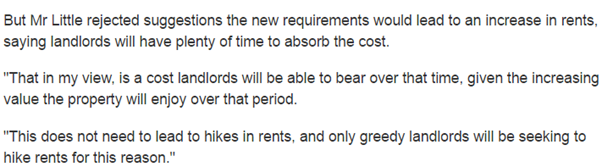
Source: Healthy Homes Bill won’t up rents Little | Politics | Newshub.
An upgrade increases the value of a rental property if the improvements that increase its rental value. You cannot have the increase in the value of the asset without the increase in rent.
I will contract out the rest of my answer to David Friedman’s superb book Laws Order:
For an application of economics to a different part of the law, consider the nonwaivable warranty of habitability, a legal doctrine under which some courts hold that apartments must meet court-defined standards with regard to features such as heating, hot water, sometimes even air conditioning, whether or not such terms are provided in the lease—indeed, even if the lease specifically denies that it includes them.
The immediate effect is that certain tenants get services that their landlords might not otherwise have provided. Some landlords are worse off as a result; some tenants are better off. It seems as though supporting or opposing the rule should depend mainly on whose side you are on.
In the longer run, the effect is quite different. Every lease now automatically includes a quality guarantee. This makes rentals more attractive to tenants and more costly to landlords. The supply curve, the demand curve, and the price, the rent on an apartment, all shift up. The question, from the standpoint of a tenant, is not whether the features mandated by the court are worth anything but whether they are worth what they will cost.
The answer may well be no. If those features were worth more to the tenants than they cost landlords to provide, landlords should already be including them in their leases—and charging for them. If they cost the landlord more than they are worth to the tenant, then requiring them and letting rents adjust accordingly is likely to make both landlord and tenant worse off. It is particularly likely to make poorer tenants worse off, since they are the ones least likely to value the additional features at more than their cost.
A cynical observer might conclude that the real function of the doctrine is to squeeze poor people out of jurisdictions that adopt it by making it illegal, in those jurisdictions, to provide housing of the quality they can afford to rent.
If my analysis of the effect of this legal doctrine seems implausible, consider the analogous case of a law requiring that all cars be equipped with sunroofs and CD changers. Some customers—those who would have purchased those features anyway—are unaffected. Others find that they are getting features worth less to them than they cost and paying for them in the increased price of the car.
07 May 2016 Leave a comment
in economics, income redistribution, Public Choice, rentseeking Tags: bribery and corruption
06 May 2016 Leave a comment
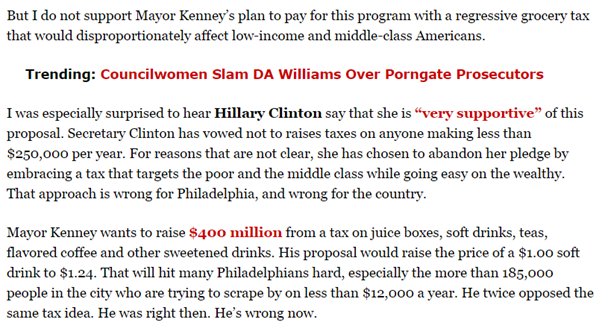
in applied price theory, health economics, income redistribution, politics - USA, Public Choice, rentseeking Tags: 2016 presidential election, do gooders, heavy-handed Samaritans, meddlesome preferences, nanny state, regressive taxes, sin taxes, soda taxes, sugar taxes
04 May 2016 Leave a comment
in applied price theory, development economics, economic history, economics, economics of crime, economics of regulation, entrepreneurship, Gordon Tullock, growth disasters, growth miracles, income redistribution, law and economics, Public Choice, rentseeking Tags: bribery and corruption, Tullock paradox
30 Apr 2016 Leave a comment
in comparative institutional analysis, constitutional political economy, energy economics, environmental economics, global warming, Public Choice, rentseeking Tags: European Union, expressive voting, green rent seeking, Italy, renewable energy, solar power, wind power
Massimo Tavoni and Caterina Gennaioli published a nice paper showing that corruption and violence was higher in the high wind provinces of Italy after the installation of wind generators. They built on earlier work about countries with abundant renewable resources and weak institutions. The main question in their paper
… is whether an increase in the expected returns of investments in wind energy, following the introduction of the new policy regime based on a green certificate system, has driven economic agents, namely bureaucrats and entrepreneurs, to engage more in rent seeking activities.
As they studied Italy, there is no surprise about the answer which was yes. High winds ensure high returns of the wind farm investment, but whether this translates into more bribery depends on institutional quality. There was more corruption, and so especially in high-wind provinces of Italy.
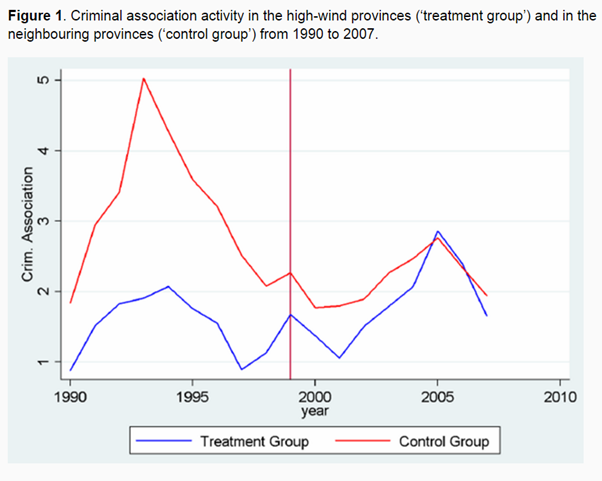
Source: Green policy and corruption | VOX, CEPR’s Policy Portal.
The construction of an average wind park is associated with an increase of criminal association activity of 6%. Italy will have more corruption than elsewhere in the old European Union.
The wider problem is renewable energy is a celebrity technology. In the context of expressive politics, so many cheer for solar and wind power that standards drop in terms of who qualifies for subsidies and who should lose support when their investments do not turn out as promised.
https://twitter.com/CountCarbon/status/715136022414299138
Wind power is not new, it is intermittent, is unsuitable for modern work, and is land constrained but it is still subsidised. Green rent seeking is a real risk even in countries with the best political institutions.
26 Apr 2016 Leave a comment
in applied price theory, development economics, economic history, growth disasters, growth miracles, Public Choice, rentseeking Tags: anti-market bias, economics of socialism, rational irrationality, The Great Escape, The Great Fact
A new World Bank study shows the dramatic reductions in global poverty and inequality as a result of the spread of market institutions and freer trade.

Source: Capitalism, Global Trade, and the Reduction in Poverty and Inequality | Cato @ Liberty
24 Apr 2016 Leave a comment
in economics of regulation, energy economics, environmental economics, global warming, Public Choice, rentseeking Tags: antimarket bias, antiscience left, green rent seeking, Greenpeace, nuclear power, pessimism bias, rational irrationality, wind power

24 Apr 2016 Leave a comment
in economics of education, human capital, income redistribution, labour economics, minimum wage, poverty and inequality, rentseeking Tags: Director's Law, IQ, rational irrationality, social justice warriors
The majority of New Zealanders do not qualify for university. Perhaps Labour and the Greens should spend more time worrying about those who do not achieve university entrance standard.

Source: School leavers with NCEA level 3 or above | Education Counts.
Anyone who achieve university entrance standard is among the intellectual elite. They have a head start in life. Labour and the Greens are preoccupied with giving those with a head start in life more freebies.
24 Apr 2016 Leave a comment
in applied welfare economics, politics - New Zealand, Public Choice, rentseeking, urban economics Tags: Auckland, housing affordability, land supply, land use planning, NIMBYs, Resource Management Act, urban limits, zoning
New Zealand housing prices were pretty flat up for the two decades until the passage of the Resource Management Act (RMA) in 1993. They then soared well before any foreign buyers such as from China entered the market.
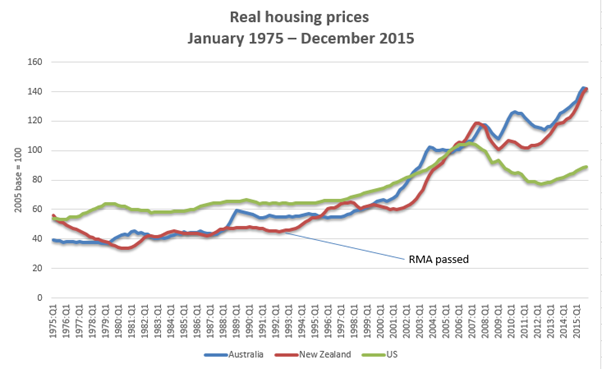
Source: International House Price Database – Dallas Fed December 2015; nominal housing prices for each country is deflated by the personal consumption deflator for that country.
Most of the housing price rises were under the watch of a Labour Government – a party which is supposed to look out for working families.
The failure of the Labour Party to nip the problem in the bud when they had a working majority in Parliament means future solutions run into the political problem that any significant increase in supply of land may push many with recent mortgages such as in Auckland into negative equity.
Since they left office in 2008, leaving land supply regulation in a mess, the approach of Labour has been political opportunism rather than supporting RMA reform.
Labour recently admitted the need to increase the supply of land, but have not put forward practical ideas to increase the supply of land.
The National Party is not much better in terms of real solutions to regulatory constraints on the supply of land.
23 Apr 2016 1 Comment
in applied price theory, applied welfare economics, economics of regulation, labour economics, labour supply, occupational choice, occupational regulation, Public Choice, rentseeking Tags: adverse selection, barriers to entry, moral hazard, occupational licensing, occupational regulation
The 2015 Current Population Survey in the USA added a question about whether you needed a licence or a certificate to practice your occupation. One in 4 Americans say they need a licence or certificate. 22.4% need a license and 3.1% need a certificate among employed over the age of 16 in the USA.
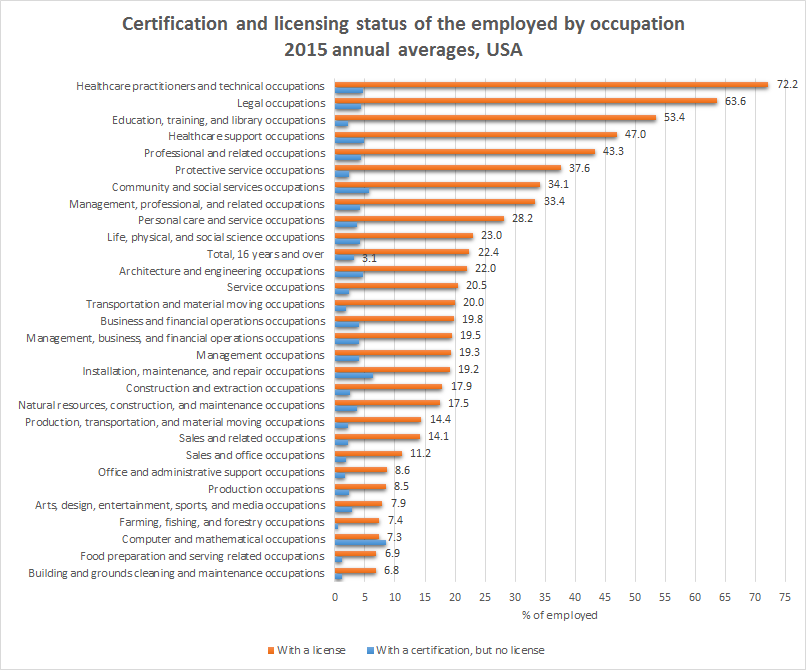
Source: Bureau of Labour Statistics, Labor Force Statistics from the Current Population Survey (2015), Certification and licensing status of the employed by occupation Table 5.
This estimate of 25% is less than the 30% estimated by Kleiner and Vorotnikov (2015) using a Harris Poll. Kleiner and Vorotnikov (2015) also found that some American states regulate twice as many occupations as others. This diversity in federalism strains any public interest explanation of occupational regulation.
Occupational regulation is more likely to be an issue for those who finished further education. It would have been better if the estimate by the Bureau of Labour Statistics was for adults and not have included teenagers.
The purpose of occupational regulation is to protect buyers from quacks and lemons – to overcome asymmetric information about the quality of the provider of the service.
The main issue with quacks in the labour market is whether there is a large cost of less than average quality service, and is there a sub-market who will buy less than average quality products in the presence of competing sellers competing on the basis of quality assurance. This demand for assurance creates opportunities for entrepreneurs to profit by providing assurance of quality.
Mostly disciplinary investigations and deregistrations under the auspices of occupational regulation are for gross misconduct and criminal convictions rather than the shading of quality.
21 Apr 2016 Leave a comment
in applied price theory, comparative institutional analysis, constitutional political economy, politics - New Zealand, Public Choice, rentseeking Tags: action bias, conjecture refutation, motivated reasoning, The fatal conceit, The pretense to knowledge

21 Apr 2016 Leave a comment
in economic history, economics of bureaucracy, economics of crime, economics of media and culture, law and economics, politics - USA, Public Choice, rentseeking Tags: bribery and corruption

In the book Plunkitt of Tammany Hall William Riordan published many of George Washington Plunkitt’s thoughts about government and about big city machines. In the link below, you can find the passage that explains the difference between honest and dishonest graft.
Honest graft is using your connections and knowledge as a government official to enrich yourself. It is essentially what we would now call “insider trading.”
Honest graft is when a goverment official goes out (for example) and buys up land because he knows a city project will need that land and he will be able to make a lot of money by buying the land now while no one else knows that it is about to be bought by the city. He can buy it cheap and then sell it at a higher price to the city.
Dishonest graft consists of doing things like blackmailing people who are doing illegal or semi-illegal things. It can also consist of actually taking money directly from the city treasury.
It is more of what you would expect mobsters to do–things like forcing prostitutes to pay money to police in order to be allowed to work in a given area rather than being arrested.
Source: How does George Plunkitt define “honest/dishonest graft”? | eNotes.

19 Apr 2016 Leave a comment
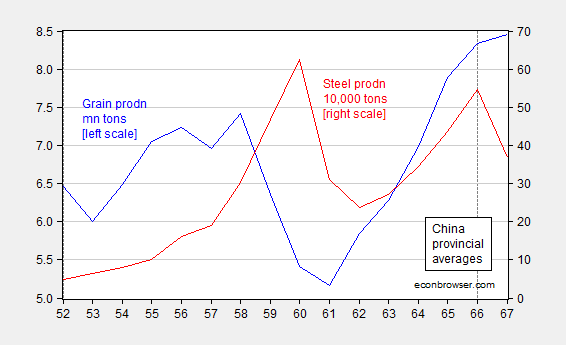
in applied price theory, applied welfare economics, comparative institutional analysis, development economics, economic growth, economic history, growth disasters, industrial organisation, law and economics, Marxist economics, Public Choice, rentseeking Tags: China, economics of planning, extreme poverty, famine, Great Leap Forward
Celebrating humanity's flourishing through the spread of capitalism and the rule of law
Celebrating humanity's flourishing through the spread of capitalism and the rule of law
Celebrating humanity's flourishing through the spread of capitalism and the rule of law
Celebrating humanity's flourishing through the spread of capitalism and the rule of law
Celebrating humanity's flourishing through the spread of capitalism and the rule of law
Celebrating humanity's flourishing through the spread of capitalism and the rule of law
Celebrating humanity's flourishing through the spread of capitalism and the rule of law
Celebrating humanity's flourishing through the spread of capitalism and the rule of law
A History of the Alt-Right
Econ Prof at George Mason University, Economic Historian, Québécois
Celebrating humanity's flourishing through the spread of capitalism and the rule of law
Scholarly commentary on law, economics, and more
Beatrice Cherrier's blog
Celebrating humanity's flourishing through the spread of capitalism and the rule of law
Celebrating humanity's flourishing through the spread of capitalism and the rule of law
Celebrating humanity's flourishing through the spread of capitalism and the rule of law
Why Evolution is True is a blog written by Jerry Coyne, centered on evolution and biology but also dealing with diverse topics like politics, culture, and cats.
Celebrating humanity's flourishing through the spread of capitalism and the rule of law
A rural perspective with a blue tint by Ele Ludemann
DPF's Kiwiblog - Fomenting Happy Mischief since 2003
Celebrating humanity's flourishing through the spread of capitalism and the rule of law
The world's most viewed site on global warming and climate change
Tim Harding's writings on rationality, informal logic and skepticism
A window into Doc Freiberger's library
Let's examine hard decisions!
Commentary on monetary policy in the spirit of R. G. Hawtrey
Thoughts on public policy and the media
Celebrating humanity's flourishing through the spread of capitalism and the rule of law
Politics and the economy
A blog (primarily) on Canadian and Commonwealth political history and institutions
Reading between the lines, and underneath the hype.
Economics, and such stuff as dreams are made on
"The British constitution has always been puzzling, and always will be." --Queen Elizabeth II
Celebrating humanity's flourishing through the spread of capitalism and the rule of law
Celebrating humanity's flourishing through the spread of capitalism and the rule of law
WORLD WAR II, MUSIC, HISTORY, HOLOCAUST
Undisciplined scholar, recovering academic
Celebrating humanity's flourishing through the spread of capitalism and the rule of law
Res ipsa loquitur - The thing itself speaks
In Hume’s spirit, I will attempt to serve as an ambassador from my world of economics, and help in “finding topics of conversation fit for the entertainment of rational creatures.”
Researching the House of Commons, 1832-1868
Articles and research from the History of Parliament Trust
Reflections on books and art
Posts on the History of Law, Crime, and Justice
Celebrating humanity's flourishing through the spread of capitalism and the rule of law
Exploring the Monarchs of Europe



Recent Comments