


via Managerial Econ: Forget income inequality, lets go after zoning restrictions….
Celebrating humanity's flourishing through the spread of capitalism and the rule of law
01 Jul 2014 1 Comment
in financial economics, human capital, income redistribution, rentseeking Tags: pension fund socialism, Peter Drucker, Piketty

Any attack on capitalism these days is a direct attack of the retirement savings of ordinary workers. We live in the age of what Peter Drucker called pension fund socialism in 1976. As Drucker added in 1991:
The rise of pension funds as dominant owners and lenders represents one of the most startling power shifts in economic history.
The first modern pension fund was established in 1950 by General Motors.
Four decades later, pension funds control total assets of $2.5 trillion, divided about equally between common stocks and fixed-income securities. Demographics guarantee that these assets will grow aggressively for at least another ten years.
The majority of equity capital is owned by pension funds and other collective investment vehicles corralling the savings of ordinary people. Much of the rest of physical capital is owned by workers through home ownership.
In the age of human capital, 70-90% of all capital in the economy is human capital. The notion of unskilled workers labouring away with the capital supplied by the bosses is 19th century throwback.
The rentier rich has been long replaced by the working rich. They make their fortunes in their own life times – sometimes as business entrepreneurs, sometimes through rent-seeking.
It is also the age of specific human capital, with a proliferation of technologies and products. The rising specialisation of firms and their production inputs has forced firms to try harder to find those inputs that suit their needs best. Management has the task of finding the right inputs. The role and reward to managers has therefore risen.
When the rise in returns on investments in human capital is beneficial and desirable, and policies designed to deal with inequality must take account of its cause. Growth in education levels has been a significant source of rising wages, productivity, and living standards over the past century.
The initial impact of higher returns to human capital is wider inequality in earnings, but that impact becomes more muted and may be reversed over time as young people invest more in their human capital.
The rentier class has been replaced by the working rich. The evidence on the top 1% is most consistent with theories of superstars, skill biased technological change, greater scale and their interaction of these factors.
Individuals who are really good at making money can now apply their skills to larger amounts of capital and reach far larger audiences and markets for their products and services. That favours CEOs, athletes, celebrities, corporate lawyers, successful entrepreneurs and other working rich Who have a skill or talent that can be supplied at little cost on a much larger scale. Some have a special dark place in their hearts for people who earned their money through honest hard work.
20 Jun 2014 Leave a comment
in financial economics, global financial crisis (GFC), great recession, macroeconomics, rentseeking Tags: crony capitalism, TARP
The US House of Representatives initially voted down the TARP in a grand coalition of right-wing republicans and left-wing democrats, voting 205–228. The right-wing republicans opposed the bailout because capitalism is a profit AND loss system. Democrats voted 140–95 in favour of the Bill while Republicans voted 133–65 against it.
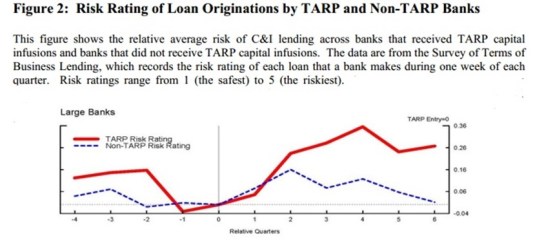
The chart above shows that the degree of risk in commercial loans made by TARP recipients appears to have increased. This is no surprise. In the 1960s, Sam Peltzman published a paper in in the 1960s showing that when deposit insurance was introduced in the USA in the 1930s, the banks halve their capital ratios. They did not need to have as much capital as before to back their lending. The chart below shows that the TARP really didn’t do much for economic policy uncertainty.

In an open letter sent to Congress, over 100 university economists described three fatal pitfalls in the TARP:
1) Its fairness. The plan is a subsidy to investors at taxpayers’ expense. Investors who took risks to earn profits must also bear the losses. The government can ensure a well-functioning financial industry without bailing out particular investors and institutions whose choices proved unwise.
2) Its ambiguity. Neither the mission of the new agency nor its oversight is clear. If taxpayers are to buy illiquid and opaque assets from troubled sellers, the terms, timing and methods of such purchases must be crystal clear ahead of time and carefully monitored afterwards.
3) Its long-term effects. If the plan is enacted, its effects will be with us for a generation. For all their recent troubles, America’s dynamic and innovative private capital markets have brought the nation unparalleled prosperity. Fundamentally weakening those markets in order to calm short-run disruptions is will short-sighted.
A recent IMF study of 42 systemic banking crises showed that in 32 cases, there was government financial intervention.
Of these 32 cases where the government recapitalised the banking system, only seven included a programme of purchase of bad assets/loans (like the one proposed by the US Treasury). These countries were Mexico, Japan, Bolivia, Czech Republic, Jamaica, Malaysia, and Paraguay.
The Government purchase of bad assets was the exception rather than the rule in banking crises and rightly so. The TARP mostly benefited bank shareholders. A case of privatising the gains and socialising the losses from banking was passed on the votes of Congressional Democrats.
14 Jun 2014 Leave a comment
in Adam Smith, economics of regulation, Public Choice, rentseeking Tags: competition and monopoly, The wealth of nations
The proposal of any new law or regulation of commerce which comes from this order, ought always to be listened to with great precaution, and ought never to be adopted till after having been long and carefully examined, not only with the most scrupulous, but with the most suspicious attention.
It comes from an order of men, whose interest is never exactly the same with that of the public, who have generally an interest to deceive and even oppress the public, and who accordingly have, upon many occasions, both deceived and oppressed it.
10 Jun 2014 Leave a comment
in entrepreneurship, industrial organisation, international economics, Public Choice, rentseeking Tags: picking winners

What World Bank consultant would risk his fee and return business on advising Egypt to specialise in the export of toilets to Italy? But Egypt’s largest single manufacturing export is toilets to Italy where it captured 93% of the market.
Kenya has a booming export business in cut flowers for men to buy for their wives. Kenya has 40% of the European markets for cut flowers. Nigeria has 84% of the Norwegian market for floating docks. The Philippines has 71% of the global market for electronic integrated circuits.
What development expert would have picked these winners? They’re far too far away from the conventional wisdom and the safe bets that are behind picking winners in government circles.
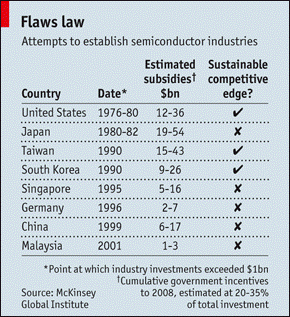
Picking winners by governments requires heroic assumptions not only about the information politicians and bureaucrats have about the present and their ability to predict the future, but also about their motivations and their ability to resist capture by special interests. The Economist explains:
None of these studies addresses a deeper problem with the way industrial policy tends to develop over time.
Earlier efforts have tended to degenerate into rent-seeking, lobbying and cosy deals between incumbent firms and bureaucrats, stifling innovation and the process of creative destruction.
The problem, of course, is that … industrial policy requires disinterested, benevolent policymakers who can do it well. Unfortunately, they do not yet have a recipe for how such policymakers can be created.
Policy is made by real people with political and personal motivations. What they come up with is unlikely to be as well designed as the ones in the models.
09 Jun 2014 Leave a comment
in economics of regulation, rentseeking, urban economics Tags: housing prices, land use regulation

The picture tells a 1000 words.
06 Jun 2014 Leave a comment
in Adam Smith, rentseeking Tags: The wealth of nations

The bounty to the white-herring fishery is a tonnage bounty; and is proportioned to the burden of the ship, not to her diligence or success in the fishery; and it has, I am afraid, been too common for vessels to fit out for the sole purpose of catching, not the fish, but the bounty.
02 Jun 2014 Leave a comment
in income redistribution, Public Choice, rentseeking Tags: The Samaritan's dilemma

HT: The Town Crier
01 Jun 2014 Leave a comment
in constitutional political economy, Gary Becker, income redistribution, Public Choice, rentseeking, Sam Peltzman Tags: growth in government, The Great Restraint
From 1950 to 1980 the size of government doubled in the developed world and then stopped dead in 1980. This great restraint on the growth of government happened everywhere. It was not just Thatcher’s Britain or Reagan’s America. It was everywhere, in France and Germany, and even in Scandinavia.
Peltzman’s data below has government spending double between 1950 and 1980, and then nothing much happened in between 1980 and 2007 – the size of government is pretty flat as a share of GDP for 27 years.
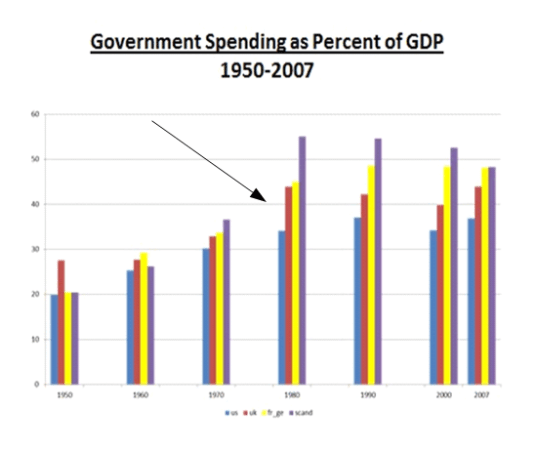
Source: Sam Peltzman, The Socialist Revival? (2012).
There is a noticeable reduction in the size of government spending in Scandinavia. Reagan and Thatcher had nothing on those Social Democrats in Scandinavia when it comes to cutting the size of government.
Governments everywhere hit a brick wall in terms of their ability to raise further tax revenues. Political parties of the Left and Right recognised this new reality.
Government spending grew in many countries in the 20th century because of demographic shifts, more efficient taxes, more efficient spending, a shift in the political power from those taxed to those subsidised, shifts in political power among taxed groups, and shifts in political power among subsidised groups.
The median voter in all countries was alive to the power of incentives and to not killing the goose that laid the golden egg.
After 1980, the taxed, regulated and subsidised groups had an increased incentive to converge on new lower cost modes of redistribution.
More efficient taxes, more efficient spending, more efficient regulation and a more efficient state sector reduced the burden of taxes on the taxed groups.
Most subsidised groups benefited as well because their needs were met in ways that provoked less political opposition.
Gary Becker made this warning about the political repercussions of tax reform and economic reform in general for the size of government:
…the greater efficiency of a VAT and its ease of collection is a two-edged sword.
On the one hand, it would raise a given amount of tax revenue efficiently and cheaply.
Since economists usually evaluate different types of taxes by their efficiency and ease of collecting a given amount of tax revenue, economists typically like value added taxes.
The error in this method of evaluating taxes is that it does not consider the political economy determinants of the level of taxes.
From this political economy perspective, the value added tax does not look so attractive, at least to those of us who worry that governments would spend and tax at higher levels than is economically and socially desirable.
Reforms ensued after 1980 led by parties on the Left and Right, with some members of existing political groupings benefiting from joining new political coalitions.
The deadweight losses of taxes, transfers and regulation limit inefficient policies and the sustainability of redistribution.
Peltzman likes to note that at the start of the 20th century, the United States government was about 8% of GDP. The two largest programs were education and highways. The post office was as big as the military.
Government is about five times that now with defence, health, education and income security accounting for 70% of this total. Peltzman makes the very interesting point that:
There is no new program in the political horizon that seems capable of attaining anything like the size of any of these four.
For the time being the future government rest on the extent of existing mega programs.
Health and income security account for 55% of total government spending in the OECD. It is in these two programs where the future of the growth of government lie.
The pressure for that growth in government will come from the elderly. Governments will have to choose between high taxes on the young to fund these programs for the elderly or find other options.
23 May 2014 Leave a comment
in applied price theory, applied welfare economics, economic growth, economics, international economics, Public Choice, rentseeking Tags: anti-foreign bias, Bryan Caplan, free trade, protectionism
20 May 2014 Leave a comment
in applied welfare economics, industrial organisation, Public Choice, rentseeking, survivor principle Tags: corporate welfare, farm welfare, middle-class welfare
The term corporate welfare was coined by Ralph Nader in 1956. Corporate welfare is subsidies, tax breaks, or other favourable treatment for business and implies that business are much less needy of such treatment than the poor.
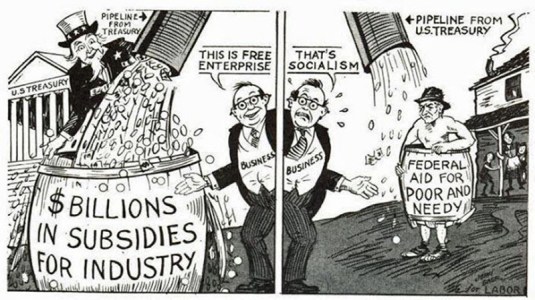 The Right talks of the deserving and undeserving poor. The Left countered with payments to business.
Supporters of corporate welfare often justify them as remedying some sort of purported market failure.
Businesses, big and small, see market failure everywhere under balance sheets that are in the red.
The notion behind corporate welfare is profits should be private while losses should be a reason for a taxpayer bailout.
 Both direct and indirect subsidies to businesses are classified as corporate welfare. The reason is businesses as supposed to make a profit or go out of business.
If a business is losing money, they should try better or do something different or just go out of business.
Losses are not a reason for a taxpayer bailout. No business project should be premised on government subsidies.
The purpose of the capital market is to direct investment to projects that have a future and take support away from failing projects.
The capital market is picking winners and losers every day because that’s its job. That’s what it’s good at.
The participants in the capital market who are not good at picking winners and avoiding losers will themselves will go soon out of business.
Corporate welfare is increasingly used interchangeably with crony capitalism.
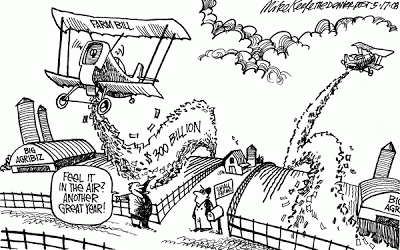 A kissing cousin of corporate welfare is farm welfare. These are the countless subsidies that farmers get in Europe and America, and in the past, in New Zealand.
Middle-class welfare is cash payments by the government to the non-poor. These payments to the middle-class can be for having children such as in Working for Families, for early-childhood education or for childcare. Middle-class welfare also can be tax breaks and subsidies for retirement savings of the nonpoor.
 It is pointless to tax the middle-class and then give them their money pretty much straight back as a cash payment for a particular purpose be it child care or for their retirement. Middle-class welfare covers at least in part expenses the middle-class could have covered themselves but for the taxes.
Celebrating humanity's flourishing through the spread of capitalism and the rule of law
Scholarly commentary on law, economics, and more
Beatrice Cherrier's blog
Celebrating humanity's flourishing through the spread of capitalism and the rule of law
Celebrating humanity's flourishing through the spread of capitalism and the rule of law
Celebrating humanity's flourishing through the spread of capitalism and the rule of law
Why Evolution is True is a blog written by Jerry Coyne, centered on evolution and biology but also dealing with diverse topics like politics, culture, and cats.
Celebrating humanity's flourishing through the spread of capitalism and the rule of law
Celebrating humanity's flourishing through the spread of capitalism and the rule of law
A rural perspective with a blue tint by Ele Ludemann
DPF's Kiwiblog - Fomenting Happy Mischief since 2003
Celebrating humanity's flourishing through the spread of capitalism and the rule of law
The world's most viewed site on global warming and climate change
Tim Harding's writings on rationality, informal logic and skepticism
A window into Doc Freiberger's library
Let's examine hard decisions!
Commentary on monetary policy in the spirit of R. G. Hawtrey
Thoughts on public policy and the media
Celebrating humanity's flourishing through the spread of capitalism and the rule of law
Politics and the economy
A blog (primarily) on Canadian and Commonwealth political history and institutions
Reading between the lines, and underneath the hype.
Economics, and such stuff as dreams are made on
"The British constitution has always been puzzling, and always will be." --Queen Elizabeth II
Celebrating humanity's flourishing through the spread of capitalism and the rule of law
Celebrating humanity's flourishing through the spread of capitalism and the rule of law
WORLD WAR II, MUSIC, HISTORY, HOLOCAUST
Undisciplined scholar, recovering academic
Celebrating humanity's flourishing through the spread of capitalism and the rule of law
Res ipsa loquitur - The thing itself speaks
In Hume’s spirit, I will attempt to serve as an ambassador from my world of economics, and help in “finding topics of conversation fit for the entertainment of rational creatures.”
Researching the House of Commons, 1832-1868
Articles and research from the History of Parliament Trust
Reflections on books and art
Posts on the History of Law, Crime, and Justice
Celebrating humanity's flourishing through the spread of capitalism and the rule of law
Exploring the Monarchs of Europe
Cutting edge science you can dice with
Small Steps Toward A Much Better World
“We do not believe any group of men adequate enough or wise enough to operate without scrutiny or without criticism. We know that the only way to avoid error is to detect it, that the only way to detect it is to be free to inquire. We know that in secrecy error undetected will flourish and subvert”. - J Robert Oppenheimer.
The truth about the great wind power fraud - we're not here to debate the wind industry, we're here to destroy it.
Celebrating humanity's flourishing through the spread of capitalism and the rule of law
Celebrating humanity's flourishing through the spread of capitalism and the rule of law
Economics, public policy, monetary policy, financial regulation, with a New Zealand perspective
Celebrating humanity's flourishing through the spread of capitalism and the rule of law
Restraining Government in America and Around the World


 Utopia, you are standing in it!
Recent Comments