Prime Minister Jim Hacker: “Well, of course we do what we can. There are many calls on the public purse: inner cities, schools, hospitals, kidney machines…”
The Kidney Machine Gambit & @NZSuperFund @VernonSmall @TaxpayersUnion
27 Mar 2017 Leave a comment
in fiscal policy, politics - New Zealand, public economics, television Tags: sovereign wealth funds, Yes Prime Minister
98% top US economists disagree @NZSuperFund strategy @VernonSmall @JordNZ
24 Mar 2017 Leave a comment
in financial economics, fiscal policy, politics - New Zealand, public economics Tags: active investing, efficient markets hypothesis, passive investing, sovereign wealth funds
There is always one. Liran Einav had to be the only economist out of 100 or so top American and European economists who disagreed with the proposition that:
In general, absent any inside information, an equity investor can expect to do better by choosing a well-diversified, low-cost index fund than by picking a few stocks.
The New Zealand Superannuation Fund’s policy of active investing has one supporter out of 100 surveyed by the Initiative for Global Markets. I suppose it is better than none.
Letter to @DomPost on @NZSuperfund performance @Taxpayersunion utopiayouarestandinginit.com/2017/03/18/let… https://t.co/wxo6F1zZn5—
Jim Rose (@JimRose69872629) March 18, 2017
The chief executive of the fund quibbles by claiming there is a 3rd way between active and passive investing but there is not as William Sharp explained in his timeless 1991 article, The Arithmetic of Active Management:
- A passive investor always holds every security from the market, with each represented in the same manner as in the market. Thus if security X represents 3 per cent of the value of the securities in the market, a passive investor’s portfolio will have 3 per cent of its value invested in X. Equivalently, a passive manager will hold the same percentage of the total outstanding amount of each security in the market2.
- An active investor is one who is not passive. His or her portfolio will differ from that of the passive managers at some or all times. Because active managers usually act on perceptions of mispricing, and because such misperceptions change relatively frequently, such managers tend to trade fairly frequently — hence the term “active.”
An active fund is a fund that is not a passive fund. If you do not own a balanced portfolio of every security in the market, you are an active investor.
The majority of the New Zealand Superannuation fund is passively invested but some of it is not. It is invested in dogs like KiwiBank, in Z service stations and even in some bad Portuguese loans.
It’s "threadbare" to question @NZSuperFund’s investment strategy @TaxpayersUnion
23 Mar 2017 Leave a comment
There really is an issue on which economists are unanimous, a big issue to boot.
Source: Diversified Investing | IGM Forum.
Actively-managed mutual funds cannot earn excess returns over index funds because in aggregate they earn the same as index funds, less the difference in cost. This was proposed by Sharpe in his timeless 1991 article, The Arithmetic of Active Management.
Of course, certain definitions of the key terms are necessary. First a market must be selected — the stocks in the S&P 500, for example, or a set of “small” stocks. Then each investor who holds securities from the market must be classified as either active or passive.
- A passive investor always holds every security from the market, with each represented in the same manner as in the market. Thus if security X represents 3 per cent of the value of the securities in the market, a passive investor’s portfolio will have 3 per cent of its value invested in X. Equivalently, a passive manager will hold the same percentage of the total outstanding amount of each security in the market2.
- An active investor is one who is not passive. His or her portfolio will differ from that of the passive managers at some or all times. Because active managers usually act on perceptions of mispricing, and because such misperceptions change relatively frequently, such managers tend to trade fairly frequently — hence the term “active.”
… Properly measured, the average actively-managed dollar must underperform the average passively-managed dollar, net of costs. Empirical analyses that appear to refute this principle are guilty of improper measurement.
In 2008, Warren Buffett made a bet of $1 million with Protégé Partners LLC that, including fees, costs and expenses, an S&P 500 index fund would outperform a hand-picked portfolio of hedge funds over the 10 years ending December 31, 2017.
How much is Working for Families per year?
20 Mar 2017 Leave a comment
in fiscal policy, politics - New Zealand, public economics Tags: family tax credits
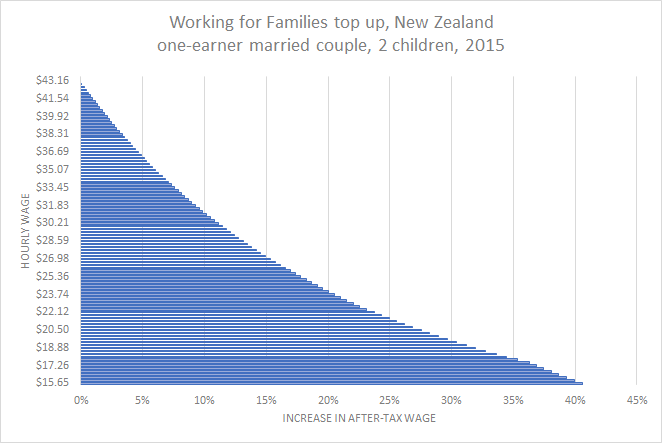
The last Labour Government so hated tax cuts that it would not call its family tax credit a family tax credit. For those on the minimum wage, it could increase your income by 1/3rd. Oddly enough, because of abatement rates of 22.5% after $36,000, two minimum wage earners do not get much at all.
Shouldn’t @NZSuperfund be funded by earmarked taxes? @TaxpayersUnion
19 Mar 2017 Leave a comment
in fiscal policy, macroeconomics, politics - New Zealand, public economics Tags: intergenerational equity, intergenerational justice, old age pensions, sovereign wealth funds
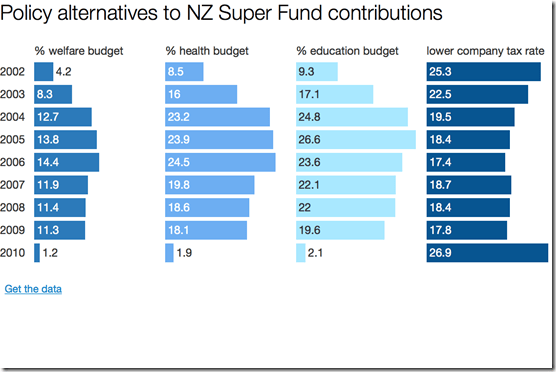
Pre-funding of New Zealand’s old age pension obligations requires contributions to the New Zealand Superannuation Fund now, higher taxes now in return for lower taxes later through the joys of compounding of the returns on the investments. If that is so, when the contributions are not made, the $3 billion in annual taxes should not be collected.
Source: Andrew Coleman, PAYGO vs SAYGO: Prefunding Government-provided Pensions, Motu Economics and Public Policy 26 Oct 2010.
There should be a separate New Zealand superannuation fund contribution levy that should lapse when contributions are suspended, as they were from 2009, and the pay-outs start after 2036? Otherwise, taxpayers will never see the promised lower taxes in the future. Never?
Source: Andrew Coleman Mandatory retirement income schemes, saving incentives, and KiwiSaver at http://www.treasury.govt.nz/publications/reviews-consultation/savingsworkinggroup/pdfs/swg-b-m-mris-24dec10.pdf
Constitutional political economy matters despite the reluctance of most who specialise in Social Security reform to think about that backend public choice risk. Unless there is iron-clad guarantee of lower taxes in the future, the whole deal about pre-funding superannuation pay-outs is a con.
That politicians can pass a law in 2003 to pre-fund old-age pensions 40 years hence and expect the politicians of 2036 and onwards to honour the deal with tax cuts is politically naive.
Efficient taxes lead to higher taxes
19 Mar 2017 1 Comment
in economic growth, fiscal policy, macroeconomics, public economics Tags: growth of government, size of government
My op-ed on the NZ super fund in the New Zealand Herald
18 Mar 2017 Leave a comment

The remainder of the op-ed can be found at http://www.nzherald.co.nz/opinion/news/article.cfm?c_id=466&objectid=11808972
Honest broker The Opportunities Party forgets its own history
23 Feb 2017 Leave a comment
in applied price theory, fiscal policy, politics - New Zealand, Public Choice, public economics

How much will Morgan’s capital tax cost you?
19 Feb 2017 3 Comments
in fiscal policy, politics - New Zealand, public economics
| Average house value January 2017 | Morgan capital tax 6% return |
Morgan capital tax 3.5% return |
|
|
New Zealand |
$631,302 |
$11,363 |
$6,629 |
|
Main Urban Areas |
$754,572 |
$13,582 |
$7,923 |
|
Auckland Area |
$1,047,699 |
$18,859 |
$11,001 |
|
Wellington Area |
$582,322 |
$10,482 |
$6,114 |
|
Far North District |
$389,811 |
$7,017 |
$4,093 |
|
Whangarei District |
$463,319 |
$8,340 |
$4,865 |
|
Kaipara District |
$463,896 |
$8,350 |
$4,871 |
|
Rodney District |
$933,456 |
$16,802 |
$9,801 |
|
Rodney – Hibiscus Coast |
$908,966 |
$16,361 |
$9,544 |
|
Rodney – North |
$961,450 |
$17,306 |
$10,095 |
|
North Shore City |
$1,214,291 |
$21,857 |
$12,750 |
|
North Shore – Coastal |
$1,387,368 |
$24,973 |
$14,567 |
|
North Shore – Onewa |
$971,364 |
$17,485 |
$10,199 |
|
North Shore – North Harbour |
$1,189,924 |
$21,419 |
$12,494 |
|
Waitakere City |
$836,574 |
$15,058 |
$8,784 |
|
Auckland City |
$1,225,096 |
$22,052 |
$12,864 |
|
Auckland City – Central |
$1,065,420 |
$19,178 |
$11,187 |
|
Auckland_City – East |
$1,532,815 |
$27,591 |
$16,095 |
|
Auckland City – South |
$1,107,912 |
$19,942 |
$11,633 |
|
Auckland City – Islands |
$1,036,288 |
$18,653 |
$10,881 |
|
Manukau City |
$901,422 |
$16,226 |
$9,465 |
|
Manukau – East |
$1,158,197 |
$20,848 |
$12,161 |
|
Manukau – Central |
$686,567 |
$12,358 |
$7,209 |
|
Manukau – North West |
$781,110 |
$14,060 |
$8,202 |
|
Papakura District |
$684,172 |
$12,315 |
$7,184 |
|
Franklin District |
$660,557 |
$11,890 |
$6,936 |
|
Thames-Coromandel District |
$645,780 |
$11,624 |
$6,781 |
|
Hauraki District |
$359,520 |
$6,471 |
$3,775 |
|
Waikato District |
$441,525 |
$7,947 |
$4,636 |
|
Matamata-Piako District |
$398,682 |
$7,176 |
$4,186 |
|
Hamilton City |
$531,337 |
$9,564 |
$5,579 |
|
Hamilton – North East |
$678,886 |
$12,220 |
$7,128 |
|
Hamilton – Central & North West |
$489,611 |
$8,813 |
$5,141 |
|
Hamilton – South East |
$482,333 |
$8,682 |
$5,064 |
|
Hamilton – South West |
$466,235 |
$8,392 |
$4,895 |
|
Waipa District |
$490,723 |
$8,833 |
$5,153 |
|
Otorohanga District |
$243,964 |
$4,391 |
$2,562 |
|
South Waikato District |
$188,852 |
$3,399 |
$1,983 |
|
Waitomo District |
$172,405 |
$3,103 |
$1,810 |
|
Taupo District |
$418,130 |
$7,526 |
$4,390 |
|
Western Bay of Plenty District |
$575,089 |
$10,352 |
$6,038 |
|
Tauranga City |
$672,752 |
$12,110 |
$7,064 |
|
Rotorua District |
$379,865 |
$6,838 |
$3,989 |
|
Whakatane District |
$380,691 |
$6,852 |
$3,997 |
|
Kawerau District |
$177,183 |
$3,189 |
$1,860 |
|
Opotiki District |
$248,261 |
$4,469 |
$2,607 |
|
Gisborne District |
$271,632 |
$4,889 |
$2,852 |
|
Wairoa District |
$161,966 |
$2,915 |
$1,701 |
|
Hastings District |
$392,182 |
$7,059 |
$4,118 |
|
Napier City |
$419,099 |
$7,544 |
$4,401 |
|
Central Hawkes Bay District |
$253,787 |
$4,568 |
$2,665 |
|
New Plymouth District |
$415,761 |
$7,484 |
$4,365 |
|
Stratford District |
$234,372 |
$4,219 |
$2,461 |
|
South Taranaki District |
$198,934 |
$3,581 |
$2,089 |
|
Ruapehu District |
$156,971 |
$2,825 |
$1,648 |
|
Whanganui District |
$207,752 |
$3,740 |
$2,181 |
|
Rangitikei District |
$163,111 |
$2,936 |
$1,713 |
|
Manawatu District |
$289,350 |
$5,208 |
$3,038 |
|
Palmerston North City |
$348,581 |
$6,274 |
$3,660 |
|
Tararua District |
$163,877 |
$2,950 |
$1,721 |
|
Horowhenua District |
$258,047 |
$4,645 |
$2,709 |
|
Kapiti Coast District |
$482,723 |
$8,689 |
$5,069 |
|
Porirua City |
$484,164 |
$8,715 |
$5,084 |
|
Upper Hutt City |
$433,538 |
$7,804 |
$4,552 |
|
Lower Hutt City |
$482,632 |
$8,687 |
$5,068 |
|
Wellington City |
$702,081 |
$12,637 |
$7,372 |
|
Wellington – Central & South |
$703,433 |
$12,662 |
$7,386 |
|
Wellington – East |
$753,259 |
$13,559 |
$7,909 |
|
Wellington – North |
$627,791 |
$11,300 |
$6,592 |
|
Wellington – West |
$808,685 |
$14,556 |
$8,491 |
|
Masterton District |
$276,020 |
$4,968 |
$2,898 |
|
Carterton District |
$321,476 |
$5,787 |
$3,375 |
|
South Wairarapa District |
$370,839 |
$6,675 |
$3,894 |
|
Tasman District |
$498,111 |
$8,966 |
$5,230 |
|
Nelson City |
$508,343 |
$9,150 |
$5,338 |
|
Marlborough District |
$423,753 |
$7,628 |
$4,449 |
|
Kaikoura District |
$398,058 |
$7,165 |
$4,180 |
|
Buller District |
$183,573 |
$3,304 |
$1,928 |
|
Grey District |
$211,780 |
$3,812 |
$2,224 |
|
Westland District |
$234,405 |
$4,219 |
$2,461 |
|
Hurunui District |
$378,276 |
$6,809 |
$3,972 |
|
Waimakariri District |
$434,854 |
$7,827 |
$4,566 |
|
Christchurch City |
$497,539 |
$8,956 |
$5,224 |
|
Christchurch – East |
$371,157 |
$6,681 |
$3,897 |
|
Christchurch – Hills |
$667,077 |
$12,007 |
$7,004 |
|
Christchurch – Central & North |
$588,632 |
$10,595 |
$6,181 |
|
Christchurch – Southwest |
$477,247 |
$8,590 |
$5,011 |
|
Christchurch – Banks Peninsula |
$514,403 |
$9,259 |
$5,401 |
|
Selwyn District |
$547,094 |
$9,848 |
$5,744 |
|
Ashburton District |
$348,788 |
$6,278 |
$3,662 |
|
Timaru District |
$335,449 |
$6,038 |
$3,522 |
|
MacKenzie District |
$420,915 |
$7,576 |
$4,420 |
|
Waimate District |
$229,085 |
$4,124 |
$2,405 |
|
Waitaki District |
$260,433 |
$4,688 |
$2,735 |
|
Central Otago District |
$411,111 |
$7,400 |
$4,317 |
|
Queenstown-Lakes District |
$1,032,560 |
$18,586 |
$10,842 |
|
Dunedin City |
$359,055 |
$6,463 |
$3,770 |
|
Dunedin – Central & North |
$372,295 |
$6,701 |
$3,909 |
|
Dunedin – Peninsular & Coastal |
$320,180 |
$5,763 |
$3,362 |
|
Dunedin – South |
$342,080 |
$6,157 |
$3,592 |
|
Dunedin – Taieri |
$375,669 |
$6,762 |
$3,945 |
|
Clutha District |
$190,208 |
$3,424 |
$1,997 |
|
Southland District |
$236,549 |
$4,258 |
$2,484 |
|
Gore District |
$200,826 |
$3,615 |
$2,109 |
|
Invercargill City |
$239,252 |
$4,307 |
$2,512 |
Liability is 6 percent of your capital equity which is then taxed at 30%. The return is assumed to be equal to the long-term bond rate for the last 10 years. That was 6% when Morgan wrote his book in 2011; that average long-term rate is about 3% now. I used his 2011 assumptions.


Recent Comments