21 Aug 2015
by Jim Rose
in applied price theory, business cycles, economic growth, economic history, labour economics, labour supply, macroeconomics, politics - Australia, politics - New Zealand, politics - USA, public economics
Tags: Australia, British economy, productivity shocks, real business cycles, taxation and labour supply
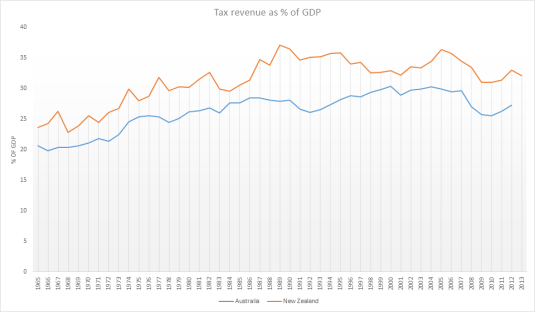
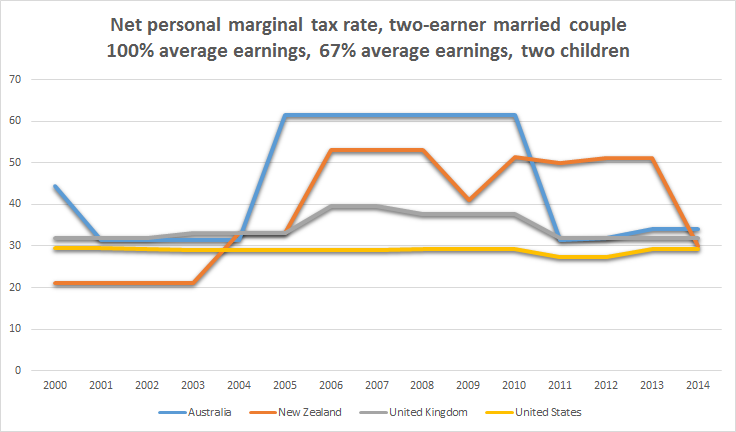
Interesting to notice that in New Zealand and the USA after these increases in marginal tax rates on single taxpayers, their economies slowed down. What appears to have happened is a number of people reached the next income tax marginal tax rate threshold.

Source: OECD StatExtract.
20 Aug 2015
by Jim Rose
in applied price theory, applied welfare economics, human capital, labour supply, politics - New Zealand, public economics
Tags: family tax credits, lost decades, taxation and the labour supply
21% would have been a good guess of the average and marginal tax rates of the New Zealand single earner or couple including with children and even a second earner in 2001. New Zealand average and marginal tax rates have been on a wild ride since the year 2000.

Sources: OECD StatExtract and OECD Taxing Wages.
As the above chart shows, while the average tax rate of a single earner with no children is pretty much unchanged at about 20%, he now faces a marginal tax rate of 30% or more rather than 21% in 2001.
For a married couple with one income, as the above chart shows, their average tax rate has been about zero for a good 10 years now but their net marginal tax rate is a good 50% or more because of abatement rates on family tax credits, which is a skewed incentive situation. A large income effect from the family tax credit encourages the consumption of leisure but a high marginal tax rate discourages working more.

Sources: OECD StatExtract and OECD Taxing Wages.
For two earner couples, their average tax rates have fallen because of family tax credits but their marginal tax rates have gone through the roof as the above chart shows. A tax system that discourages quite severely any further work or investment in human capital by average earners may have adverse effects on the long-term trend growth rate of New Zealand.
17 Aug 2015
by Jim Rose
in applied price theory, applied welfare economics, economic growth, economic history, entrepreneurship, financial economics, fiscal policy, industrial organisation, labour economics, labour supply, macroeconomics, politics - New Zealand, public economics
Tags: ageing society, company tax rate, deadweight cost of taxes, demographic crisis, efficient markets hypothesis, laffer curve, New Zealand superannuation fund, old age pensions, retirement savings, social insurance, sovereign wealth funds, taxation and entrepreneurship, taxation and investment, taxation and labour supply
The New Zealand Superannuation Fund, the sovereign wealth fund part funding New Zealand’s old-age pension from 2029/2030 onwards, has been a bit of a wild ride. Sometimes the earnings of the Fund were well below and sometimes earning well above the long-term bond rate.
![image_thumb[3] image_thumb[3]](https://utopiayouarestandinginit.com/wp-content/uploads/2015/08/image_thumb3_thumb.png?w=709&h=442)
Source: New Zealand Superannuation Fund Annual Report 2014.
Since its inception, the Fund earned an average annual return of 9.78%, which was 5.06% above the long-term bond rate, and 1.03% above its reference portfolio.

No information was given in the annual report of the New Zealand Superannuation Fund on the marginal dead weight cost of the taxes raised to fund the New Zealand Superannuation Fund to see whether there is any net benefit to taxpayers from its establishment and continued operation.

The New Zealand Government has contributed $14.88 billion to the fund from prior its inception in 2001 to the suspension of contributions in 2009 by the incoming National Party Government.

Source: New Zealand Treasury.
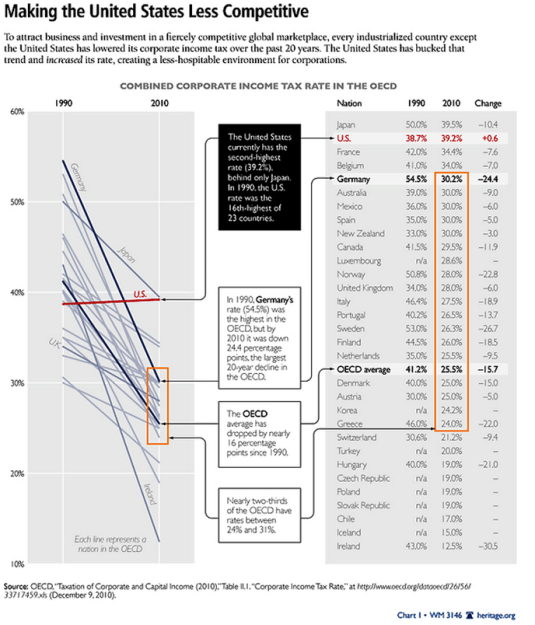
Over the nine years in which contributions were made, the company tax rate of 28% could have easily been up to 10 percentage points lower.
The New Zealand Treasury estimates that a one percentage point cut in the company tax costs about $220 million in forgone revenue if there are no other changes to the tax system. These are static estimates that do not include any feedback from greater investment and higher growth.
The New Zealand Superannuation Fund must beat the market every single year to make up for the deadweight cost of its funding, a premium for the investment risk added to the Crown’s portfolio and the cost to New Zealand’s growth rate of higher than otherwise taxes on income, entrepreneurship and investment.

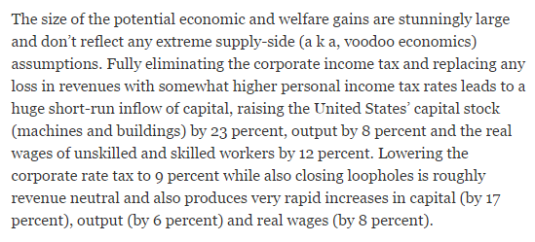
Source: Abolish the Corporate Income Tax – The New York Times.
16 Aug 2015
by Jim Rose
in applied price theory, economic growth, fiscal policy, macroeconomics, politics - Australia, politics - New Zealand, politics - USA, Public Choice, public economics
Tags: British economy, company tax rate, company taxation, optimal tax theory, race to the top, tax competition
15 Aug 2015
by Jim Rose
in constitutional political economy, law and economics, politics - USA, public economics
Tags: constitutional law, rule of law, separation of powers
JONATHAN TURLEY
By Darren Smith, Weekend contributor
Nearly eleven months after holding the State of Washington in contempt for failing to provide an adequate funding plan for financing primary education in the state, the Washington Supreme Court issued an order fining the state $100,000.00 per day until the legislature satisfies the Court’s judgement in its landmark McCleary decision.
After three special sessions, the Legislature failed to provide a clear and fully funded plan. The Court acted, much to the chagrin of many of the state legislators. A few of which had some rather interesting solutions to address their failures to act.
View original post 1,375 more words
15 Aug 2015
by Jim Rose
in applied price theory, industrial organisation, politics - New Zealand, public economics
Tags: privatisation, state owned enterprises
In the editorial today in the Dominion Post on the Solid Energy fiasco, the editorial writer made quite an extraordinary statement:
“Ideologues of the Right will claim that the whole sad fiasco shows the dangers of the state getting into business. This is simple-minded. Not all SOEs have ended up hundreds of millions of dollars in debt. Some SOEs have been well run; some have not.”
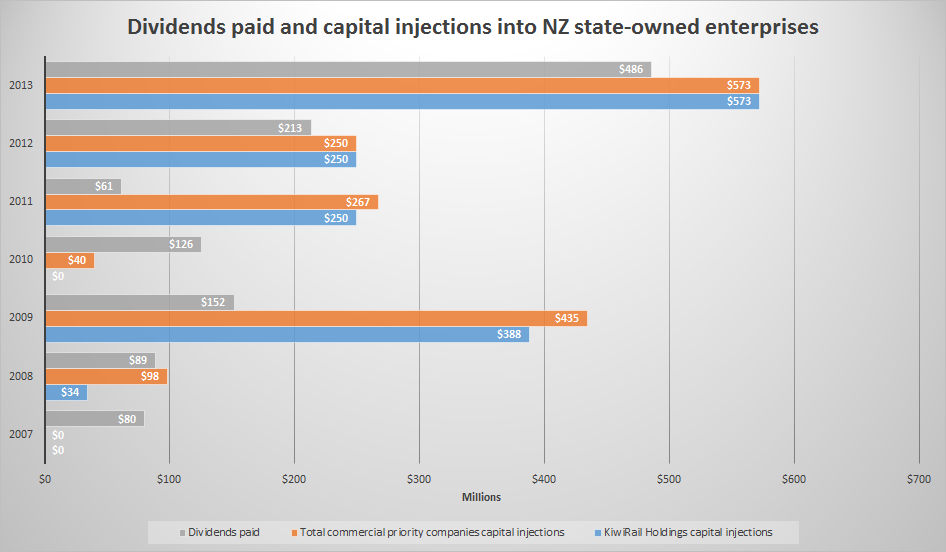
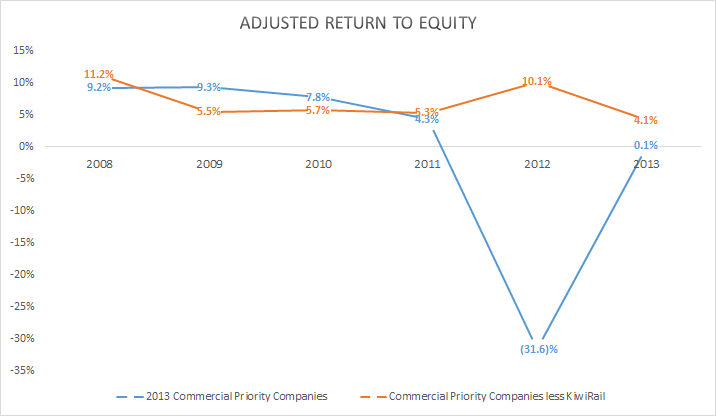
It is absurd to claim that making a $20 million net profit on a portfolio of $30 billion in state owned enterprises in 2013 is some sort of reasonable investment for the taxpayer.
Homepaddock
Opponents to the sale of minority shareholdings in a few state owned assets would have us believe that the government is selling the family silver.
Treasury’s annual portfolio return shows that silver isn’t returning much:
Government businesses with assets worth $45 billion made a total net profit of just $20 million in the year to June 30, according to the Treasury’s annual portfolio report.
The assets don’t include Meridian Energy, Air New Zealand and Mighty RiverPower, which were partially privatised, but cover troubled entities like KiwiRail, Solid Energy and New Zealand Post, which are all struggling to make their business models work.
The annual review covers Crown-owned assets valued at $125b.
A return of just $20 million on $125b is lamentably low.
“For the residual commercial priority portfolio, overall performance (with some notable exceptions) was mediocre,” the Treasury’s Crown Ownership Monitoring Unit says in the report. . .
Total shareholder…
View original post 332 more words
15 Aug 2015
by Jim Rose
in applied price theory, development economics, economic history, industrial organisation, politics - USA, public economics, rentseeking, survivor principle
Tags: Puerto Rico
Arindrajit Dube
(Co-authored with Ben Zipperer. Posted at Washington Center for Equitable Growth)
Puerto Rico today faces a serious debt crisis, recently defaulting on a bond payment. The proximate cause is a slowdown in economic growth since the mid-2000s, which has reduced tax revenues, and a declining labor market, where employment growth has been mostly in the red since 2007.
There are many explanations for the economic downturn and the resulting fiscal crisis, but some commentators have incorrectly blamed the island’s high minimum wage. To be sure, the federal minimum wage—which has applied to Puerto Rico since 1983—is much more binding there than it is on the mainland. Because hourly wages are substantially lower in Puerto Rico compared to the U.S. mainland, the federal minimum wage policy affects more of the workforce there. In 2014, for example, the federal minimum wage stood at 77 percent of the median hourly wage in Puerto Rico…
View original post 117 more words
14 Aug 2015
by Jim Rose
in applied price theory, income redistribution, labour economics, politics - New Zealand, poverty and inequality, Public Choice, public economics
Tags: child poverty, Director's Law, family poverty, family tax credits, welfare state
One group with negative net tax liability is low- to middle-income households with dependent children. For example, single-earner families with two children can earn up to around $60,000 pa before they pay any net tax.
Around half of all households with children receive more in welfare benefits and tax credits than they pay in income tax.
Bryan Perry (2015, p. 41)
![clip_image002[6] clip_image002[6]](https://utopiayouarestandinginit.com/wp-content/uploads/2015/08/clip_image0026_thumb.jpg?w=268&h=177)
10 Aug 2015
by Jim Rose
in applied price theory, applied welfare economics, comparative institutional analysis, currency unions, economic growth, economic history, economics of regulation, entrepreneurship, Euro crisis, fiscal policy, global financial crisis (GFC), income redistribution, labour economics, labour supply, macroeconomics, Marxist economics, poverty and inequality, Public Choice, public economics, rentseeking
Tags: British disease, entrepreneurial alertness, Eurosclerosis, France, German unification, Germany, growth of government, sick man of Europe, social insurance, Sweden, taxation and entrepreneurship, taxation and investment, taxation and labour supply, welfare state
The Washington Centre for Equitable Growth recently tweeted that inequality harms growth in the USA as compared to Sweden, France, Germany and the UK. It was relying on some dodgy OECD research.
The Washington Centre for Equitable Growth did not check their inequality ratios they tweeted against trends in economic growth and economic policy since 1970, which I have reproduced in figure 1. Germany is not included in figure 1 because German data on growth is thrown askew by German unification.
Figure 1: Real GDP per British, French and Swede aged 15-64, 2014 US$ (converted to 2014 price level with updated 2011 PPPs), 1.9 per cent detrended, 1970-2013

Source: Computed from OECD Stat Extract and The Conference Board. 2015. The Conference Board Total Economy Database™, May 2015, http://www.conference-board.org/data/economydatabase/
Figure 1 shows that France has been in a long-term decline since the late 1970s despite the blessings of a more equal society than the USA as championed by the Washington Centre for Equitable Growth. In figure 1, a flat line is growth in real GDP per working age person, PPP, at the same rate as the USA for the 20th century, which was 1.9% per year. A falling line in figure 1 indicates growth of less than 1.9% while a rising line indicates growth in real GDP per working age person, PPP, in excess of 1.9%. In figure 1, France hardly ever grew at the trend rate of growth for the USA of 1.9% per year and was frequently well below that rate.

Sweden tells a slightly different story in figure 1 because of regime change in the early 1990s when Sweden adopted more liberal economic policies where taxes and government spending were reduced:
The rapid growth of the state in the late 1960s and 1970s led to a large decline in Sweden’s relative economic performance. In 1975, Sweden was the 4th richest industrialised country in terms of GDP per head. By 1993, it had fallen to 14th.
That regime change reversed a long economic decline since 1970 under the egalitarian policies of the Swedish Social Democratic Party. Under the Swedish Social Democratic Party, Sweden was almost always growing at less than the trend rate of growth of the USA, which was 1.9%. That position reversed only when there was a turn away from big government and high taxes.

Figure 1 tells a similar story for the British economy: a long economic decline in the 1970s when Britain was the sick man of Europe. Under Thatchernomics, Europe had a long economic boom for 20 years or more – see figure 1.
In the 1970s, under the high taxes of the Heath, Callaghan and Wilson administrations, as figure 1 shows, Britain was the sick man of Europe. With the election of the Thatcher Government, Britain soon grew at better than the US trend growth rate for nearly 20 years through few exceptions.
02 Aug 2015
by Jim Rose
in labour economics, labour supply, politics - Australia, politics - New Zealand, politics - USA, public economics
Tags: Australia, British economy, Canada, France, Germany, taxation and labour supply
Previous Older Entries Next Newer Entries
Recent Comments