
Suburban rent seeking and green rent seeking are a dangerous brew for housing affordability
13 Jan 2015 Leave a comment


Child poverty monitor report finds that housing unaffordability is the cause of rising child poverty in NZ
02 Dec 2014 Leave a comment

Decongesting Auckland – For real – by Andrew Atkin
26 Nov 2014 Leave a comment
in politics - New Zealand, urban economics Tags: Andrew Atkin, Auckland urban limit, congestion charges, RMA, zoning
Housing habitability laws
25 Nov 2014 1 Comment
in economics of regulation, urban economics Tags: consumer products standards, do gooders, economics of regulation, nanny state, offsetting behaviour, rent control, The fatal conceit, The pretence to knowledge, urban economics

Minimum standards for rental housing is back in the news in New Zealand. After some deaths in some rather nasty fires in rental houses without fire alarms, there are demands that landlords must put fire alarms in place and maintain those fire alarms. About a dozen people or so die in fires in New Zealand every year.
The fact that in the proposed regulation, landlords are also required to maintain those fire alarms – ensure they have batteries in them – is a microcosm of the economics of rental housing habitability laws.
Even when landlords put in fire alarms, low income tenants prefer to spend their money on something other than replacement batteries for those alarms. These tenants are presumed to be competent to vote and drive cars, but not manage the risk of fires in the houses in which they live.
Maybe the reason for the lack of interest of low income tenants in putting batteries and fire alarms is domestic household fires are relatively rare these days. Fire is buried in the green area of the diagram below and is similar to drowning and falls.
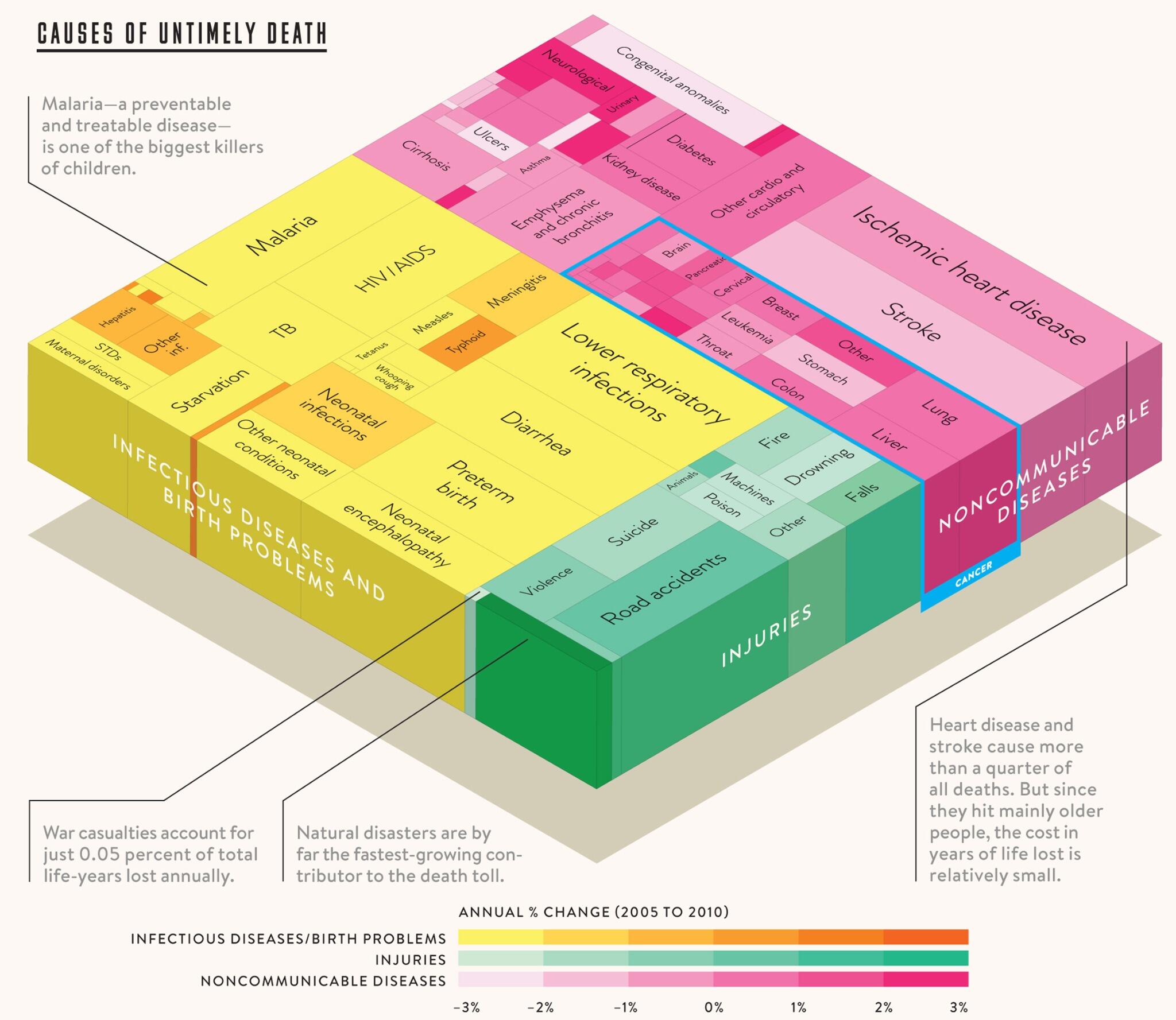
The American data below suggests that your chances of dying by fire are about the same as dying from choking and a little worse from dying from post surgery complications.

Rather than in need of nudging, your average low income tenants seems to have it pretty right regarding the risks of dying in a fire.
When I went looking for some economics of housing habitability laws, Google was a bit of a disappointment. There are some empirical work done in the 1970s and early 1980s and then it fell away.
My suspicion is there is not so much empirical work on the economics of housing habitability laws because proving the obvious is not a good investment in Ph.D. topics or tenure track economic research.

Walter Block wrote an excellent defence of slumlords in his 1971 book Defending the Undefendable:
The owner of ghetto housing differs little from any other purveyor of low-cost merchandise. In fact, he is no different from any purveyor of any kind of merchandise. They all charge as much as they can.
First consider the purveyors of cheap, inferior, and second-hand merchandise as a class. One thing above all else stands out about merchandise they buy and sell: it is cheaply built, inferior in quality, or second-hand.
A rational person would not expect high quality, exquisite workmanship, or superior new merchandise at bargain rate prices; he would not feel outraged and cheated if bargain rate merchandise proved to have only bargain rate qualities.
Our expectations from margarine are not those of butter. We are satisfied with lesser qualities from a used car than from a new car. However, when it comes to housing, especially in the urban setting, people expect, even insist upon, quality housing at bargain prices.
Richard Posner discussed housing habitability laws in his Economic Analysis of the Law. The subsection was titled wealth distribution through liability rules. Posner concluded that habitability laws will lead to abandonment of rental property by landlords and increased rents for poor tenants.

What do-gooder would want to know that a warranty of habitability for rental housing will lead to scarcer, more expensive housing for the poor! Surprisingly few interventions in the housing market work to the advantage of the poor.
Certainly, there will be less rental housing of a habitability standard below that demanded by do-gooders. In the Encyclopaedia of Law and Economics entry on renting, Werner Hirsch said:
It would be a mistake, however, to look upon a decline in substandard rental housing as an unmitigated gain. In fact, in the absence of substandard housing, options for indigent tenants are reduced. Some tenants are likely to end up in over-crowded standard units, or even homeless.
One World Trade Center is finally open for business. All 12 years of construction in one gif!
07 Nov 2014 Leave a comment
in economics of media and culture, politics - USA, urban economics Tags: World Trade Center
Why Middle-Class Americans Can’t Afford to Live in Liberal Cities – The Atlantic
07 Nov 2014 Leave a comment
in applied welfare economics, economics of regulation, environmental economics, income redistribution, Public Choice, rentseeking, urban economics Tags: Director's Law, green rent seeking, land use regulation, zoning


Andrew Atkin explains how housing affordability has been destroyed in New Zealand.
05 Nov 2014 Leave a comment
in economics of regulation, politics - New Zealand, politics - USA, urban economics Tags: Auckland urban limit, land use regulation, metropolitan urban limits, Resource Management Act, zoning
Heritage trumps safety
03 Nov 2014 Leave a comment
in applied welfare economics, economics of regulation, urban economics Tags: Christchurch earthquake, green rent seeking, health and safety, Heritage regulation

Quote of the day:
. . . Deaths in earthquakes are somewhat unavoidable. But deaths caused by regulatory structures that force that little value is placed on human life, or that prevent a building owner from tearing down a building very likely to kill a pile of people in a quake, are worse than tragic – they’restupid. Offsetting Behaviour.
It’s in a post on heritage rules which make some buildings untouchable and how the burden of providing the heritage amenity falls on the owner of the building.
He has a better idea:
I’ve suggested an alternative structure where we run heritage protection as an on-budget Council expenditure. Have each Council decide how much money they’re willing to put into heritage preservation, perhaps have Central provide a matching grant, and open it up to further voluntary contributions from the public. Then, have the heritage boards decide how and…
View original post 176 more words
Solutions should reflect the problem definition and analysis: Duncan Garner on child poverty
02 Nov 2014 Leave a comment
in economics of religion, labour economics, politics - New Zealand, urban economics, welfare reform Tags: child poverty, Duncan Garner, expressive voting, green rent seeking, land use zoning, regulation of land supply, Resource Management Act
Duncan Garner wrote a passionate column yesterday in the local paper calling for gutsy action on child poverty.
His analysis of the causes of child poverty in New Zealand was good. Garner’s solutions had nothing to do with what he had identified as the causes of child poverty. As Garner himself wrote:
… in order to tackle poverty it’s important to attempt to define what it means today.
Poverty is children living in crowded, damp homes who don’t get three square meals a day.
They may not have their own bed, they won’t see a doctor when they’re sick and many of them will be admitted to hospital with serious poverty-related illnesses such as respiratory problems and skin infections.
They may live in households where paying the rent accounts for 60 per cent of the family’s income every week.
Garner then discussed the plight of one particular family in Auckland:
The parents are nice people, with seven children.
They shared a tiny home with three other adults and another child.
Dad works full-time at a meat factory and they had been waiting 10 months for a state house. They had beds in the dining room and lounge.
They couldn’t afford the cost of a private rental home. One son, aged 11, had a serious lung problem. I saw poverty in action that day and it was deeply disturbing. I highlighted their plight on my radio show and within weeks a shamed Housing NZ had found them a home.
The family Garner discussed is in a tiny house because they lacked the income to rent a better one. They must rely on social housing provided by government with income related rents.
Recurring through his problem definition is the impact that rising housing costs is having on the poor.
Nonetheless, Garner then advocates cash payments to low income families, a tax credit system seen as more generous and inclusive, and a back to school bonus without addressing the supply of housing.
The evidence is overwhelming in New Zealand that the main driver of the increases in the child poverty since the 1980s is rising housing costs.
In the longer run after housing costs child poverty rates in 2013 were close to double what they were in the late 1980s mainly because housing costs in 2013 were much higher relative to income than they were in the late 1980s.
– Bryan Perry, 2014 Household Incomes Report – Key Findings. Ministry of Social Development (July 2014).
Any policy to reduce child poverty must increase the supply of houses by reducing regulatory restrictions on the supply of land.
The Metropolitan Limit confines the expansion of Auckland beyond the existing built-up area. This regulatory constraint explains the exceptionally high housing price-income ratio of Auckland.

The limit imposed on the horizontal expansion of the city in green fields encourages increases in residential prices. As demand for new housing increases, no new land supply can enter the market and stem price rises in response to this increased demand.

If you serious about child poverty, you have to criticise government regulation: the dead hand of the Resource Management Act (RMA) on the poor and the vulnerable.
Edward Glaeser on Radio New Zealand on how cities are the healthiest, greenest, and richest (in cultural and economic terms) places to live
10 Oct 2014 Leave a comment
in urban economics Tags: Edward Glaeser
http://www.radionz.co.nz/audio/remote-player?id=2601280
- Cities haven’t demised as once thought would happen but urban living remains dynamic and important.
- Change in cities has followed technology progress – originally cities built around places of industry and transport hubs, that changed as transport costs changed.
- People assumed the trend would continue with information technology changes but the opposite happened. Led to increased returns to being smart and innovative. Cities make that happen easier due to a greater chance of interaction between people.
- Cities are places of pleasure as well as productivity.
- Government policy shouldn’t be anti urban – most western countries have a suburban twist on public policy that penalises the city in favour of the suburbs.
- Every time we say no to developments that add dwellings we’re saying no to families who would like to live in the city and saying no to a more affordable city.
- The most economically successful cities tend to be strong on education – human capital is the bedrock to success.
- The paradox of development from an environmental perspective is that things that look green are usually pretty brown and things that look brown are usually pretty green. This is primarily because people in dense areas tend to have fewer transport emissions and smaller dwellings use less energy.
- The biggest human advancements have come from interaction between different sectors where ideas can spread
- Tech companies like Google show the importance of face to face interaction rather than just teleworking. After all if any companies could do remote working it’s them.
- Unlike with providing clean water there is no engineering solution to congestion and we can’t build your way out of it. Only way to address it is by pricing it.
- Two great dangers in building cities is NIMBISM and Monumentalism. Need to find a balance between the two to create more liveable cities
HT: transportblog


 Utopia, you are standing in it!
Recent Comments