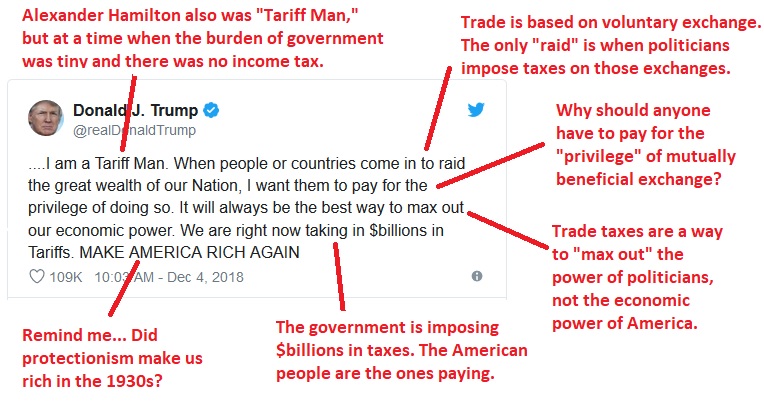
Donald Trump, who describes himself as “Tariff Man,” recently wrote a column in defense of his protectionist trade policy for the Wall Street Journal. After reading the column, my first thought was that Trump was trying to show he is more economically illiterate than Joe Biden (a big challenge, as seen here and here). And […]
How we connect economically with the world is critical. Brian Easton writes – The British Labour Government is struggling. Partly it is because they were badly prepared in opposition: the Conservative Government was making such a charlie of itself that Labour expected that it would do better and gave little thought as to how it […]
It seems as if a few times every week, I see a headline about President Trump announcing a new tariff or repealing a tariff, sometimes involve many countries and sometime just a few. However, it is not at all clear that any president has a right to alter tariffs. This question was raised before Trump…
Assume the courts do not strike this down (perhaps they will?). Will foreigners still be hired at the entry level with an extra 100k surcharge? I would think not,as university budgets are tight these days. I presume there is some way to turn them down legally, without courting discrimination lawsuits? What if you ask them […]
Our estimates indicate that the AfD’s vote share would shrink by as much as 75% if the CDU adopted its immigration stance. These results suggest that the electoral success of populist parties is strongly linked to genuine policy preferences, rather than being driven solely by dissatisfaction with political elites or protest voting. That is from […]
In our textbook, Tyler and I give an amusing example of how entrepreneurs circumvented U.S. tariffs and quotas on sugar. Sugar could be cheaply imported into Canada and iced tea faced low tariffs when imported from Canada into the U.S., so firms created a high-sugar iced “tea” that was then imported into the US and […]
In Washington, D.C., District Court Judge Randolph Moss has issued a notable decision against the Trump Administration in Refugee and Immigrant Center for Legal and Educational Services v. Noem. Judge Moss rejected the use of Trump’s January 20 “invasion” executive proclamation to block undocumented immigrants from pursuing asylum applications and other legal pathways. The court essentially rules […]
TweetMr. Howard Lutnick Secretary, U.S. Department of Commerce Washington, DC Mr. Lutnick: Yesterday you tweeted this: Our trade deal with Vietnam is a massive win for America’s businesses, manufacturers, and farmers! For the FIRST TIME EVER, Vietnam will open its market to the United States. They will pay 20% to sell their products here, and…
That is the new book by John H. Cochrane, Luis Garicano, and Klaus Masuch, and the subtitle is Challenges, Evolution, and Future of the Euro. Excerpt: Our main theme is not actions taken in crises, but that member states and EU institutions did not clean up between crises. They did not reestablish a sustainable framework […]
Below is my column in the New York Post on the decision yesterday finding that the Trump tariffs are invalid. What happens now will be, if nothing else, interesting. Dusk has come to Liberation Day. Trump has options, but the pressure will now be greater on Congress as bilateral trade agreements are moving forward. Here […]
TweetWhen President Ronald Reagan delivered this address in November 1982, I was a 24-year-old graduate student. Radically libertarian at that point for almost six years, I was sufficiently astute enough to know that Reagan wasn’t terrible on most of the issues that I cared about, but I was nevertheless insufficiently mature and astute enough to…
The White House released a list of countries and the tariff rates they charged the US. It was clearly wrong as NZ has an average tariff of around 1.7% on US imports and the list said 20%. I thought it was because they were including our GST of 15%. That would have been very dumb, […]
See ‘Mellon vs. Churchill’ Review: The Payback Problem by Benn Steil. He reviewed the book Mellon vs. Churchill: The Untold Story of Treasury Titans at War by Jill Eicher. Excerpts:”In a nutshell, the debt story of the 1920s goes like this. Following World War I, 10 countries owed the U.S. more than $10 billion ($190 billion…
Chris Trotter writes – What does India want from New Zealand? Not our dairy products, that’s for sure, it’s got plenty of those. Indeed 45 percent of the Indian population are small-scale farmers, most of them running a few head of cattle – not to eat, you understand – but to milk. If it once […]
Why Evolution is True is a blog written by Jerry Coyne, centered on evolution and biology but also dealing with diverse topics like politics, culture, and cats.
“We do not believe any group of men adequate enough or wise enough to operate without scrutiny or without criticism. We know that the only way to avoid error is to detect it, that the only way to detect it is to be free to inquire. We know that in secrecy error undetected will flourish and subvert”. - J Robert Oppenheimer.


 Utopia, you are standing in it!
Recent Comments