
At least 20% of New Zealand workers are subject to occupational regulation
08 Jul 2014 Leave a comment
in applied price theory, applied welfare economics, comparative institutional analysis, David Friedman, economics of information, economics of regulation, entrepreneurship, industrial organisation, labour economics, law and economics, managerial economics, market efficiency, Milton Friedman, personnel economics, politics - New Zealand, Ronald Coase Tags: adverse selection, asymmetric information, blackboard economics, moral hazard, occupational regulation, screening, signalling
There are at least 98 regulated occupations in New Zealand covering about 20% of the workforce. In 2011, this amounts to 440,371 workers. The skills that are regulated range across all skill sets and many occupations:
- 49% of regulation is in the form of a licence;
- 18% of regulated work is in the form of licensing of tasks;
- 31% of regulated workers require a certificate; and
- 4% of regulated workers require registration.
There are 32 different governing Acts that regulated occupations in New Zealand with 55% of the workers subject to occupational regulation are employed in just five occupations:
- 98,000 teachers;
- 48,500 nurses;
- 42,730 bar managers;
- 32,733 chartered accountants; and
- 22,749 electricians.
The Health Practitioners Competency Assurance Act 2003 regulates 22 occupations and a total of 89,807 workers. The next best is the 10 occupations regulated by the Health and Safety in Employment Act 2002 which regulates an unknown number of occupations. The Civil Aviation Act 1990 regulates eight occupations and 19,095 workers, the Building Act 2004 regulates seven occupations and 21,101 workers and the Maritime Transport Act 1994 regulates six occupations and 20,500 workers. 12 of the regulated occupations are regulated under laws passed since 2007.
The purpose of occupational regulation is to protect buyers from quacks and lemons – to overcome asymmetric information about the quality of the provider of the service.
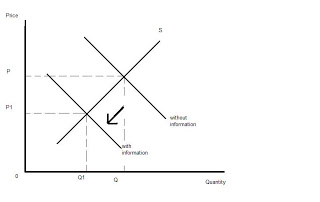
Adverse selection occurs when the seller knows more than the buyer about the true quality of the product or service on offer. This can make it difficult for the two people to do business together. Buyers cannot tell the good from the bad products on offer so many they do not buy to all and withdraw from the market.
Goods and services divide into inspection, experience and credence goods.
- Inspection goods are goods or services was quality can be determined before purchase price inspecting them;
- Experience goods are goods whose quality is determined after purchase in the course of consuming them; and
- Credence goods are goods whose quality may never be known for sure as to whether the good or service actually worked – was that car repair or medical procedure really necessary?
The problem of adverse selection over experience and credence goods present many potentially profitable but as yet unconsummated wealth-creating transactions because of the uncertainty about quality and reliability.
Buyers are reluctant to buy if they are unsure of quality, but if such assurances can be given in a credible manner, a significant increase in demand is possible.
Any entrepreneur who finds ways of providing credible assurances of the quality of this service or work stands to profit handsomely. Brand names and warranties are examples of market generated institutions that overcome these information gaps through screening and signalling.
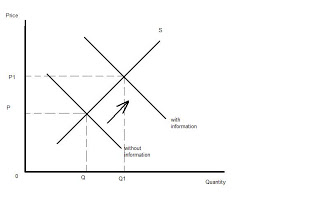
Screening is the less informed party’s effort, usually the buyer, to learn the information that the more informed party has. Successful screens have the characteristic that it is unprofitable for bad types of sellers to mimic the behaviour of good types.
Signalling is an informed party’s effort, usually the seller, to communicate information to the less informed party.
The main issue with quacks in the labour market is whether there are a large cost of less than average quality service, and is there a sub-market who will buy less than average quality products in the presence of competing sellers competing on the basis of quality assurance. This demand for assurance creates opportunities for entrepreneurs to profit by providing assurance.
David Friedman wrote a paper about contract enforcement in cyberspace where the buyer and seller is in different countries so conventional mechanisms such as the courts are futile in cases where the quality of the good is not as promised or there is a failure to deliver at all:
Public enforcement of contracts between parties in different countries is more costly and uncertain than public enforcement within a single jurisdiction.
Furthermore, in a world where geographical lines are invisible, parties to publicly enforced contracts will frequently not know what law those contracts are likely to fall under. Hence public enforcement, while still possible for future online contracts, will be less workable than for the realspace contracts of the past.
A second and perhaps more serious problem may arise in the future as a result of technological developments that already exist and are now going into common use. These technologies, of which the most fundamental is public key encryption, make possible an online world where many people do business anonymously, with reputations attached to their cyberspace, not their realspace, identities
Online auction and sales sites address adverse selection with authentication and escrow services, insurance, and on-line reputations through the rating of sellers by buyers.
E-commerce is flourishing despite been supposedly plagued by adverse selection and weak contract enforcement against overseas venders.
In the labour market, screening and signalling take the form of probationary periods, promotion ladders, promotion tournaments, incentive pay and the back loading of pay in the form of pension investing and other prizes and bonds for good performance over a long period.
In the case of the labour force, there are good arguments that a major reason for investments in education is as a to signal quality, reliability, diligence as well as investment in a credential that is of no value the case of misconduct or incompetence. Lower quality workers will find it very difficult if not impossible to fake quality and reliability in this way – through investing in higher education.
In the case of teacher registration, for example, does a teacher registration system screen out any more low quality candidates for recruitment than do proper reference checks and a police check for a criminal record.
Mostly disciplinary investigations and deregistrations under the auspices of occupational regulation is for gross misconduct and criminal convictions rather than just shading of quality.
Much of personnel and organisational economics is about the screening and sorting of applicants, recruits and workers by quality and the assurance of performance.
Alert entrepreneurs have every incentive to find more profitable ways to manage the quality of their workforce and sort their recruitment pools.
Baron and Kreps (1999) developed the recruitment taxonomy made up of stars, guardians and foot-soldiers.
Stars hold jobs with limited downside risk but high performance is very good for the firm – the costs of hiring errors for stars such as an R&D worker are small: mostly their salary. Foot-soldiers are employees with narrow ranges of good and bad possible outcomes.
Guardians have jobs where bad performance can be a calamity but good job performance is only slightly better than an average performance.
Airline pilots and safety, compliance, finance and controller jobs are all examples of guardian jobs where risk is all downside. Bad performance of these jobs can bring the company down. Dual control is common in guardian jobs.
The employer’s focus when recruiting and supervising guardians is low job performance and not associating rewards and promotions with risky behaviours. Employers will closely screen applicants for guardian jobs, impose long apprenticeships and may limit recruiting to port-of-entry jobs.
The private sector has ample experience in handling risk in recruitment for guardian jobs. Firms and entrepreneurs are subject to a hard budget constraints that apply immediately if they hire quacks and duds.
Blackboard economics says that governments may be able to improve on market performance but as Coase warned that actually implement regulatory changes in real life is another matter:
The policy under consideration is one which is implemented on the blackboard.
All the information needed is assumed to be available and the teacher plays all the parts. He fixes prices, imposes taxes, and distributes subsidies (on the blackboard) to promote the general welfare.
But there is no counterpart to the teacher within the real economic system
Occupational regulation comes with the real risk of the regulation turning into an anti-competitive barrier to entry as Milton Friedman (1962) warned:
The most obvious social cost is that any one of these measures, whether it be registration, certification, or licensure, almost inevitably becomes a tool in the hands of a special producer group to obtain a monopoly position at the expense of the rest of the public.
There is no way to avoid this result. One can devise one or another set of procedural controls designed to avert this outcome, but none is likely to overcome the problem that arises out of the greater concentration of producer than of consumer interest.
The people who are most concerned with any such arrangement, who will press most for its enforcement and be most concerned with its administration, will be the people in the particular occupation or trade involved.
They will inevitably press for the extension of registration to certification and of certification to licensure. Once licensure is attained, the people who might develop an interest in undermining the regulations are kept from exerting their influence. They don’t get a license, must therefore go into other occupations, and will lose interest.
The result is invariably control over entry by members of the occupation itself and hence the establishment of a monopoly position.
Friedman’s PhD was published in 1945 as Income from Independent Professional Practice. With co-author Simon Kuznets, he argued that licensing procedures limited entry into the medical profession allowing doctors to charge higher fees than if competition were more open.
Data Source: Martin Jenkins 2012, Review of Occupational Regulation, released by the Ministry of Business, Innovation and Employment under the Official Information Act.
The Keynesian vision of macroeconomic policy
05 Jul 2014 Leave a comment
in macroeconomics, Milton Friedman, organisational economics Tags: forecasting errors, Keynesian macroeconomics, leads and lags on monetary policy, The fatel conceit, The pretence to knowledge

A market economy is subject to fluctuations which need to be corrected, can be corrected, and therefore should be corrected
Franco Modiglani
Milton Friedman’s vision is far more circumspect because of the limits on the information people have and their ability to update that information. His critique has nothing to do with his views on macroeconomics:
The central problem is not designing a highly sensitive [monetary] instrument that offsets instability introduced by other factors [in the economy], but preventing monetary arrangements becoming a primary source of instability…
Keynesians have a host of metaphors in their rhetorical arsenal; one frequently voiced is that a wise government should “lean against the wind” when choosing policy. Friedman jumped on this:
We seldom know which way the economic wind is blowing until several months after the event, yet to be effective, we need to know which way the wind is going to be blowing when the measures we take now will be effective, itself a variable date that may be a half year or a year or two from now. Leaning today against next year’s wind is hardly an easy task in the present state of meteorology
Friedman’s remarks, as even his strong critics admit, strike at the heart of any activist stabilisation policy. By meeting Keynesians on their own theoretical turf and scrutinising their practice, Friedman manages to produce objections that both Keynesians and non-Keynesians must take seriously.
A key part of any response to Friedman rests on the ability of forecasters to do their jobs with tolerable accuracy. After reading the annual reports of the Fed, Milton Friedman noticed the following pattern:
In the years of prosperity, monetary policy is a potent weapon, the skilful handling of which deserves the credit for the favourable course of events; in years of adversity, other forces are the important sources of economic change, monetary policy had little leeway, and only the skilful handling of the exceedingly limited powers available prevented conditions from being even worse
Central banks pay due to the implications of the leads and lags on monetary policy only as an ex-post facto rationalisation for disappointment.
If there is such a thing as a liquidity trap, bring it on!
04 Jul 2014 Leave a comment
in business cycles, fiscal policy, macroeconomics, Milton Friedman, monetary economics Tags: Allan Meltzer, JM Keynes, liquidity trap, Milton Friedman
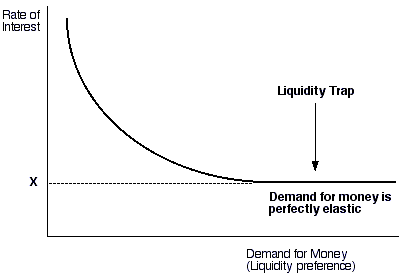
In the Keynesian pipedream, in a liquidity trap, there is perfect substitutability of money and bonds at a zero short-term nominal interest rate. This renders monetary policy ineffective.
Keynesians claim that the demand for money may be so persistently high that the rate of interest could not fall low enough to stimulate investment sufficiently to raise the economy out of the depression. Allan Meltzer explains:
A liquidity trap means that increases in money by the central bank (monetary base) cannot affect output, prices, interest rates or other variables. Changes in the money stock are entirely matched by changes in the demand to hold money.
With a liquidity trap, the public simply hoards the money the central bank creates rather than attempting to run down additions to their cash balances with increased consumer expenditure. This limitless accumulation of money by the public is not a real world phenomenon. The public will not forever accumulate money.
Auerbach and Obstfeld noted in "The Case for Open-Market Purchases in a Liquidity Trap" that to the extent that long-term interest rates are positive short-term interest rates are expected to be positive in the future, trading money for interest-bearing public debt through open market operations reduces future debt-service requirements.
- A massive monetary expansion during a liquidity trap should improve social welfare by reducing the taxes required in the future to service the now much smaller national debt!!!!
- A quantitative easing during a liquidity trap is, in effect, as good as or even better than a lump sum tax.
Central banks perhaps should contrive liquidity traps because they can then buy back the public debt because of the unlimited demand for money.
The logic of the liquidity trap is people will without limit give up bonds for non-interest bearing cash. If monetary policy is impotent near the zero bound, the central bank should buy trillions of dollars of federal bonds and payoff the public debt. This is a logical implication of liquidity traps for an optimal fiscal policy!!!! Is my reasoning wrong?
In addition to D.H. Robertson, Jacob Viner, Milton Friedman, Philip Cagan, Don Patinkin, Auerbach and Obstfeld, Robert H. Lucas, Greg Mankiw, and Bernanke and Blinder as sceptics about a liquidity trap, Keynes wrote in 1936:
Whilst the limiting case might become practically important in future, I know of no example of it hitherto. Indeed, owing to the unwillingness of most monetary authorities to deal boldly in debts of long term, there has not been much opportunity for a test.
Meltzer, who wrote A History of the Federal Reserve, Vol. 1: 1913-1951 points to several periods when interest rates were at or close to zero:
“In 1954, interest rates were 0.5 percent or below, and we had no problem recovering,” he says. “In 1948 to 1949, we had zero interest rates. Also in 1937 to 1938. We had no problem recovering.”
The Pigou effect states that when there is deflation of prices, employment (and output) will be increased due to an increase in wealth (and thus consumption). The deflation increases the value of cash balances and therefore the wealth of consumers. They spend some of this additional wealth.
After reading the annual reports of the Fed in the 1920s and 1930s, Milton Friedman noticed the following pattern:
In the years of prosperity, monetary policy is a potent weapon, the skilful handling of which deserves the credit for the favourable course of events; in years of adversity, other forces are the important sources of economic change, monetary policy had little leeway, and only the skilful handling of the exceedingly limited powers available prevented conditions from being even worse

Milton Friedman on what presidents can do to increase the economic growth rate
28 Jun 2014 1 Comment
in economic growth, macroeconomics, Milton Friedman Tags: Milton Friedmand, The fatel conceit, The pretense to knowledge
First of all, I don’t think the president has a great deal to do with keeping the economy going…
I think presidents have a great deal to do with keeping the economy from growing…
I think the economy is largely independent of the government, and what keeps it going is its own internal development.
However, you can short-circuit that internal development. If you impose very high taxes, and eliminate the incentive to innovate, to improve, to take risks, and do things, you’ll kill the economy. And that’s what’s happened over and over again in other countries around the world.
Are you now or have you ever been a monetarist?
26 Jun 2014 Leave a comment
in macroeconomics, Milton Friedman, monetarism Tags: Milton Friedman, monetarism, The Fed

Milton Friedman argued that no member of the Fed would have ever answered yes to that question.
Milton Friedman on the future of the Euro
23 Jun 2014 Leave a comment
in currency unions, Euro crisis, macroeconomics, Milton Friedman Tags: Euro, optimal currency areas
I think the euro is in its honeymoon phase. I hope it succeeds, but I have very low expectations for it.
I think that differences are going to accumulate among the various countries and that non-synchronous shocks are going to affect them. Right now, Ireland is a very different state; it needs a very different monetary policy from that of Spain or Italy.
You know, the various countries in the euro are not a natural currency trading group. They are not a currency area. There is very little mobility of people among the countries.
They have extensive controls and regulations and rules, and so they need some kind of an adjustment mechanism to adjust to asynchronous shocks—and the floating exchange rate gave them one. They have no mechanism now.
If we look back at recent history, they’ve tried in the past to have rigid exchange rates, and each time it has broken down. 1992, 1993, you had the crises. Before that, Europe had the snake, and then it broke down into something else.
So the verdict isn’t in on the euro. It’s only a year old. Give it time to develop its troubles (2000)
AND
The drive for the Euro has been motivated by politics not economics.
The aim has been to link Germany and France so closely as to make a future European war impossible, and to set the stage for a federal United States of Europe.
I believe that adoption of the Euro would have the opposite effect.
It would exacerbate political tensions by converting divergent shocks that could have been readily accommodated by exchange rate changes into divisive political issues.
The order brought about by the mutual adjustment of many individuals in a market
21 Jun 2014 Leave a comment
in applied price theory, comparative institutional analysis, F.A. Hayek, Milton Friedman Tags: Adam Smith, FA Hayek, Milton Friedman, Pete Boetkke, spontaneous order

Pete Boettke has written extensively about how The Wealth of Nations is about social order among strangers. The market is a social order much larger than our span of moral sympathy.
In civilized society [man] stands at all times in need of the co-operation and assistance of great multitudes, while his whole life is scarce sufficient to gain the friendship of a few persons. In almost every other race of animals each individual, when it is grown up to maturity, is entirely independent, and in its natural state has occasion for the assistance of no other living creature.
But man has almost constant occasion for the help of his brethren, and it is in vain for him to expect it from their benevolence only. He will be more likely to prevail if he can interest their self-love in his favour, and show them that it is for their own advantage to do for him what he requires of them.
Whoever offers to another a bargain of any kind, proposes to do this. Give me that which I want, and you shall have this which you want, is the meaning of every such offer; and it is in this manner that we obtain from one another the far greater part of those good offices which we stand in need of.
To realize this social cooperation, Boettke argues that social institutions must be in place such as private property, keeping promises through contract, and the acceptance of the legitimacy of the transfer of property by consent. The division of labour is the key to the ability of the market system to produce social cooperation among distant and different anonymous actors.
The civilising influence of commerce is well-known as is it as the key to peace. We fear neither Russia nor China because of extensive economic interdependencies makes war pointless for all. The common market ended war in Western Europe.
The co-operation and peace is a spontaneous product of Hayek’s concept of catallaxy which is
the order brought about by the mutual adjustment of many individual economies in a market
The youtube clip is Milton Friedman’s discussion of the famous essay I, Pencil and how strangers cooperated in peace and harmony in the market even though they might hate each other if they ever met. I, Pencil details the complexity of its own creation and the numerous people involved is the absence of a master mind, of anyone dictating or forcibly directing these countless actions. Instead, we find the invisible hand at work.
Capitalism is a system which enables cooperation between millions of strangers so that they may jointly pursue their diverse goals.
Machiavelli, Mises, Milton Friedman, W.H. Hutt and Walsingham’s Manual on practical public policy advising
21 Jun 2014 1 Comment
in constitutional political economy, James Buchanan, Ludwig von Mises, Milton Friedman, Murray Rothbard, Public Choice Tags: Machiavelli, W.H. Hutt, Walsingham's Manual

Ludwig Von Mises worked as an economic-policy advisor to the Vienna Chamber of Commerce from 1909 to 1934. As Richard Ebeling notes:
What comes out from reading Mises’s policy writings from this period of his European career is that if you had asked him a fiscal, or monetary, or regulatory-policy question in the context of his role as analyst at the Chamber of Commerce, he would not have said, and did not simply say, "laissez-faire" — abolish the central bank, deregulate the economy, and eliminate taxes.
Mises accepted the context of which his policy options must be worked out. Ebeling went on to note that Mises seemed to think in three policy horizons:
- The most optimal institutional and policy arrangements in society for the fostering of the classical-liberal ideal of freedom and prosperity, based on the knowledge that he thought sound economic theory could provide;
- the actual circumstances of the present, but focused on the intermediary goals that would be leading in the direction of that more distant, "optimal" horizon; and
- current situation and the immediate future
In the 1970s, Rothbard criticised Milton Friedman for advocating indexation of prices and wages as a method to reduce some of the negative effects from an on-going inflation. Rothbard regarded this as a sell-out.
Richard Nixon’s responses to Milton Friedman were rather more flattering in terms of his policy purity:
I don’t care what Milton Friedman says, he’s not running for re-election.
In 1922, during the worsening Great Austrian Inflation, Mises proposed indexation of wages and prices. Ebeling explained Mises as follows:
- what was inefficient and unnecessary in the three-tiered Austrian bureaucratic system of federal, provincial, and municipal regulators and taxing authorities;
- what specific reforms should be introduced, how they could be experimented with in smaller regions of Austria; and
- how best to overcome the resistance of those in the bureaucracy fearful of losing their jobs
Milton Friedman was purer than this – always the first best advice:
The role of the economist in discussions of public policy seems to me to be to prescribe what should be done in the light of what can be done, politics aside, and not to predict what is ‘politically feasible’ and then recommend it.
Little wonder that Friedman had little time for those economists who promised more than they could deliver and warned less than they should of the hazards and difficulties that may lie ahead the particular policies that were being considered:
A major problem of our time is that people have come to expect policies to produce results that they are incapable of producing. …
we economists in recent years have done vast harm—to society at large and to our profession in particular—by claiming more than we can deliver.
We have thereby encouraged politicians to make extravagant promises, inculcate unrealistic expectations in the public at large, and promote discontent with reasonably satisfactory results because they fall short of the economists’ promised land.
W.H. Hutt steered the middle course that I favour:
In our judgment, the best you will be able to get away with is programme A along the following lines; but if you could find a convincing way of really explaining the issue to the electorate, our advice would have to be quite different.
We should have to recommend programme B, along the following lines.
James Buchanan emphases political realities in a similar way:
We start from here, from where we are, and not from some idealized world peopled by beings with a different history and with utopian institutions. Some appreciation of the status quo is essential before discussion can begin about prospects for improvement.
Ebeling ends by saying:
Even as that uncompromising and principled proponent of individual liberty and the free market, Mises was called upon in his role as policy analyst and advocate to sometimes devise "second-" and "third-best" policy proposals in an imperfect world dominated by collectivist and interventionist ideas and practices.
for those who have sometimes asked, "Well, but how do you apply Austrian Economics to the ‘real world’ of public policy?" here is the answer by the economist who has been considered the most original, thoroughgoing, and uncompromising member of the Austrian School over the last one hundred years! His policy analyses provide us with warning signs and guideposts to assist us in thinking about and designing better policies for our own time.
In The Prince, Machiavelli said in a chapter on how to choose wise advisors and avoid flatterers.
Therefore a wise prince ought to hold a third course by choosing the wise men in his state, and giving to them only the liberty of speaking the truth to him, and then only of those things of which he inquires, and of none others; but he ought to question them upon everything, and listen to their opinions, and afterwards form his own conclusions.
With these councillors, separately and collectively, he ought to carry himself in such a way that each of them should know that, the more freely he shall speak, the more he shall be preferred; outside of these, he should listen to no one, pursue the thing resolved on, and be steadfast in his resolutions. He who does otherwise is either overthrown by flatterers, or is so often changed by varying opinions that he falls into contempt…
A prince, therefore, ought always to take counsel, but only when he wishes and not when others wish; he ought rather to discourage every one from offering advice unless he asks it; but, however, he ought to be a constant inquirer, and afterwards a patient listener concerning the things of which he inquired; also, on learning that any one, on any consideration, has not told him the truth, he should let his anger be felt.
I think Mises read less of Machiavelli and more of the now 400 year old book written by an French courter called not to A Practical Guide for Ambitious Politicians, or Walsingham’s Manual which Gordon Tullock republished in 1961.
I have a copy of this rare book republished in 1961 which was translated again in 2007 under the title Treatise on the Court. The Early Modern Management Classic on Organizational Behaviour.
For Mises to survive and prosper as a policy advisor as he struggled for position within a small elite group amidst fierce competition, he had to know how organisations worked, how to find the levers of power and press them. That is why is pitched his advice in light of the immediate,medium term or long term policy horizon horizon as set out in the dot points above.
Walsingham’s Manual has a whole chapter on when the courtier should warn of the hazards and difficulties that may lay ahead and when he should humour the prince in his inclinations that mesh well with what Mises did. There is another chapter on how to deal with rival courtiers that made Sir Humphrey proud:
Those who feel compelled to compete with you will not be won over by shows of respect or veneration. You can, however, coax them onto a different path by
- encouraging them to aim for a goal more ambitious than yours,
- helping them achieve this goal,
- offering to help advance their ambitions, and
- playing down your own goal as being too insignificant for them to aspire to.
Imply that you have no choice but to pursue your goal because you aren’t capable of competing (as they are) for anything better. By way of contrast, praise your competitors’ reputation, power, abilities and merit: suggest that they can do far better than you and should set their sights higher.
If ever you come to fear that a competitor may get ahead of you, raise doubts and insecurities in his mind about what he wants to do. Discuss the pros and cons of the matter, but always in a way that reinforces why he should give up and look elsewhere.
Your best and quickest course, though, is to disguise or hide your objective until it’s too late for anyone to compete with you or block you.
Pushing an ambitious plan too openly may repel the very people who would have helped you if you’d been more discreet, making your task more difficult and damaging your chances of success.
Then, if you do prevail, you’ll attract more envy than you would have otherwise, and if you fail, you’ll look that much more foolish. Your safest course is to do as rowers do, turning your back on your objective and showing every sign of having some other destination.
Double standards watch: was Milton Friedman a double secret communist agent?
20 Jun 2014 Leave a comment
in development economics, growth miracles, Milton Friedman Tags: Chile, China, double standards, Milton Friedman, tinpot dictatorships, totalitarian dictatorships


In March 1975, Friedman had a 45-minute meeting with Pinochet while he was on a private visit to Chile. Friedman later wrote a letter to that tin-pot military dictator proposing some economic remedies. That advice was the same advice he gave to countries all around the world such as to the government of India in 1955 .
Friedman advocated quick and severe cuts in government spending and inflation, deregulation, a floating exchange rate and more open international trade policy and to
provide for the relief of any cases of real hardship and severe distress among the poorest classes.
Milton Friedman first visited China in 1980. According to Ronald Coase’s book on Chinese economic reform, as part of that visit, Friedman gave a week long seminar to Chinese government officials. Friedman met with the leadership of this totalitarian dictatorship. Friedman returned again as a guest of the Chinese government in 1988 and 1993:
Milton Friedman and his wife Rose visited China in 1980 and 1988 to learn about the economic reform that was taking place there and to share their economic knowledge and insights with the Chinese people.
Friedman gave lectures in numerous cities and held discussions with government officials, managers, bankers, students, professors and even with ordinary people in their homes and on the streets.
In their second visit they met with Zhao Ziyang… General Secretary of the Chinese Communist Party, to discuss China’s economic reform.

In his meetings with the Chinese leaders when he first visited China in 1980, Friedman strongly emphasised
the importance of unfettered markets, pointing to China’s neighbour, Hong Kong, as a model to be followed by mainland China.
Steven Cheung wrote about those visits and the extremely sophisticated discussions Friedman had with top Chinese officials and their economic advisers in 1988 with Cheung as his translator. The only two points they disagreed on was the control that the Communist Party had over the society and when to loosen exchange-rate controls. Cheung said that Zhao’s rationale for delay deserved a good grade in any graduate exam. Following Friedman’s meetings with Zhao, he said the general secretary
was the best economist I have ever met from a socialist country
Subsequent to his 1988 meeting with Zhao Ziyang, Milton Friedman wrote him a letter that gave much the same advice that he gave to Pinochet. Friedman also advised the Chinese against following the market socialism model of Yugoslavia because although it would work for a while before further economic growth required privatisation.
Why is it wrong to have one 45 minute meeting with the tin-pot dictator and yet give seminars and detailed policy advice to a totalitarian dictatorship. Friedman would spend the rest of his life being defamed as an accomplice to evil for meeting Pinochet for 45 minutes. Friedman later noted that he gave communist dictatorships the same advice he gave Pinochet:
It’s curious. I gave exactly the same lectures in China that I gave in Chile. I have had many demonstrations against me for what I said in Chile.
Nobody has made any objections to what I said in China. How come?
If the same standard of evidence is applied to all people who visit dictatorships, Friedman must be a Communist agent or at least a collaborator and responsible for all the horrors that took place in China before and after he visited: the Great Leap Forward and the cultural revolution would be examples. Friedman also visited Yugoslavia: market socialism is his fault as well.

Margaret Thatcher, Hayek & Friedman | Margaret Thatcher Foundation
19 May 2014 Leave a comment
in Austrian economics, F.A. Hayek, macroeconomics, Milton Friedman Tags: credibility, gradualism, Margaret Thatcher, neoliberalism, Thomas Sargent
Thatcher read Hayek’s Road to Serfdom as an undergraduate at Oxford. She took away two key lessons for her life: you cannot compromise with socialism, even the mild social democratic forms; and she saw her own party was doing just that, which put her deeply at odds with its leadership.

After she became Leader of the Opposition, Thatcher cut short a leftish member of her own Conservative Party Research Department by showing him a copy of The Constitution of Liberty, slamming it down on the table declaring “this is what I believe”.
Thatcher’s relationship with Milton Friedman was different to that of Hayek and not as long standing. Friedman met Thatcher for the first time at a dinner in 1978.
After Thatcher came to office in 1979, Friedman was a critic of the monetary regime of the Thatcher government, questioning her monetary policy targets, questioning the raising of the value added tax to finance income tax cuts, and urging deeper spending cuts in the 1979 budget. Friedman was also a strong critic of the monetary policies of the Fed at that time as well, arguing that they lacked credibility, transparency and were very erratic.
In a letter to the Times on 3 March 1980 Friedman stated that he opposed “fine-tuning” and strongly preferred:
a steady monetary and fiscal policy announced long in advance and strictly adhered to
Hayek disagreed with Friedman about the role of gradualism in a letter to the Times on 26 March 1980:
The chief practical issue today is how fast inflation can be and ought to be stopped.
On this, I am afraid, my difference from Friedman makes me take an even more radical position.
The reason is that I believe that the artificial stimulus which inflation gives to business and employment lasts only so long as inflation accelerates, that is, so long as prices turn out to be higher than expected.
Inflation clearly cannot accelerate indefinitely, but as soon as it ceases to accelerate, all the windfalls due to prices turning out higher than expected, which kept unprofitable businesses and employment going, disappear.
Every slowing down of inflation must therefore produce temporary conditions of extensive failures and unemployment.
No inflation has yet been terminated without a “stabilization crisis”.
To advocate that inflation should be slowed down gradually over a period of years is to advocate a long period of protracted misery. No government could stand such a course.
Milton Friedman’s general views on Britain when Thatcher first came to office were clear-cut and were also stated in his letter to the Times on 3 March 1980:
…while monetary restraint is a sufficient condition for controlling inflation, it is a necessary but not sufficient condition for improving Britain’s productivity – the fundamental requirement for restoring Britain to full economic health.
That requires measures on a broader front to restore and improve incentives, promote productive investment, and give a greater scope for private enterprise and initiative.
Both Hayek and Friedman wrote privately about the Thatcher policies of the early 1980s, decrying them as gradualism. So much for the retired professors as the ring masters of neo-liberalism and Thatcher as their pawn.
Friedman and Hayek disagreed with each other, in important respects, about both gradualism in monetary policy and macroeconomics in general.
Thatcher did not follow their conflicting policy advice to her. At best, Thatcher was a wayward disciple of squabbling prophets.
Friedman was a strong critic of Austrian macroeconomics and its supposed role in the 1930s policy response or lack of a response to the Great Depression:
I think the Austrian business-cycle theory has done the world a great deal of harm.
If you go back to the 1930s, which is a key point, here you had the Austrians sitting in London, Hayek and Lionel Robbins, and saying you just have to let the bottom drop out of the world.
You’ve just got to let it cure itself. You can’t do anything about it. You will only make it worse. You have Rothbard saying it was a great mistake not to let the whole banking system collapse.
I think by encouraging that kind of do-nothing policy both in Britain and in the United States, they did harm.
Hayek was equally critical of the macroeconomics of Milton Friedman and his methodology in general:
I do indeed regard the abandonment of the whole macroeconomics nonsense as very important, but it is for me a very delicate matter and I have for some time avoided stating my views too bluntly and would not have time to state them adequately.
The source of the difficulty is the constant danger that the Mont Pelerin society might split into a Friedmanite and a Hayekian wing.
I have long regretted my failure to take time to criticise Friedman’s Positive Economics almost as much as my failure to return to the critique of Keynes General Theory after I had dealt with his Treatiese.
It still seems to me paradoxical that Keynes, who was rather contemptuous of econometrics, should have become the main source of the revival of macroeconomics – which incidentally was also the reason why Milton was for a time a Keynesian.
I believe a good and detailed critical analysis of macroeconomics would be very desirable.
Brad Delong pointed out in 2000 that the New Keynesian macroeconomic research program was developed in the 20th century monetarist tradition mostly in the work of Milton Friedman.
Tom Sargent argued in 1981 that Thatcher’s medium term economic strategy was gradualism, and the sustained budget deficits would result in unpleasant monetarist arithmetic:
…In order that the current British plan be viewed as credible it is necessary that the large prospective government deficits over the next several years be counterbalanced by prospective surpluses further down the line.
It is difficult to point to much either in current legislation, or equally importantly, in the general British political climate that could objectively support such an outlook.
…Gradualism invites speculation about future reversals with U-turns in policy.
Large contemporary government deficits unaccompanied by concrete prospects for future government surpluses promote realistic doubts about whether monetary restraint must be abandoned sooner or later to help finance the deficits.
Such doubts not only call into question the likelihood that the plan can successfully permanently reduce inflation, but also can induce high real cost in terms of depressed industry and lengthened unemployment in response to what may be viewed as only temporary downward movements in nominal aggregate demand that the monetary restraint induces.
What did Thatcher actually do?
by discrediting socialism so thoroughly, she prompted in due course the adoption by the Labour Party of free market economics, and so, as she wryly confessed in later years, “helped to make it electable”.
The archives of the Margaret Thatcher foundation has released extensive correspondence and other documents about Thatcher, Hayek and Friedman.
The end of the great inflation in Australia in 1990 was a policy accident
02 May 2014 Leave a comment
in macroeconomics, Milton Friedman, politics - Australia Tags: current account deficits, inflation, monetary policy
No one under 40 has an adult memory of inflation in Australia. They have forgotten what high inflation was like.

Those older than 40 have forgotten how inflation was tamed.
Edward Nelson’s paper ‘Monetary policy neglect and the Great Inflation in Canada, Australia, and New Zealand‘ is good on this. His paper trawls through the press reports of the 1970s onwards to document exactly what the views of the day were of the causes of inflation:
- Policy-makers at least from 1971 viewed inflation as resulting from factors beyond their control, not as a consequence of their monetary policy decisions;
- Policy-makers embraced non-monetary approaches against inflation in a manner that defied political classification; and
- Highly interventionist strategies of compulsory wage and price controls was adopted by the traditionally more anti-interventionist of the major political parties;
The Governments and Reserve Bank of the 1970s and 1980s attributed the double-digit inflation of that time to a range of causes other than loose monetary policy.
1988 witnessed a major monetary policy tightening in Australia.
The tightening itself was motivated by balance-of-payments rather than inflation considerations. It was that old bogey, the current account deficit. The current account is the most pernicious statistic published.
The fall in inflation to 3% in 1991 transformed the views of policymakers and observers about the role of monetary policy in inflation control.
As late as 1990, the Governor of the Reserve Bank rejected central-bank inflation targeting as infeasible in Australia, and cited the need to use other tools such as wages policy.
When inflation fell below 3% in early 1991—clearly a response to the period of monetary restraint – I can assure you that none of the briefings to ministers at that time forecasted inflation to fall so rapidly.
Policy attitudes changed all through brute experience; no neo-liberal conspiracies here. Milton Friedman was still a swear word back then and the idea that inflation was a monetary phenomenon was still career limiting.
Gruen and Stevens (2000) record that in the 1990s, “the main insight of two centuries of monetary economics… that monetary policy ultimately determined inflation” convinced the authorities that non-monetary approaches to inflation control should be abandoned in favour of central-bank inflation targeting.
The current account did not change much as a result of the deep recession designed to bring it under control. The current account deficit as a major policy problem was quietly forgotten.
 Utopia, you are standing in it!
Recent Comments