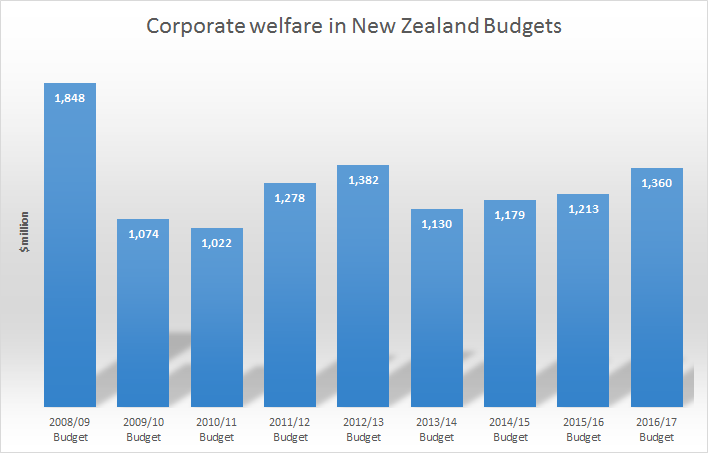
My latest corporate welfare report is out at the Taxpayers Union website. The company tax could be 6 percentage points lower but for this generosity of politicians picking winners.
Source: New Zealand Budget Papers, various years.
It is not as bad as you think under the last Labour government budget. $700 million of those hand-outs to business was seed capital for agricultural research institute. That institute to be run out of the investment income on that $700 million one-off injection which the incoming National Party-led government cancelled.
Another $675 million in that last Labour budget was to KiwiRail and OnTrack. Other than that, the Labour Party ran a pretty tight ship on business subsidies. There are no particular record of picking winners. Labour did buy a real loser in KiwiRail. You heard it here first.
For a generation, a campaign by the green movement against the growing of genetically modified crops has held sway across Europe. These foodstuffs are a threat to health, the environment and the small independent farmer, NGOs have argued.
As result, virtually no GM crops have been grown on Europe’s farms for the past 25 years. Yet hard evidence to support what is, in all but name, a ban on these vilified forms of plant life is thin on the ground. In fact, most scientific reports have indicated that they are generally safe, both to humans and the environment.
This point was endorsed last week when a 20-strong committee of experts from the US National Academies of Science announced the results of its trawl of three decades of scientific studies for “persuasive evidence of adverse health effects directly attributable to consumption of foods derived from genetically engineered crops”. It found none.
Instead the group uncovered evidence that GM crops have the potential to bestow considerable health benefits. An example is provided by golden rice, a genetically modified rice that contains beta carotene, a source of vitamin A. Its use could save the lives of hundreds of thousands of children who suffer from vitamin A deficiency in the third world, say scientists.
Scientists and governments around the world overwhelmingly agree that climate change is real, is largely human-induced and needs urgent action to prevent.
There is, in fact, a broad and overwhelming scientific consensus that climate change is occurring, is caused in large part by human activities (such as burning fossil fuels), and if left un-checked will likely have disastrous consequences.
Furthermore, there is solid scientific evidence that we should act now on climate change – and this is reflected in the statements by these definitive scientific authorities.
Greenpeace International spends 34% of all funds raised on fundraising; its local arm is not much better. Good to see that Greenpeace NZ pays their collectors a living wage, but not a cent more, to pester people on the street and cold-call them at home. Greenpeace has the effrontery to accuse others of being paid advocates.
My two cents on the sharp rise of partisanship and congressional polarisation is they are driven by the great restraint in the growth of government spending in the 1980s.
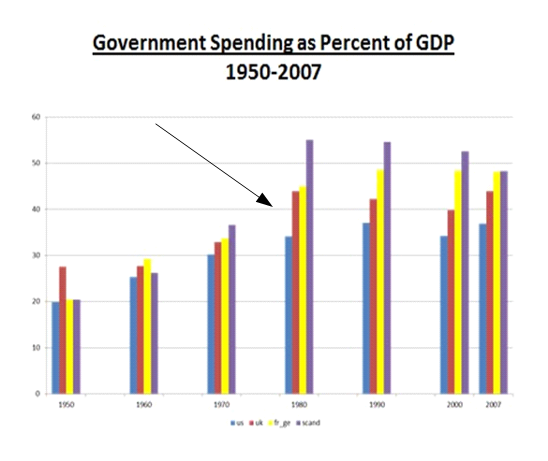
From 1950 to 1980 the size of government doubled but then stopped dead in the 1980s. This great restraint on the growth of government happened everywhere. It was not just Thatcher’s Britain or Reagan’s America. It was everywhere, France and Germany, and even Scandinavia.
Peltzman’s data which I have charted has government spending in the USA, Britain, France and Scandinavia doubling between 1950 and 1980, and then nothing much happened between 1980 and 2007 – the size of government was pretty flat as a share of GDP for 27 years.
Governments everywhere hit a brick wall in terms of their ability to raise further tax revenues. Political parties of the Left and Right recognised this new reality.
Government spending grew in many countries in the m-d-20th century because of demographic shifts, more efficient taxes, more efficient spending, a shift in the political power from those taxed to those subsidised, shifts in political power among taxed groups, and shifts in political power among subsidised groups Importantly for explaining later political polarisation, that growth of government was concentrated in four programs – defence, health, education and income security
The median voter in all countries was alive to the power of incentives and to not killing the goose that laid the golden egg which underwrote the initial growth in the size of government. The rising deadweight losses of taxes, transfers and regulation limit inefficient policies and the sustainability of redistribution.
After 1980, the taxed, regulated and subsidised groups had an increased incentive to converge on new lower cost modes of redistribution to protect what they had. More efficient taxes, more efficient spending, more efficient regulation and a more efficient state sector reduced the burden of taxes on the taxed groups. Reforms ensued after 1980 led by parties on the Left and Right, with some members of existing political groupings benefiting from joining new coalitions.
A lot more is at stake when the main political battleground is dividing a relatively fixed revenue pie post-1980 than a growing pie Between 1950 and 1980. Fiscally conservative voters will elect parties strongly committed to no new taxes. Their opponents will look for equally ideologically committed parties. Peltzman makes the very interesting point that:
There is no new program in the political horizon that seems capable of attaining anything like the size of any of these four. For the time being the future government rest on the extent of existing mega programs.
Health and income security account for 55% of total government spending in the OECD. It is in these two programs where the future of the growth of government lie.
The pressure for that growth in government will come from the elderly. Governments will have to choose between high taxes on the young to fund the current generosity of social insurance, healthcare and old-age pensions or find other options. Peltzman explains this political tension for programs benefiting the elderly in his essay The Socialist Revival:
Deficit financing of future growth in these programs becomes increasingly problematic. So we now have the seeds of political conflict rather than consensus.
These very large programs confer substantial benefits on some. These beneficiaries resist any change in the status quo. But the benefits have to be financed at substantial cost to today’s workers. Many of them will not benefit on balance from these programs over their lifetimes. It is by no means clear whether the number of winners exceeds the number of losers today.
Policies that were once unthinkable now can be discussed and even implemented here and there. These include increased retirement ages, less generous public health care programs, more reliance on private saving for retirement and so forth.
Given that intergenerational and other struggles over who is taxed and who faces benefit cuts, middle-of-the-road politicians lose their appeal to the electorate.
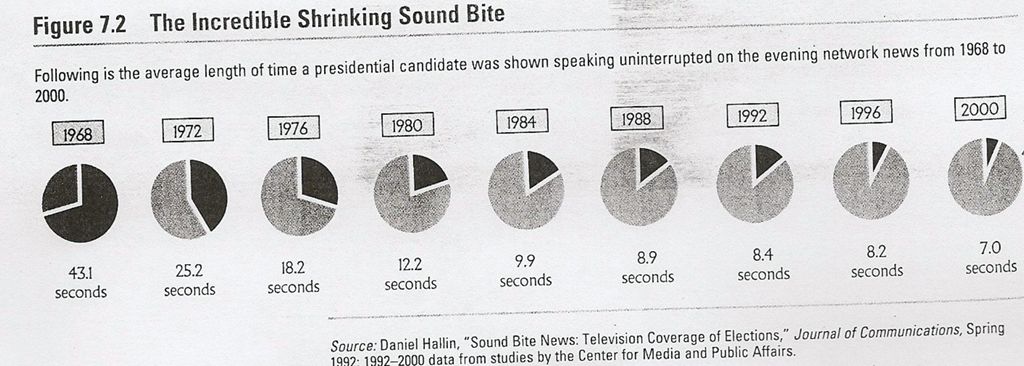
Another reason for greater political polarisation is the rising cost of time. Sound-bites news programs and current affairs are now a couple of seconds long when they used to be 15 seconds long maybe 30 years ago.
People have less time to pay attention to politics so they want to work out quickly from short sound-bites whether the politicians they are contemplating supporting are made of the right stuff. For voters in a hurry, conviction politicians are more appealing be they of the left or of the right. Voters want someone who will hold fast against new taxes or for new taxes as the case may be. Much is at stake as Sam Peltzman explained in his 2012 essay The Socialist Revival:
The steady growth of the old age population share is on the verge of a substantial acceleration… This means that government health care and public pension spending growth will also have to accelerate merely to keep the promises implicit in present programs.
The political economy will have to choose between higher taxes on the young to keep these promises, an accelerated shrinkage of the rest of the budget or less generous public health and pension programs. It is not clear yet which way the decision will go.
What is clear is that for the first time since the invention of the welfare state the magnitude and generosity of its signature programs is at political risk.
In this stand-off between those who might have to pay more in taxes and those who might receive less in old age pensions, welfare benefits and services including healthcare, neither side wants a politician naturally inclined to blink and compromise. They will elect politicians who hang tough for their side of the argument and their share of the budget.
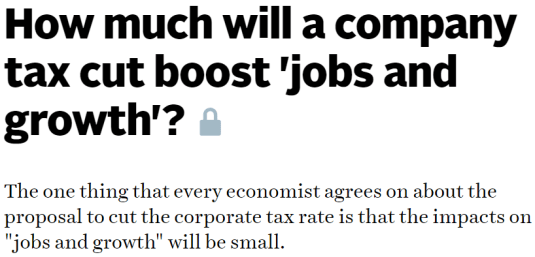
It is unfortunate that the Australia Institute today misspoke when it claimed that every economist agrees that the effect of a company tax rate cut is small.
— Australia Institute (@TheAusInstitute) June 24, 2016
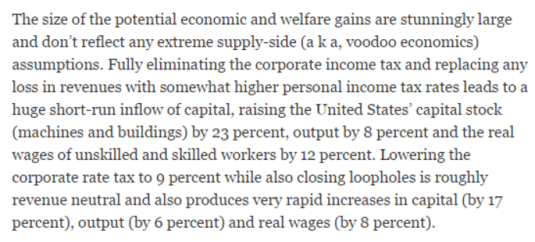
The top economists in the field of public economics disagree. Their views are freely available on the Internet. They are easiest to find by googling the words abolish the corporate tax. Optimal rate of tax on capital is zero are other good words to Google.
Paul Krugman responds to my post about a recent column of his. He is correct that not all economists agree that low capital taxation is desirable; he appropriately cites Diamond and Saez, who are on the high-capital-tax side of this debate. FYI, here is another recent paper, written in part as a response to Diamond and Saez, which finds that optimal rates of capital taxation, while positive, are quite low.
But that is not really the issue. If Paul had said “reasonable economists disagree, here are the arguments, and here is why I tend to favor one side rather than the other” I would not have objected.
Instead, in his original column, he wrote as if there were no reasonable arguments for the policy pursued by the Bush administration, and he attributed the most vile motives to those who advanced the policy.
This episode illustrates a fundamental difference between Paul and me. I try not to assume the worst in other people, just because they disagree with me.
Taxes on incomes from capital should be much lower because capital migrates from high-tax to low-tax locations, reducing capital-to-labour ratios in the higher company tax countries.
The Australia Institute manages to put itself in the contradictory position of saying a company tax rate just means more revenue for the IRS in the USA but Google, Facebook and other multinationals managed to avoid tax on a massive stale through tax havens. If the former is correct, their less company tax in Australia means more company tax paid in the USA means multinationals must be rather unsuccessful at avoiding tax through tax havens.
Multinationals are both avoiding company tax in Australia and offshore and paying it in full in the USA if Australia’s company taxes cut if the Australian Institute is to be believed today.
The Australia Institute obviously has not picked up on the relentless bullying that Ireland was subject to by the rest of the European Union over its 12.5% company tax.
The Irish company tax rate of 12.5% was initially on export profits. To finesse European Union member state complaints about that 12.5% company tax rate on discrimination grounds,the Irish government extended that low rate to all companiesin 1995.
I am yet to see a minister of finance welcoming a company tax cut in a competing jurisdiction, rubbing his hands in anticipation of greater tax revenues on the foreign profits of multinationals that are headquartered in his country.
If there is an ounce of sense in what the Australia Institute said about foreign taxmen benefiting from low company taxes in Australia, high corporate tax rate countries such as Germany, France and the USA should welcome low company tax rates in destination countries for foreign investment originating in those countries but they do not.
Rather than seek tax harmonisation, high tax country should welcome low company taxes in competing investment destinations but they do not. Why is this so if the Australia Institute is making sense?
The Nordics are alert to not killing the goose that laid the golden egg. Company taxes are relatively low in Scandinavian countries as compared to the USA so that businesses do not flee to other jurisdictions.
A large welfare state such as those in the Nordic countries require a significant amount of revenue, so the tax base in these countries must be broad. This also means higher taxes on consumption through the VAT or GST and higher taxes on middle-income taxpayers.
Business taxes are a less reliable source of revenue because of capital flight and disincentives to invest. Thus, the Nordics do not place above-average tax burdens on capital income and focus taxation on labour and consumption. All those nuances are lost if you are to believe the Australia Institute today.
Control over the number and spacing of women was central to women’s liberation. Young Labour and the Wild Greens forgot that last night on the BackbencherTV show. Neither could handle the notion that people should wait until they can afford to have children before having them. This is an old working class value with which the Young Labour panel member completely disagreed.
Bryan Caplan argues that there is an undeserving poor if they fail to follow the following reasonable steps to avoid poverty and hardship:
Work full-time, even if the best job you can get isn’t fun.
Spend your money on food and shelter before getting cigarettes and cable TV.
Use contraception if you can’t afford a child
Raising a child takes a lot of effort and a lot of money. One poor person rarely has enough resources to comfortably provide this combination of effort and money.
Young Labour in particular has forgotten the old working class value of being a responsible parent able to afford to raise your children and give them the best things in life.
Being a parent is hard work that requires a bit of discipline if child poverty is to be avoided through ill-considered choices and a lack of family planning.
Labour believes that all individuals should have control over their own sexual and reproductive lives. An individual’s choice to determine the number and timing of one’s children cannot be compromised.
To ensure that all people can make free and informed choices about their future, Labour supports safe, affordable and universal access to contraception, sexual and reproductive services and information. Labour recognises all women have the right to make their own choices about their own bodies, and should have access to abortion services
The Greens this week has decided to offer every support short of real help to those being massacred and brutalised by ISIS
“The NZDF deployment to Iraq does not make us safer, but puts New Zealand troops at risk and makes New Zealanders unnecessary targets of ISIL.
“We condemn the horrific violence of ISIL. New Zealand should be using its leverage as a member of the UN Security Council to curb ISIL’s access to funding and arms, not keeping our troops in danger for another year and a half,” said Mr Shaw.
This is straight out of the Yes Prime Minister episode on how the Foreign & Commonwealth Office explains how it helps foreign nations in trouble from invasion and tyranny. A 4 stage plan on how to do nothing.
In his recent speech before the House of Commons on further assistance to those fighting ISIS since Syria, Labour Party foreign office spokesman Hilary Benn described this as walking to the other side of the road.
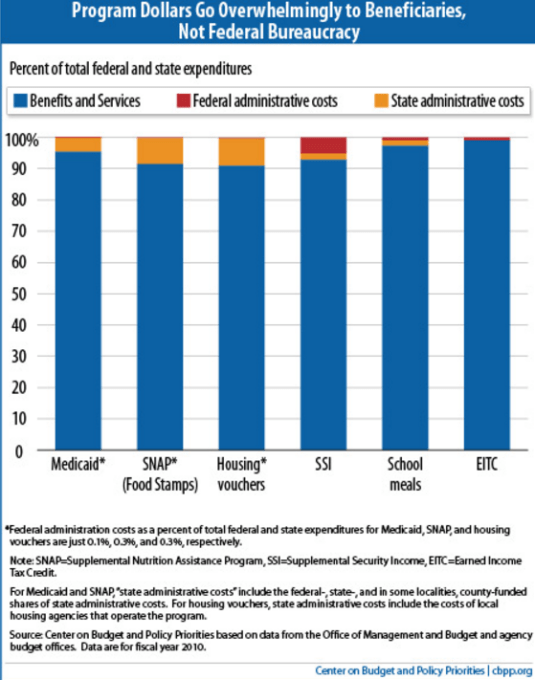
Firing the entire welfare state bureaucracy does not save the day for a universal basic income as Robert Greenstein explains
Suppose UBI provided everyone with $10,000 a year. That would cost more than $3 trillion a year — and $30 trillion to $40 trillion over ten years.
This single-year figure equals more than three-fourths of the entire yearly federal budget — and double the entire budget outside Social Security, Medicare, defense, and interest payments. It’s also equal to close to 100 percent of all tax revenue the federal government collects…
Where would the money to finance such a large expenditure come from? That it would come mainly or entirely from new taxes isn’t plausible.
We’ll already need substantial new revenues in the coming decades to help keep Social Security and Medicare solvent and avoid large benefit cuts in them. We’ll need further tax increases to help repair a crumbling infrastructure that will otherwise impede economic growth. And if we want to create more opportunity and reduce racial and other barriers and inequities, we’ll also need to raise new revenues to invest more in areas like pre-school education, child care, college affordability, and revitalizing segregated inner-city communities.
A UBI that’s financed primarily by tax increases would require the American people to accept a level of taxation that vastly exceeds anything in U.S. history. It’s hard to imagine that such a UBI would advance very far, especially given the tax increases we’ll already need for Social Security, Medicare, infrastructure, and other needs.
“It would be a small levy placed on the banks, which would go into an insurance fund. It’s been operating successfully in many, many other countries.” But Mr Shaw said the Government and Reserve Bank keep putting off the change, saying customers can choose the bank they believe is most stable. “Consumers are not well educated about the stability of banks, so what that means is they tend to flow to the really big Australian-owned banks.”
Deposit insurance has a long history of promoting banking instability and irresponsible lending. It has not operated successfully in other countries nor in New Zealand. The Green Party announcement made no mention of New Zealand’s recent experience with deposit insurance
On Sunday 12 October 2008, at the peak of the global financial crisis, the Government decided that it needed to implement a form of retail deposit guarantee scheme to avoid a flight of funds from New Zealand institutions to those in Australia. It needed to do this urgently: The Crown Retail Deposit Guarantee Scheme (the Scheme) was designed and announced that same day.
The deposit guarantee was extended to finance companies. Money flooded into previously high risk investments as investors had nothing to lose and everything to gain from the higher returns.
From the outset, the advice from officials recognised that the decision to include finance companies in the Scheme carried significant risk. Once deposits with these companies were guaranteed, depositors could safely move investments to where they would get the highest return, irrespective of the risk of company failure.
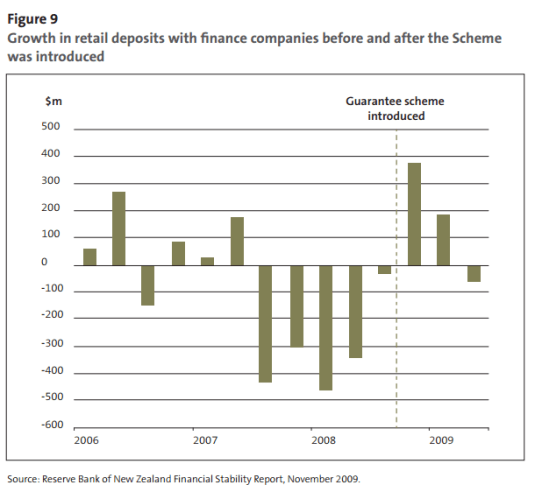
The finance companies also had less reason to minimise risk in their investment activity. The Crown was carrying much of this risk. During 2009, the Treasury watched some of that behaviour eventuate. Deposits with finance companies under the Scheme grew, in some instances significantly. We saw one example where a finance company’s deposits grew from $800,000 to $8.3 million after its deposits were guaranteed. At South Canterbury Finance Limited, the deposits grew by 25% after the guarantee was put in place.
On blunting incentives, otherwise known as ‘moral hazard’, Bill English can’t seriously expect everyday savers to analyse the loan books of banks to assess their credit risk when they open their accounts, let alone do this on a six-monthly basis.
At its height, the bank and finance company guarantees totalled over $133 billion. Ninety-six institutions were covered by the scheme – 60 non-bank deposit takers, 12 banks and 24 collective investment schemes. All guarantees had ended by December 2011.
To put context on the risk that the taxpayer, this $133 billion underwritten by the taxpayer return for little or no insurance fee was nearly twice the amount the Government spends in a year, or about 2/3rd of GDP.
If a financial institution in the Scheme failed, taxpayers would repay all of the money that eligible people had deposited or invested, up to a cap of $1 million each.
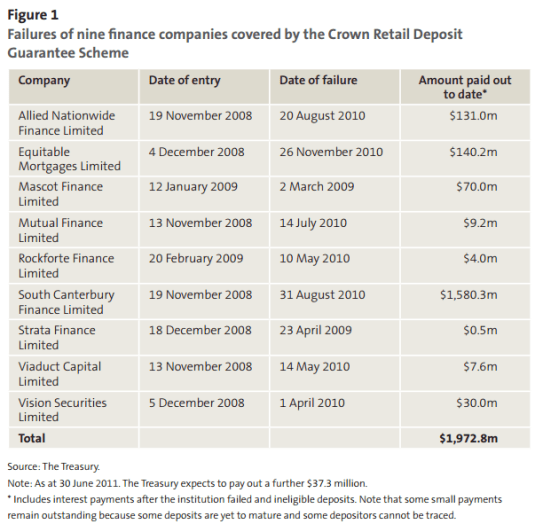
Nine finance companies out of the 30 accepted into the scheme failed. This resulted in payments by the taxpayer to the investors of $2 billion. Expected recoveries are currently estimated at about $0.9 billion after the completion of the various receiverships of these institutions according to the recent report on the scheme by the Auditor-General.
The deposit guarantee was extended to the finance companies despite 28 such companies failing between 2006 and 2008. This included some larger finance companies such as Bridgecorp Finance (New Zealand) Limited, Provincial Finance Limited, and Hanover Finance Limited.
FDR was initially opposed to deposit insurance in the USA in 1933 because it would encourage greater risk taking by banks. Sam Peltzman in the mid-1960s found that U.S. banks in the 1930s halved their capital ratios after the introduction of federal deposit insurance.
If you want to make banks safer, increase their capital ratios and require them to have more subordinated debt in their capital requirements.
Any form of deposit insurance requires extensive regulation of insured bank portfolios to prevent excessive risk-taking. The Kareken and Wallace model of deposit insurance which is based on moral hazard, predicts that if a government sets up deposit insurance and doesn’t regulate bank portfolios to prevent them from taking too much risk, the government is setting the stage for a financial crisis. The Kareken-Wallace model makes you very cautious about lender-of-last-resort facilities and very sensitive to the risk-taking activities of banks.
Kareken and Wallace called for much higher capital reserves for banks and more regulation to avoid future crises. It is much easier to require banks to put up more capital than to not take risks with the monies invested in them by depositors.
Why Evolution is True is a blog written by Jerry Coyne, centered on evolution and biology but also dealing with diverse topics like politics, culture, and cats.
In Hume’s spirit, I will attempt to serve as an ambassador from my world of economics, and help in “finding topics of conversation fit for the entertainment of rational creatures.”





Recent Comments