Everything amazing now compared to 1946 but @jacindaardern not happy @dbseymour
10 Jul 2016 Leave a comment
in applied welfare economics, economic history, economics, politics - New Zealand, poverty and inequality Tags: The Great Enrichment, The Great Escape
Compulsory Te Reo Māori betrays those @nzlabour represents @jacindaardern @AndrewLittleMP
09 Jul 2016 Leave a comment
in economics of education, politics - New Zealand Tags: economics of languages, expressive voting, network goods, New Zealand Labour Party
This policy of Labour of making Te Reo Māori compulsory in primary school and perhaps high school is reckless and betrays those for whom Labour claims to speak.
I must first declare a bias. I struggled to pass high school English. I never scored a single mark in a phonetics test – zero every time. I was hopeless at learning Japanese. I was wise enough to resist encouragement for my dear departed mother to enrol in French classes. I had no wish to be the class dunce in French.
The only reason I went to university was Mr. Carney in the first week of grade 7 noticed that I was in the level II classes for English and social science. As all my brothers and sisters topped the school or near enough, he assumed I was hiding my light under a bushel. He promoted me to the level III classes, which put me in the stream to matriculation colleges and therefore university.
Imagine how much I would have hated study if I was required to learn a language other than English when I was struggling terribly to learn English. I am still a bad speller. I leave it to the reader to judge my grammar. Who wants to be the class dunce in both English and French?
Requiring students of modest academic ability to acquire a 2nd language when they may not be doing well in mastering the basics is playing with their lives as though they were little toys.
Learning another language is not a priority for the Pākehā children nor Māori mokupuna when you consider the poor literacy rates among Māori, Pasifika and some Pākehā.

Source: Literacy skills of young adult New Zealanders | Education Counts.
60%of Pākehā are above the minimum level of competence to meet the prose literacy requirements of a knowledge society. This contrasts with the majority of Māori and Pasifika who are below the minimum level of competence.
Requiring children who do not have an aptitude for language or school in general to learn a language will reinforce in those who are not doing well that they are not very smart. This will give them more reasons to hate school and leave as soon as possible and never go back.

Source: Literacy skills of young adult New Zealanders | Education Counts.
Taking student learning time away from basic literacy skills will do little for a Māori economic development. This is because this taking of student learning time away from literacy and basic education will slow the closing of income gaps between Māori and others.
The key to helping children who do not have an aptitude to succeed at school is to find subjects where they do do well so they can get a good start to life. If students are not good at academic subjects, requiring them to do more academic studies such as study a language is fool-hardy.
Learning Te Reo Māori will not help children in their other subjects. The psychology of the transfer of learning was founded 100 years ago to explore the hypothesis that learning Latin gave the student muscle to learn other subjects, both other languages and generally learn faster.
Educational psychologists found that Latin does not help much in studying other languages and other subjects. No significant differences were found in deductive and inductive reasoning or text comprehension among students with 4 years of Latin, 2 years of Latin or no Latin at all.
#Dallaspoliceshooting brought out best and worst in @ACLUTx @ACLU
09 Jul 2016 Leave a comment
in economics of crime, politics - USA
The American Civil Liberties Union seems to be against making policing safer.

Source: Was using the Dallas robot bomb legal? – The Washington Post.
Police are workers with the same right of any other worker not only to go home to their families safely and uninjured at the end of the day, they have the same right under the common law to defend their lives and the lives of others with reasonable force.
Whether there is a deadly threat to police, they are lawfully entitled to defend their own lives and those of others with deadly force. If the police reasonably believe that someone poses an imminent danger of death to others, and that killing him is necessary to prevent that danger, they can try to kill him.
Armed criminals can always lay down their arms and surrender. I am all for technologies that make policing safer and therefore the rest of us safer.
Despite the media hype, surprisingly few people are shot by police who are unarmed and not resisting. The Washington Post estimated that less than 5% of police killings are in any way suspicious.
If it was 2007 again, what would @jamespeshaw @PhilTwyford do on housing affordability?
08 Jul 2016 Leave a comment
in applied price theory, economics of regulation, politics - New Zealand, urban economics

Source: Housing ‘challenge’ still not a ‘crisis’ | Radio New Zealand News.
Neither Labour nor the Greens have explained where the new land will come from inside the Auckland Metropolitan Limit to build their 100,000 additional houses nor why their proposals will be granted resource consents under existing resource management legislation.
The National Party is unwilling to push shared with resource management law reform despite having 61 votes to do so because of fear of losing votes in the centre.
Police shootings by threat level since 1 January 2016
08 Jul 2016 Leave a comment
in economics of crime, law and economics, politics - USA Tags: law and order, police shootings
The Washington Post no longer classifies whether the deceased was attacking police or not in its online database. That filter on its 2016 database has been removed. It is possible to filter the data to say whether particular weapons were present.
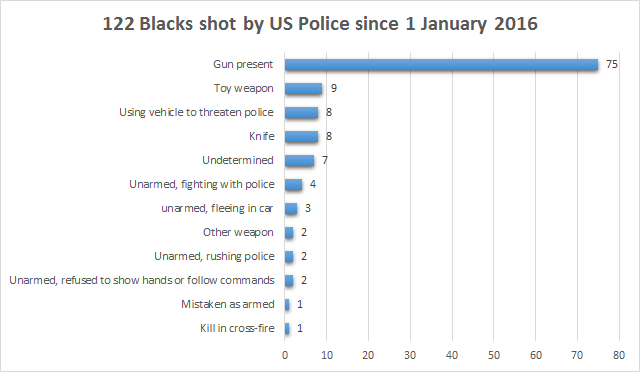
Source: Fatal force: A Washington Post investigation of people shot and killed by police in 2016 – Washington Post. Downloaded at 10:25 p.m., 7 July 2016 New Zealand standard time.
Looking up individual shooting reports in the database provides information on whether the unarmed suspect was doing in terms of resisting police or not. The seven undetermined cases involve disputed facts over whether the suspect was armed or was resisting the police..
The Economist Crony Capitalism Index
08 Jul 2016 Leave a comment
in applied price theory, applied welfare economics, comparative institutional analysis, constitutional political economy, development economics, economics of bureaucracy, entrepreneurship, financial economics, growth disasters, growth miracles, industrial organisation, politics - USA, Public Choice, rentseeking, survivor principle Tags: crony capitalism, superstar wages, superstars, top 1%

…
Why join @NZGreens rather than @nzlabour?
05 Jul 2016 1 Comment
in constitutional political economy, environmentalism, politics - New Zealand, Public Choice
British political psychology data suggests systematically different personalities for the average green and average labour voter that may transfer to New Zealand. Greens are more than what Paul Keating described them: “a bunch of opportunists and Trots hiding behind a gumtree”.
Labour voters are more agreeable and emotionally stable but far less open to new experiences than the average green voter. Not surprisingly, within the green movement, they tend to prefer consensus in internal decision-making but are rather uncompromising and self-righteous in their policy demands. Labour parties in Australia prefer to avoid coalitions with the Greens now because of bad experiences with their uncompromising nature in previous alliances.
As greens are more likely to get upset and are far less conscientious than others on the political spectrum, maybe they are happy to be a political movement rather than a party of government?
To be a party of government requires compromise, a willingness to appeal to the average voter, and to adopt policies because they are wedge issues rather than because they are principled stands. The Labour Party wants to govern; Greens want to make a point.
Third term governments are an ugly sight because they are unlikely to be a re-elected. Labour governments in the throes of inevitable electoral defeat are very opportunistic about changing policies to have one last roll the dice to cling to office. This is something greens are much less likely to countenance. They prefer defeat over compromise.
Nitpicking @stevenljoyce reply 2 @TaxpayersUnion on corporate welfare @JordNZ
05 Jul 2016 Leave a comment
in applied price theory, applied welfare economics, comparative institutional analysis, economics of bureaucracy, industrial organisation, politics - New Zealand, Public Choice, rentseeking, survivor principle Tags: creative destruction, endogenous growth theory, industry policy, innovation, picking losers, picking winners, public goods, R&D, water economics
The best the Minister for Economic Development, Steven Joyce, could do in response to my recent report on corporate welfare was nit-picking. Joyce said my definition of corporate welfare was flawed and that spending on R&D will grow the economy. He said
“To brand things like tourism promotion and building cycle-ways as corporate welfare is, I think, creative but not accurate at all.”
Joyce also said my report was
just somebody picking out a whole bunch of government programmes that in many cases don’t involve payments to firms at all…
Those that do involve payments to firms are specifically designed to encourage the development for example of the business R&D industry. Politicians don’t choose them.
Payments in kind are business subsidies. R&D is so important to the economy that the last thing you want is its direction to be biased by funding from government. Bureaucrats have a conservative bias and do not fund oddballs and long shots. The oddballs and hippies in the picture below could only afford the photo because they won a radio competition in Arizona.

The R&D expenditure that was criticised in my report was commercialisation, not basic research, which was specifically praised. Which research to commercialise is for entrepreneurs.
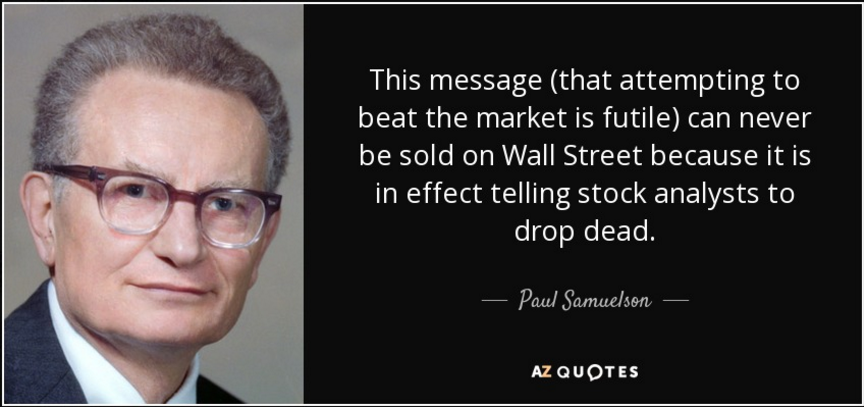
There is no reason whatsoever to think bureaucrats administering R&D subsidy budgets set by politicians are any better than private entrepreneurs at picking the next big thing.
Page 33 of "An Illustrated Guide to Income" more economic #dataviz at: bit.ly/10M7lqR http://t.co/FcmaqZWB32—
Catherine Mulbrandon (@VisualEcon) May 09, 2013
If bureaucrats were any good at picking winners, were any good at beating the market, they would go work for a hedge fund on an astronomically better salary package. The salary package of one top hedge fund manager exceeds the entire payroll budget of most New Zealand government departments including those administering R&D subsidies and other hand-outs.

Government expenditure in vital areas such as innovation should be justified on the basis of cost-benefit ratios and a rationale for why bureaucrats have superior access to information about the entrepreneurial prospects of unproven technologies and product prototypes.

Subsidies should not be defended because of their popularity and sexiness as Mr Joyce did for the film industry, tourism promotion and ultra-fast broadband
If they told New Zealanders that in their view tourism promotion should be cancelled, the film industry should close down, that their shouldn’t be any ultra-fast broadband…I don’t think people would be that enamoured with it.
On irrigation funding, Mr. Joyce cited a report by NZIER that found irrigation contributes $2.2 billion to the economy. Irrigation is a private good which can funded by pricing it properly including the recovery of capital costs. There is no case for a subsidy.

Public goods have spillovers, private goods such as water and irrigation do not. Users can fund the irrigation themselves buying as little or as much water as they are willing to pay out for out their own pockets. The NZIER report noted that it was not about the case for public funding:
… we are not able to quantify the environmental or social impacts if irrigation had never occurred. We also do not attempt to investigate the relative merits of public versus private sector funding of the schemes.
.@TheAusInstitute will EU finance ministers welcome 15% British company tax?
04 Jul 2016 Leave a comment
in applied price theory, politics - Australia, public economics

If the Australian Institute’s analysis of company tax cuts is to be believed, European Union member states must be rubbing their hands in glee at the extra tax revenue that will flow to them because of Britain’s plans to cut its company tax rate to 15%.
Their analysis is a company tax cut in Australia, or in this case Britain, will simply mean more taxes will be paid in the home country of the foreign investing owned company when it repatriates dividends.
Ireland was relentlessly bullied over its 12.5% company tax rates by the rest of the European Union. Facts speaks louder than words and the Australia Institute economic analysis.
You do wonder why losing finance ministers complain about lowering of company taxes as a race to the bottom. They are complaining because they are losing foreign investment to lower company tax jurisdictions.
.@MaxRashbrooke kills case for #UBI @GrantRobertson1 @JordNZ
03 Jul 2016 Leave a comment
in applied welfare economics, politics - New Zealand, poverty and inequality, Public Choice, public economics
Rashbrooke in the snap-shot quote describes the massive new taxes to fund a universal basic income as a policy shift for which middle New Zealand must be prepared properly over many years. But the purpose of these great big new taxes is to ensure that those with whom the modern welfare state was designed to protect our left no worse off, not better off, just as good as they were under the previous regime of social insurance. Why take that journey when you can target their poverty directly to the current welfare state?
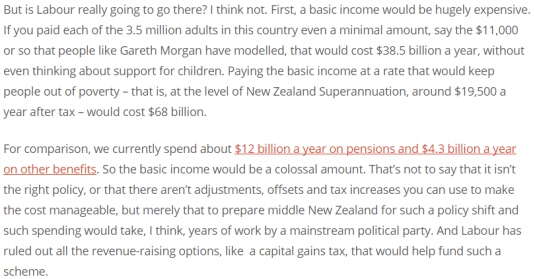
Source: Is Labour really going to deliver a UBI? – Inequality: A New Zealand Conversation.
But @OneNationAus @realdonaldtrump @UKIP are not extreme right wingers
03 Jul 2016 Leave a comment
in constitutional political economy, politics - Australia, politics - USA, Public Choice
The fatal error of the Left is to smear populists such as Hansen, Trump and UKIP as extreme right.
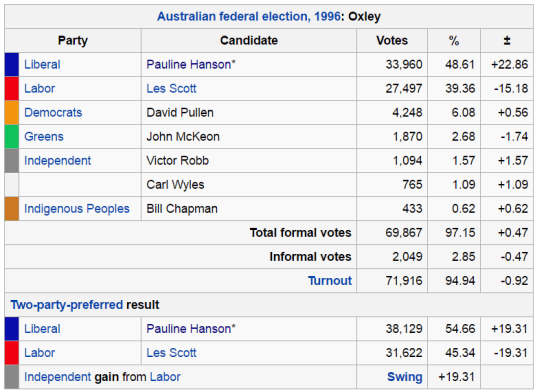
Hanson won the safest Labour seat in Queensland when first elected in 1996. Her 23% swing was mainly made up of Labour voters. Few in the media or commentariat like to remind of that.
Donald Trump defeated opposition on his right from Ted Cruz to win the Republican nomination. If moderate candidate Kasich had dropped out earlier, many of his voters would have gone to Trump, not to Cruz. Trump has appeal to working class Democrat party voters. The only group he seems to win is white men
UKIP is no longer a party out of the Tory shires, when it won 3% of the vote in 2010 in the UK. UKIP is slightly to the left of the LDP and came 2nd in 40 Labour seats in the last UK election. UKIP is a real threat to win seats from Labour or divide the working class work to allow the Tories to come through the centre.
All of these populists combine nationalism, an anti-immigration sentiment, a dislike of globalism and free trade because it involves dealing with foreigners, a preference for lower taxes but no particular opposition to extensive economic and social regulation. In many ways they are Alf Garnett Labour voters.

The work-horses of rational irrationality – antimarket bias, pessimism bias is, anti-foreign bias and make-work bias – are strong among these populist politicians and their voting base.
So few Labour Party MPs, present and upcoming, are working class in origin now that they have simply no experience of the anti-immigration and nationalist settlements of the working class. Until labour parties they work out how to deal with that and meet those concerns, they will keep losing votes to populists.
There is a wonderful quote about how a voter explained he did not vote Labour anymore because he was a white working class Englishman not on the benefit – Labour was no longer interested in him. Identity politics is not just the preserve of the left.

Wage gaps by gender, race and ethnicity persist in the USA
03 Jul 2016 Leave a comment
in discrimination, economics of education, gender, human capital, labour economics, labour supply, occupational choice, politics - USA Tags: employer discrimination, ethnic wage gap, gender wage gap, racial discrimination, racial wage gap

#Corporatewelfare since 2008 @JordNZ @MatthewHootonNZ @GrantRobertson1 @stevenljoyce
02 Jul 2016 Leave a comment
in applied price theory, economics of bureaucracy, entrepreneurship, industrial organisation, politics - New Zealand, Public Choice, rentseeking, survivor principle Tags: corporate welfare, industry policy, picking losers, picking winners, The pretense to knowledge
My latest corporate welfare report is out at the Taxpayers Union website. The company tax could be 6 percentage points lower but for this generosity of politicians picking winners.

Source: New Zealand Budget Papers, various years.
It is not as bad as you think under the last Labour government budget. $700 million of those hand-outs to business was seed capital for agricultural research institute. That institute to be run out of the investment income on that $700 million one-off injection which the incoming National Party-led government cancelled.
Another $675 million in that last Labour budget was to KiwiRail and OnTrack. Other than that, the Labour Party ran a pretty tight ship on business subsidies. There are no particular record of picking winners. Labour did buy a real loser in KiwiRail. You heard it here first.


Recent Comments