Truth is that editorialising has v little influence – less now than ever. Here's why: specc.ie/1c58mAr http://t.co/m8UM22W0zj—
Fraser Nelson (@FraserNelson) May 07, 2015
The history of Mexican sovereign debt
08 May 2015 Leave a comment
in financial economics, international economics, law and economics, politics - USA Tags: bond markets, Mexico, sovereign debt, sovereign default
Cinco de Mayo celebrates Mexico's victory in a battle sparked by debt. Could it happen again? econ.st/1JNWd1f http://t.co/xN47SVYxZN—
The Economist (@EconBizFin) May 05, 2015
By-election and death watch starts in the House of Commons tomorrow!
07 May 2015 Leave a comment
in constitutional political economy, economic history, politics, Public Choice Tags: British general election, by-elections
With a razor-thin majority likely after the British general election today, by-elections will be of unusual significance in Parliament of 650 middle-aged and older parliamentarians working under great stress with easy access to alcohol, food and little exercise. Backbench revolts will also take on a new meaning when there is a razor-thin majority.
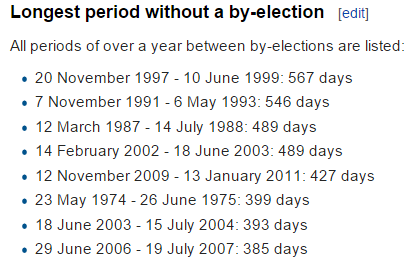
1992, 1998 and 2010 are the only calendar years in history without a single by-election in the House of Commons.
Peter Kellner’s final seat prediction – y-g.co/1byCjZ4 http://t.co/TFmg7vFUf0—
(@YouGov) May 06, 2015
The British Labour governments elected in 1964 and 1974 had small majorities. The majority was three seats after the 1974 election; four seats after the 1964 election. There was an early election in 1966 and two elections in 1974.
The Fixed Term Parliament Act rules out another general election unless a government is voted down on a motion of no confidence and another government is not formed within 14 days.
The Callaghan government fell on a no-confidence vote by one vote in 1979 after seeing its majority eroded by defeats in by-elections.

One of the jobs of the whips in the British House of Commons is to marshal sick and dying MPs for crucial votes. They have a rule that a vote of an MP goes in on the nod as long as his ambulance is parked in the speaker’s courtyard.
At least two ambulances were so parked when the Callaghan government lost its no confidence vote in 1979.
Legend has it that the Tory party whip prodded one of the patients in the back of the ambulance to check if he was still alive. He was so that the Tory whip told the Labour party whip ‘you lose’ and the Callaghan government fell by one vote.
Sir Alfred Broughton, a Labour MP who was on his death bed was not asked to come in despite offering to do so. He died four days after the vote.
Why tomorrow's UK election is looking good for Ed Miliband, via our majority-builder: econ.st/1IhUiBG http://t.co/zg6gFZq2eF—
The Economist (@EconBizFin) May 07, 2015
When asked to honour a gentlemen’s agreement about pairing sick MPs, Tory whip Bernard Weatherill said pairing had never been intended for votes on Matters of Confidence and it would be impossible to find a Conservative MP who would agree to abstain.
After a moment’s reflection, Weatherill offered to abstain because he felt it would be dishonourable to break his word to deputy Chief Whip for the Labour Party, Walter Harrison about pairing conventions, which was a gentlemen’s agreement.
Harrison was so impressed by Weatherill’s offer – which would have ended his political career – that he released Weatherill from his obligation and the Government fell by one vote on the agreement of gentlemen. Weatherill was later elected Speaker of the House of Commons.
In a most unpredictable election, 1 in 4 voters still undecided on election day
07 May 2015 Leave a comment
in politics, Public Choice Tags: British general election, expressive voting, rational ignorance, rational irrationality, voter demographics

Peter Kellner’s final seat prediction – y-g.co/1byCjZ4 http://t.co/TFmg7vFUf0—
(@YouGov) May 06, 2015
via General Election 2015: Britain prepares to go to the polls | Daily Mail Online.
Democracy in Australia
07 May 2015 Leave a comment
in constitutional political economy, Federalism, politics - Australia, Public Choice Tags: bicameralism, minor parties, new parties, protest votes, small parties, vote splitting
Vindicating my long-standing view that anybody can get into Parliament as long as they’re not a Trot, the Animal Justice Party has been elected to the New South Wales Legislative Council last month.
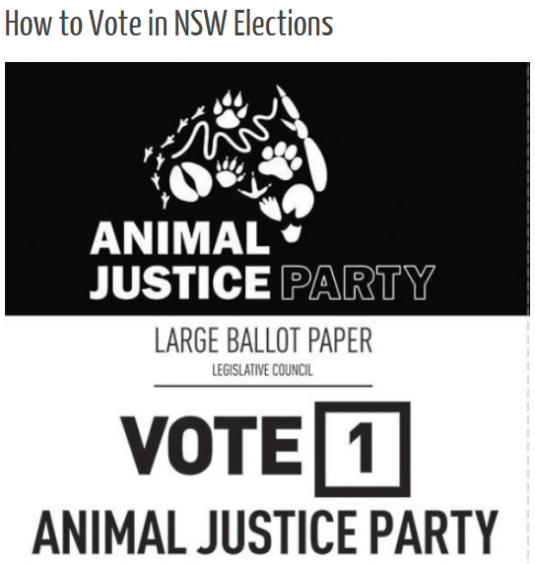
The federal and state upper houses in Australia a democracy at its finest with the voters getting what they voted for, good and hard. These upper houses are powerful, with the ability to reject any bill with varying limitations on their ability to reject or amend money bills in a few of the upper houses.
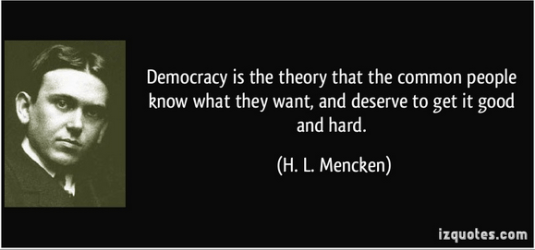
Many Australian voters – at least 20% now – don’t like the major parties , including the Greens so they vote for a wide range of minor parties and independents in upper house elections if only as a protest vote that will go back to the major parties if they lift their game. Voters don’t have this option of vote splitting and protest voting in Queensland because a Labour government abolish their upper house in the 1930s in the name of democracy.
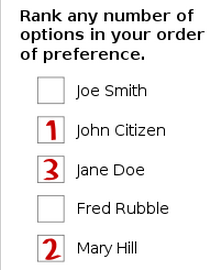
All but one of the Australian federal and state upper houses is elected by proportional representation, often with the option of a group ticket. That is, instead of filling out every box to cast a valid vote, you vote above the line put in a 1 against party you prefer.
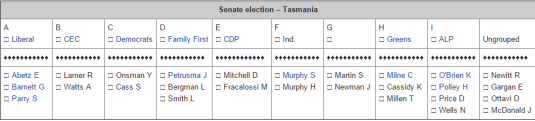
Under group ticket voting, the party whose group you voted for decides how your preferences are distributed, which plays a vital role in deciding who gets elected. More importantly, the small parties engage in preference swapping so that they accumulated enough second and subsequent preference votes to win the last seat.
The Tasmanian Legislative Council is the exception to proportional representation in Australian upper houses with 15 single member constituencies. Naturally, 12 of these 15 legislative councillors are independents. That’s a little bit low by historic standards in my home state were normally the political parties have no success in getting members elected to the Tasmanian upper house.
Minor parties and independents control the balance of power in most Australian upper houses, including the Federal Senate.
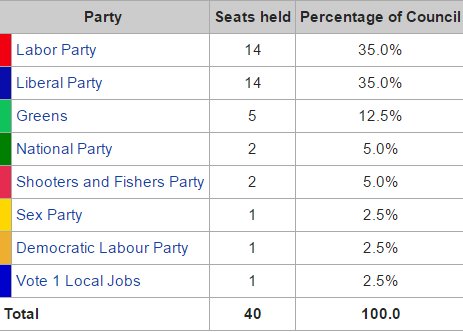
The 40 member Victorian Legislative Council is a mixed bag with the balance of power depending on which particular combination of Green plus minor party legislative councillors get together to support the governing Labour Party government. I must admire the Vote 1 Local Jobs party as a brand name.
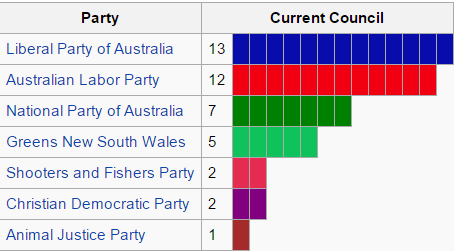
In the 42 member New South Wales Legislative Council, the Liberal National Party government relies on the god squad and anti-pornography campaigners in the Christian Democratic Party for the balance of power. If they fall short, they can always turn to the Shooters and Fishers party.
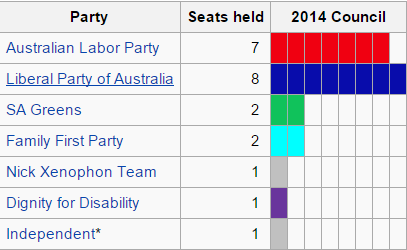
In the 22 member South Australian Legislative Council, neither of the major parties are particularly popular, nor are the South Australian Greens. To pass a bill with 12 votes, the Labour Party government must string together its seven members with a combination of the South Australian Greens, the Family First Party, Dignity for Disability, an independent and the Nick Xenophon team. Good luck.
In the Western Australian Legislative Council, the Liberal National party government has a majority, so what the Western Australian Greens and the Shooters and Fishers Party legislative councillors think don’t matter that much.
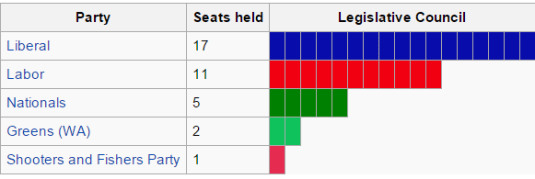
The Western Australian Legislative Council is the only upper house in Australia elected all at one time for four-year terms. For the other upper houses, half of each is elected at each lower house election for six or eight years terms. Tasmania is again the exception to this with two or three of their legislative councillors elected every year for six-year terms.
In the 76 strong Federal Senate, what could not be a more mixed bags of independents, minor parties and minor party defectors and renegades control the balance of power.
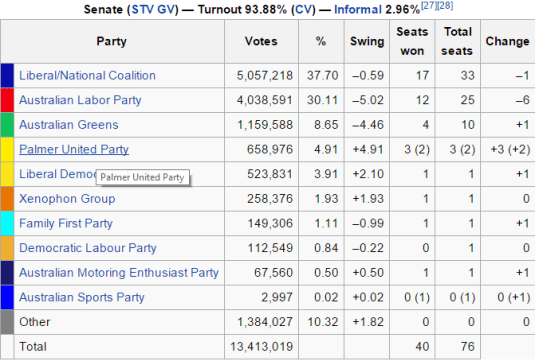
The strength of democracy lies in the ability of small groups of concerned and thoughtful citizens to band together and change things by running for office and winning elections.
That is how new Australian parties in the 20th century such as the Australian Labour Party, the Country Party, Democratic Labour Party, Australian Democrats and Greens changed Australia. Most of these parties started in someone’s living room, full of concerned citizens aggrieved with the status quo.
In the 21st century, Australian democracy could not be more democratic, with a wide range of totally obscure new political parties winning seats in the state upper houses and Federal Senate at every election.
In a democracy, we resolve our differences by trying to persuade each other and voting at elections.
The Australian Federal democracy with upper houses elected through proportional representation show that democracy could not be stronger or work any better.
In Australia, it is possible for just about anyone except a Trot to win a seat at the next election on issues that are important to them because they don’t need that many others to share their concerns and aspirations to win that last upper house seat on preferences.

The tired Marxism of @chrishipkins MP. Is government provision cheaper because they don’t have to make a profit?
05 May 2015 1 Comment
in Austrian economics, entrepreneurship, Marxist economics, politics - New Zealand Tags: schools, state owned enterprises
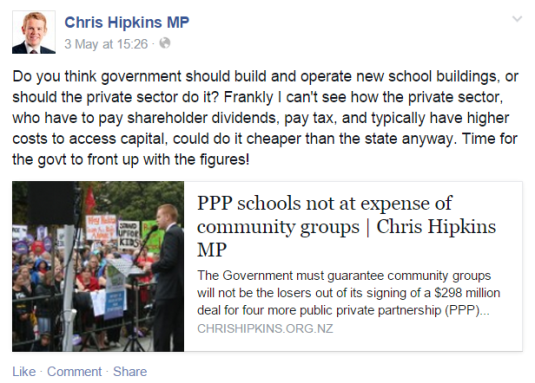
At least one Labour MP must have watched the other channel when the Berlin Wall fell. How else could Chris Hipkins, MP ever think that government provision is cheaper because they don’t have to make a profit? OK, he was a teenager when the Berlin Wall fell, but even teenagers watch the headline news or pick up the gist of the headlines from friends.
The tidiest of all Marxist arguments, the saddest of all Marxist arguments is government operation of businesses is cheaper because they don’t have to make a profit. At least we were spared the cliché “people not profits”.
Leaving to one side that government school buildings are built by private contractors to the Ministry of Education, let’s focus on whether government businesses will be cheaper because they don’t have to make a profit.
No cheap shots about how the portfolio of state owned enterprises are worth $30 billion returned a profit of $20 million to New Zealand taxpayers last year or of the inherent flaws of government ownership:
On the free market, in short, the consumer is king, and any business firm that wants to make profits and avoid losses tries its best to serve the consumer as efficiently and at as low a cost as possible.
In a government operation, in contrast, everything changes. Inherent in all government operation is a grave and fatal split between service and payment, between the providing of a service and the payment for receiving it.
The government bureau does not get its income as does the private firm, from serving the consumer well or from consumer purchases of its products exceeding its costs of operation.
No, the government bureau acquires its income from mulcting the long-suffering taxpayer. Its operations therefore become inefficient, and costs zoom, since government bureaus need not worry about losses or bankruptcy; they can make up their losses by additional extractions from the public till.
The accounting profit or loss of any firm combines two rather different concepts of profit:
- normal profit – the interest paid to those who lend capital to the form either as a loan or as equity; and
- economic profit – the earnings that result from risk taking and entrepreneurship.
Normal profit is simply at the cost of raising capital from investors. This capital can be borrowed in the form of a loan or can be equity.

Chris Hipkins, MP concedes a need to borrow capital when he talks about government typically having lower costs to access capital in the screenshot above. Both private and public builders of schools will have to pay to access capital.
Economic profit is a far more complicated concept frequently misunderstood, especially by Marxists, the Left over Left and, of course, professional media commentators. As Mises explains:
If all people were to anticipate correctly the future state of the market, the entrepreneurs would neither earn any profits nor suffer any losses. They would have to buy the complementary factors of production at prices which would, already at the instant of the purchase, fully reflect the future prices of the products. No room would be left either for profit or for loss.
What makes profit emerge is the fact that the entrepreneur who judges the future prices of the products more correctly than other people do buys some or all of the factors of production at prices which, seen from the point of view of the future state of the market, are too low. Thus the total costs of production — including interest on the capital invested — lag behind the prices which the entrepreneur receives for the product. This difference is entrepreneurial profit.
Profits arise from the dynamism of the market and the ability of superior entrepreneur’s to anticipate the future better than others for which there is always only a temporary profit:
Profits are never normal. They appear only where there is a maladjustment, a divergence between actual production and production as it should be in order to utilize the available material and mental resources for the best possible satisfaction of the wishes of the public. They are the prize of those who remove this maladjustment; they disappear as soon as the maladjustment is entirely removed.
Frank Knight in Risk, Uncertainty, and Profit (1921) distinguished between interest on capital that is lend as either a loan or equity – long-run normal profits – and the short-run profits and losses earned by superior, or suffered by inferior entrepreneurs , respectively. This entrepreneurial superiority or inferiority flows from the ability to forecast the uncertain future. Those entrepreneurs “with superior knowledge and superior foresight,” wrote Frank Fetter, “are merchants, buying when they can in a cheaper and selling in a dearer capitalisation market, acting as the equalizers of rates and prices.”
Knight argued that entrepreneurs earn profits as a return for putting up with uncertainty and anticipating uncertainty faster than the rest. Many businesses are unprofitable because of rising costs or falling sales that were not anticipated. The Knightian concept is of the profit-seeking entrepreneur investing resources under uncertainty about market demand and costs in the future.
Alchian (1950) illustrated the unreliability of cost estimation with the range of bids made in government tendering processes. When contractors bid for the same project, these entrepreneurs routinely disagree over its likely cost by margins of 20 percent. These tenderers are predicting their own costs, about which they are knowledgeable, and they have an incentive to be truthful to win the initial tender.
Profits and losses, by rewarding and penalising the entrepreneurs who are not the quickest, ensures that only what consumers want is bought to the market as Henry Hazlett explains:
In a free economy, in which wages, costs, and prices are left to the free play of the competitive market, the prospect of profits decides what articles will be made, and in what quantities—and what articles will not be made at all.
If there is no profit in making an article, it is a sign that the labour and capital devoted to its production are misdirected: the value of the resources that must be used up in making the article is greater than the value of the article itself.
Profits arise as the reward for superior foresight into the future and innovation. Both of these concepts are not associated with government run businesses as Alfred Marshall explained:
A government could print a good edition of Shakespeare’s works, but it could not get them written.
As for Hipkins’ argument that governments can borrow at a cheaper rate than private firms, Bailey and Jensen (1972) said:
…we argue that efficient allocation of risk bearing is usually more difficult for government projects than it is for private ones. Therefore, if anything, the allowance for risk should be greater for government projects than it is for otherwise comparable private ones…
We find no support for the arguments in favor of using the government bond rate or any other such universally low rate for discounting costs and benefits of public projects.
We concur in Hirshleifer’s conclusion that a public project with given attributes (in terms of dispersion of possible future outcomes and of the covariance of these outcomes with those for existing portfolios) should he discounted with at least as high a rate as a similar private project.
This “same rate” should include the appropriate allowances for taxes and other distortions in private markets (as outlined by Harberger) as well as the appropriate allowances for risk, which we have outlined above.
Moreover, if private markets in risk are as “imperfect” as many have claimed, that merely tends to increase the rate that should be used, because the government is even less able to distribute risks than are these markets.
Penn and Teller on recycling – the practice of ‘feeling good for no reason’ | Carpe Diem Blog
05 May 2015 Leave a comment
Jihad, Texas style
05 May 2015 Leave a comment
in politics - USA, war and peace Tags: gun control, Jihad, taxes, war against terror
Flash Harry way of saying people vote more conservatively as they age
04 May 2015 Leave a comment
in politics - USA Tags: voter demographics
American opinions on abortion don’t differ that much by gender
04 May 2015 Leave a comment
in law and economics, politics - USA Tags: abortion, activists, feminism

Women have in recent years been more likely than men to hold the two absolute positions on abortion — saying it should be either legal under any circumstances or illegal in all circumstances — but these differences are not large.

Within various age and partisan categories, men and women are mostly similar in their views. Only with respect to education, specifically those with a college education, is there a sizable gender gap.
College-educated women are significantly more likely than college-educated men to believe abortion should be legal under any circumstances.
via Education Trumps Gender in Predicting Support for Abortion.

In the broadest terms, the largest segments of Republicans and Democrats have consistently preferred the middle "legal only under certain circumstances" abortion position.
What’s changed since 1975 is that the percentage of Republicans favouring the "illegal in all circumstances" position has grown and the percentage favouring the "legal under any circumstances" position has decreased. The reverse pattern is seen among Democrats.

via Republicans’, Dems’ Abortion Views Grow More Polarized.
The question I ask is why isn’t this substantial number of women with reservations to varying degrees about abortion not represented by the feminists who claim to speak on their behalf in the media?

Further evidence of the success of the 1996 US welfare reforms and a lack of wage stagnation
03 May 2015 1 Comment
in economic growth, economic history, labour economics, labour supply, politics - USA, welfare reform Tags: middle-class wage stagnation, top 1%, US welfare reforms, wage stagnation
http://t.co/l7NzR1byNF—
EPI Chart Bot (@epichartbot) April 27, 2015
http://t.co/VZTp2A0H8n—
EPI Chart Bot (@epichartbot) April 05, 2015


Recent Comments