The effectiveness of environmentalists in mobilising public opinion
03 May 2015 Leave a comment
in environmental economics, environmentalism, global warming, politics - USA, Public Choice Tags: activists, expressive voting, green voters, rational ignorance, rational irrationality, voter demographics
The essence of media bias in America
02 May 2015 Leave a comment
in economics of media and culture, politics - USA Tags: media bias
How much snow it typically takes to cancel school in the US
02 May 2015 Leave a comment
in economics of regulation, politics - USA Tags: winter snow
How much snow it typically takes to cancel school in the US http://t.co/9tYHIOG3pV—
Amazing Maps (@amazinmaps) May 02, 2015
Down and out in NZ = social housing with fast broadband
02 May 2015 Leave a comment
in economics of regulation, politics - New Zealand, poverty and inequality, urban economics
The Dominion Post had a front page story yesterday about an 80-year-old pensioner required to pay for fast broadband in her new social housing. Her new apartment happens to be in my same suburb. I can see the new apartments from my window as I type.

She didn’t have much use for this fast broadband, which cost an extra $20 a month, because she is legally blind. She cannot have a landline-only option because of the way her apartment is wired and the way in which fast broadband works.
The 27 flats have been fitted with fibre-optic cabling, and residents, many of whom are pensioners or have disabilities, cannot opt for a landline-only service.
National building standards require new apartments to be wired with fast broadband. A classic example of the inability of central planning to deal with the diversity of preferences and incomes.
In this case, the victim of central planning it is an old age pensioners obviously in poor circumstances as well as legally blind who is out of pocket. She is one of a number of old age pensioners who are similarly out-of-pocket when they living on a strictly limited budget.

College graduates don’t really notice recessions
02 May 2015 Leave a comment
in business cycles, economics of education, great recession, human capital, labour economics, macroeconomics, occupational choice, politics - USA, unemployment Tags: College premium, education premium, labour demographics
Our monthly update on the question: should I stay in school? blogs.wsj.com/economics/2015… http://t.co/IaVxoAJmqe—
Josh Zumbrun (@JoshZumbrun) April 03, 2015
New Zealand and US real housing prices, 1975 – 2014
01 May 2015 Leave a comment
in economics of regulation, politics - New Zealand, urban economics
The RMA is the Resource Management Act and was passed just before New Zealand housing prices started to rise rapidly. Was this introduction of much stronger restrictions on the supply of land, followed by a 20 year long rise in the price of land housing more than a coincidence?
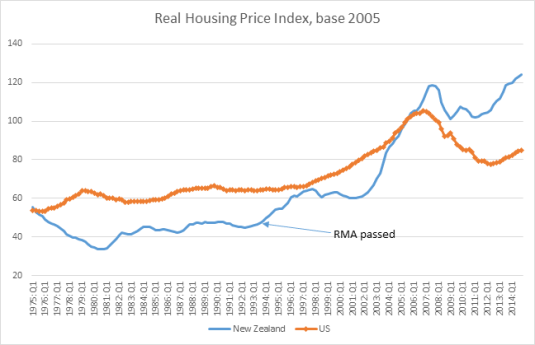
Source: Dallas Fed; Housing prices deflated by personal consumption expenditure (PCE) deflator.
Social change is rapid – opinion on same-sex marriage version
01 May 2015 2 Comments
in economics of love and marriage, law and economics, politics - USA Tags: same-sex divorce, same-sex marriage
#Dailychart: Same-sex marriage is legal in 36 states. Here's how opinion has changed econ.st/1dpjNnI http://t.co/8fdhl8KJC2—
The Economist (@ECONdailycharts) April 28, 2015
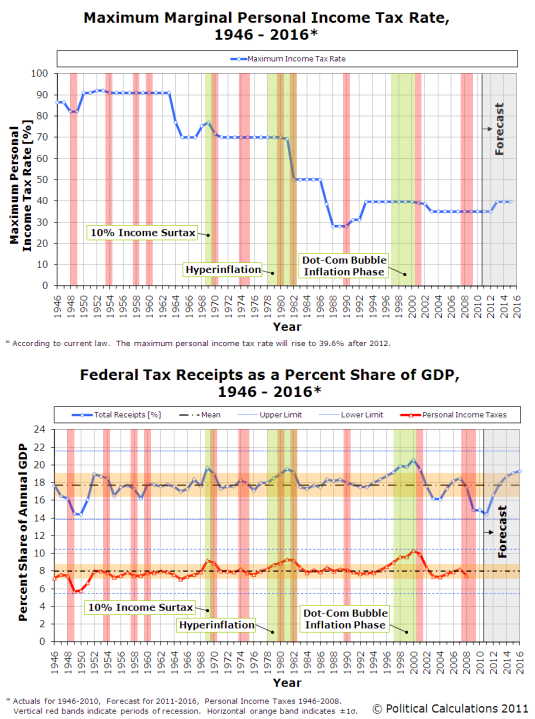
Hauser’s Law: No matter what post-war tax rates have been, tax revenues remained at about 19.5% of GDP in the USA
01 May 2015 Leave a comment
in politics - USA, Public Choice, public economics Tags: Director's Law, laffer curve
Who pays the highest income tax rate?
01 May 2015 Leave a comment
in politics - Australia, politics - New Zealand, politics - USA, public economics Tags: average tax rates, Marginal tax rates, vaccination and the labour supply
Highest income #tax rate among #OECD countries? Belgium with 42.8% statista.com/chart/3337/whe… http://t.co/RgaWxsGPzB—
Statista (@StatistaCharts) March 25, 2015
On the New Deal and the rule of law
01 May 2015 Leave a comment
in economic history, macroeconomics, monetary economics, politics - USA Tags: gold standard, New Deal, regime uncertainty, rule of law
The Left over Left is withering away
30 Apr 2015 Leave a comment
in politics - Australia, politics - New Zealand, politics - USA Tags: voter demographics
Richard Nixon’s public choice economics of the Vietnam anti-war movement
30 Apr 2015 Leave a comment
in labour economics, labour supply, occupational choice, politics - USA Tags: conscription, peace movements, Richard Nixon, Vietnam war
The Vietnam anti-war movement were primarily the result of the draft: hell no, we won’t go and the burning of draft cards. Richard Nixon was as cunning a rat who ever occupied the Oval Office. He was elected in 1968 to end the Vietnam war and to end the draft.
Nixon had an intuitive economic understanding that the anti-war movement’s rioting in the streets and campuses was very much motivated by private gain. In particular, the threat of being drafted. The notion that revolutions and political movements are motivated by private gain is not new.
Vietnamisation changed everything. In 1969, Nixon started the process of phasing down the sending of further combat troops to Vietnam and the phasing down of the draft. US troop withdrawal started on July 1st 1969 with completion dates – December 1970, June 1971 and December 1972.
By the beginning of 1972, over 400,000 U.S. military personnel had been withdrawn, virtually all combat troops. The protests were against ending up in the jungle – not up the rear with the gear. There were 24,000 US troops in Vietnam in 1972. This compares to 560,000+ in 1969.
A Vietnam vet told me that when he returned to his U.S. campus in 1971 for graduate studies, it was very quite compared to 1969 because the spectre of the draft had gone in their minds.

The anti-war movement was really motivated by hell no, we won’t go. As soon as the prospect of going to Vietnam faded away, so did the anti-war movement.
This is how fast America changed its mind on the biggest social issues
30 Apr 2015 Leave a comment
in economic history, economics of media and culture, economics of regulation, economics of religion, political change, politics - USA Tags: expressive voting, preference falsification
This is how fast America changed its mind on the biggest social issues bloom.bg/1DIk6PQ http://t.co/RjAiw0y2dV—
Bloomberg Business (@business) April 27, 2015
Democrat voters are turning against the idea of lower prices for ordinary families
29 Apr 2015 Leave a comment
in applied price theory, applied welfare economics, international economics, politics - USA, Public Choice, rentseeking Tags: antiforeign bias, expressive voting, rational ignorance, rational irrationality, voter demographics
As America inches towards a big trade deal with Asia, Obama faces a showdown with his party econ.st/1JJMJAE http://t.co/6qmt9GegWF—
The Economist (@EconBizFin) April 27, 2015


Recent Comments