Partisan differences in preferred presidential traits
29 Apr 2015 Leave a comment
in politics - USA Tags: 2016 presidential election, voter demographics
@NZGreen hypocrisy on trade ties with Cuba and Saudi Arabia – J’accuse, J’accuse
29 Apr 2015 Leave a comment
in development economics, growth disasters, Marxist economics, politics - New Zealand
The Greens in Parliament yesterday were making great play of the fact that New Zealand is willing to conclude a trade agreement with Saudi Arabia, but not with ISIS, despite the fact that both behead people.
Watermelons have short memories, which is why they are so prone to political and moral hypocrisy as they manifested yesterday. The Greens have forgotten how keen they were last year about the improvements in trade and diplomatic ties of the USA with another totalitarian relic: Cuba.
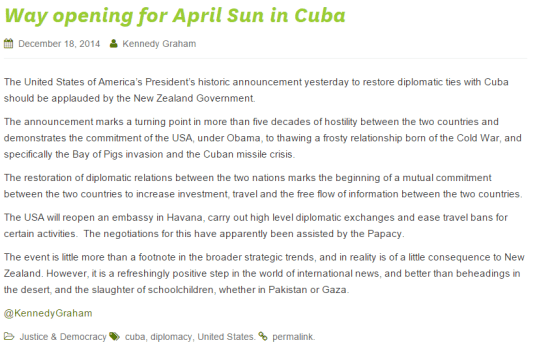
A 2009 report by Human Rights Watch concluded that
Raúl Castro has kept Cuba’s repressive machinery firmly in place…since being handed power by his brother Fidel Castro …[s]cores of political prisoners arrested under Fidel continue to languish in prison, and Raúl has used draconian laws and sham trials to incarcerate scores more who have dared to exercise their fundamental rights.
Freedom House classifies Cuba as being “Not Free” and notes that
Cuba is the only country in the Americas that consistently makes Freedom House’s list of the Worst of the Worst: the World’s Most Repressive Societies for widespread abuses of political rights and civil liberties.
Noam Chomsky once said the former Soviet Union was a dungeon with social services. Saudi Arabia is a dungeon with better social services than the Cuban dungeon. Saudi per capita income exceeds $50,000; Cuban per capita income is 1/5 of that.
In common with ISIS, a gang of thugs took over Cuba by military force in 1958 in the name of their god. Castro and his cronies murdered tens of thousands of political opponents both straight away and through the years to establish and retain their authority.
Cuba President Raul #Castro ratified its support to Venezuela against U.S. sanctions Fri at May Day parade in #Havana http://t.co/yqyF4XvcIA—
People's Daily,China (@PDChina) May 02, 2015
In common with Saudi Arabia after its foundation as a unified kingdom after the First World War, Cuba has become a hereditary monarchy that rules with an iron fist. In common with Saudi Arabia, Cuba is a haven for terrorists and a sponsor of terrorism abroad to this day.
The Green foreign affairs spokesman even went so far as to defend Westphalian sovereignty and the right of national self-determination and not to have ideologies imposed on a country.
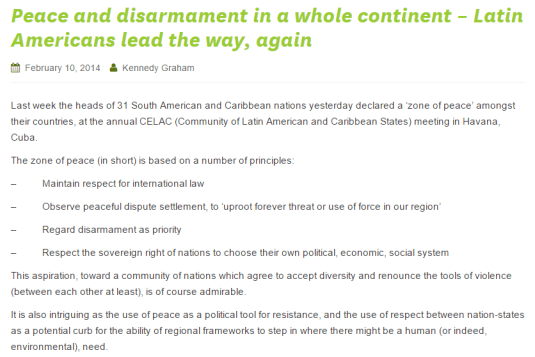
and

The Saudi and Cuban dictatorships could not have put it better. The Russian communist dictatorship did go on about democracies not interfering in their internal affairs too.
The Green foreign affairs spokesman was so dewy eyed about the Cuban healthcare system after going to Cuba as a guest of their so-called parliament that it would make Michael Moore blush.
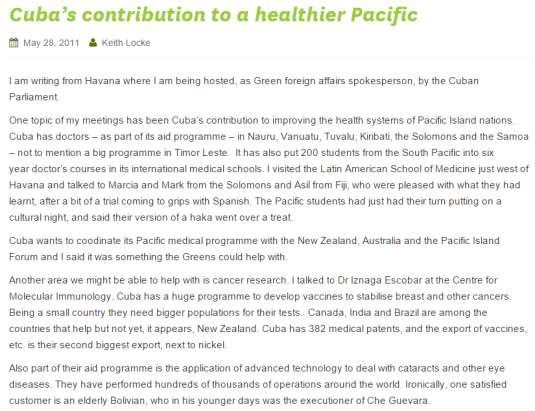
I wonder if the Greens would be so welcoming of Saudi foreign aid to the Pacific island health systems? Whatever else you can say about Saudi Arabia, they do have an excellent healthcare systems and plenty of petrodollars.
Saudi Arabia and Cuba are dungeons with Saudi Arabia having much better social services. New Zealand trades with both.
An unnamed co-conspirator in this fawning at the jackboots of a dictator even went so far as to say Cuba had its problems rather than speak truth to power and call it for what it is: a totalitarian dictatorship.
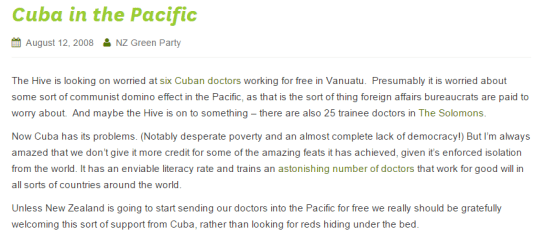
As the Greens said repeatedly regarding UN trade sanctions on Iraq after the first Gulf war, the only people that lose by limiting that trade were the ordinary people of that country were already on the end of a pretty bad deal.
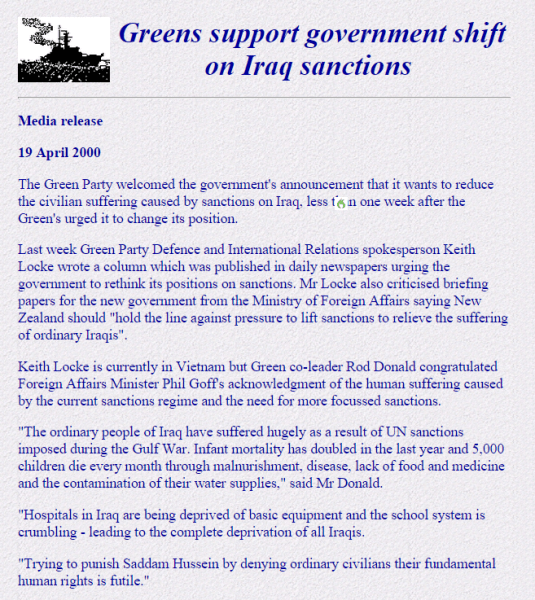
That principle set out by the Greens regarding the harm of trade sanctions on ordinary people applies to trade with Cuba and Saudi Arabia as well. A country with trade links is more to lose than a country that does not have them. The ruling elite rarely suffers from trade sanctions as Daniel Griswold observed:
Even if sanctions inflict some pain on the target country, they typically fail because of the nature of regimes most likely to become targets of sanctions. Human rights abuses tend to vary inversely with economic development. Governments that systematically deprive citizens of basic human rights typically intervene in daily economic life, resulting in underdeveloped and relatively closed economies. Such nations are the least sensitive to economic pressure. The autocratic nature of their governments also means that they are relatively insulated from any domestic discontent caused by sanctions. If anything, sanctions tend to concentrate economic power in the hands of the target government and reduce that of citizens.
The Greens cannot welcome trade and diplomatic links with one totalitarian country but not another. The Greens cannot oppose trade sanctions on Iraq because of the harm to ordinary people then call for limits on trade ties with Saudi Arabia without regard to the harm to ordinary Saudis. Trade sanctions do not work in any case as Rogoff noted:
As Hufbauer and Schott, among others, have illustrated, the effects of sanctions are often fairly disappointing – so much so that many scholars have concluded that such measures often are imposed so that governments can appear to domestic audiences to be “doing something.” Certainly, severe US sanctions on Cuba failed to bring the Castro regime to heel; indeed, President Barack Obama’s move to reestablish full diplomatic relations may have more effect.
What makes each of these dungeons horrible is their totalitarian dictatorships, not the particular God that motivates their tyranny.

Taxpayers in every country should get one of these charts
29 Apr 2015 Leave a comment
in income redistribution, politics - Australia, politics - New Zealand, politics - USA, Public Choice, public economics, rentseeking Tags: public sector transparency
Tax summary: here's another honest/informative version of @hmtreasury chart by @StrongerInNos that explains "welfare" http://t.co/SeH9FJIRWq—
Jonathan Portes (@jdportes) November 02, 2014
New Zealand does an excellent job in attracting skilled migrants
29 Apr 2015 Leave a comment
in human capital, labour economics, labour supply, politics - Australia, politics - New Zealand, politics - USA Tags: economics of immigration
Migrants (esp. new ones) to UK more likely to have tertiary education than migrants to Australia [OECD[ http://t.co/xfOSQmiCxd—
Jonathan Portes (@jdportes) March 05, 2015
Housing unaffordability in New Zealand, 1988–2013
29 Apr 2015 Leave a comment
in politics - New Zealand, urban economics Tags: housing affordability, land supply, RMA, zoning
There has been a steady decline in housing affordability in New Zealand. The position is critical of the bottom 20% of the income ladder with now four in 10 of them spending more than 30% of their disposable income on housing costs in relatively good economic times.
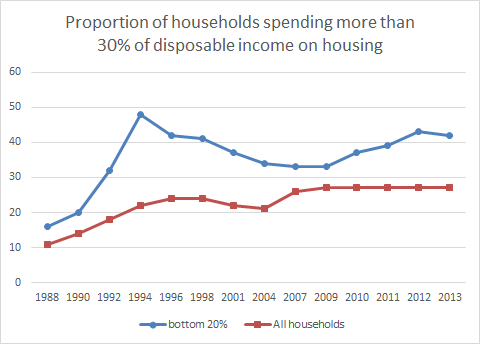
via Statistics New Zealand, New Zealand Social Indicators, Housing affordability.
Recoveries from recessions across the G-7
28 Apr 2015 Leave a comment
in business cycles, economic growth, Euro crisis, global financial crisis (GFC), great recession, macroeconomics, politics - USA Tags: British economy, Canada, Eurosclerosis, France, Germany, Italy, Japan, recoveries from recessions
UK recovery: stronger than Italy, weaker than US & Canada. http://t.co/C0TEsbzMm3—
Jonathan Portes (@jdportes) April 28, 2015
In another neoliberal victory, income taxes became more progressive in recent decades
28 Apr 2015 Leave a comment
in economic history, politics - USA, Public Choice, public economics Tags: conspiracy theories, Leftover Left, neoliberalism, taxation in the labour supply, top 1%
How much does each income group pay in taxes? bit.ly/1JHSCik by @aplundeen http://t.co/B66ynsUrkc—
Tax Foundation (@taxfoundation) April 14, 2015
The U.S. Income Tax system is progressive bit.ly/1FG9Usm by @aplundeen http://t.co/HXDWbvv1xy—
Tax Foundation (@taxfoundation) April 15, 2015
Would a living wage reduce poverty in America?
28 Apr 2015 Leave a comment
in labour economics, minimum wage, politics - Australia, politics - New Zealand, politics - USA, poverty and inequality Tags: labour demographics, living wage, poverty and inequality
Are White Republicans More Racist Than White Democrats? | FiveThirtyEight
28 Apr 2015 Leave a comment
in applied price theory, economic history, politics - USA Tags: Democratic party racism, racism, republicanism, Southern racism


New Zealand on a cloudless day
28 Apr 2015 Leave a comment
in politics - New Zealand Tags: New Zealand, space

HT: David Farrar via NASA captured this incredible shot of New Zealand under cloudless skies | Business Insider.
% spent on housing as a share of disposable income, OECD members, 2014
28 Apr 2015 Leave a comment
in politics - Australia, politics - New Zealand, politics - USA, urban economics Tags: housing affordability, RMA, supply of land, zoning
New Zealand is pretty much on top of the world as to the amount of income that households must spend keep a roof. That success is a product of local council restrictions on the supply of land and national and local regulations such as under the Resource Management Act (RMA) that increase the costs of bringing lands in the market.
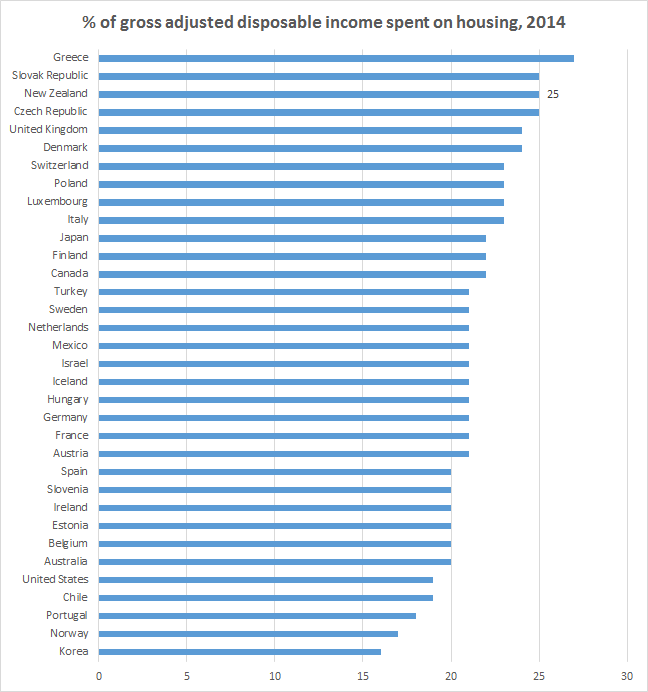
Source: OECD Better Life Index.
Note: Household net adjusted disposable income is the maximum amount that a household can afford to consume without having to reduce its assets or to increase its liabilities. It’s obtained, as defined by the System of National Accounts – SNA, adding to people’s gross income (earnings, self-employment and capital income, as well as current monetary transfers received from other sectors) the social transfers in-kind that households receive from governments (such as education and health care services), and then subtracting the taxes on income and wealth, the social security contributions paid by households as well as the depreciation of capital goods consumed by households.
Why is the rapid closing of the gender wage gap in New Zealand not celebrated more?
27 Apr 2015 1 Comment
in discrimination, gender, human capital, labour economics, labour supply, occupational choice, politics - New Zealand Tags: activists, do gooders, gender wage gap, Left-wing hypocrisy, Leftover Left
With the rapid closure in the raw female male wage gap in New Zealand over the last 15 or so years, the lack of celebration of this achievement among equal pay activists is puzzling.
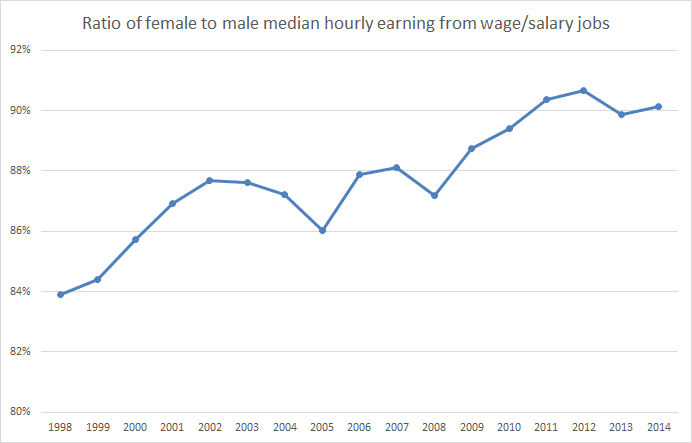
Source: Statistics New Zealand, New Zealand Social indicators, Median hourly earnings.


Recent Comments