A 2012 poll found that 62% of British voters agreed that “politicians tell lies all the time” econ.st/1ANQGPS http://t.co/3oH0FsHf0V—
The Economist (@EconEconomics) May 10, 2015
Russians are surprisingly trusting of their politicians
12 May 2015 Leave a comment
How Taxes Affect Investment Decisions For Multinational Firms
11 May 2015 Leave a comment
in applied price theory, politics - Australia, politics - New Zealand, politics - USA, public economics Tags: company tax rates, foreign investment, multinational corporations, tax competition
How Taxes Affect Investment Decisions For Multinational Firms onforb.es/1Oe5lKu by @ErikCederwall http://t.co/BduZZbHs2n—
Tax Foundation (@taxfoundation) April 15, 2015
Women and Social Mobility – Key Facts
11 May 2015 Leave a comment
in discrimination, gender, labour economics, labour supply, occupational choice, politics - USA, population economics Tags: gender wage gap
How are today's baby boomer women faring compared to their #mothers? Check out these 6 facts: brook.gs/1J2Hq1l http://t.co/DMZG536cE3—
Brookings (@BrookingsInst) May 11, 2015
1. Today’s working women (henceforth described as “daughters”) have higher wages than their mothers – but do not have higher wages than their fathers. Men have higher wages than both their fathers and their mothers.
2. The poorest women are doing best. 80% of daughters raised in the bottom quintile have higher wages than their fathers did. (h/t Scott Winship)
3. “Men’s wages remain more important to increasing couples’ family income,” despite “women’s significant generational gains” …
4. Women who grew up in households where their mother did not work actually have the highest family incomes today—but not because they themselves earn more. Daughters’ individual incomes do not vary significantly by mother’s work status, but family income does—suggesting that daughters whose mothers didn’t work have higher earning husbands. (Catherine Rampell discovered this by asking Pew to split out their analyses by mothers’ labor choices.) Perhaps those raised in more traditional settings are more likely to replicate a traditional division of labor?

via via Women and Social Mobility: Six Key Facts | Brookings Institution.
A volatile depressed neighbour? Real American and Canadian GDP growth detrended, 1955-2013 – updated
11 May 2015 Leave a comment
in business cycles, economic growth, economic history, macroeconomics, politics - USA Tags: Canada, prosperity and depression
Figure 1: Real GDP per American and Canadian aged 15-64, converted to 2013 price level with updated 2005 EKS purchasing power parities, 1955-2013
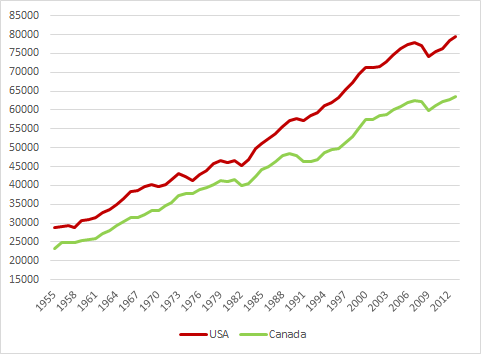
Source: Computed from OECD Stat Extract and The Conference Board, Total Database, January 2014, http://www.conference-board.org/economics
Figure 2: Real GDP per American and Canadian aged 15-64, converted to 2013 price level with updated 2005 EKS purchasing power parities, 1.9 per cent detrended, 1955-2013
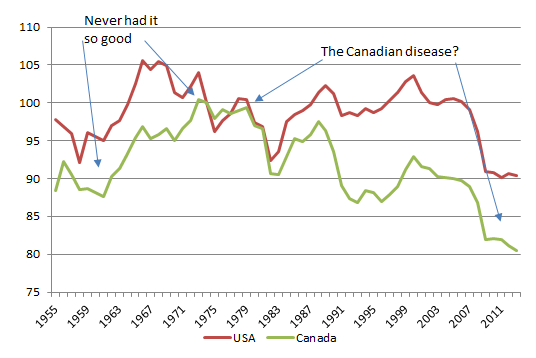
Source: Computed from OECD Stat Extract and The Conference Board, Total Database, January 2014, http://www.conference-board.org/economics
A rising line in figure 2 is above trend rate growth; a flat line is trend growth of 1.9%; and a falling line is below trend growth.
Canada has a volatile ride in the post-war period after economic success up until 1975. Despite ups and downs the Canadian economy has been in a long-term decline since 1975. Growth as rarely being at trend and was often below, sometimes sharply below trend.
None of these depressed periods in the Canadian economy were long enough to count as a great depression. Instead there was just a long-term decline.
Canada is next door to the USA and a member of the North American Free Trade Area (NAFTA) and its antecedents so its cannot blame distance nor small size for its decline in economic performance as some do in New Zealand.
Relative to the USA, Rao et al. (2006) and Sharp (2003) attributed the gap between the USA and Canada to less capital per Canadian worker, an innovation gap as shown by lower R&D expenditure in Canada, a smaller and less dynamic high technology sector in Canada, less developed human capital at the top end of the Canadian labour market, and more limited scale and scope economies in Canada.
These factors have been put forward, at one time or another, as the proximate causes of the New Zealand productivity gap with the USA. Identifying the barriers to higher Canadian productivity may offer fresh insights into removing similar productivity barriers in New Zealand.
Figure 3 suggests that the increase in tax revenues as a percentage of GDP from 30% to 35% at the same time as the Canadian economic boom came to an end and its economic decline began is worthy of further scrutiny. The strong economic recovery from 1995 onwards also coincided with the decline tax revenues as a percentage of GDP.
Figure 3: tax revenue as a percentage of GDP
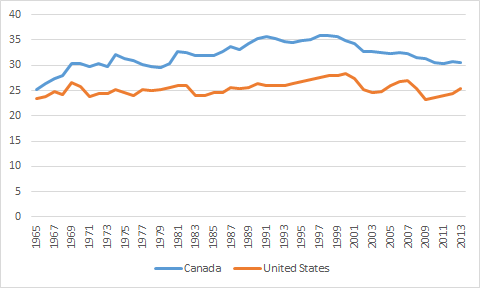
Source: OECD StatExtract
Housing affordability and land regulation around the globe
11 May 2015 Leave a comment
in politics - Australia, politics - New Zealand, politics - USA, urban economics Tags: land supply, land use regulation, NIMBYs, RMA, zoning
Auckland is up with London and New York in terms of housing unaffordability relative to median incomes. US cities with responsive land regulation don’t experience housing bubbles.
Glaeser and Gyourko summarised the findings of a number of studies on land supply and housing prices:
Recent research also indicates that house prices are more volatile, not just higher, in tightly regulated markets …. price bubbles are more likely to form in tightly regulated places, because the inelastic supply conditions that are created in part from strict local land-use regulation are an important factor in supporting ever larger price increases whenever demand is increasing.
…. It is more difficult for house prices to become too disconnected from their fundamental production costs in lightly regulated markets because significant new supply quickly dampens prices, thereby busting any illusions market participants might have about the potential for ever larger price increases.
Via The Truth About the U.S. Housing Market | Seeking Alpha.
A short guide to the Middle East conflict
11 May 2015 Leave a comment
in politics - USA, war and peace Tags: Al-Qaeda, Hamas, ISIS, Middle-East politics, Muslim Brotherhood, war on terror
A short guide to the Middle East from @FT. Mind = Blown. http://t.co/kfzJ9b1NM8—
Mina Fayek (@minafayek) August 24, 2013
Full-time work on the minimum wage is enough to keep a NZ family out of poverty!
10 May 2015 Leave a comment
in labour economics, minimum wage, politics - Australia, politics - New Zealand, politics - USA, poverty and inequality Tags: capitalism and freedom, child poverty, family poverty, Left-wing hypocrisy, living wage, New Zealand Greens, New Zealand Labour Party, Simon Chapple
Where a 40-hour workweek doesn't lift families from poverty: bloom.bg/1AFOD0q http://t.co/eBoJSz1TkX—
Bloomberg VisualData (@BBGVisualData) May 23, 2015
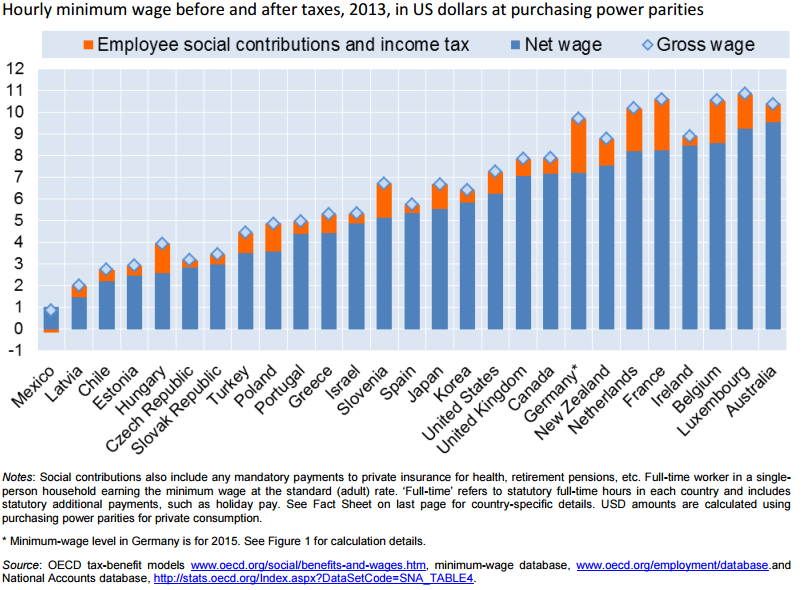
An OECD chart that shows New Zealand parents only need to work a little over 40 hours a week on the minimum wage to lift a family out of poverty in New Zealand.

The figure above shows that a lone parent with two children needs to work about 25 hours a week stay out of poverty in 2013 in New Zealand Once taxes are taken into account as well as additional family benefits such as in-work tax credits. New Zealand is one of the easiest places in the world to get out of poverty by working part-time for a sole mother.
The figure above from the OECD shows that New Zealand couple with two children needs to work about 40 hours a week to stay out of poverty. Of course, what is poverty depends on the definition of the poverty line and in this case by the OECD, it is defined as 50% of the median wage after taxes and family benefits. Another common definition of poverty is earning less than 60% of the median wage
The minimum wage is $14.75 per hour in New Zealand while proposals for a living wage in New Zealand are now $19.25 an hour. The Labour Party wants to increase the minimum wage to $15 per hour.The Greens want to increase the minimum wage to the living wage.
Simon Chapple and Jonathan Boston pointed out in their excellent book last year on child poverty in New Zealand that full-time work by one parent and part-time work by the other in the same household is enough to lift families out of most definitions of poverty:
Sustained full-time employment of sole parents and the fulltime and part-time employment of two parents, even at low wages, are sufficient to pull the majority of children above most poverty lines, given the various existing tax credits and family supports.
The best available analysis, the most credible analysis, the most independent analysis in New Zealand or anywhere else in the world that having a job and marrying the father of your child is the secret to the leaving poverty is recently by the Living Wage movement in New Zealand.
According to the calculations of the Living Wage movement, earning only $19.25 per hour with a second earner working only 20 hours affords their two children, including a teenager, Sky TV, pets, international travel, video games and 10 hours childcare. This analysis of the Living Wage movement shows that finishing school so your job pays something reasonable and marrying the father of your child affords a comfortable family life.
The OECD’s analysis also showed that incentives for New Zealanders to work more and earn more is better than in most countries in terms of what happens if they earn a wage increase.
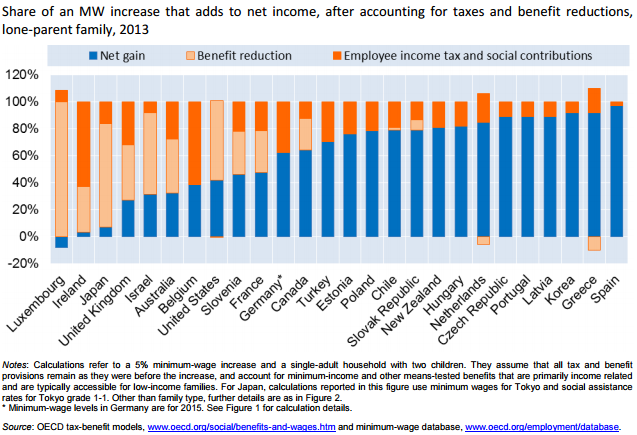
In New Zealand, when there is a 5% minimum wage increase, four percentage points of that wage increase actually stays in the hands of the worker.
In some countries such as Australia, the USA and UK, 60 to 80%of the minimum wage increase is gobbled up in reductions in benefits and taxes. At the same time, the minimum wage increase makes it less profitable for your employer to retain you so your job is more at risk.
The only explanation I have for why the Labour Party, NZ Greens and the living wage movement don’t highlight the success of the existing minimum wage in reducing family poverty in New Zealand is mass kidnappings.
But for these abductions most fowl, I’m sure the Labour Party, NZ Greens and the living wage movement would be dancing in the street celebrating successes of capitalism and freedom in New Zealand in keeping families out of poverty through the minimum wage.
Nick Cohen gets to the nub of Labour’s vote winning problem
10 May 2015 Leave a comment
Brilliant paragraph by @NickCohen4 on how the Left hate the English. theguardian.com/commentisfree/… http://t.co/NIoQJUhUA0—
Guy Walters (@guywalters) May 10, 2015
Land use regulation knocks 10 points of US GDP!
10 May 2015 Leave a comment
in economic growth, economics of regulation, income redistribution, macroeconomics, politics - New Zealand, politics - USA, rentseeking, urban economics Tags: Enrico Moretti, Green Left, housing affordability, Inner-city Left, labour mobility, land supply, land use planning, land use regulation, NIMBYs, regional mobility, RMA, zoning
Bloomberg Business highlighted a great new study by Enrico Moretti on power of the regulatory restrictions on land supply to destroy wealth.

Moretti focused on the impact that restrictions on land supply have on the ability of workers to move to higher productivity cities. Moretti is the second best urban economist working at the moment. The best is Ed Glaeser. Moretti concluded that
A limited number of American workers can have access to these very high-productivity cities
He concluded that a more efficient distribution would be “a general benefit for the entire economy.”
The secret of his analysis was to look at how different US cities, the high productivity cities, contributed to national economic growth. He then explore the implications of fewer and fewer workers been able to move to these cities to take advantage of the great productive potential. The barrier to them moving was high housing prices and high rents.
For example, labour productivity grew quickly in San Francisco, New York and San Jose overt 45-years. All of these cities are famous for their human capital-intensive industries including technology and finance. These cities weren’t America’s growth engine:
The reason is that the main effect of the fast productivity growth in New York, San Francisco, and San Jose was an increase in local housing prices and local wages, not in employment.
Despite the large difference in local GDP growth between New York, San Jose, and San Francisco and the Rust Belt cities, both groups of cities had roughly the same contribution to aggregate output growth.
The drivers of US growth between 1964 and 2009 were southern U.S. cities and 19 other large cities. These cities attracted many residents because of good weather and abundant supply of cheap housing.
The lesson both the US and for New Zealand, and Auckland in particular, is this reallocation of population away from the expensive cities with restricted land supply reduced national output because these population movements bring workers to cities "where the marginal product of labour is low."
In a technology boom town such as San Francisco, it is now what like New Zealand will be as Generation Rent runs its course – 65% of residents are renters:
Over the past year, the City and County of San Francisco boasted the second strongest labour market in the nation, adding 25,000 new jobs. Yet only 2,548 new housing units were permitted and even fewer were built.
Just think: 25,000 new workers and their families have been knocking on San Francisco doors, but there are new units for less than 10 percent of them. It is not surprising that apartment prices get bid up.
The war situation in Iraq and Syria
10 May 2015 Leave a comment
ISW Iraq SITREP. Baiji-Repeat of Tikrit w/ roles of Iranian militias vs. Coalition airstrikes?
iswiraq.blogspot.com/2015/05/iraq-s… http://t.co/QLwhV0lkhS—
ISW (@TheStudyofWar) May 09, 2015
ISW Syria SITREP is out. Did Hezbollah decide to not engage JN or is "Qalamoun battle coming"? bit.ly/1JOMZ4R http://t.co/eb3zIQuhwU—
ISW (@TheStudyofWar) May 05, 2015
HT: Lorenzo M Warby
Hypocritical Greens betray NZ sovereignty to US court decision but oppose investor state dispute settlement on sovereignty grounds
10 May 2015 Leave a comment
in defence economics, economics of crime, international economic law, international economics, International law, law and economics, politics - New Zealand, politics - USA Tags: foreign policy, free trade agreements, green hypocrisy, green party, investor state disputes settlement, national security, preferential trading agreements, war against terror
The Greens are happy to betray New Zealand’s sovereignty to a US court where New Zealand’s side of the story was not heard, New Zealand was not a litigant, New Zealand was not named in the proceedings and New Zealand had not agreed to waive its sovereign immunity under US law.

The Greens on the other hand are hysterical about the prospect of New Zealand voluntarily submitting to investor state disputes settlement through an international treaty. International treaties normally are about trading in sovereignty: you give up some form of sovereignty return for something you value more.

It is thoroughly hypocritical of the Greens to argue the New Zealand should bow down to a foreign court when that court rules in a way that it favours its ideological agenda but refuse to support the principle of international arbitration in circumstances where that may advance New Zealand’s national interests.

At a minimum, New Zealand itself chose to give up its sovereignty if it agrees to investor state dispute settlement in a trade agreement. The decision was not imposed by a foreign court where it was not heard nor was a party.


Of particular concern to the Greens is international arbitration could "trump the public’s vote vote". New Zealand has repeatedly elected parties that support the alliance with America, and support a robust security and intelligence policy, including electronic surveillance as part of the war on terror.
The last week of the 2014 general election campaign was dominated by the Government Security Communications Bureau and its cooperation with the National Security Agency and the extent to which New Zealand security services engaged in electronic surveillance in New Zealand and abroad.

The Greens want to subvert that democratic decision that has been repeated over many New Zealand elections about national security and foreign relations to defer to an American court when New Zealand didn’t even appear as a party.

The US Court of appeal was deciding an issue of statutory interpretation of the Patriot Act. There was no constitutional issues at hand.
The Patriot Act expires in a month unless it is extended. Congress has ample opportunity to amend the renewed law to overturn the appeal court’s decision for the future operation of its security and intelligence laws.
The Greens want a Court of Appeal interpretation of the American Patriot Act to extend to New Zealand without a vote of the New Zealand people or the parliament having any say on whether to give up New Zealand’s sovereignty or waive sovereign immunity in American courts.
.
Hillary Clinton Isn’t Inevitable
10 May 2015 Leave a comment
in politics - USA Tags: 2016 presidential election, Hillary Clinton
Megan McArdle wrote a very good list of reasons why Hillary Clinton is not a certainty to be elected President:
- She’s old
- It’s not clear how far she’ll outperform Barack Obama with women.
- I doubt she’ll replicate Obama’s turnout among black voters.
- The Emerging Democratic Majority is questionable.
- She’s not a particularly good candidate – She has never won a tough election.
- All the Clinton baggage is going to come back to haunt her.
- Obama’s approval ratings do not make for long coattails.

US and Canadian unemployment rates, 1956–2014
10 May 2015 Leave a comment
in business cycles, economic growth, job search and matching, labour economics, labour supply, macroeconomics, politics - USA, unemployment Tags: Canada, unemployment rates

Source: OECD StatExtract
Unemployed people are defined as those who report that they are without work, that they are available for work and that they have taken active steps to find work in the last four weeks.
The ILO Guidelines specify what actions count as active steps to find work; these include answering vacancy notices, visiting factories, construction sites and other places of work, and placing advertisements in the press as well as registering with labour offices.
Senator Warren made a good case against Investor-State Dispute Settlement in the TPP
09 May 2015 Leave a comment
in economic history, economics of regulation, entrepreneurship, industrial organisation, international economic law, international economics, law and economics, politics - Australia, politics - New Zealand, politics - USA, property rights Tags: Australian productivity commission, free trade agreements, investor state disputes settlement, Leftover Left, preferential trade agreements, Senator Elizabeth Warren, Twitter left
In the Washington Post a few months ago, Senator Elizabeth Warren made a balanced case against investor state dispute settlement, not only in the Trans-Pacific Partnership. But in any trade agreement.
Apart from a few rushes of blood in rhetoric to appeal to her base, she made reasoned arguments, good use of history, and put up constructive alternatives to what she was criticising. Furthermore, she put forward arguments that appealed to every point in the political spectrum. The Left over Left critics of investor state disputes settlement clauses in trade agreements in New Zealand never do that.
She echoed arguments I have made the at investor state disputes settlement clauses have no place in trade agreements between liberal democracies.
Liberal democracies have independent courts and honest politics where everyone gets a fair go. That means sometimes you’re on the losing side of politics, but you as free to persuade the majority that they are mistaken. That is democracy in action: sometimes you win, sometimes you lose and there is an election in a few years where you can get another go.
New Zealand has a Closer Economic Relations Agreement with Australia. One provision is a requirement that in most cases New Zealanders are treated the same as Australians under Australian law.
To explain this, some years ago, a New Zealand television production company successfully sued the Australian television regulator to have New Zealand made television shows recognised as Australian content under the 50% Australian content regulations for free-to-air television in Australia.
Note the New Zealand business sued in the Federal Court of Australia and won. They had their day in court.
Senator Warren makes the point that if a business in the USA is unhappy with a regulation, they can challenge by normal democratic and legal means, which investor state disputes settlement undermines:
If a foreign company that makes the toxic chemical opposes the law, it would normally have to challenge it in a U.S. court. But with ISDS, the company could skip the U.S. courts and go before an international panel of arbitrators. If the company won, the ruling couldn’t be challenged in U.S. courts, and the arbitration panel could require American taxpayers to cough up millions — and even billions — of dollars in damages.
Senator Warren also provides a good history of the emergence of investor state disputes settlement and the relevance of that history to contemporary developments:
But after World War II, some investors worried about plunking down their money in developing countries, where the legal systems were not as dependable. They were concerned that a corporation might build a plant one day only to watch a dictator confiscate it the next. To encourage foreign investment in countries with weak legal systems, the United States and other nations began to include ISDS in trade agreements.
Investor state disputes settlement were indeed created to protect businesses that did not have robust democracies and legal systems. Would be international investors in one of these countries were promised international redress if there was a coup, a takeover of their investments or some other unforeseen negative impact because sovereign risk.
She then asked why are these provisions in trade agreements with liberal democracies where they have no relevance:
Those justifications don’t make sense anymore, if they ever did. Countries in the TPP are hardly emerging economies with weak legal systems. Australia and Japan have well-developed, well-respected legal systems, and multinational corporations navigate those systems every day, but ISDS would pre-empt their courts too.
Senator Warren also makes a good point that investor state disputes settlement undermines competition between legal jurisdictions and the rewards for having a sound legal system:
…to the extent there are countries that are riskier politically, market competition can solve the problem. Countries that respect property rights and the rule of law — such as the United States — should be more competitive, and if a company wants to invest in a country with a weak legal system, then it should buy political-risk insurance.
Political risk is is an entrepreneurial opportunity for the insurance market. The World Bank’s Multilateral Investment Guarantee Agency provides insurance to those investing in developing countries against expropriation (including indirect expropriation), as well as acts of war and terrorism. Export Finance schemes of many governments offer political risk Insurance. Anyone who travels in the less safe countries of the world routinely buys travel insurance.
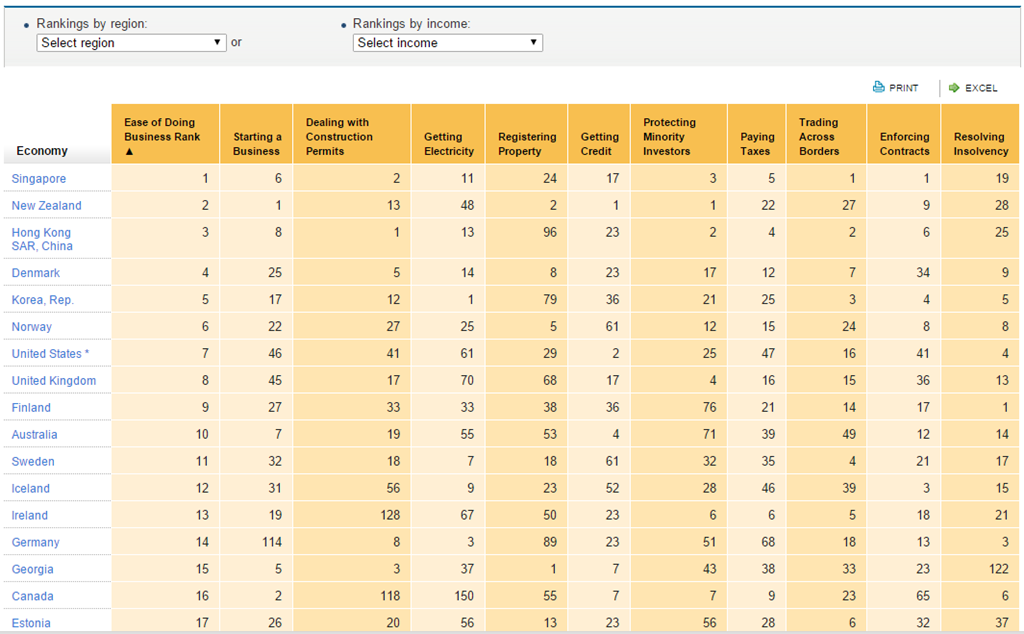
The World Bank puts out an annual index on ease of doing business in every country of the world so foreign investors can’t say they won’t warned of the risks they were taking for the profits they sought.
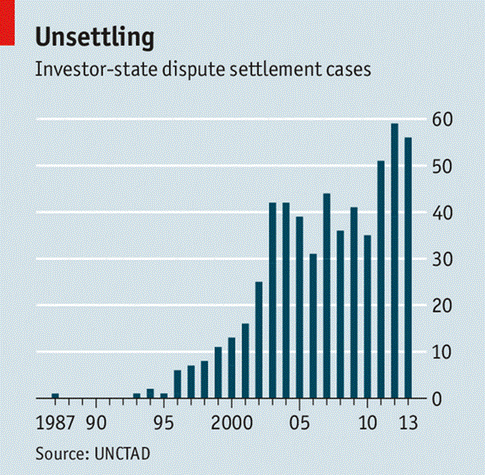
Investor state disputes that were indeed referred to international arbitration used to be rare. Now they are more common as Senator Warren explains:
From 1959 to 2002, there were fewer than 100 ISDS claims worldwide. But in 2012 alone, there were 58 cases.
Recent cases include a French company that sued Egypt because Egypt raised its minimum wage, a Swedish company that sued Germany because Germany decided to phase out nuclear power after Japan’s Fukushima disaster, and a Dutch company that sued the Czech Republic because the Czechs didn’t bail out a bank that the company partially owned. U.S. corporations have also gotten in on the action: Philip Morris is trying to use ISDS to stop Uruguay from implementing new tobacco regulations intended to cut smoking rates.
In a response to Senator Warren’s op-ed, Gary Clyde Hufbauer said:
…only 13 ISDS cases have been brought to judgment against the United States. The United States has not lost a single case.
Why? Because the United States does not expropriate private property without compensation, and the United States does not enact arbitrary or discriminatory laws against foreign firms. Contrary to what the Senator implies, American taxpayers have not had to cough up millions and even billions of dollars in damages. They have not had to cough up anything.
The best part of Senator Warren’s op-ed is when she appeals to all points of the political spectrum based on arguments that do indeed appealed to them:
Conservatives who believe in U.S. sovereignty should be outraged that ISDS would shift power from American courts, whose authority is derived from our Constitution, to unaccountable international tribunals. Libertarians should be offended that ISDS effectively would offer a free taxpayer subsidy to countries with weak legal systems. And progressives should oppose ISDS because it would allow big multinationals to weaken labour and environmental rules.
Senator Warren did make a good case against investor state disputes settlement, particularly between liberal democracies. Foreign investors should take their chances in domestic politics and the courts like the rest of us. They’ve invested in a liberal democracy with independent courts, honest politicians and a commitment to a market economy.

Investor state disputes settlement clauses in trade agreements allow foreign investors to sue the host country for laws, policies, or court decisions they find objectionable. This gives foreign investors more rights than local investors; more influence than local citizens. That is contrary to equality before the law, which is the essence of liberalism.

The point that the Twitter Left rarely makes against investor state disputes settlement, and Senator Warren goes a way towards making is the shield offered by investor state disputes settlement clauses against predatory, corrupt governments in underdeveloped countries, many of which were socialist kleptocracies, has become a sword against regulations that arise in any liberal democracy that were sought and obtained through normal democratic means.
The Australian Productivity Commission held a public inquiry into regional and bilateral trade agreements in 2010. The commission specifically addressed investor state disputes settlement in its subsequent report:
1. There does not appear to be an underlying economic problem that necessitates the inclusion of ISDS provisions within agreements. Available evidence does not suggest that ISDS provisions have a significant impact on investment flows.
2. Experience in other countries demonstrates that there are considerable policy and financial risks arising from ISDS provisions.
The Productivity Commission concluded that investor state dispute settlement provisions are just not worth bargaining coin:
Nor, in the Commission’s assessment, is it advisable in trade negotiations for Australia to expend bargaining coin to seek such rights over foreign governments, as a means of managing investment risks inherent in investing in foreign countries. Other options are available to investors.
The Australian Productivity Commission was quite right to question the advantages of setting up a preferential legal system for anyone:
…a bilateral arrangement with Australia to provide a ‘preferential legal system’ for Australian investors is unlikely to generate the same benefits for that country than if its legal system was developed on a domestic non-preferential basis.
To the extent that secure legal systems facilitate investment in a similar way that customs and port procedures facilitate goods trade, there may be a role for developed nations to assist through legal capacity building to develop stable and transparent legal and judicial frameworks.
When the Left over Left usually argues against investor state disputes settlement provisions they get so carried away with the conspiratorial rhetoric that they overlook a much better argument.
Investor state disputes settlement provisions are bad deal from liberal democracies. Liberal democracies with the rule of law, a market economy and private property rights offer ample protections to any foreign investor.

In trade agreements with less democratic countries, the need for reciprocal promises may not be worth the price when there are other options for investment protection, such as political risk insurance.
The question must be asked as to who lobbies for these agreements considering how much is opposition they provoke, and how useful they are as a mobilisation tool for the Twitter Left in their relentless campaign against lower prices and higher living standards.


Recent Comments