Double Standards in Evaluating Violence by Self-Identified Christians and Muslims

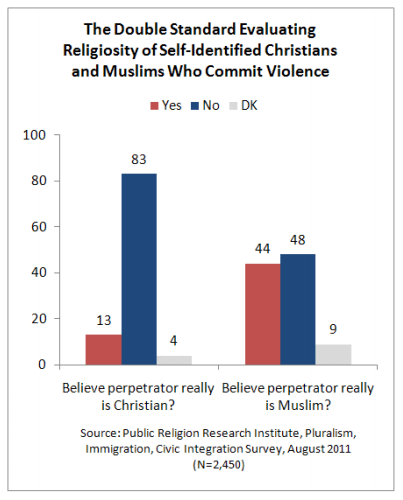
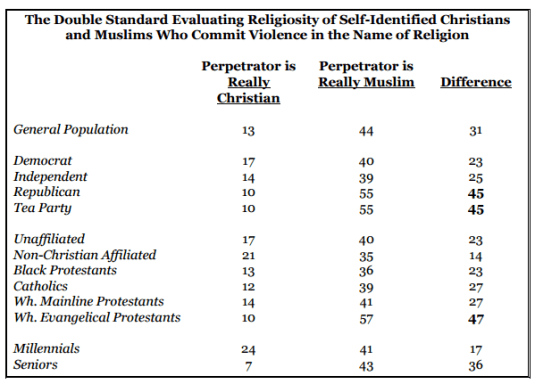
There are no large differences between Republicans (10 percent), Democrats (17 percent) and independents (14 percent) in views of whether a self-identified Christian who commits acts of violence in the name of Christianity is really Christian. However, there are significant partisan differences in views about whether a self-identified Muslim who commits acts of violence in the name of Islam is really Muslim. A majority (55 percent) of Republicans say that such a person is Muslim, compared about 4-in-10 Democrats (40 percent) and independents (39 percent). Majorities of Democrats (51 percent) and independents (53 percent) disagree that a self-identified Muslim who commits acts of violence is really Muslim.

White evangelical Protestants stand out strongly from other major religious groups in evaluating the religiosity of a self-identified Muslim who commits violence. Only roughly 4-in-10 white mainline Protestants (41 percent), Catholics (39 percent), black Protestants (36 percent), and non-Christian religiously affiliated Americans (35 percent) say a self-proclaimed Muslims who commits acts of violence in the name of Islam is really Muslim. In contrast, nearly 6-in-10 (57 percent) white evangelical Protestants believe that self-identified Muslims who commit acts of violence in the name of Islam are really Muslim.

Via What It Means to Be an American: Attitudes in an Increasingly Diverse America Ten Years after 9/11 | Brookings Institution.

Who pays income tax in the USA?

The survivalist community have finally gone organic and renewable

Marco Rubio is a top tier candidate

Image

PETA does not run a no-kill shelter

The racial demographics of police arrest rates in the USA

Zero hour contracts may be outlawed in New Zealand–updated

In another triumph of the Socialist Left of the National Party, the supposedly centre-right New Zealand government is considering outlawing zero hours contracts:

ONE News can exclusively reveal the Workplace Relations Minister is leaning towards outlawing the contracts and other employment provisions that he sees as unfair…

The Minister of Workplace Relations said the most punitive aspects of zero-hour contracts will be banned:

Mr Woodhouse has previously said a ban of zero-hour contracts would be an overreaction, but signalled the outlawing of aspects including:

•Restraint of trade clauses that stop someone working for a competing business if an employer does not provide the desired hours of work.

•The cancellation of shifts at short or no notice.

One reason for this is to neutralise a wedge issue with the Labour Party. The labour parties in both New Zealand and United Kingdom plan to outlaw zero hours contracts.

The NZ Labour Party’s Certainty at Work private member’s bill would require employment agreements to include an indication of the hours an employee will have to work to complete tasks expected of them.

Aaron Director pointed out that there are many real world business practices that behave differently from the caricatures in textbooks and arouse suspicious responses from economists (as well as from lay observers including lay observers with no ideological agenda).

Director said that visions of market power dance their heads and some of these suspect practices have been regulated for reasons he attributed in a large part to intellectual laziness. Ronald Coase made the same observation about knee-jerk responses to perplexing new business practices:

One important result of this preoccupation with the monopoly problem is that if an economist finds something—a business practice of one sort or other—that he does not understand, he looks for a monopoly explanation.

And as in this field we are very ignorant, the number of ununderstandable practices tends to be rather large, and the reliance on a monopoly explanation, frequent.

Much of the lasting influence of Aaron Director and of Ronald Coase came from their ability to show that simple judgements about business practices often cannot withstand rigorous scrutiny.

The organisation of and the contracting practices in the labour market is not a complicated despite the best efforts of the Left over Left and unions to pretend that it is so, as Richard Epstein explains:

Labour markets are not characterized by tricky externalities. They do not pollute streams or require the creation of public goods.

They are not characterized by genuine breakdowns in information, as workers are in a position to observe the conditions of their employment on a day-to-day basis.

Left to their own devices, without explicit support from union activities, they will be highly competitive, and thus work hard to allocate scarce human capital to its most productive use.

Workers have the option to quit for higher wages, and employers can always seek out low cost techniques to reduce their labour costs. Any short-term dislocation for firms or individuals is more than offset by the overall increase in the system productivity, spurred in part by clear signals that should increase investments in human capital.

In the UK, the Work Foundation found that 80% of those on zero hours contracts are not looking for another job; only 26% wanted longer hours. This implies that 74% were content with their current work times arrangements.

The inherent inequality of bargaining power between employers and workers and the reserve army of the unemployed must not be all that they are cracked up to be these days if low paid workers have to sign legally enforceable restraint of trade agreements, which is a common complaint about zero hours contracts. The worker does not have guaranteed hours but must promise not to work for someone else in the same line of business.

Obviously, the few members of the reserve army of the unemployed lucky enough to have a low pay, insecure job that offers no regular hours have so many other job options that their employers must get them to agree not to quit and job-hop at will. Jobs must be readily available to low paid workers for otherwise why do employers insist on this restraint of trade in employment agreements?

If there is an inherent inequality of bargaining power between the bosses and the workers, why do employers seek restraint of trade agreements against these downtrodden workers who are supposed to have few options but to accept the miserable zero hours job offer before them?

The question that must always be asked is why do people deemed competent to vote and drive cars sign zero hours contract? What is in it for them – for the worker who signs these contracts – especially for workers who already have a job and are switching to a zero hours contract? David Friedman asked this question about the economics of restraint of trade agreements for employees:

…the employer who insists on an employee signing a non- competition agreement will find that he must pay, in additional wages or other terms of employment, the cost that the agreement imposes upon the employee, as measured by the employee and revealed in his actions.

It follows that the employer will insist on such an agreement only if he believes that its value to him is greater than its cost to the employee… The contract is designed, after all, with the objective of getting the other party to sign it.

If I am designing the contract and offering it to many other parties, that may put me in a position to commit myself to insisting on terms that give me a large fraction of the benefit that the contract produces. But it is still in my interest to maximize the size of that net benefit-which I do by only insisting on terms that are worth at least as much to me as they cost the other party.

If zero hours contracts are as bad as the Left over Left claim, the job quit rates for these contracts should be high, and people moving from existing jobs should be under-represented in this section of the labour force. If a worker already has a job, they have few reasons to sign up to such a purportedly poor job offer. Show me the evidence.

Unless we have a good idea about why firms are moving to zero hours contracts, which we don’t, and why employees sign these contracts rather than work for other employers who offer more regular hours of work, meddling in these still novel to the officious observer arrangements is risky.
Gun control advocates in the USA will have to rethink their messaging

Hillary’s presidential run is Directors’ law personified

The 2008 US presidential campaign was the best soapie on TV. The 2016 season of that show looks even better.

Back in 2008, Hillary Clinton’s campaign rhetoric intrigued me. It was all about the middle-class and helping the middle class. No working part class warriors today in the main strain of the Democratic Party. The 2016 campaign is the same.

The median voter is a middle-class voter. The median voter is the swinging voter or the independent voter in American terminology. All parties go after this voter if they want to win elections.

Director’s Law of public expenditure is that public expenditure is used primary for the benefit of the middle class, and is financed with taxes which are borne in considera class war rhetoric in a campaign announcement is mainly for the benefit of the left of the party to discourage primary runs by Sen Warren, in particular ble part by the poor and the rich because the median voter comes from the middle-class.

Presidential primary and general election debates in 2016 will be about how things were getting harder for the middle-class and the Republican or Democratic candidate pitching for votes will stand up for the middle-class better than their competition in the presidential primary or general election.

Morning radio in New Zealand, the state owned broadcaster, interviewed one of their political contacts about Hillary’s announcement. His suggestions were her were go left, young Hillary, go left. He wanted her to imitate the policies of the left-wing Democratic Party potential candidate Senator Warren and significantly increase the minimum wage.

At no time did our intrepid reporter on 9 to Noon ask whether this go left political strategy would increase the chances of Hillary winning or have any relevance under a Republican-controlled Senate and House of Representatives or help the Democratic Party win back the House.

Republican-control of Congress will be a strong incentive to Hillary to go to the centre if she wants to have any chance of implementing any of her policies. The class war rhetoric in her campaign announcement is mainly to neutralise the chances of Senator Warren contesting the primaries. Oddly enough, the priorities of Senator Warren also focus on the concerns of the middle-class voters such as about student loans rather than paying the rent and buying groceries.

The NZ Greens want to introduce food stamps, but only for part of the year?!

The welfare state has a long history of providing some of its support to the needy in kind rather than in cash. This can range from soup kitchens to public housing as well as food stamps.

In the USA, food stamps provide provide food-purchasing assistance for low- and no-income people living. Food stamps can only be exchanged for food.

Instead of requiring the poor and needy to attend a soup kitchen, they can be given vouchers to buy food at supermarkets and take it home and cook at themselves. These days some sort of debit card system can be used where purchases are restricted to food at supermarkets and other participating retailers.

A close parallel with food stamps, properly understood, is free school breakfast programs. The welfare state is providing in-kind support to hungry children. This is done at school, to ensure that the children eat the meals.

Rather than rely on their parents to spend their welfare benefits and income support on food for their children, the food is given directly to the children when they arrive at school in the morning. In New Zealand, these free school breakfast programs are restricted to schools in low income areas.

There is a Feed the Kids Bill in Parliament sponsored by the Green Party. I have frequently criticised this proposal as it doesn’t provide breakfast to needy children at the weekends and school holidays. They are left to go hungry. Abandoned by their so called social justice champions through lack of imagination and self-awareness.

If children are showing up at school without their breakfast on a regular basis, their parents should reported that the child protection authorities for intervention. This can start with budget advice and assistance with applying for any additional and emergency financial support they are eligible for from Work and Income New Zealand.

Soup kitchens not only provides people with food, it provides various other assistance to help people to get back on their feet.

If you were proposing a food stamps program in New Zealand because children are going hungry, you’ll be laughed at if you suggested it should only apply the part of the year such as during the school term.

That is precisely what the Greens are doing. The only difference is how they are organised the provision of in-kind support to children, this case, food. Instead of their parents collecting a debit card that can only be used to buy food, the food is eaten by their children at school.

New Zealand, Australian and US real housing price index, 1975–2014, 2005 base

The housing spikes in Australia and New Zealand preceded the global financial crisis, starting in about 1999, and were largely unaffected by the GFC. Housing prices in the USA were pretty calm except in the lead up to the GFC, and took a dive with the onset of the global financial crisis and great recession.

image

Source: Dallas Fed; Housing prices deflated by personal consumption expenditure (PCE) deflator.

.

America’s poor are richer than Europe’s nonpoor

https://twitter.com/SeanMcElwee/status/572831648238211072

Housing space per capita

Ownership of property and consumer goods

HT: How Poor Are America’s Poor? Examining the “Plague” of Poverty in America.

Image

The mass kidnappings of peace activists has gone global

Image

The cost of solar power 1977-2013

Image

What are the Democrat – Republican part as in spreads on the major issues

Image

Previous Older Entries Next Newer Entries

Libertarian Land

Celebrating humanity's flourishing through the spread of capitalism and the rule of law

Arin’s Substack

Celebrating humanity's flourishing through the spread of capitalism and the rule of law

David Andolfatto

Celebrating humanity's flourishing through the spread of capitalism and the rule of law

Monetary Non-Neutrality

Celebrating humanity's flourishing through the spread of capitalism and the rule of law

Reason Magazine

Celebrating humanity's flourishing through the spread of capitalism and the rule of law

Coyote Blog

Celebrating humanity's flourishing through the spread of capitalism and the rule of law

Thoughts from the North

Celebrating humanity's flourishing through the spread of capitalism and the rule of law

Fardels Bear

A History of the Alt-Right

Vincent Geloso

Econ Prof at George Mason University, Economic Historian, Québécois

Bassett, Brash & Hide

Celebrating humanity's flourishing through the spread of capitalism and the rule of law

Truth on the Market

Scholarly commentary on law, economics, and more

The Undercover Historian

Beatrice Cherrier's blog

Matua Kahurangi

Celebrating humanity's flourishing through the spread of capitalism and the rule of law

Temple of Sociology

Celebrating humanity's flourishing through the spread of capitalism and the rule of law

Velvet Glove, Iron Fist

Celebrating humanity's flourishing through the spread of capitalism and the rule of law

Why Evolution Is True

Why Evolution is True is a blog written by Jerry Coyne, centered on evolution and biology but also dealing with diverse topics like politics, culture, and cats.

NoTricksZone

Celebrating humanity's flourishing through the spread of capitalism and the rule of law

Homepaddock

A rural perspective with a blue tint by Ele Ludemann

Kiwiblog

DPF's Kiwiblog - Fomenting Happy Mischief since 2003

The Dangerous Economist

Celebrating humanity's flourishing through the spread of capitalism and the rule of law

Watts Up With That?

The world's most viewed site on global warming and climate change

The Logical Place

Tim Harding's writings on rationality, informal logic and skepticism

Doc's Books

A window into Doc Freiberger's library

The Risk-Monger

Let's examine hard decisions!

Uneasy Money

Commentary on monetary policy in the spirit of R. G. Hawtrey

Barrie Saunders

Thoughts on public policy and the media

Liberty Scott

Celebrating humanity's flourishing through the spread of capitalism and the rule of law

Point of Order

Politics and the economy

James Bowden's Blog

A blog (primarily) on Canadian and Commonwealth political history and institutions

Science Matters

Reading between the lines, and underneath the hype.

Peter Winsley

Economics, and such stuff as dreams are made on

A Venerable Puzzle

"The British constitution has always been puzzling, and always will be." --Queen Elizabeth II

The Antiplanner

Celebrating humanity's flourishing through the spread of capitalism and the rule of law

Bet On It

Celebrating humanity's flourishing through the spread of capitalism and the rule of law

History of Sorts

WORLD WAR II, MUSIC, HISTORY, HOLOCAUST

Roger Pielke Jr.

Undisciplined scholar, recovering academic

Offsetting Behaviour

Celebrating humanity's flourishing through the spread of capitalism and the rule of law

JONATHAN TURLEY

Res ipsa loquitur - The thing itself speaks

Conversable Economist

In Hume’s spirit, I will attempt to serve as an ambassador from my world of economics, and help in “finding topics of conversation fit for the entertainment of rational creatures.”

The Victorian Commons

Researching the House of Commons, 1832-1868

The History of Parliament

Articles and research from the History of Parliament Trust

Books & Boots

Reflections on books and art

Legal History Miscellany

Posts on the History of Law, Crime, and Justice

Sex, Drugs and Economics

Celebrating humanity's flourishing through the spread of capitalism and the rule of law

European Royal History

Exploring the Monarchs of Europe

Tallbloke's Talkshop

Cutting edge science you can dice with