Rand Paul on marijuana decriminalisation by target audience
01 Apr 2015 Leave a comment
in economics of crime, law and economics, liberalism, libertarianism, politics - USA Tags: 2016 presidential election, Rand Paul
The causes of housing unaffordability
01 Apr 2015 Leave a comment
in politics - New Zealand, politics - USA, urban economics Tags: Don Brash, land supply, Resource Management Act, zoning
The relative political importance of climate change
01 Apr 2015 Leave a comment
in environmental economics, global warming, politics - Australia, politics - New Zealand, politics - USA Tags: 2014 congressional elections, climate alarmism, global warming, opinion polls, voter demographics
Desperately seeking a neoliberal conspiracy to slash taxes to the bone in Australia and New Zealand
31 Mar 2015 Leave a comment
in politics - New Zealand, politics - USA, public economics Tags: neoliberalism, Rogernomics, tax reform
If our friends on the Left are to be believed, governments fell under the spell of a flying visit by Milton Friedman and his local neoliberal cronies and slashed taxes to the bone from about the mid-1980s in Australia and New Zealand.
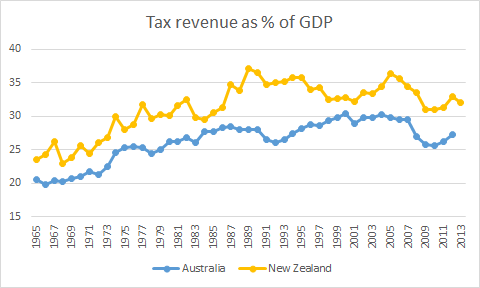
Source: Revenue Statistics – Comparative tables.
In Australia’s case, the only time tax revenue as a percentage of GDP fell prior to the election of a Labour government in 2007 was during a deep recession in 1991. This was a recession bought on by irresponsible monetary policy by Paul Keating– the Keating recession.
As for New Zealand, the tax take increase quite considerably under tax reforms of the Labour Government of the 1980s. Roger Douglas, far from being a neoliberal plant, seemed to be a double secret agent of a tax maximising Leviathan. Little wonder the New Zealand economy was sluggish in the late 1980s because of this large increases in the tax take.
Osborne won't rule out tax cut for top earners ind.pn/1JaeId4 http://t.co/LvO7vgmmX0 http://t.co/YU3600Sk5s—
Marcus Chown (@marcuschown) April 05, 2015
Tax reform leads to higher taxes – the evidence on the GST
31 Mar 2015 Leave a comment
in constitutional political economy, politics - Australia, politics - New Zealand, Public Choice, public economics, taxation Tags: Geoffrey Brennan, James Buchanan, tax reform
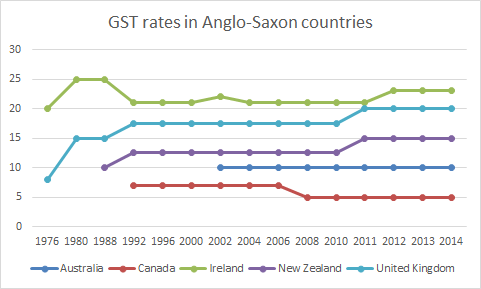
The GST increased from 10 to 15% in New Zealand; more than doubled in the UK; but GST rates were stable or went up and down in the remaining Anglo-Saxon countries.
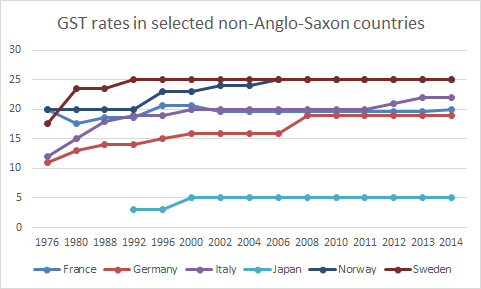
As for a selection of other non-Anglo-Saxon countries , Brennan and Buchanan were right. Tax reforms such as a broad-based consumption tax leads to higher taxes through time.
ICYMI: How does Australia's GST compare with other nations? ab.co/1eBsdrS #factcheck http://t.co/QFP05xonEB—
ABC Fact Check (@ABCFactCheck) July 31, 2015
The GST (goods and services tax) in Europe is known as the value added tax (VAT).
Source: OECD Tax Database – OECD.
New Zealand and Australian private health insurance rates compared
31 Mar 2015 Leave a comment
in health economics, politics - Australia, politics - New Zealand
Seems like imposing a tax on those did not have a private cover induced high income people to take out private cover stop

Via http://www.healthfunds.org.nz/pdf/dec2013%20Quarterly%20statistical%20summary.pdf

Via INFOGRAPHIC: A snapshot of private health insurance in Australia.
Putin’s popularity ratings of late
31 Mar 2015 Leave a comment
in politics - USA, war and peace Tags: Putin, Russian politics
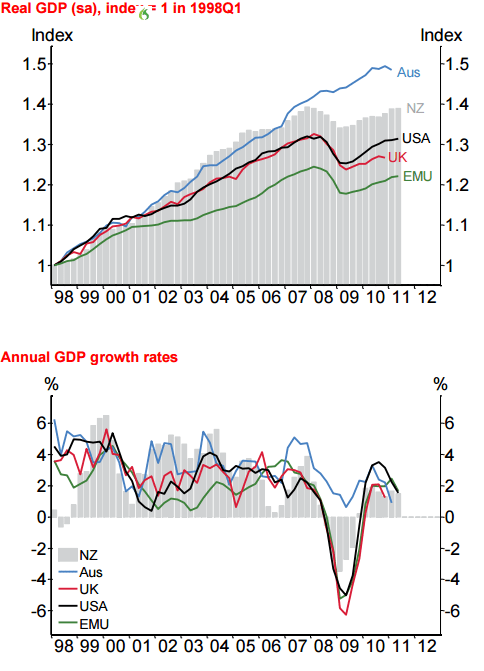
Recent New Zealand economic growth compared
31 Mar 2015 Leave a comment
in economic growth, macroeconomics, politics - Australia, politics - New Zealand, politics - USA
The impact of drought on the 1998 mild New Zealand recession
31 Mar 2015 Leave a comment
in business cycles, economic growth, macroeconomics, politics - New Zealand Tags: 1998 recession, drought, real business cycles
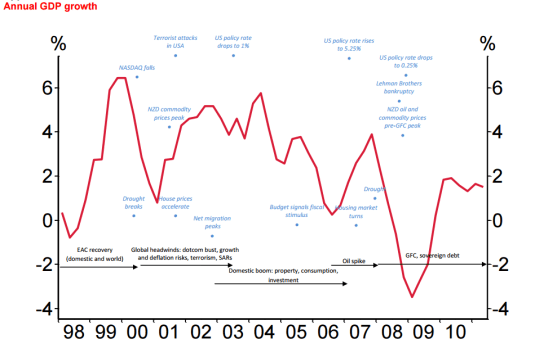
Reserve Bank of New Zealand has these conclusions about the contribution of drought to the business cycle in the late 1990s in New Zealand and in particular the mild 1998 recession:
a back-of-the-envelope estimate of the impact of the drought-induced fall in supply would suggest a contribution from the agricultural sector to production GDP for the March quarter of 1998 of around -0.4 percentage points out of the total 1 per cent fall in production GDP. In the June quarter of 1998, the contribution from these sectors was close to zero.
Figure 27:

In 1998, agricultural and hunting industry contributed per cent of real GDP. . That included the production of livestock, wool, dairy, horticulture, and crops, as well as the provision of agricultural contracting services and hunting. In the same year, the primary food manufacturing industry contributed 3 per cent of GDP. This category covers the processing of meat and dairy products for export and local markets.
A tale of two parents
30 Mar 2015 Leave a comment
in human capital, labour economics, labour supply, occupational choice, politics - USA, population economics, poverty and inequality, welfare reform Tags: child poverty, family demographics, family structures, single parents
Whitlam’s curse – How higher education drives inequality among the bottom 99%
30 Mar 2015 Leave a comment
in economics of education, human capital, labour economics, labour supply, occupational choice, politics - Australia, politics - USA Tags: David Autor, education premium, Gough Whitlam, top 1%
Gough Whitlam abolished tuition fees at Australian universities in 1972. The idea was to reduce inequality. He entrenched it instead, and gave a flying start to those of already above-average talents.
David Autor in a recent paper has illustrated how the gap between the highly educated and the less educated is growing at a far faster rate than the gap between the top 1% in the bottom 99% in the USA. David Autor argues that
a single minded focus on the top 1% can be counterproductive given that the changes to the other 99% have been more economically significant.

- since the early 1980s, the earnings gap between workers with a high school degree and those with a college education has become four times greater than the shift in income during the same period to the very top from the 99%.
- Between 1979 and 2012, the gap in median annual earnings between households of high-school educated workers and households with college-educated ones expanded from $30,298 to $58,249, or by roughly $28,000.
- If the incomes of the bottom 99% are grown at the same pace as the top 1% their incomes would have increased by $7000 per household.
Autor argues that the growth of skill differentials among the other 99% is more consequential than the rise of the 1% for the welfare of most citizens.

via How Education Drives Inequality Among the 99% – Real Time Economics – WSJ.
To punish the discussion of public affairs through libel judgments is to shut off discussion of the very kind most needed
29 Mar 2015 Leave a comment


Recent Comments