Via Reduction of Cases and Deaths of Vaccine-Preventable Diseases in the US — Our World in Data.
Reduction of Cases and Deaths of Vaccine-Preventable Diseases in the US
26 Mar 2015 Leave a comment
in economics of media and culture, health economics, politics - USA
Why, to many critics, Mother Teresa is still no saint – The Washington Post
26 Mar 2015 Leave a comment
The New Zealand gender wage gap is 6%, not 36% as the Greens claim
25 Mar 2015 Leave a comment
in discrimination, gender, human capital, labour economics, labour supply, occupational choice, politics - New Zealand Tags: gender wage gap
Another reason why that treaty with China over climate change won’t count much
25 Mar 2015 1 Comment
in environmental economics, global warming, politics - USA Tags: China, climate alarmism, global warming
Gentlemen Reading Each Others’ Mail: A Brief History of Diplomatic Spying as a force for peace and nuclear stability
24 Mar 2015 Leave a comment
in politics - New Zealand, politics - USA, war and peace Tags: game theory, mutually assured destruction, nuclear deterrence, nuclear war, Ronald Reagan
At the 2009 G20 meetings in London, GCHQ set up fake internet cafes for delegates to use to log their keystrokes. If you are dumb enough to use an Internet cafe for official business, you deserve to be spied on.
Barack Obama, even with special encryption software, is now allowed to email only some 20 aides, family members and friends whose devices have similar protections.
All this spy v. spy stuff is a force for peace. At the 1921 Naval conference aimed to limit naval capability among the world’s powers as a way of curbing the war-ship arms race at the time, the U.S. wanted Japan to concede to having fewer ships, but Japan wanted slightly more. With code-cracking, the U.S. discovered that it was more important to the Japanese to preserve their relationship with the U.S. than to be able to spend more on their navy.
“We pressed hard, and Japan abandoned its position that it wanted to build more,” Kahn said. “We won a great victory for not just the U.S., but for the whole world because we built fewer war ships and we had more money to build roads and for other infrastructure.”
Richard Posner in a lecture some years ago talked about how useful spying was during the cold war. Each side develop a far more accurate appreciation of the other’s strengths. As a result, it did not overreact nor under react to threats. For example, it was through U-2 spying that the USA learned that there was no missile gap with Russia. In fact, Russia is very weak and much less of a threat.
In 1983, Ronald Reagan learned through secret intelligence that through a series of misinterpretations of routine military manoeuvres in Western Europe, and some bureaucrats at Russian embassies trying to inflate their own importance and knowledge of the workings of their host governments, the Soviet leadership came to the impression that they were a ruse for war and they were under the threat of imminent attack. The Russians started to prepare to counter attack.
At the same time, a Korean airline was shot down by the Russian air force. Privately, Reagan and his advisers are horrified that such a thing could happen through a comedy of errors and that could lead to something far worse through mutual alarm and tests of will.
Historians now regard 1983 as the closest time there was a possibility of a nuclear war since the Cuban missile crisis. It all arose through a series of misunderstandings of a series of routine military manoeuvres against a background of worsening relations with the Soviet union. Robert Gates, Deputy Director for Intelligence in 1983, has published thoughts on the exercise that dispute this conclusion:
Information about the peculiar and remarkably skewed frame of mind of the Soviet leaders during those times that has emerged since the collapse of the Soviet Union makes me think there is a good chance—with all of the other events in 1983—that they really felt a NATO attack was at least possible and that they took a number of measures to enhance their military readiness short of mobilization.
After going through the experience at the time, then through the post-mortems, and now through the documents, I don’t think the Soviets were crying wolf. They may not have believed a NATO attack was imminent in November 1983, but they did seem to believe that the situation was very dangerous. And US intelligence [SNIE 11–9-84 and SNIE 11–10–84] had failed to grasp the true extent of their anxiety.
This secret intelligence led Reagan to both reappraise his attitude to the Russians and put out some peace feelers and take other stabilising measures. The period is known as the Reagan reversal. In his memoirs, Reagan wrote of a 1983 realization:
Three years had taught me something surprising about the Russians: Many people at the top of the Soviet hierarchy were genuinely afraid of America and Americans. Perhaps this shouldn’t have surprised me, but it did…
During my first years in Washington, I think many of us in the administration took it for granted that the Russians, like ourselves, considered it unthinkable that the United States would launch a first strike against them.
But the more experience I had with Soviet leaders and other heads of state who knew them, the more I began to realize that many Soviet officials feared us not only as adversaries but as potential aggressors who might hurl nuclear weapons at them in a first strike…
Well, if that was the case, I was even more anxious to get a top Soviet leader in a room alone and try to convince him we had no designs on the Soviet Union and Russians had nothing to fear from us.
Reagan began seeking a rapprochement with the Kremlin fifteen months before Gorbachev took office. Reagan spoke of common concerns, the mutual desire for peace and the urgent need to address “dangerous misunderstandings” between Moscow and Washington.
via Gentlemen Reading Each Others’ Mail: A Brief History of Diplomatic Spying — The Atlantic, L. Gordon Crovitz: Gentlemen Read Each Other’s Mail – WSJ and Able Archer 83 – Wikipedia, the free encyclopedia.
How you adjust for inflation makes a big difference to long-term wages growth
24 Mar 2015 Leave a comment
in applied welfare economics, politics - USA
There are several measures of inflation. The measure that is used will have a substantial impact on reported growth in real wages.
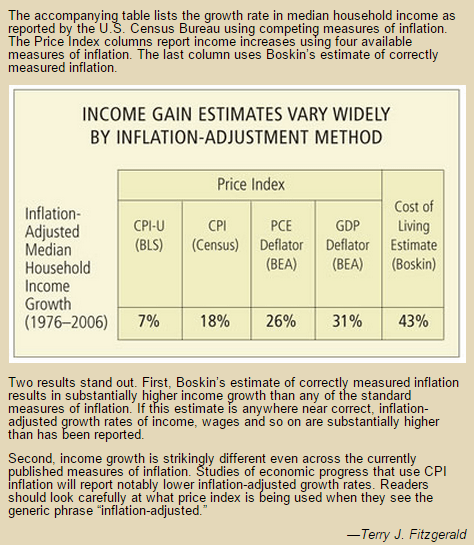
via Where Has All the Income Gone? | Federal Reserve Bank of Minneapolis.
How conservative are the Republican presidential candidates?
24 Mar 2015 Leave a comment
in politics - USA Tags: 2016 presidential election

In Defence of Negativity in Politics – John G. Geer
24 Mar 2015 Leave a comment
in economics of information, economics of media and culture, politics - Australia, politics - New Zealand, politics - USA, Public Choice Tags: Attack Ads, expressive voting, John G. Geer, political psychology, rational ignorance, rational irrationality
John G. Geer, author of In Defense of Negativity: Attack Ads in Presidential Campaigns, argues that negative ads are positive. They focus on important political issues and give voters critical information about differences between candidates. Attack ads do not degrade, but rather enrich the democratic process. When political candidates attack each other, they raise doubts about each other’s views and qualifications. Voters—and the democratic process—benefit from this clash of opinions.
The Great Enrichment – cost of household appliances version
23 Mar 2015 Leave a comment
in politics - USA, technological progress Tags: living standards, The Great Enrichment
we find that people at all income levels now have access to many more material possessions than they did in the 1980s. Moreover, there has been a narrowing of the gap between high and low-income classes in terms of ownership of these items.
It is hard to argue against the improvement in the standard of living that has accompanied these trends. Hence, the standard narrative that rising income inequality has somehow hurt the middle and lower-income classes is not supported by data.

Kabul, 1972
23 Mar 2015 Leave a comment
in economic history, economics of religion, politics - USA Tags: Afghanistan, Islam, women's rights
Far Left Mana Movement admits it’s really cheap to feed the kids
23 Mar 2015 Leave a comment
in applied welfare economics, labour economics, politics - New Zealand, poverty and inequality, welfare reform Tags: activists, child poverty, Leftover Left, school breakfast programmes
Joe Trinder, the Mana News editor, today blogged about the great expense of feeding the kids for ordinary families. In the course of doing so, he showed how extremely cheap it was for parents to make their children breakfast. The Far Left has inadvertently capitulated on school breakfast programmes been outside the reach of ordinary families.

I completely agree with Joe. A 1 kg box of Weet-Bix costs $7 and a 2 L bottle of milk costs $5.55. I buy the cheaper brands of Weet-Bix than this myself.

1 kg box of Weet-Bix will last maybe two weeks. 2 L of milk will last not much less than that if you pour the milk on Weet-Bix to the extent I do. Two weeks breakfast will cost much less than one dollar per breakfast as argued by Eugene Rush in her letter to the editor a few months ago.
If a family can’t find $.55 to make their children breakfast, they need targeted specific intervention from Work and Income New Zealand to see what additional financial assistance they need, including budget advice, and from the child protection agency, Child, Youth and Families.
- Providing a hungry child with breakfast at school through a Feed the Kids Bill is parliamentary grandstanding that doesn’t strike at the root of the problem.
- These hungry children are not provided with breakfast either at the weekend or during the school holidays. They are abandoned by the process set up under the Feed the Kids Bill championed by the hard left.
- Worst of all, what about the parents? No good parent would have breakfast while their child goes hungry.
No provision is made by the hard left in its Feed the Kids Bill to feed the parents of these hungry children who also go hungry every morning. There is no other charitable explanation as to why their children were not given breakfast. No one in the house can afford breakfast both during school days, at the weekend and in school holidays.

As shown from the screenshot above, the Otago University’s annual Food Cost Survey suggests that to meet basic needs, a family must spend $44 per week for a five-year-old and $34 per week for a four-year-old in Wellington, which is where I live. That is, it costs about five or six dollars per day per child to feed them. A liberal diet for a small child for a day costs not much more than a cup of coffee at a cafe where I’m going shortly. The real issue is the income of parents.
The best solution to poverty is to move people into a job. Simon Chapple is quite clear in his book in the middle of last year with Jonathan Boston that a sole parent in full-time work, and a two parent family with one earner with one full-time and one part-time worker, even at low wages, will earn enough to lift their children above most poverty thresholds.
Sustained full-time employment of sole parents and the fulltime and part-time employment of two parents, even at low wages, are sufficient to pull the majority of children above most poverty lines, given the various existing tax credits and family supports.
The best available analysis, the most credible analysis, the most independent analysis in New Zealand or anywhere else in the world that having a job and marrying the father of your child is the secret to escaping poverty is recently by the Living Wage movement in New Zealand.
According to the calculations of the Living Wage movement, earning only $18.80 per hour with a second earner working only 20 hours per week affords their two children, including a teenager, Sky TV, pets, international travel, video games and 10 hours childcare. This analysis of the Living Wage movement shows that finishing school so your job pays something reasonable and marrying the father of your child affords a comfortable family life.
The Guardian on the strength of the scientific consensus on global warming and on GMOs
22 Mar 2015 Leave a comment
in environmental economics, health economics, politics - Australia, politics - New Zealand, politics - USA
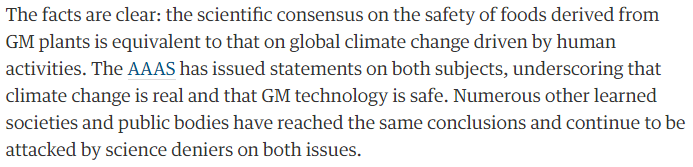
I marvel at the ability of The Guardian to launch a diatribe against science deniers on GMOs, and not mention that most of them come from the left-wing of politics and the Greens and the environmental movement.


Recent Comments