When Americans voted for the House of Representatives in 2012, Democratic candidates won 1.4 million more votes than Republicans. Yet after the dust settled, the GOP ended up with a 234-201 majority in the chamber.
Last year, in contrast, the GOP won a national landslide. But despite winning big victories in these four states, they only picked up one new House seat overall among them (in North Carolina). That’s because Republicans already won nearly all of the competitive seats in 2012 — partly because of gerrymandering…
Severalanalysesfind that simple geography matters more — many Democratic voters are packed closer together in urban areas.
Since 1989, there’s been no significant change in the public’s concern level over global warming. To put this in perspective, note that the most expensive public-relations campaign in history—one that includes most governmental agencies, a long list of welfare-sucking corporations, the public school system, the universities, an infinite parade of celebrities, think tanks, well-funded environmental groups and an entire major political party—has, over the past 25 years or so, increased the number of Democrats who “worry greatly” about global warming by a mere four percentage points.
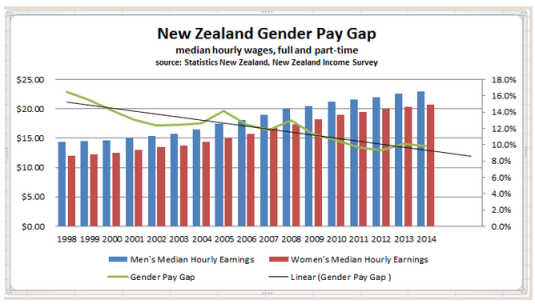
The OECD puts the gender wage gap in New Zealand at about 6% for full-time employees on an hourly basis when measured using median earnings.
The Ministry of Women’s Affairs puts that gender wage gap estimate at 9.9% by measuring median hourly earnings, but the Ministry includes both full-time and part-time employees.
Conflating full-time and part-time earnings when measuring wage gaps is unwise. The level of compensating differentials in full-time and part-time jobs differ. More of the net pay package of a part-time job would be convenience and flexibility. A full-time job tends to indicate greater commitment to the labour force day in day out and less interest in flexibility and time off during the week.
At the 2009 G20 meetings in London, GCHQ set up fake internet cafes for delegates to use to log their keystrokes. If you are dumb enough to use an Internet cafe for official business, you deserve to be spied on.
Barack Obama, even with special encryption software, is now allowed to email only some 20 aides, family members and friends whose devices have similar protections.
All this spy v. spy stuff is a force for peace. At the 1921 Naval conference aimed to limit naval capability among the world’s powers as a way of curbing the war-ship arms race at the time, the U.S. wanted Japan to concede to having fewer ships, but Japan wanted slightly more. With code-cracking, the U.S. discovered that it was more important to the Japanese to preserve their relationship with the U.S. than to be able to spend more on their navy.
“We pressed hard, and Japan abandoned its position that it wanted to build more,” Kahn said. “We won a great victory for not just the U.S., but for the whole world because we built fewer war ships and we had more money to build roads and for other infrastructure.”
Richard Posner in a lecture some years ago talked about how useful spying was during the cold war. Each side develop a far more accurate appreciation of the other’s strengths. As a result, it did not overreact nor under react to threats. For example, it was through U-2 spying that the USA learned that there was no missile gap with Russia. In fact, Russia is very weak and much less of a threat.
In 1983, Ronald Reagan learned through secret intelligence that through a series of misinterpretations of routine military manoeuvres in Western Europe, and some bureaucrats at Russian embassies trying to inflate their own importance and knowledge of the workings of their host governments, the Soviet leadership came to the impression that they were a ruse for war and they were under the threat of imminent attack. The Russians started to prepare to counter attack.
At the same time, a Korean airline was shot down by the Russian air force. Privately, Reagan and his advisers are horrified that such a thing could happen through a comedy of errors and that could lead to something far worse through mutual alarm and tests of will.
Historians now regard 1983 as the closest time there was a possibility of a nuclear war since the Cuban missile crisis. It all arose through a series of misunderstandings of a series of routine military manoeuvres against a background of worsening relations with the Soviet union. Robert Gates, Deputy Director for Intelligence in 1983, has published thoughts on the exercise that dispute this conclusion:
Information about the peculiar and remarkably skewed frame of mind of the Soviet leaders during those times that has emerged since the collapse of the Soviet Union makes me think there is a good chance—with all of the other events in 1983—that they really felt a NATO attack was at least possible and that they took a number of measures to enhance their military readiness short of mobilization.
After going through the experience at the time, then through the post-mortems, and now through the documents, I don’t think the Soviets were crying wolf. They may not have believed a NATO attack was imminent in November 1983, but they did seem to believe that the situation was very dangerous. And US intelligence [SNIE 11–9-84 and SNIE 11–10–84] had failed to grasp the true extent of their anxiety.
This secret intelligence led Reagan to both reappraise his attitude to the Russians and put out some peace feelers and take other stabilising measures. The period is known as the Reagan reversal. In his memoirs, Reagan wrote of a 1983 realization:
Three years had taught me something surprising about the Russians: Many people at the top of the Soviet hierarchy were genuinely afraid of America and Americans. Perhaps this shouldn’t have surprised me, but it did…
During my first years in Washington, I think many of us in the administration took it for granted that the Russians, like ourselves, considered it unthinkable that the United States would launch a first strike against them.
But the more experience I had with Soviet leaders and other heads of state who knew them, the more I began to realize that many Soviet officials feared us not only as adversaries but as potential aggressors who might hurl nuclear weapons at them in a first strike…
Well, if that was the case, I was even more anxious to get a top Soviet leader in a room alone and try to convince him we had no designs on the Soviet Union and Russians had nothing to fear from us.
Reagan began seeking a rapprochement with the Kremlin fifteen months before Gorbachev took office. Reagan spoke of common concerns, the mutual desire for peace and the urgent need to address “dangerous misunderstandings” between Moscow and Washington.
Why Evolution is True is a blog written by Jerry Coyne, centered on evolution and biology but also dealing with diverse topics like politics, culture, and cats.
In Hume’s spirit, I will attempt to serve as an ambassador from my world of economics, and help in “finding topics of conversation fit for the entertainment of rational creatures.”






Recent Comments