
Was Aaron Sorkin right? Hollywood discriminates? Sacrifices profit to indulge sexism?
17 Dec 2014 1 Comment
What do the top income earners in Australia earn on average?
16 Dec 2014 Leave a comment
in income redistribution, politics - Australia Tags: top 1%

Source: topincomes-parisschoolofeconomics
As with New Zealand, plenty of people in the top income brackets in Australia would regard themselves as middle class – entrepreneurs and professionals who made their way up from the bottom.
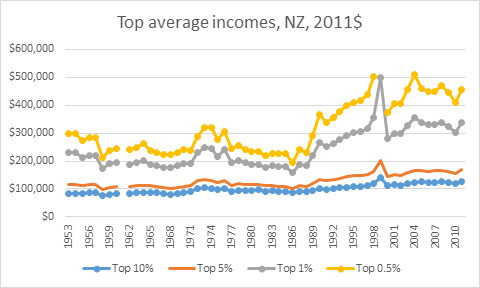
As with New Zealand, there is a major spike in top earnings around the time of the 1985 tax reform when the top tax rate was cut from 66% to 49% in Australia.
Source: topincomes-parisschoolofeconomics
As for trans-Tasman comparisons, the top 10% and top 5% in Australia do earn more than their compatriots in New Zealand.
The top 1% in Australia are much better performers than the top 1% in New Zealand, but then again wages and incomes are about a third higher in Australia as compared to New Zealand.
The Australian 0.5% are clearly superior to their New Zealand rivals, earning at least 50% more than them on average.
The New Zealand chart is in New Zealand dollars in 2011; the Australian chart is in Australian dollars in 2010.
A reason for the higher earnings of the Australian top 1% is the larger economy offers a greater superstar effect.

Globalisation and technological changes would allow the Australian best performers, including the top managers and top chief executives, in a given field to serve a bigger market and thus reap a greater share of its revenue. But this would also reduce the spoils available to the less gifted in the business. Australia, as the seven times larger economy, allows their best performers to serve bigger domestic markets.
How much do the top income earners actually earn in NZ?
16 Dec 2014 Leave a comment
in economic history, income redistribution, labour economics, politics - New Zealand, Rawls and Nozick Tags: top 1%

Source: topincomes-parisschoolofeconomics
Note: top income share data for adults for New Zealand adults go back only as far as 1953.
To begin with, a large number of people who see themselves as middle class will have to reclassify themselves in terms of class membership.
More importantly, they will have to pick up on their class consciousness because they are either in the top 10% as any successful professional is because the average income of the top 10% in New Zealand is $128,000. With a bit of luck, these members of the ruling class will be able to afford a house in Auckland without having to borrow from mum and dad.
Pretty much every successful professional is in the top 5% in New Zealand, with an average income of $170,000.
These rich have a lot of people look down upon and order about as junior or senior members of the ruling class, even if they did know they were a member of the ruling class until they looked at the diagram above. Welcome to the ruling class. Goodbye to the middle-class. Get over it.
As for the top 1% in New Zealand, they have an average income in 2011 of $336,000. Once again, successful professionals, successful entrepreneurs and what’s left of the rentier class will have to accept that supreme power as the ruling class of the capitalist system is open to just about anybody who does well at university and enters the professions. Are there no standards?
As for the top 0.5%, data on the top 0.1% stopped in 1989, they earned an average of $457,000 a year in 2011. That is starting to look like good money, though you do have to brush shoulders with celebrities, athletes and more than a few successful small entrepreneurs, but at least you are starting to earn a lot more than your average suburban doctor who is a member of the top 10%.
The ruling class is not what it used to be – the rentier class, old money. That the rich of today – the ruling class of the capitalist system – is open to many ordinary people who are new rich or just plain urban professionals, athletes, musicians and celebrities is a common finding all round the world. As Piketty and Saez explained for the USA:
This rise in top income shares is not due to the revival of top capital incomes, but rather to the very large increases in top wages (especially top executive compensation).
As a consequence, top executives (the “working rich”) have replaced top capital owners at the top of the income hierarchy over the course of the twentieth century.
Many of the rich both in New Zealand and overseas are working rich who made their money themselves and came from middle class or upper middle-class backgrounds.
Many of these rich are well educated smart people rather than the inheritors of wealth. The working rich and most of the rich of the 21st century must be well educated because so many of them are professionals in occupations where you must succeed at university to get in the ground floor, or they are athletes, musicians and other celebrities who must work their way up from the bottom.
A large number of New Zealanders who regarded themselves as middle class action are part of the rich – the top 10%, top 5% and banging on the doors of the top 1% or better – so they better start carrying themselves about with the airs and graces of the ruling class. Better practice by putting a plum in your mouth.
p.s. There was a big spike in top incomes in 1999. It seems like a lot of people in New Zealand brought forward income in 1998 and 1999 in anticipation of the election of a Labour Party government in the 1999 New Zealand general election, and an immediate increase in the top tax rate from 33% to 39% for incomes over $60,000.
The top 10% are a bunch of bludgers in New Zealand too
16 Dec 2014 Leave a comment
in economics of education, income redistribution, politics - Australia, politics - New Zealand, politics - USA Tags: education premium, top 1%
Source: topincomes-parisschoolofeconomics
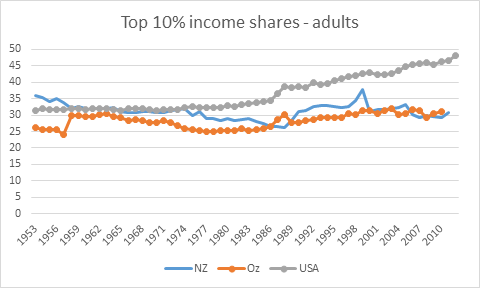
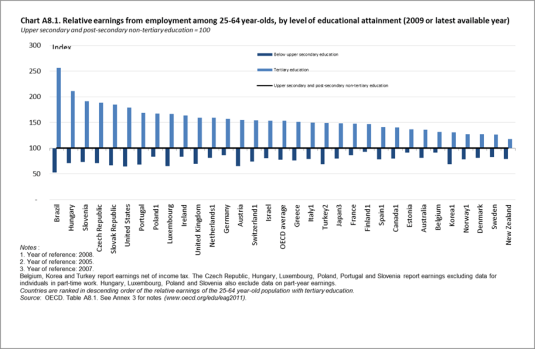
One reason why the top 10% in New Zealand have been a pretty ordinary lot compared to the USA is New Zealand’s university graduate premium – the college premium as it is known in the USA – is at the very bottom of the OECD ladder at about 18% – rock bottom 32nd out of 32 – the wooden spoon.
The College premium in the USA is about 64%, as shown in the OECD data below from OECD Education at Glance. Naturally, this high College premium in the USA should show up in well educated, highly skilled people earning a lot more than those that don’t go to college and don’t go to graduate school.
Stats link: http://dx.doi.org/10.1787/888932460515
Little wonder that the USA top 10% are breaking away from the pack. This slow increase in the income share of the top 10% since the early 1970s coincided with large numbers, including many more women in long duration professional degrees, going to university.
Prior to the mid-1970s, the College premium in the USA had been falling for about a decade because of large numbers of people going on to College and many of these two graduate school to get a draft deferment.
People married younger then so by the time people were at the end of College or graduate school, they were usually married with children and got of further draft deferment and aged out of the draft system.
The top 1% in New Zealand have been bone lazy for at least 60 years now
16 Dec 2014 2 Comments
in income redistribution, politics - Australia, politics - New Zealand Tags: top 1%

Source: topincomes-parisschoolofeconomics
Note: top 1% income share data for adults for New Zealand adults go back only as far as 1953.
The top 1% in New Zealand have had a good 60 years to immiserate the proletariat and what are they done? Nothing!
The top 1% share of national income is much the same as it was in 1953! The Australian top 1% haven’t done much better. Bludgers, the lot of them.
What do the Occupy movement have to protest about in New Zealand if the rich haven’t been getting richer?

@bryce_edwards New Zealand’s war on the poor – a fact check
15 Dec 2014 Leave a comment
in economic history, income redistribution, labour economics, Marxist economics, politics - USA, technological progress Tags: Bryce Edwards, Leftover Left, poverty and inequality
Bryce Edwards has shown in today’s column that he knows nothing about inequality in New Zealand, despite the statistics being at his fingertips:
Under capitalism there’s always going to be a war against the poor.
The process by which we divide up the resources of any society normally involves exploiting the majority for the benefit of the minority.
It’s called inequality. And this is how it is in New Zealand: those who have the most power look for ways to extract that money for themselves, or at least retain the status quo.
Against this are those who want to have a more equal society. It’s an age-old political issue, and one that has traditionally been at the heart of the left-right political divide.
In 2014 this concern about inequality has been a key feature of politics, underpinning much of what has occur…
Although the rich appear to have been winning for three decades in their ‘war against the poor’, perhaps the tide is turning?
There’s still every indication of severe poverty and inequality in this country.
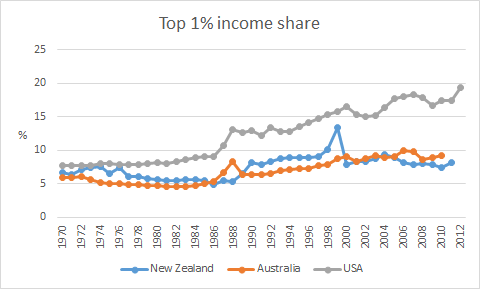
Firstly, inequality has not increased in New Zealand for at least 20 years when either measured in figure 1 by the Gini coefficient or in figure 2, the top 1% income shares. Both the Gini coefficient and the top 1% income shares have not risen for 20 years.
Figure 1: Gini coefficient New Zealand 1980-2015

Source: Bryan Perry, Household incomes in New Zealand: Trends in indicators of inequality and hardship 1982 to 2013. Ministry of Social Development (July 2014).
Figure 2: Top 1% income shares, USA, New Zealand and Australia, 1970-2012
Source: top incomes database
Secondly, the benefits of the economic boom that lasted 15 years from the early 1990s until the onset of the global financial crisis would spread broadly across all sections of the New Zealand community. As shown in figure 3, both before and after housing costs increased. As shown in figure 4, real household incomes increased pretty much evenly across all of the 10 income deciles between 1994 and 2013.
Figure 3: Real household income trends before housing costs (BHC) and after housing costs (AHC), 1982 to 2013 ($2013)
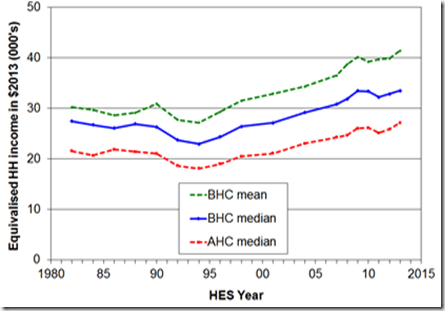
Source: Bryan Perry, Household incomes in New Zealand: Trends in indicators of inequality and hardship 1982 to 2013. Ministry of Social Development (July 2014).
Figure 4: Real household incomes (BHC), changes for top of income deciles, 1994 to 2013
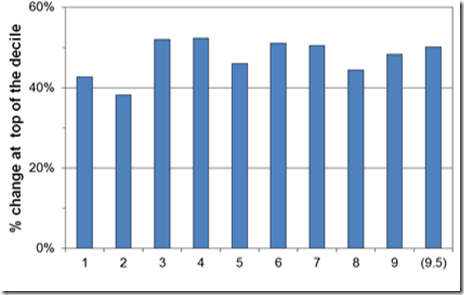
Source: Bryan Perry, Household incomes in New Zealand: Trends in indicators of inequality and hardship 1982 to 2013. Ministry of Social Development (July 2014).
Thirdly, as shown in figure 5, between 1994 and 2010, real equivalised median household income rose 47% from 1994 to 2010; for Māori, this rise was 68%; for Pasifika, the rise was 77%. Median household income increases of nearly 50% in 16 years should be celebrated.
Figure 5: Real equivalised median household income (before housing costs) by ethnicity, 1988 to 2013 ($2013).

Source: Bryan Perry, Household incomes in New Zealand: Trends in indicators of inequality and hardship 1982 to 2013. Ministry of Social Development (July 2014).
The massive improvements in Māori incomes since 1992 were based on rising Māori employment rates, fewer Māori on benefits, more Māori moving into higher paying jobs, and greater Māori educational attainment. Māori unemployment reached a 20-year low of 8 per cent from 2005 to 2008.
Over the last more than two decades in New Zealand, there has been sustained income growth spread across all of New Zealand society contrary to the warmed over Marxism of Bryce Edwards. Perry (2014) reviews the data every year for the Ministry of Social Development. He concluded that:
Overall, there is no evidence of any sustained rise or fall in inequality in the last two decades.
The level of household disposable income inequality in New Zealand is a little above the OECD median.
The share of total income received by the top 1% of individuals is at the low end of the OECD rankings.
Bryce Edwards’ analysis was in the typical Marxist tradition – it had no gender analysis. He failed to mention that New Zealand has the smallest gender wage gap of all the industrialised countries.

As he did not notice these great successes in household incomes, incomes of every decile, Māori economic development and the empowerment of women, Bryce Edwards had nothing to add in terms of either consolidating or improving on them.
Let freedom reign
15 Dec 2014 Leave a comment
in economics of crime, law and economics, liberalism, politics - Australia Tags: war on terror
This is shot that captures the #sydneysiege: sheer terror/relief of escaped hostages, incredible work of @nswpolice http://t.co/iCffJZ9NuZ—
Caroline Marcus (@carolinemarcus) December 15, 2014
Was the 1990s in the USA a boom period or business as usual?
15 Dec 2014 Leave a comment

Source: Edward Prescott
Further evidence of the dynamic, deregulated nature of the New Zealand labour market
15 Dec 2014 2 Comments
in economics of regulation, labour economics, law and economics, politics - Australia, politics - New Zealand, politics - USA, unemployment Tags: employment law, employment protection, labour market dynamics, labour market regulation
The chart below shows that New Zealand is far more flexible than Western Europe and is pretty near the USA in terms of people moving in and out of the unemployment pool every month with great ease. There are very high outflow rates from unemployment among the Anglo-Saxon and Nordic economies. The economies of Continental Europe stand in stark contrast. Unemployment outflow rates in these economies lie below 10% at a monthly frequency.
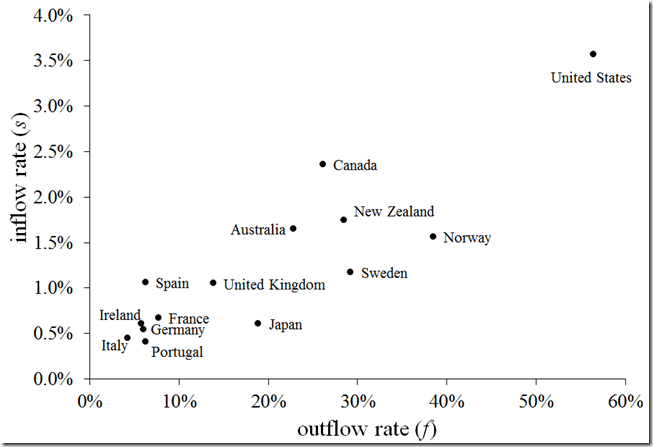
Source: Unemployment Dynamics in the OECD, Elsby, Hobijn and Şahin (2013).
Abe’s snap election pays off with big win for LDP | The Japan Times
15 Dec 2014 Leave a comment
in economic growth, macroeconomics, politics, Public Choice Tags: Edward Prescott, Japan

the ruling bloc secured a two-thirds supermajority in the 475-seat House of Representatives, giving it the power to override the Upper House.
When I arrived in Japan in 1995, the LDP was out of power and written off.
The LDP were true stayers in politics. They managed to get back into power soon after the 1995 general election by forming a coalition with the Socialist party.
The Socialist party leader was initially the Prime Minister then he resigned later and was replaced by an LDP Prime Minister.
The grip on power of the LDP was consolidated by the great competence of the Koizumi administration.

Source: Edward Prescott
The LDP lost power again in about 2007 but regained power in the next election through the extreme incompetence of their opposition.
In the current election, the main opposition party were unable even to put up enough candidates to actually win a majority.
The key contribution of the main opposition parties in Japan was well stated when they last won an election in 2007. They have shown that they can actually win an election when the LDP performs poorly. That is an important discipline that may not have been there in the 1980s.
via Abe’s snap election pays off with big win for LDP | The Japan Times.
Global warming – where there is and is not a consensus to deny | Ordinary Times
14 Dec 2014 Leave a comment
in applied welfare economics, climate change, environmental economics, environmentalism, global warming, Karl Popper, politics - Australia, politics - New Zealand, politics - USA, Public Choice Tags: climate alarmism, expressive voting, global warming

The motte for climate change activists are the following:
- Global temperatures are rising.
- Greenhouse gases lead to increased temperatures.
- Greenhouse gases emitted by humans have led to measurable increases in temperature beyond what would have occurred without any humans.
The above points are highly defensible because Science. I believe they are true (though I do so only via trust in others rather than having evaluated any of the research involved personally).
Activists, however, do not sit in this motte for long. They often go on to make a lot of other claims in the bailey:
- Long-term projections of the Earth’s climate are accurate.
- Catastrophe will result in a few decades due to human carbon emissions.
- Nuclear energy is not a viable alternative to fossil fuels.
- Carbon capture is not viable.
- Geoengineering is not viable.
- Unilateral subsidization of renewables by Western industrialized nations is an effective way to reduce global emissions of greenhouse gases.
- Subsidies of energy-efficient products are a better use of resources rather than research and development.
- Subsidizing vehicles that pollute less than other vehicles will provide a net reduction in greenhouse emissions.
- LEED-certified buildings are more energy-efficient than old buildings.
- Building new LEED-certified buildings reduces net greenhouse emissions relative to not building them.
- Sending oil by railcar will result in less net emissions than sending oil through a pipeline (e.g. the Keystone pipeline).
Not all activists make all of these claims, but I think most make at least some claims that are less defensible than those in the motte.
The end result is that anyone who opposes any of the views, even questionable ones sitting in the bailey, can be branded an anti-science denialist. Strictly speaking, this is unfair since there certainly isn’t a scientific consensus on questions like whether it makes sense to spend thousands of dollars subsidizing Chevy Volts while taxing bicycles and safety helmets at 8%.
via An Example of the Motte and Bailey Doctrine | Ordinary Times.


Recent Comments