Poverty rates among immigrants and natives across the OECD
16 Jul 2015 Leave a comment
in income redistribution, labour economics, politics - Australia, politics - New Zealand, politics - USA, poverty and inequality, welfare reform Tags: Australia, child poverty, economics of immigration, family poverty
NIMBY: Where, When, And to Which Developers It Happens in the USA
15 Jul 2015 Leave a comment
in economics of regulation, environmental economics, politics - Australia, politics - New Zealand, politics - USA, urban economics Tags: green rent seeking, Inner-city Left, land supply, land use planning, NIMBYs, zoning

How many working poor in USA, UK, Canada, Australia and New Zealand?
14 Jul 2015 Leave a comment
in international economics, labour supply, minimum wage, politics - Australia, politics - New Zealand, politics - USA, poverty and inequality, welfare reform Tags: Australia, British economy, Canada, low pay, New Zealand, social insurance, welfare state, working poor
Figure 1: working poor – proportion of employed persons with income below the poverty line (50% of median disposable income) living in households with a working age head and at least one worker in USA, UK, Canada, Australia and New Zealand, 2013
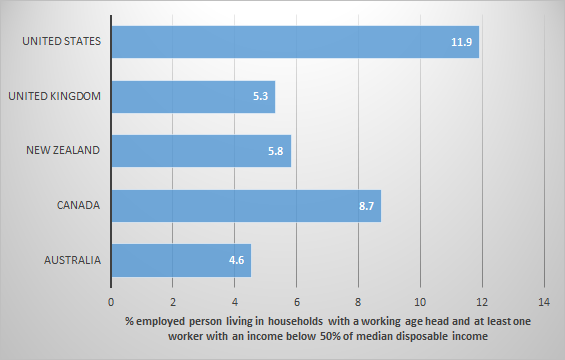
Source: In It Together – Why Less Inequality Benefits All – © OECD 2015, OECD Income Distribution Database (IDD), www.oecd.org/social/income-distribution-database.htm, Table 1.A1.1. Key indicators on the distribution of household disposable income and poverty, 2007, 2011 and 2013 or most recent year.
Does education pay in New Zealand?
14 Jul 2015 Leave a comment
in economics of education, human capital, labour economics, occupational choice, politics - Australia, politics - New Zealand, politics - USA Tags: College premium, graduate premium
Immigrants and their children across the OECD
14 Jul 2015 Leave a comment
in labour economics, labour supply, politics - Australia, politics - New Zealand, politics - USA, population economics Tags: Australia, economics of identity, economics of immigration
Poverty rates by age of youngest child – USA, UK, Canada and Australia
11 Jul 2015 Leave a comment
in economics of love and marriage, labour economics, labour supply, law and economics, politics - Australia, politics - USA, poverty and inequality, welfare reform Tags: Australia, British economy, Canada, child poverty, family poverty, marriage and divorce, single mothers, single parents
Figure 1: poverty rates by age of youngest child, 2004

Voter turnout among voting age people
11 Jul 2015 Leave a comment
Under the shy Labour voter theory, countries with low turnouts should have right-wing governments and countries with high turnouts should have left-wing governments. Do they?
Voter turnout among voting age people
Turkey 86%
Sweden 83
France 71
Mexico 65
UK 61
US 54pewresearch.org/fact-tank/2015… http://t.co/lmMcqqM4JD—
Conrad Hackett (@conradhackett) June 01, 2015
A living wage helps well-off households more!
10 Jul 2015 Leave a comment
in applied price theory, applied welfare economics, econometerics, income redistribution, politics - Australia, politics - New Zealand, politics - USA, Public Choice, rentseeking Tags: activists, British economy, British politics, do gooders, expressive voting, living wage, rational ignorance, rational irrationality, The fatal conceit, The pretence to knowledge, unintended consequences
Do Living Wage advocates realise it helps richer households more than poorer ones? My take: telegraph.co.uk/finance/budget… … http://t.co/YPTB6v7tSB—
Fraser Nelson (@FraserNelson) July 10, 2015
A lot of voters want to protect themselves from the scourge of lower prices
09 Jul 2015 Leave a comment
in industrial organisation, international economics, politics - Australia, politics - New Zealand, politics - USA Tags: antiforeign bias, antimarket bias, expressive voting, free trade, rational ignorance, rational irrationality, voter demographics
Who favors free trade?
(The affluent.)
nytimes.com/2015/05/28/ups… @BrendanNyhan http://t.co/kojmUWUtH0—
Justin Wolfers (@JustinWolfers) May 27, 2015
OECD starting a business rankings (New Zealand (1st) to Germany (114th)) – World Bank Doing Business rankings
09 Jul 2015 Leave a comment
in applied price theory, applied welfare economics, comparative institutional analysis, economics of regulation, industrial organisation, law and economics, politics - Australia, politics - New Zealand, politics - USA, property rights Tags: British economy, doing business, France, Germany, Italy, World Bank
Figure 1: Starting a business rankings – World Bank Doing Business rankings, OECD countries, 2014
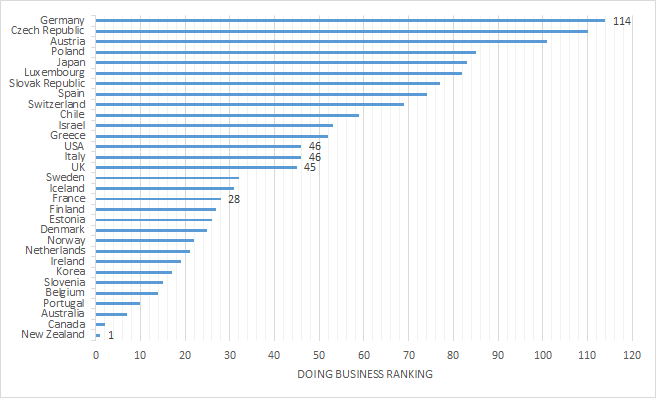
Source: Doing Business – Measuring Business Regulations – World Bank Group.
There is surprising wide range in the World Bank Doing Business ranking of the difficulty and delays in starting a business across the OECD.
Germany is ranked 114 from the world for starting a business. New Zealand is ranked first with the USA, Italy and the UK ranked in the mid 40s in the Doing Business database.
Poverty rates by number of children – USA, UK, Canada and Australia
08 Jul 2015 Leave a comment
in labour economics, politics - Australia, politics - USA, population economics, poverty and inequality, welfare reform Tags: child poverty, family poverty, single mothers, single parents
Figure 1: poverty rates of adults aged 20 to 54 by presence of children, 2004

The political bias of psychologists
05 Jul 2015 Leave a comment
in economics of bureaucracy, economics of education, economics of media and culture, politics - Australia, politics - New Zealand, politics - USA, Public Choice, rentseeking Tags: academic bias, bureaucratic bias, expressive voting, Leftover Left, media bias, occupational choice, political bias, rational ignorance, rational irrationality, social psychology, Twitter left
Why is it that the economics profession is the only profession questioned on the grounds of its political diversity?

1) Academic psychology once had considerable political diversity, but has lost nearly all of it in the last 50 years;
2) This lack of political diversity can undermine the validity of social psychological science via mechanisms such as the embedding of liberal values into research questions and methods, steering researchers away from important but politically unpalatable research topics, and producing conclusions that mischaracterize liberals and conservatives alike;
3) Increased political diversity would improve social psychological science by reducing the impact of bias mechanisms such as confirmation bias, and by empowering dissenting minorities to improve the quality of the majority’s thinking; and
4) The underrepresentation of non-liberals in social psychology is most likely due to a combination of self-selection, hostile climate, and discrimination.
via Psychology’s Political Diversity Problem | Psychology Today.


Recent Comments