
.@NZGreens @amnestynz would call a NZ designated terrorist #Hamas storming NZ borders a peaceful protest, not a riot, not an act of war?
20 May 2018 Leave a comment
in defence economics, economics of crime, International law, law and economics, laws of war, politics - New Zealand, war and peace Tags: Gaza Strip, Hamas, Israel, war against terror
But @SeanPlunket was hounded for saying a lot less than this about a migrant
19 May 2018 Leave a comment
in economics of media and culture, politics - New Zealand Tags: political correctness

.@NZLabour @NZGreens think too many gang members are in prison or not bailed! @sst_nz
18 May 2018 Leave a comment
in economics of crime, politics - New Zealand

Prison muster falling in most years since 2010 except for gang members @sst_nz; The more gang members in prison, the better
18 May 2018 Leave a comment
in economics of crime, politics - New Zealand
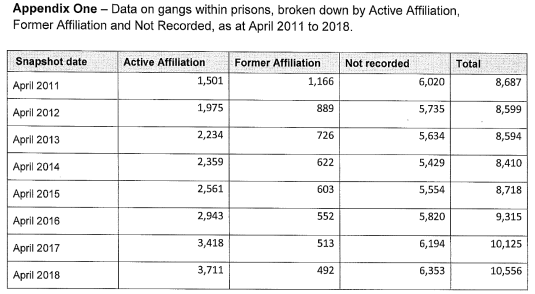
Source: released under the Official Information Act by the Department of Corrections, 18 May 2018.
Still chasing @PeterGluckman @ChiefSciAdvisor justice report references under OIA @sst_nz
17 May 2018 Leave a comment
in economics of crime, politics - New Zealand
“Thanks for your email.
It is unfortunate that you dressed up email exchanges and office conversations as something more than they were. You were attempting to glean credibility from watercooler conversations.
The Gluckman report refers to a briefing which implies that it is a document, but as you now advise, it refers to iterative communication between analysts. I have already asked for those emails.
If this briefing by the justice sector were conversations, you must say that the information I asked for is not available because it is impractical to recall those conversations. It would have helped if you said in the report that you are referencing conversations at work as a credible backup for a controversial policy claim.
I chat to people all the time but do not reference those conversations in anything I have ever written. If I plan to reference a conversation, I write a note for file.
People reference presentations and public lectures, but they reference them precisely as that giving the date and location and a URL whenever possible.
You must say that your briefing does not exist or cannot be found. That is the requirement when I ask for official information and you cannot find it.
It is basic to good scientific practice if you reference something you must be prepared to show it to someone when they ask for it. It is clear you cannot do that.
This official information request is well past its due date and should have been actioned and finalised a long time ago.
I asked for those emails that were part of the iterative communication between analysts repeatedly and they have not been supplied. Supply them.
If the iterative communication between our analysts were just office conversations around the so-called water cooler, own up and say the information cannot be found because they were office conversations that were not documented. I suggest you check archives and official records laws about keeping proper notes of important information.
You are perfectly aware that anything cited in the footnotes of an official document can be sought under the Act. More so if you are attempting to add credibility to a controversial social policy area.
A key purpose of the Official Information Act is to catch bureaucrats with their pants down. Saying things they cannot back up at all or exaggerating the credibility of what they are saying.”
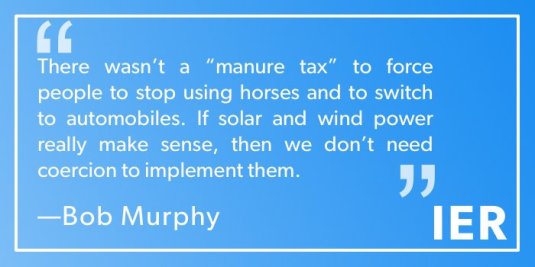
#Marx200 The private sector net labour share has been stable for decades in NZ! Our local top 1% should be drummed out of the international ruling class for just not trying, much less succeeding in any way in extracting more labour surplus to ensure the rich get richer and the poor get poorer
09 May 2018 Leave a comment
in economic history, politics - New Zealand, poverty and inequality
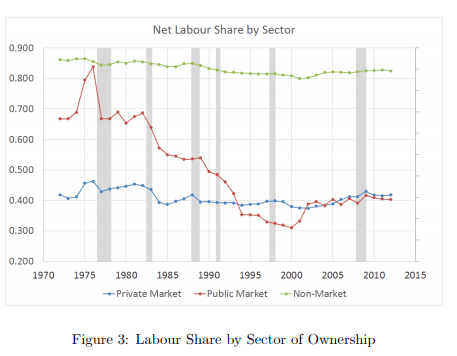
Source: Benjamin Bridgman & Ryan Greenaway-McGrevy (2016) The fall (and rise) of labour share in New Zealand, New Zealand Economic Papers, DOI: 10.1080/00779954.2016.1219763
To quote their abstract
The share of national income going to labour in New Zealand fell substantially between the 1970s and the end of the century. Approximately half of this decline was then recovered in the following decade. In this paper, we argue that the decline from the mid-1980s onwards is due to public sector reforms. Corporatisation re-orientated the public trading enterprises away from a broad range of social and trading objectives towards generating profits, while increased fiscal discipline in non-market government departments reduced payroll costs. Consistent with this hypothesis, we show that most of the decline in aggregate labour share from the mid-1980s onwards can be attributed to a significant fall in the labour share of the public sector. To more formally analyse the effects of the reforms, we build a simple model of structural transition. The model yields several predictions that are consistent with observed trends in sectoral labour share. First, there is a large and permanent decline in public sector labour share after the reforms. Second, there is a smaller, short-run decline in private sector labour share that is reversed over the long run. The model can, therefore, explain not only the decline in aggregate labour share from the mid-1980s onwards; it can also explain the partial recovery in labour share beginning in 2002.
Is Labour’s Loss Capital’s Gain? @MarjaLubeck @_chloeswarbrick
09 May 2018 Leave a comment
in applied price theory, labour economics, politics - New Zealand, unions
At a Parliamentary select committee this morning, a Labour and a Green MP were convinced that the labour’s falling share of GDP was evidence of rising profits to capital because of a loss of union bargaining power.
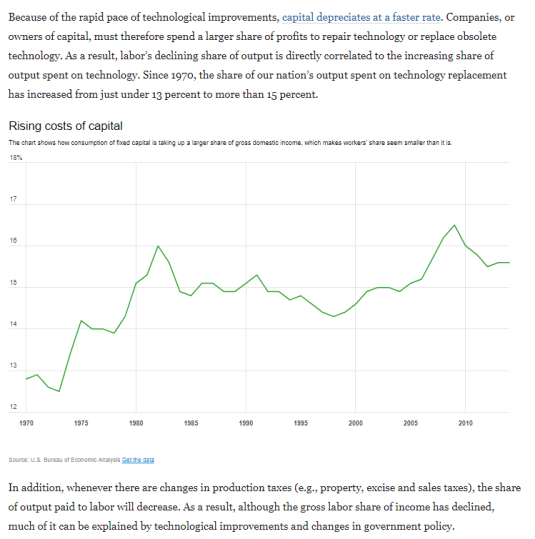
Instead, in the USA, where the data is best analysed, this decline in the gross labour share is a statistical illusion bought on by a greater part of GDP going to depreciation of ICT equipment which depreciates faster than in the past. The decline in the gross labour share does not mean the capitalists are sharing more of the total left. As Benjamin Bridgman said
US labor share has been falling since the 1970s. I show that it has not fallen as much once items that do not add to capital, depreciation and production taxes, are netted out. Recent net labor share is within its historical range, whereas gross share is at its lowest level. This effect holds for other high-income economies. The overall picture is no longer one of unprecedented, globally declining labor share. Using gross share as a proxy for net share can give misleading results. US gross share and inequality are correlated, whereas net share, the correct measure, is not.
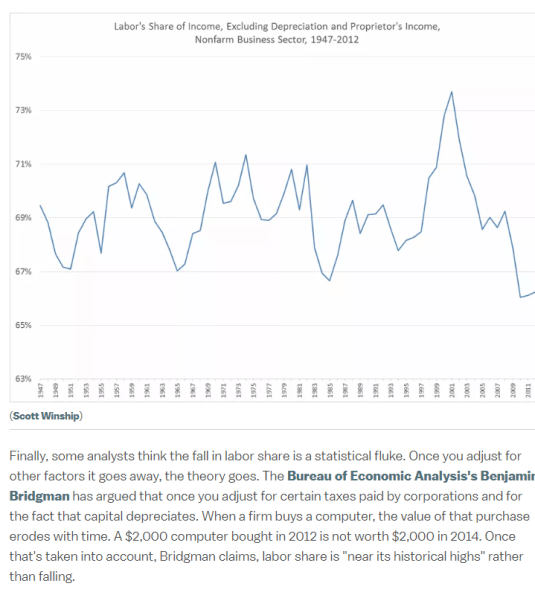
From https://www.vox.com/2015/1/8/7511281/labor-share-income
Employment Relations Amendment Bill kills incentive to join unions? @charles_finny @EricCrampton @oneforthedr
09 May 2018 Leave a comment
in applied price theory, labour economics, politics - New Zealand, unions
The only reason I joined a union at the Department of Labour was pay rises under the collective agreement were conditional upon union membership. They even ran a membership drive every time they negotiated a rise. Indeed, I might have joined up after the first of those membership drives.
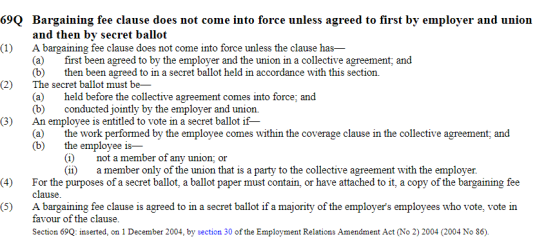
I wish the Employment Relations Amendment Bill was in effect back then because it would have saved me a couple of hundred dollars a year. I would have started on the union wage at least and had no obligation to join the union to benefit from all the conditions they negotiated in the past. The amending bill inserts a new clause that says with regard to individual employment agreements that
No term or condition of employment may be expressed to alter automatically after the 30-day period in a way that makes it inconsistent with the collective agreement.
This new amendment requires all employees to start on the collective agreement terms for the first 30 days of their employment. You always start on the union rates. In the past, people could opt in to the union agreement. Now they can opt out but can keep all the benefits of that union agreement while not having to pay a union membership fee.
There is no incentive to join the union because nothing they offer you in terms of pay is conditional on continuing union membership. No employer offers less than the union pay and may wish to offer more to particularly appealing recruits without passing that pay rise on to the rest of the workforce.
I would join the union in the future if they delivered a pay rise that was not available to those on individual employment agreements. But I have no incentive to join the union prior to that time. I can keep my money.
Cartels usually want the cartel price to extend to all in the industry. Unions are different because they must collect fees from employees to pay their rent and meet their payroll. They need to have members to survive because unions are funded by membership fees. For them, compulsory union membership is all about the cash.
The unions seem to want to head in the same direction as France where about 10% of the French workforce are members are unions despite 90% of workers being covered by collective agreements. I do not know how French unions pay their bills because no one has an incentive to join a union if the union pay and conditions apply anyway.
If I was an employer, I would point out to an employee that they have no need to join the union because they already get all the union conditions and should save their money until the union delivers something more than they have now.
Unions want this amendment as a way of winning members. It backfires because the union conditions of employment are not conditional on union membership so no one has any reason to join the union unless they deliver more in the future. Save your union fee until you get something concrete in return for it in the future.
Unions can collect bargaining fees provided a workplace agrees to it in a secret ballot under the current law. I would certainly vote against a bargaining fee in that secret ballot.
The 2017 Labour Party manifesto does go on about the need for union won wage rises to be passed on to everyone in the industry. I am all for that if I was in that industry especially if I do not have to pay any union fees to get the pay rise.
Why join a union if none of its current benefits are conditional on union membership? Wait until they offer you something specific in the future before you part with your union fee. What have you done for me lately is the decision rule.
If unions want to unionise a new workplace, just wait and see whether they deliver a pay rise before joining them. Freeride for as long as you can. There is no incentive for new employees to join that union until they win another pay rise.
Maybe I should have delayed posting this until after the Bill was passed so that there is no time for last-minute amendments. But then again, the unions have blocked me on Twitter so maybe they will never find out.
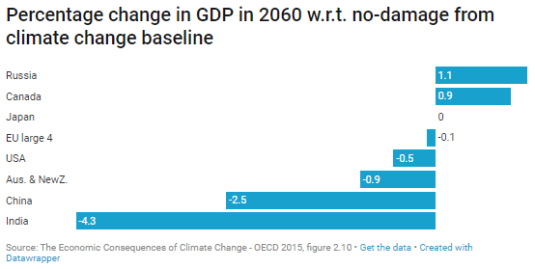
Little change in NZ GDP because of global warming by 2060? @jamespeshaw @EricCrampton
08 May 2018 Leave a comment
in applied welfare economics, energy economics, environmental economics, environmentalism, global warming, politics - New Zealand
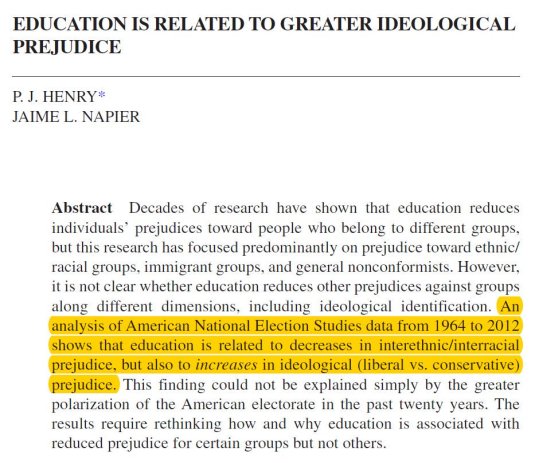
Education changes the type of prejudice
07 May 2018 Leave a comment
in politics - Australia, politics - New Zealand, politics - USA, population economics, Public Choice Tags: political psychology
.@GuardianWorld exaggerates NZ homeslessness by ten-fold
04 May 2018 Leave a comment
in labour economics, politics - New Zealand, poverty and inequality, urban economics Tags: homelessness


I am now a @DomPost hack as well as a @NZHerald hack according to some of @Whaleoil’s commentariat?!
04 May 2018 Leave a comment
in administration, energy economics, industrial organisation, politics - New Zealand
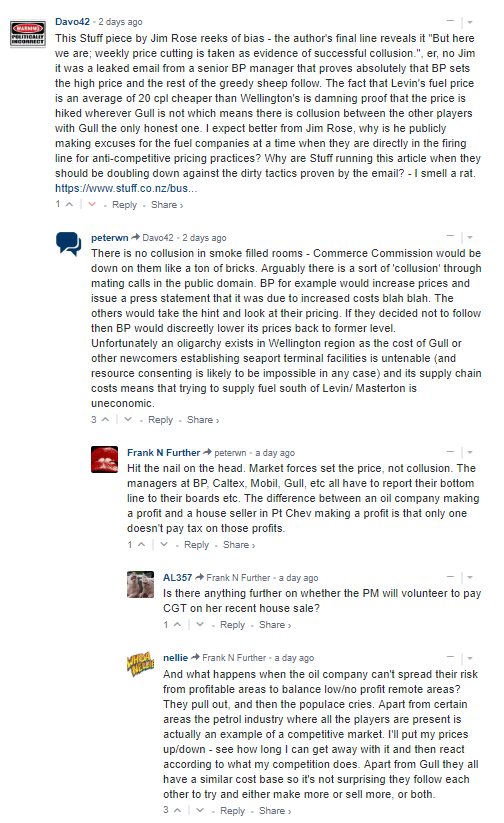

From https://www.whaleoil.co.nz/2018/05/whaleoil-general-debate-1411/
As Ronald Coase said in 1972
One important result of this preoccupation with the monopoly problem is that if an economist finds something—a business practice of one sort or other—that he çloes not understand, he looks for a monopoly explanation. And as in this field we are very ignorant, the number of ununderstandable practices tends to be rather large, and the reliance on a monopoly explanation, frequent.
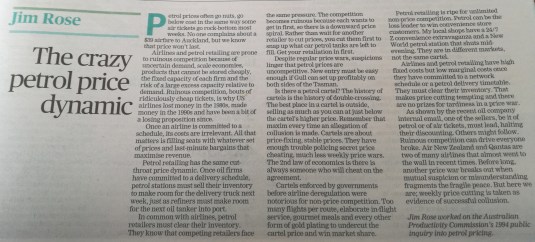
My @DomPost op-ed on petrol pricing and the theory of the empty core @EricCrampton
03 May 2018 Leave a comment
in applied price theory, energy economics, industrial organisation, politics - New Zealand Tags: cartel theory, conspiracy theories, game theory
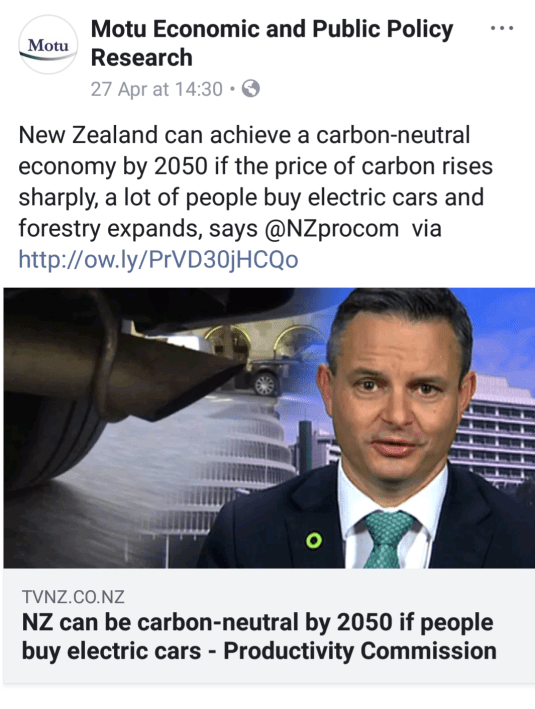
With friends @nzprocom @moturesearch commenting like this, a zero carbon economy policy won’t survive to face its enemies
28 Apr 2018 Leave a comment
in applied price theory, applied welfare economics, economics of bureaucracy, energy economics, environmental economics, global warming, politics - New Zealand, Public Choice Tags: climate alarmism


Recent Comments