Where will land come from 4 @NZGreens housing plan? @GarethMP

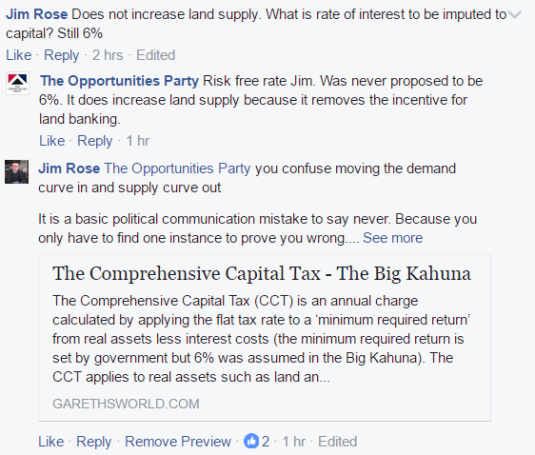
The Greens are at it again proposing to build 100,000 affordable houses without ever explaining where the additional new land will come from.

image

There would have to be an amendment to the proposed Auckland unitary plan to free up more land for there to be a net increase in the supply of land in Auckland.

Unless there is that such amendment, a government plan to build 100,000 affordable houses in Auckland and elsewhere will simply be competing for the same fixed supply of land. If the supply of land is constrained from expanding by much, the only thing that will happen is that the price will go up with more money chasing the same amount of land and housing.

Just how anti-science are the @NZGreens?

One out of four for accepting the consensus position in the sciences of climate change, GMOs, vaccines and fluoridation. A rather disappointing scoreboard for the New Zealand Greens.

Let us start with the good: the position on climate science from the Greens policy platform:

We must act according to credible science on climate change, which demands urgent action to reduce greenhouse gas emissions as soon as possible, and sustained action to safely remove excess greenhouse gas from the atmosphere.

Let us move on to the bad which is GMOs, quoting from their platform

The Green Party believes that Genetic engineering should occur within a contained laboratory setting only. Our food and our environment must be kept GE Free. To this end, the Green Party will:

  1. Ban the commercial release and field trials of GE organisms.

  2. Prohibit field-testing or production of GE foods within New Zealand.

  3. Work towards a ban on GE food imports.

  4. Require safety testing for any imported GE food or commodity that is allowed to enter the New Zealand food supply.

  5. Allow gene technology in secure containment to continue to be used subject to assessment by the Environmental Risk Management Agency.

Now let us move on to the ugly which is vaccinations, again quoting from their platform, which is not to mention it at all. Greens health spokesman Kevin Hague said

Our official position is influenced by the fact that we do not have a firm policy on it as we don’t have consensus from our members. However there are some key points on which we all do agree;

  1. Immunisation is an individual medical choice, and should never be mandatory. Nor should it be promoted in a way that makes people feel pressured into being immunised, or immunising their children.
  2. Parents should have access to impartial information which provides them with information about the risks and benefits of immunisation, so that all individuals (and parents in the case of children) can make an informed decision about immunisation.
  3. Parents should not be penalised for not immunising their children, nor should there be incentive payments or rewards or access to other goods and services, or any linking of immunisation to benefit entitlement.
  4. Some parents will choose to have their child immunised against some diseases, but not others. No parents should be forced to make a decision between their child having all immunisations or having none.

That strike two so now let us move on to the decidedly ugly which is fluoridation

The presumption that parents know the best interests of their children requires very strong evidence before it is overturned. Of course, you do not have too tolerate their unvaccinated children coming to school to infect your children. It is another thing for the Green Party of New Zealand to see both sides of the fluoridation argument:

C. Fluoridation of Community Water Supplies

The issue of fluoridating community water supplies requires a difficult balance between the public health effects and the rights of individuals to opt out altogether or avoid excessive intake. The Party membership has indicated that when considering fluoridation proposals, the Green Party caucus shall:

  • Have particular regard to the public health benefits of fluoridated community water supplies.
  • Have particular regard to the potential public health risks of excessive fluoride consumption via community water supplies.
  • Have regard for the ability of individuals to opt out.

The Green Party will:

  1. Support the use of ‘opt-out’ options by local authorities for residents living in areas with fluoridated public water supplies, where shown to be feasible.
  2. Commission an independent study on the impacts of fluoridation to public health.
  3. Support education initiatives to advise caregivers of the potential for babies to develop dental fluorosis when mixing formula with fluoridated water

Green Party of the New Zealand – health policy.

One out of four is not good enough considering how prissy this Greens are about scientific consensus on climate change.

image

Political leanings of American professors @robhosking

Sociologists are rather level-headed compared to that hotbed of political bias, which is American history professors. Hardly any of them see themselves as a Republican. I must take back a few nasty things I said about political bias and sociologists.

image

Source: THE SOCIAL AND POLITICAL VIEWS OF AMERICAN PROFESSORS Neil Gross and Solon Simmons, Working Paper, September 24, 2007

@metiria house prices won’t drop 40% by raising taxes, banning foreigners

Just increase the supply of land. Extending the capital gains tax and banning foreigners from buying land will do no good. An average house price 10 times the average income in Auckland is not a demand-side problem.

Source: Is Your Town Building Enough Housing? – Trulia’s Blog.

There are plenty of examples of US cities with different land supply restrictions but common national surges in demand for housing such as prior to the GFC. Cities with liberal land supply experienced only small increases in house prices.

Source: Regionally, Housing Rebound Depends on Jobs, Local Supply Tightness – The Long-Awaited Housing Recovery – 2013 Annual Report – Dallas Fed from Federal Housing Finance Agency; Bureau of Economic Analysis; “The Geographic Determinants of Housing Supply,” by Albert Saiz, Quarterly Journal of Economics, vol. 125, no. 3, 2010, pp. 1253–96.

The Greens should follow ACT and the Labour Party in calling for the abolition of the Auckland urban limit and changes in council finances so they can fund the necessary infrastructure quickly.

A nuclear free New Zealand delayed the end of the Cold War

image

If the dilettantes at the end of the known world accomplished anything at all by declaring New Zealand nuclear free after 1984, anything at all, it was to prolong the Cold War, embolden Communist Russia and increase the chance of a nuclear exchange. As George Orwell said in 1941

Pacifism is objectively pro-Fascist. This is elementary common sense. If you hamper the war effort of one side you automatically help that of the other. Nor is there any real way of remaining outside such a war as the present one. In practice, ‘he that is not with me is against me’.

The idea that you can somehow remain aloof from and superior to the struggle, while living on food which British sailors have to risk their lives to bring you, is a bourgeois illusion bred of money and security.

Mr Savage remarks that ‘according to this type of reasoning, a German or Japanese pacifist would be “objectively pro-British”.’ But of course he would be! That is why pacifist activities are not permitted in those countries (in both of them the penalty is, or can be, beheading) while both the Germans and the Japanese do all they can to encourage the spread of pacifism in British and American territories. The Germans even run a spurious ‘freedom’ station which serves out pacifist propaganda indistinguishable from that of the P.P.U. They would stimulate pacifism in Russia as well if they could, but in that case they have tougher babies to deal with.

In so far as it takes effect at all, pacifist propaganda can only be effective against those countries where a certain amount of freedom of speech is still permitted; in other words it is helpful to totalitarianism.

There is a strong peace movement in the 1930s that undermined rearmament at every point. Indeed, the then leader of the British Labour Party met with Hitler one afternoon with the aim of persuading him to become a Christian pacifist. He failed.

image

The slaughterhouse of World War I would certainly rest on the memory but Hitler gave them no choice but to rearm yet some on the Left would not accept this reality. The purpose of British foreign policy in the 1930s was to buy time to rearmament before the inevitable clash.

The pro-fascism of the peace movement continues to this day. To quote Michael Walzer

so many leftists rushed to the defense of civil liberties while refusing to acknowledge that the country faced real dangers–as if there was no need at all to balance security and freedom.

Maybe the right balance will emerge spontaneously from the clash of right-wing authoritarianism and left-wing absolutism, but it would be better practice for the left to figure out the right balance for itself, on its own; the effort would suggest a responsible politics and a real desire to exercise power, some day.

But what really marks the left, or a large part of it, is the bitterness that comes with abandoning any such desire. The alienation is radical.

How else can one understand the unwillingness of people who, after all, live here, and whose children and grandchildren live here, to join in a serious debate about how to protect the country against future terrorist attacks? There is a pathology in this unwillingness, and it has already done us great damage.

With one exception, democracies do not go to war with other democracies. There are plenty of undemocratic countries out there with dictators willing to have it go if they see weakness.

That is before you consider the suspicion that the Communist dictatorships had of other countries. In Tom Schelling’s view, many wars including World War 1 were the products of mutual alarm and unpredictable tests of will.

image

Robert Aumann argued well that the way to peace is like bargaining in a medieval bazaar. Never look too keen, and bargain long and hard. Aumann argues that:

If you are ready for war, you will not need to fight. If you cry ‘peace, peace,’ you will end up fighting… What brings war is that you signal weakness and concessions.

A nuclear free New Zealand signalled weakness and a willingness to make concessions. The peace movements across all democracies had the same effect.

image

Disarmament increases the chances of war. Aumann gave the example of the Cold War of how their stockpiles of nuclear weapons and fleets of bombers prevented a hot war from starting:

In the long years of the cold war between the US and the Soviet Union, what prevented “hot” war was that bombers carrying nuclear weapons were in the air 24 hours a day, 365 days a year? Disarming would have led to war.

Peace activists are utterly clueless about what is discussed at peace talks. The ability to negotiate a credible peaceful settlement between sovereign states depends on:

  • the divisibility of the outcome of the dispute,
  • the effectiveness of the fortifications and counterattacks with which an attacker would expect to have to contend, and
  • on the permanence of the outcome of a potential war.

Central to any peace talks is that any peace agreement is credible – it will hold and not will not be quickly broken:

A state would think that another state’s promise not to start a war is credible only if the other state would be better off by keeping its promise not to start a war than by breaking its promise.

Peace talks occur only when there something to bargain about. As James Fearon explained, there must be

a set of negotiated settlements that both sides prefer to fighting

That need for a bargaining range is the fundamental flaw of peace activists. When they call for peace talks, peace activists never explain what will be discussed in a world where everybody is not like them terms of good intentions.

What are the possible negotiated settlements that each both side will prefer to continue fighting? Diplomacy is about one side having some control over something the other side wants and this other side have something you want to exchange. In a war, the attacker thinks he can get what it wants to fighting for it.

If peace activists truly want peace, rather than victory for the other side, they must prepare for war including fortified borders so that the other side doesn’t dare cross them and start a war. A peace settlement depends upon the ability to divide the contested territory with or without fortified borders to make a settlement credible:

…despite the costs and risks of war, if a dispute is existential, or, more generally, if the whole of a contested territory is sufficiently more valuable than the sum of its parts, then a peaceful settlement is not possible.

A peaceful settlement of a territorial dispute, and especially a settlement that includes an agreement not to fortify the resulting border, also can be impossible if a state thinks, even if over optimistically, that by starting a war it would be able at a small cost to settle the dispute completely in its favour permanently.

Best defence of Employment Contracts Act is a @FairnessNZ graphic

image

Source: Low Wage Economy | New Zealand Council of Trade Unions – Te Kauae Kaimahi, with extra annotations by this blogger.

#DavidAislabie shares @MaxRashbrooke’s boy’s own view of pre-1984 NZ as an egalitarian paradise

David Aislabie yesterday in the Wanganui Chronicle went beyond Max Rashbrooke’s boy’s own view of the 1970s New Zealand is an egalitarian paradise. Aislabie said

The post-war New Zealand I grew up in was the envy of the world — an egalitarian paradise and a great place to bring up children.

It is a sad irony that the baby boomers who benefited from the welfare state they inherited from their parents’ generation should be responsible for snatching those benefits away from subsequent generations.

At least last year, Max Rashbrooke was good enough to qualify his pre-economic reform egalitarian paradise to not include women and Maori

New Zealand up until the 1980s was fairly egalitarian, apart from Maori and women, our increasing income gap started in the late 1980s and early 1990s,” says Rashbrooke. “These young club members are the first generation to grow up in a New Zealand really starkly divided by income.

Leaving out a good 60% of the population from the pre-1984 New Zealand egalitarian paradise is a bit of a stretch on any paradise.

image Pre-1984 was no paradise to sing that you were glad to be gay; you could have been thrown in jail and many were.

Yes Prime Minister on a minister of manufacturing @jamespeshaw @julieannegenter


NZ top income earners as lazy as ever @MaxRashbrooke @CloserTogether

Max Rashbrooke was good enough to remind us that the 2013 update of New Zealand top income shares came online a few days ago.

As is well known to everyone except those obsessed with top income shares, New Zealand top income shares have not changed much since the late 1980s. They are now no higher than in the good old days when New Zealand was an egalitarian paradise in their eyes.

image

Source: The World Wealth and Income Database.

US, Australian and NZ real house prices, March 1975 to March 2016

image

Source: International House Price Database – Dallas Fed.

.@NZlabour wants to crash house prices! @NZGreens take on the NIMBYs! @PhilTwyford

There has been an unexpected outbreak of political courage on the left of New Zealand politics.

The Labour Party wants to crash housing prices by not only abolishing the Auckland urban limit, but ensuring councils can fund the necessary infrastructure to bring new land to the market:

Labour will remove the Auckland urban growth boundary and free up density controls. This will give Auckland more options to grow, as well as stopping land bankers profiteering and holding up development. New developments, both in Auckland and the rest of New Zealand, will be funded through innovative infrastructure bonds.

In response, the Greens want to take on the inner city NIMBYs by greatly increasing housing density and new developments in their pristine suburbs

Like Labour, we believe that people should have a choice about where they live. But a lot of people want to live close to the central city where they work or study. That means delivering more high-quality, inner city housing options, not endless sprawling new suburbs.

It’s often easier and cheaper to revitalise central suburbs than it is to build new suburbs on the city fringes. Infrastructure for new sprawling subdivisions is very expensive.

This outbreak of courage is surprising after the resolute opposition of these parties to any reform of the Resource Management Act to loosen up the land supply.

It is a breakthrough nonetheless because at least the Labour Party admits that housing affordability is about increasing land supply by removing the Auckland urban limit.

New Zealand tops world in growth in the housing price to income ratio

image

Source: IMF Global Housing Watch.

New Zealand tops the developed world in housing price growth in 2015

image

Source: IMF Global Housing Watch.

Difference between @nzlabour @NZGreens; between @AustralianLabor @Greens

To be a party of government requires compromise, a willingness to appeal to the average voter, and to adopt policies because they are wedge issues rather than because they are principled stands.


Labour (at least their social democratic wings) want to win and govern by adopting policies that work; Greens want to send a message.

Everything amazing now compared to 1946 but @jacindaardern not happy @dbseymour

Source: ‘Everything is amazing right now and nobody is happy’ or ‘Americans forget how good they have it’ – AEI | Carpe Diem Blog » AEIdeas

Previous Older Entries Next Newer Entries

Bassett, Brash & Hide

Celebrating humanity's flourishing through the spread of capitalism and the rule of law

Truth on the Market

Scholarly commentary on law, economics, and more

The Undercover Historian

Beatrice Cherrier's blog

Matua Kahurangi

Celebrating humanity's flourishing through the spread of capitalism and the rule of law

Temple of Sociology

Celebrating humanity's flourishing through the spread of capitalism and the rule of law

Velvet Glove, Iron Fist

Celebrating humanity's flourishing through the spread of capitalism and the rule of law

Why Evolution Is True

Why Evolution is True is a blog written by Jerry Coyne, centered on evolution and biology but also dealing with diverse topics like politics, culture, and cats.

Down to Earth Kiwi

Celebrating humanity's flourishing through the spread of capitalism and the rule of law

NoTricksZone

Celebrating humanity's flourishing through the spread of capitalism and the rule of law

Homepaddock

A rural perspective with a blue tint by Ele Ludemann

Kiwiblog

DPF's Kiwiblog - Fomenting Happy Mischief since 2003

The Dangerous Economist

Celebrating humanity's flourishing through the spread of capitalism and the rule of law

Watts Up With That?

The world's most viewed site on global warming and climate change

The Logical Place

Tim Harding's writings on rationality, informal logic and skepticism

Doc's Books

A window into Doc Freiberger's library

The Risk-Monger

Let's examine hard decisions!

Uneasy Money

Commentary on monetary policy in the spirit of R. G. Hawtrey

Barrie Saunders

Thoughts on public policy and the media

Liberty Scott

Celebrating humanity's flourishing through the spread of capitalism and the rule of law

Point of Order

Politics and the economy

James Bowden's Blog

A blog (primarily) on Canadian and Commonwealth political history and institutions

Science Matters

Reading between the lines, and underneath the hype.

Peter Winsley

Economics, and such stuff as dreams are made on

A Venerable Puzzle

"The British constitution has always been puzzling, and always will be." --Queen Elizabeth II

The Antiplanner

Celebrating humanity's flourishing through the spread of capitalism and the rule of law

Bet On It

Celebrating humanity's flourishing through the spread of capitalism and the rule of law

History of Sorts

WORLD WAR II, MUSIC, HISTORY, HOLOCAUST

Roger Pielke Jr.

Undisciplined scholar, recovering academic

Offsetting Behaviour

Celebrating humanity's flourishing through the spread of capitalism and the rule of law

JONATHAN TURLEY

Res ipsa loquitur - The thing itself speaks

Conversable Economist

In Hume’s spirit, I will attempt to serve as an ambassador from my world of economics, and help in “finding topics of conversation fit for the entertainment of rational creatures.”

The Victorian Commons

Researching the House of Commons, 1832-1868

The History of Parliament

Articles and research from the History of Parliament Trust

Books & Boots

Reflections on books and art

Legal History Miscellany

Posts on the History of Law, Crime, and Justice

Sex, Drugs and Economics

Celebrating humanity's flourishing through the spread of capitalism and the rule of law

European Royal History

Exploring the Monarchs of Europe

Tallbloke's Talkshop

Cutting edge science you can dice with

Marginal REVOLUTION

Small Steps Toward A Much Better World

NOT A LOT OF PEOPLE KNOW THAT

“We do not believe any group of men adequate enough or wise enough to operate without scrutiny or without criticism. We know that the only way to avoid error is to detect it, that the only way to detect it is to be free to inquire. We know that in secrecy error undetected will flourish and subvert”. - J Robert Oppenheimer.

STOP THESE THINGS

The truth about the great wind power fraud - we're not here to debate the wind industry, we're here to destroy it.

Lindsay Mitchell

Celebrating humanity's flourishing through the spread of capitalism and the rule of law

Alt-M

Celebrating humanity's flourishing through the spread of capitalism and the rule of law

croaking cassandra

Economics, public policy, monetary policy, financial regulation, with a New Zealand perspective

The Grumpy Economist

Celebrating humanity's flourishing through the spread of capitalism and the rule of law

International Liberty

Restraining Government in America and Around the World