@DN_Debatt_betyg @LibyAlonso Vem vaktar väktarna? Vem tillser att experter är fria från bias? Vem nudgar, nudgarna? http://t.co/T01Va6UYOV—
Old Whig (@aClassicLiberal) July 26, 2015
The Progressive Mind
06 Aug 2015 Leave a comment
in liberalism, Marxist economics, politics - Australia, politics - New Zealand, politics - USA, Public Choice Tags: antiforeign bias, antimarket bias, expressive voting, Left-wing hypocrisy, Leftover Left, makework bias, meddlesome preferences, nanny state, political correctness, rational irrationality, Twitter left
Cannabis is pretty harmless by comparison
06 Aug 2015 Leave a comment
in economics of regulation, health economics, politics - Australia, politics - New Zealand, politics - USA Tags: alcohol regulation, economics of prohibition, marijuana decriminalisation, medical marijuana decriminalisation
US deaths (2013)
Tobacco 437k
Alcohol 29k
Opoids 16k
Heroin 8k
Cocaine 5k
Marijuana 0vox.com/2014/5/19/5727… http://t.co/o8yMDf7oE0—
Conrad Hackett (@conradhackett) August 04, 2015
I’m worried! I’m sympathising with organic farmers over a land use conflict!
06 Aug 2015 1 Comment
in applied price theory, applied welfare economics, economics of regulation, industrial organisation, law and economics, politics - New Zealand, property rights, Public Choice, rentseeking, Richard Epstein, survivor principle Tags: common law, economics of agriculture, food snobs, green rent seeking, land use conflicts, land use planning, law of nuisance, noise pollution, nuisance, old common law, organic farming, Richard Epstein, William Blackstone, zoning
Writing this blog of sound mind and sober disposition, I still have considerable sympathy with two organic farmers over a land use conflict they have with the neighbouring gun range.

Local land use regulations allows a gun club to set up 600 m away with competitive shooting days all day for 88 days a year. That is a voluntary self restraint. They could hold shooting competitions every day of the year. The local land use regulations allow the use of guns on rural land. The gun club used this absence of a prohibition on the use of guns in the frequency of use to set up a gun range to fire guns all day long on rural land.

Now here is the rub. There something wrong with the concept of quiet enjoyment of your land if a neighbour can fire off a large amount of noises continuously. The occasional noise, the occasional gunshot yes, but all day? I live near the airport, but I knew it was there when we bought the property and the lands was a little cheaper because of that.
The organic farmers are unusually pristine and prissy about what they want by neighbours to protect the sacredness of their more expensive snob food. I’m not too sure whether they would want to grant their neighbours an equal right to unusual land uses such as opening a gun range. That said, the organic farmers do have a point about a very noisy neighbouring land use that can be heard some distance away.
The organic farmers, of course, could have negotiated with their neighbours for covenants to restrict land use that undermine there are unusually pristine requirements for quiet enjoyment of their land and their neighbours land too. Easy to do when the land is first unused, but once economic activity accumulates, not so easy in terms of transaction costs and hold-outs.

The Left opposed airline deregulation
05 Aug 2015 Leave a comment
in applied price theory, applied welfare economics, comparative institutional analysis, economic history, economics of regulation, entrepreneurship, income redistribution, industrial organisation, politics - Australia, politics - New Zealand, politics - USA, Public Choice, rentseeking, survivor principle Tags: airline deregulation, antimarket bias, bootleggers and baptists, expressive voting, Leftover Left, rational ignorance, rational irrationality
CHART: US average airfares 1979 to 2014 measured in number of hours work at the average wage. @chartoftheday http://t.co/q7Phz3VkU0—
Mark J. Perry (@Mark_J_Perry) August 02, 2015
Gender wage gap, USA, UK, Australia and New Zealand since 1970
04 Aug 2015 1 Comment
in discrimination, gender, labour economics, politics - Australia, politics - New Zealand, politics - USA Tags: Australia, British economy, gender wage gap
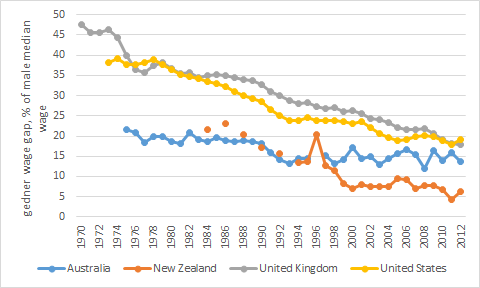
New Zealand does much better than most on the gender wage gap for full-time workers.
Figure 1: gender wage, % of median male wage, full-time employees, USA, UK, Australia and New Zealand, 1970 – 2012
Source: Earnings and wages – Gender wage gap – OECD Data.
The gender wage gap in figure 1 is unadjusted and defined as the difference between median earnings of men and women relative to median earnings of men. Data refer to full-time employees.
I never found it terribly helpful to include part-time workers, such as in an hourly measure of the gender wage gap because of a larger trade-off between cash wages and work life balance in part-time jobs.
What difference did the Kyoto protocol make and that’s before you consider 3rd World development
04 Aug 2015 Leave a comment
in development economics, economic history, energy economics, environmental economics, global warming, growth miracles, politics - Australia, politics - New Zealand, politics - USA Tags: climate alarmism clock, climate treaties, expressive voting, free-riders, Kyoto Protocol, rational ignorance, rational irrationality
The lamps were going out all over Europe this day 1914
03 Aug 2015 Leave a comment
in economic history, liberalism, politics - Australia, politics - New Zealand, politics - USA, war and peace Tags: World War I
Feuding with the Left over Left again @gtiso @helenkellyCTU
03 Aug 2015 Leave a comment
in economic history, politics - New Zealand Tags: antimarket bias, expressive voting, Leftover Left, lost decades, rational ignorance, rational irrationality, Twitter left
TPP – Trojan Horse in a global race to the bottom
03 Aug 2015 Leave a comment
in international economics, International law, law and economics, politics - Australia, politics - New Zealand, politics - USA, property rights, Public Choice Tags: free trade agreements, ISDS, regional trade agreements, TPPA
I can’t think of a single fact that this crank got right in this clip on the Trans-Pacific partnership agreement (TPPA).
Robert Reich, a Democratic party hack, referred to the TPPA as the biggest trade deal ever. He ignored a large number of multinational trade deals under the World Trade Organisation and the GATT such as the Uruguay round and the current Doha round.
http://www.cuts-international.org/brf-97-1.gif
Reich claims the deal is negotiated in secret and later talks about its submission to the Congress for fast track.
Robert Reich claims that investor state dispute settlement allows challenges to any regulation and compensation for unfair reductions in profits. It is a far narrow criteria than that involving discrimination against foreigners.
http://images.slideplayer.com/5/1585527/slides/slide_6.jpg
Currently, about 3000 international treaties give the ability to sue governments. Some 2700 of these are Bilateral Investment Treaties. The rest are trade treaties, including NAFTA. These treaties have spread rapidly around the world since the 1990s.
The TPP draft chapter says that the point of investment protection has long been “to encourage and promote the flow of investment…as a means to promote economic growth.”
At the same time, the TPP draft chapter specifically highlights “the inherent right to regulate…to protect legitimate public welfare objectives, such as public health, safety, the environment, the conservation of living or non-living exhaustible natural resources, and public morals.”


Robert Reich talks about the Trans Pacific Partnership and its implications especially if it is signed. It would be the largest trade deal in history representing 792 million people and accounting for 40% of the world economy. Well worth a look.
Tax rates on labour income across the OECD area
02 Aug 2015 Leave a comment
in labour economics, labour supply, politics - Australia, politics - New Zealand, politics - USA, public economics Tags: Australia, British economy, Canada, France, Germany, taxation and labour supply
How high is the US #tax burden on labor? Here's an OECD comparison tax.foundation/1KojUv9 by @samcjordan_ @kpomerleau http://t.co/fSAT8ut52z—
Tax Foundation (@taxfoundation) July 24, 2015
The exchange rate “needs” to come down?
01 Aug 2015 Leave a comment
in inflation targeting, macroeconomics, monetary economics, politics - New Zealand Tags: central banking, forecasting errors, The fatal conceit, The pretence to knowledge
Anyone who had a good idea about what the the New Zealand dollar should be would be trading on their own account. These super-rich would not be wasting their time giving advice to others. Their time would be too handsomely rewarded for such meagre returns as pontificating to others as to what they should do with their portfolios.
https://twitter.com/JimRose69872629/status/626597273007296514
One of my delights as a bureaucrat was at a meeting between the Reserve Bank of New Zealand and the International Monetary Fund some 15 years or so ago
The Fund asked whether Bank whether it thought the exchange rate was too high, and what their exchange-rate modelling say about this?
- The reply of the Deputy Governor of the Reserve Bank of New Zealand was we don’t have exchange rate model because we don’t think there are any good. Gone are those days.
- The International Monetary Fund team was quite flabbergasted by this response.
At one stage the Fund team tried to draw me into the conversation about the level of New Zealand dollar because I was there representing the New Zealand Treasury. I was only attended as an observer, so naturally my response to their questions was to waffle incoherently. I could have been blunter and simply said the Reserve Bank of New Zealand spoke for New Zealand in this matter, but that would have been impolite.

I’ve been continuing to reflect on Graeme Wheeler’s repeated observation that New Zealand’s exchange rate “needs” to come down. I’m still not entirely sure what he means. The exchange rate is an asset price and presumably should reflect all expected future relevant information, not just spot information about current dairy prices. And the market has no particular reason to focus on stabilising the net international investment position at around current levels. Indeed, although it is a convenient reference point, neither does the Reserve Bank.
“Need” or not, I’d have thought it was likely that the exchange rate would fall further.
The ANZ Commodity Price Index, which lags behind (for example) falling GDT and futures dairy prices, has already had one of the larger falls in the history of the series.
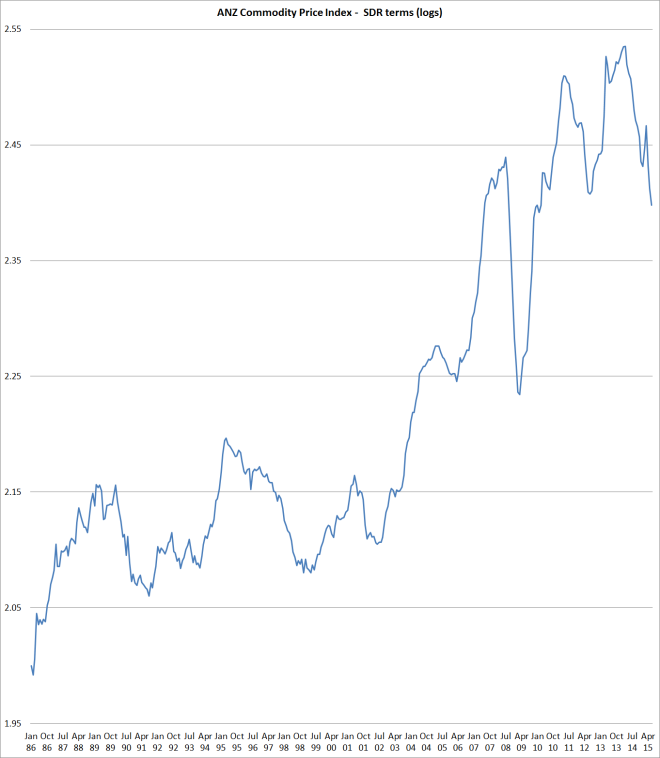
Meanwhile, the fall in the exchange rate, while material, remains pretty small by the standards of past New Zealand adjustments…
View original post 165 more words

Would the reckless maritime protests of @Greenpeace be tolerated on land?
01 Aug 2015 Leave a comment
in economics of crime, environmental economics, environmentalism, law and economics, politics - Australia, politics - New Zealand, politics - USA, property rights, Rawls and Nozick, transport economics Tags: Greenpeace, John Rawls, peaceful protest
Were the Greenpeace runabouts observing maritime safety rules such as avoiding collisions and giving way? Any protester that behaved like that in a car would be immediately arrested and charged.
Why it is tolerated in the high seas is beyond me when it would never be tolerated on the road. No one would pretend reckless driving was peaceful protest. Is it okay to behave recklessly in a boat? No one would accept that in a car on land.
Central to the notion of peaceful protest is fidelity to democracy and the rule of law. The idea is not to impose your will upon others, but to persuade the majority to reconsider their position by showing the passionate extent to which you disagree with them and honestly believe they are mistaken.
The civil disobedient is attempting to appeal to the “sense of justice” of the majority and a willingness to accept arrest is proof of the integrity of the act says Rawls:
…any interference with the civil liberties of others tends to obscure the civilly disobedient quality of one’s act.
Rawls argues that the use or threat of violence is incompatible with a reasoned appeal to fellow citizens to move them to change a law. The actions are not a means of coercing or frightening others into conforming to one’s wishes. That is a breach of the principles of a just society.
Why do @NZGreens want NZ to lead the world by example on a carbon tax, but not unilateral free trade?
31 Jul 2015 Leave a comment
in David Friedman, environmental economics, global warming, international economics, Milton Friedman, Murray Rothbard, politics - New Zealand Tags: antiforeign bias, antimarket bias, carbon tax, carbon trading, climate treaties, expressive voting, free trade, global warming, left-wing double standards, Left-wing hypocrisy, New Zealand Greens, protectionism, rational ignorance, rational irrationality, unilateral free trade


NZ’s greenhouse gas emissions are high per person and unit of GDP but have fallen since 1990 oe.cd/10z http://t.co/f5BMLMvTjq—
OECD Publications (@OECD_Pubs) June 10, 2015


Recent Comments