Tax summary: here's another honest/informative version of @hmtreasury chart by @StrongerInNos that explains "welfare" http://t.co/SeH9FJIRWq—
Jonathan Portes (@jdportes) November 02, 2014
Taxpayers in every country should get one of these charts
29 Apr 2015 Leave a comment
in income redistribution, politics - Australia, politics - New Zealand, politics - USA, Public Choice, public economics, rentseeking Tags: public sector transparency
New Zealand does an excellent job in attracting skilled migrants
29 Apr 2015 Leave a comment
in human capital, labour economics, labour supply, politics - Australia, politics - New Zealand, politics - USA Tags: economics of immigration
Migrants (esp. new ones) to UK more likely to have tertiary education than migrants to Australia [OECD[ http://t.co/xfOSQmiCxd—
Jonathan Portes (@jdportes) March 05, 2015
Housing unaffordability in New Zealand, 1988–2013
29 Apr 2015 Leave a comment
in politics - New Zealand, urban economics Tags: housing affordability, land supply, RMA, zoning
There has been a steady decline in housing affordability in New Zealand. The position is critical of the bottom 20% of the income ladder with now four in 10 of them spending more than 30% of their disposable income on housing costs in relatively good economic times.
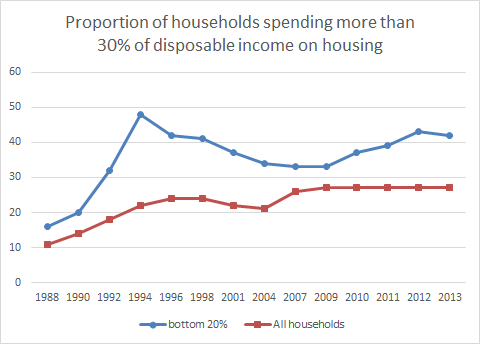
via Statistics New Zealand, New Zealand Social Indicators, Housing affordability.
Would a living wage reduce poverty in America?
28 Apr 2015 Leave a comment
in labour economics, minimum wage, politics - Australia, politics - New Zealand, politics - USA, poverty and inequality Tags: labour demographics, living wage, poverty and inequality
New Zealand on a cloudless day
28 Apr 2015 Leave a comment
in politics - New Zealand Tags: New Zealand, space

HT: David Farrar via NASA captured this incredible shot of New Zealand under cloudless skies | Business Insider.
% spent on housing as a share of disposable income, OECD members, 2014
28 Apr 2015 Leave a comment
in politics - Australia, politics - New Zealand, politics - USA, urban economics Tags: housing affordability, RMA, supply of land, zoning
New Zealand is pretty much on top of the world as to the amount of income that households must spend keep a roof. That success is a product of local council restrictions on the supply of land and national and local regulations such as under the Resource Management Act (RMA) that increase the costs of bringing lands in the market.
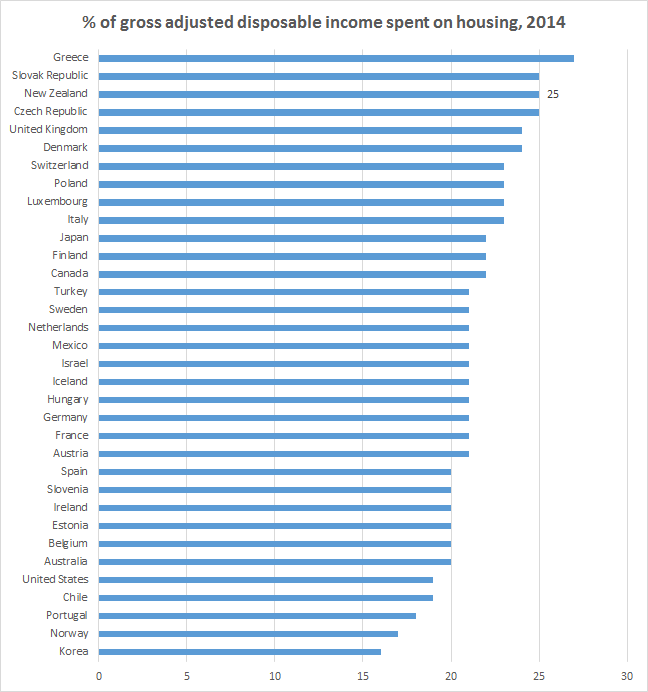
Source: OECD Better Life Index.
Note: Household net adjusted disposable income is the maximum amount that a household can afford to consume without having to reduce its assets or to increase its liabilities. It’s obtained, as defined by the System of National Accounts – SNA, adding to people’s gross income (earnings, self-employment and capital income, as well as current monetary transfers received from other sectors) the social transfers in-kind that households receive from governments (such as education and health care services), and then subtracting the taxes on income and wealth, the social security contributions paid by households as well as the depreciation of capital goods consumed by households.
Why is the rapid closing of the gender wage gap in New Zealand not celebrated more?
27 Apr 2015 1 Comment
in discrimination, gender, human capital, labour economics, labour supply, occupational choice, politics - New Zealand Tags: activists, do gooders, gender wage gap, Left-wing hypocrisy, Leftover Left
With the rapid closure in the raw female male wage gap in New Zealand over the last 15 or so years, the lack of celebration of this achievement among equal pay activists is puzzling.
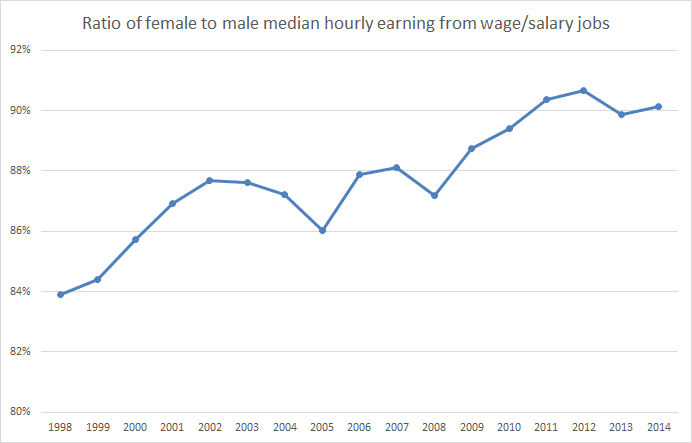
Source: Statistics New Zealand, New Zealand Social indicators, Median hourly earnings.
The role of the courts in end of life choices for the terminally ill
26 Apr 2015 Leave a comment
in comparative institutional analysis, constitutional political economy, law and economics, politics - New Zealand, Public Choice Tags: assisted dying, assisted suicide, euthanasia, Justice Scalia
Lindsay Mitchell has a nice summary of the latest developments on an application to the High Court of New Zealand by a terminally ill patient for a declaration that her assisted suicide would not be unlawful and subject to the criminal law. This application currently before the court is specific to that individual and is crafted to claim that it will set no general precedent.
I’m with Justice Scalia when he argues that fundamental issues such as these should be decided by parliaments. As he says regarding general social change:
The virtue of a democratic system [with a constitutionally guaranteed right to free speech] is that it readily enables the people, over time, to be persuaded that what they took for granted is not so and to change their laws accordingly.
The amount of social change in the mid to late 20th century has been stunning. Yes, assisted dying years a passionate issue and some people are impatient, but again I believe Justice Scalia is right when he said:
We might have let the People decide. But that the majority will not do. Some will rejoice in today’s decision, and some will despair at it; that is the nature of a controversy that matters so much to so many. But the Court has cheated both sides, robbing the winners of an honest victory, and the losers of the peace that comes from a fair defeat. We owed both of them better. I dissent.
That importance of a fair defeat at the ballot box and in Parliament is important both to when and if a bill on end of life choice is passed, and to how quickly support opposition to that bill will be mobilised before such a bill even is put into the Parliamentary ballot of private member’s bills.
Nothing stirs up the impassioned (and most other people as well) more than depriving them of their right to support or oppose what is important to them through political campaigns and at an election. The losing side, we all end up on the losing side at one time or another, are much more likely to accept an outcome if they had their say and simply lost the vote at the election or in Parliament.

A decision by the High Court authorising assisted dying in some way does not offer the peace of a fair defeat where the votes are added up where your vote counted as much as mine and one side or the other lost as must always be in a democracy. That’s how majority rule works.
The last bill before the New Zealand Parliament to allow a death with dignity through an assisted suicide for the terminally ill was in 2003 and it failed by three votes: 60 votes to 57 votes.
It is not the role of the courts to hurry up the marshalling of those extra few votes to change the law to judicial action and dispensation. Again, when Scalia dissented on a parental rights case:
I have no reason to believe that federal judges will be better at this than state legislatures; and state legislatures have the great advantages of doing harm in a more circumscribed area, of being able to correct their mistakes in a flash, and of being removable by the people
As Justice Scalia explains, the purpose of the law is to slow the impassioned majority down, not speeding it up:
Judges are sometimes called upon to be courageous, because they must sometimes stand up to what is generally supreme in a democracy: the popular will.
Their most significant roles, in our system, are to protect the individual criminal defendant against the occasional excesses of that popular will, and to preserve the checks and balances within our constitutional system that are precisely designed to inhibit swift and complete accomplishment of that popular will.
Those are tasks which, properly performed, may earn widespread respect and admiration in the long run, but — almost by definition — never in the particular case.
The intervention in a court to grant that right before Parliament is willing to act will only mobilise opposition to any future private member’s bill because they have been denied the right to oppose it through normal democratic means. What are those normal democratic means? Scalia explains when discussing the right to an abortion:
The States may, if they wish, permit abortion on demand, but the Constitution does not require them to do so. The permissibility of abortion, and the limitations upon it, are to be resolved like most important questions in our democracy: by citizens trying to persuade one another and then voting.
Assisted suicide has had popular support for many decades in New Zealand. The reason political parties do not act is those who are against assisted suicide are passionately against it and will change their vote because of such a bill. Those who are for assisted suicide are unlikely to change their vote if a bill is not passed by Parliament.
 For these reasons regarding strong passionate minority opposition and weak majority support, the Labour Party’s new leader pressured a member of his caucus to withdraw a private member’s bill on end of life choice.
Similarly, the Green Party showed equal political cowardice in this matter. They don’t regard a death with dignity to be a priority for them, despite their alleged social liberalism and a willingness to champion the right to abortion in the most recent general election in 2014, which is a socially contentious issue.

The reason is a private member’s bill on abortion in New Zealand won’t get anywhere because the current compromise works – a point to which I shall return. A private member’s bill on end of life choice sponsored by a Green MP would attract too much political flak for the Green Party to handle.
The law has long acted to prevent, by force if necessary, suicide – including suicide by refusing to take appropriate measures necessary to preserve one’s life after the point at which life become unbearable. Justice Scalia argued that:
I believe in liberal democracy, which is a democracy that worries about the tyranny of the majority, but it is the majority itself that must draw the lines.
Whether the patient’s wishes to be honoured in this area is left to elected representatives to legislate. Justice Scalia asks
Are there, then, no reasonable and humane limits that ought not to be exceeded in requiring an individual to preserve his own life? There obviously are, but they are not set forth in the Due Process Clause.
What assures us that those limits will not be exceeded is the same constitutional guarantee that is the source of most of our protection – what protects us, for example, from being assessed a tax of 100% of our income above the subsistence level, from being forbidden to drive cars, or from being required to send our children to school for 10 hours a day, none of which horribles is categorically prohibited by the Constitution.
Our salvation is the Equal Protection Clause, which requires the democratic majority to accept for themselves and their loved ones what they impose on you and me.
The biggest threat to an End of Life Choice bill passing the New Zealand Parliament is judicial intervention in this charged social issue that will only mobilises the opponents of the very right the applicants to the court seek. Scalia again this time on the risks of the courts moving in advance of the popular will, and thereby poisoning the democratic process:
Leaving this matter to the political process is not only legally correct, it is pragmatically so. That alone… can produce compromises satisfying a sufficient mass of the electorate that this deeply felt issue will cease distorting the remainder of our democratic process.
As an example of the importance of democratic compromises in securing the votes in Parliament, there is a voluntary euthanasia bill currently before the Scottish Parliament. It has been stuck in committee for two years because it not only promises end of life choice, it also grants a right of euthanasia to those with progressive degenerative diseases.
By overreaching to progressive degenerative diseases, this Bill in the Scottish Parliament is bogged down because euthanasia as distinct from a death with dignity is a step too far from many members of Parliament willing to support end of life choice for the terminally ill such as provided for in the House of Lords Private Member’s Bill on end of life choice.

Any private member’s bill that does pass the New Zealand Parliament on end of life choice will be riddled with compromises and will have a genuine concern to prevent abuse and guard against questionable decisions made when judgements of the terminally ill is clouded in some way. No court in a single judgement can provide all those details and compromises.

The law attracts more than its share of reformers wanting to use the courts and judge-made law for political purposes. If you want to reform the world, do what we ordinary people have to do: change your vote, write to an MP, protest, donate to or even join a political party, or run for parliament.
The great strength of democracy is a small group of concerned and thoughtful citizens can band together and change things by mounting single issue campaigns or joining a political party and running for office and winning elections or influencing who wins.
Indeed, it is that very strength of democracy – small groups of concerned citizens banding together – is what is holding up legislating on an end of life choice. It is not that minorities are powerless and individuals are voiceless. Exactly the opposite.
Many people have passionate opinions for and against an End of Life Choice Bill. These opinions are taken into account by members of Parliament in fine detail depending on how voters will vote at the next election.
What can be undemocratic about members of Parliament paying attention to how a wide range of ordinary members of the community might vote if they disappoint them.
The key safeguard of minorities against the majority is their ability to block vote. Yes, those in the majority will be annoyed at the power of the minority to slow down the passage of a End of Life Choices Bill.
Yet on some other matter passionate to them those currently in the majority will one day or another end up in a minority. The rotation of power is common in democracies, and the worst rise to the top.
It is wise to design constitutional safeguards to minimise the damage done when those crazies to the right or left of you get their chance in office, as they will sooner or later rather than focus on the powers you and those that currently agree with you should have in your few days in which you fleetingly have a majority.
Too many policies and ideas of the one political party or another assume that they are the face of the future, rather than just another political party that will hold power as often as not and always for an uncertain time.
New Zealand Parliamentary elections are always close because of proportional representation. This makes reality of ending up in the minority again very quickly in a few years very real.
Yesterday’s majority of the vote sooner or later and often sooner than they expect will break off into different minorities on the next big issue of the day.
These newly formed minorities will use that same ability to band together as a minority to block vote to protect what they think is important and advance agendas they think are to be wider benefit despite the opinion of the current majority to the contrary. All reforms start as a minority viewpoint.
You can’t complain about democracy not working because it’s working precisely as it should: parliamentarians paying attention to a great number of people from all walks of life vote in light of how they as members of Parliament voted on specific issues that are important to them.
What victory at Gallipoli could have stopped
25 Apr 2015 Leave a comment
in laws of war, politics - Australia, politics - New Zealand, war and peace Tags: Anzac Day, Armenian genocide, Gallipoli campaign, Ottoman Empire, war crimes, World War I
On May 24, 1915, the Allied Powers jointly issued a statement explicitly charging for the first time ever another government of committing `a crime against humanity’.
Today is marked by Armenians worldwide as the 100th anniversary of the Armenian genocide. vox.com/2015/4/22/8465… http://t.co/7pqqSowW3O—
Vox Maps (@VoxMaps) April 24, 2015
The Allied Governments announce publicly that they will hold personally responsible all members of the Ottoman Government, as well as those of their agents who are implicated in the Armenian massacres.

Article 230 of the 1920 Treaty of Sèvres required the defeated Ottoman Empire to
…hand over to the Allied Powers the persons whose surrender may be required by the latter as being responsible for the massacres committed during the continuance of the state of war on territory which formed part of the Ottoman Empire on August 1, 1914.
Ottoman military and high-ranking politicians were transferred to the Crown Colony of Malta on board of the SS Princess Ena and the SS HMS Benbow by the British forces, starting in 1919. These war criminals were eventually returned to Constantinople in 1921 in exchange for 22 British hostages held by the government in Ankara.
But for victory at Gallipoli, the Anzacs would have been the first Sergeant at Arms of a war crimes trial. By marching into Constantinople, the Anzacs may have been able to prevent the purging of the Ottoman archives of evidence of complicity of specific individuals.
#GallipoliFlashback: Real time sequence of events during the first day of the Anzac landing nzh.nu/M2jbf http://t.co/8Em54XZxtH—
(@nzherald) April 24, 2015
via 40 maps that explain World War I | vox.com and 1915 – Allies Condemn Turkish Genocide of Armenians – Joint declaration Condemning Turkish Genocide of Armenians as Crimes Against Humanity.
World War 1– the initial New Zealand response
25 Apr 2015 Leave a comment
in economic history, politics - New Zealand, war and peace Tags: World War I
The Gallipoli campaign: the Allies invade Turkey
25 Apr 2015 Leave a comment
in politics - Australia, politics - New Zealand, war and peace Tags: Anzac Day, Gallipoli campaign, World War I

The impact of the top tax rate in the depth and severity of the great depression
24 Apr 2015 Leave a comment
in business cycles, fiscal policy, great depression, macroeconomics, politics - New Zealand, politics - USA, public economics Tags: capital taxation, New Zealand, taxation and the labour supply, top tax rate
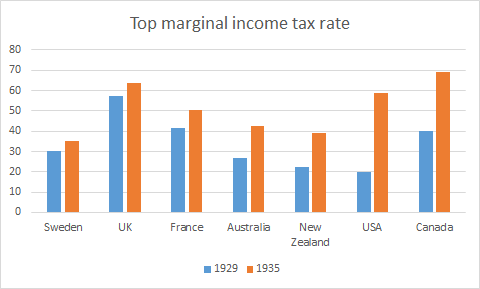
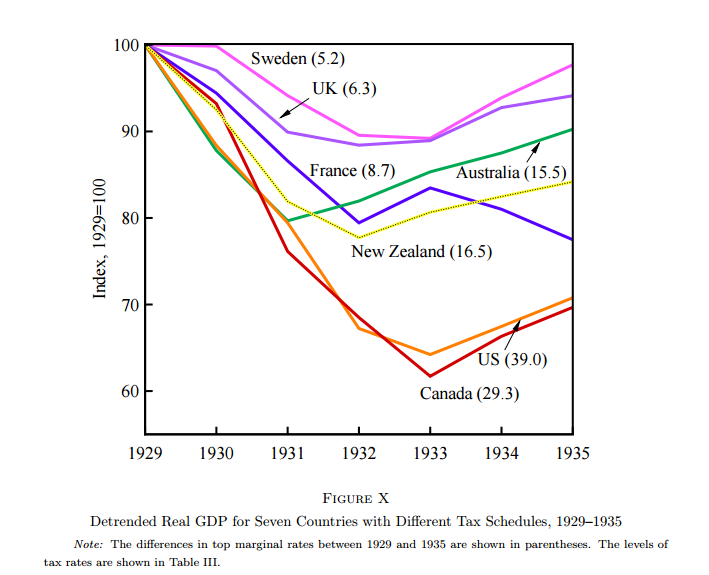
Source: Ellen McGrattan.
There were large differences in increases in the 1930s in the top marginal income tax rate between Sweden, the UK, France with Australia and New Zealand and between the USA and Canada and the rest as McGrattan explains:
These data show that there is a strong negative correlation, roughly −94%, between the change in the top income tax rates and the deviation in per capita real GDP relative to trend in 1933.
Company tax rates around the world
24 Apr 2015 Leave a comment
in international economics, politics - Australia, politics - New Zealand, politics - USA, Public Choice, public economics Tags: company tax rate, tax competition
Australian and New Zealand inflation rates adjusted for new goods and quality bias of 1.5%
23 Apr 2015 Leave a comment
in inflation targeting, macroeconomics, politics - Australia, politics - New Zealand Tags: Australia, CPI bias, inflation, New Zealand
In praise of measurement error: good thing no one noticed the severe deflation in Australia and in New Zealand in the late 1990s for otherwise the do-gooders might have felt the need to do something about it. Good thing no one is panicking over the recent mild deflation in New Zealand as well.
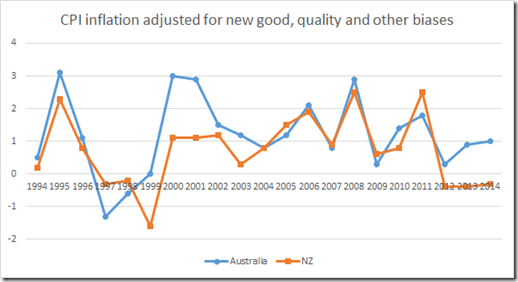
Source: OECD StatExtract


Recent Comments