The economics of tobacco addiction and #livingwage compared

image

Image

Police shootings by threat level since 1 January 2016

The Washington Post no longer classifies whether the deceased was attacking police or not in its online database. That filter on its 2016 database has been removed. It is possible to filter the data to say whether particular weapons were present.

image

Source: Fatal force: A Washington Post investigation of people shot and killed by police in 2016 – Washington Post. Downloaded at 10:25 p.m., 7 July 2016 New Zealand standard time.

Looking up individual shooting reports in the database provides information on whether the unarmed suspect was doing in terms of resisting police or not. The seven undetermined cases involve disputed facts over whether the suspect was armed or was resisting the police..

The Economist Crony Capitalism Index

image

But @OneNationAus @realdonaldtrump @UKIP are not extreme right wingers

The fatal error of the Left is to smear populists such as Hansen, Trump and UKIP as extreme right.

Hanson won the safest Labour seat in Queensland when first elected in 1996. Her 23% swing was mainly made up of Labour voters. Few in the media or commentariat like to remind of that.

Donald Trump defeated opposition on his right from Ted Cruz to win the Republican nomination. If moderate candidate Kasich had dropped out earlier, many of his voters would have gone to Trump, not to Cruz. Trump has appeal to working class Democrat party voters. The only group he seems to win is white men

UKIP is no longer a party out of the Tory shires, when it won 3% of the vote in 2010 in the UK. UKIP is slightly to the left of the LDP and came 2nd in 40 Labour seats in the last UK election. UKIP is a real threat to win seats from Labour or divide the working class work to allow the Tories to come through the centre.

All of these populists combine nationalism, an anti-immigration sentiment, a dislike of globalism and free trade because it involves dealing with foreigners, a preference for lower taxes but no particular opposition to extensive economic and social regulation. In many ways they are Alf Garnett Labour voters.

The work-horses of rational irrationality – antimarket bias, pessimism bias is, anti-foreign bias and make-work bias – are strong among these populist politicians and their voting base.

So few Labour Party MPs, present and upcoming, are working class in origin now that they have simply no experience of the anti-immigration and nationalist settlements of the working class. Until labour parties they work out how to deal with that and meet those concerns, they will keep losing votes to populists.

There is a wonderful quote about how a voter explained he did not vote Labour anymore because he was a white working class Englishman not on the benefit – Labour was no longer interested in him. Identity politics is not just the preserve of the left.

Wage gaps by gender, race and ethnicity persist in the USA

https://twitter.com/r_fry1/status/748952723089874944

Why the polarisation of Congress? The Great Restraint? Sound-bite politics?

My two cents on the sharp rise of partisanship and congressional polarisation is they are driven by the great restraint in the growth of government spending in the 1980s.

From 1950 to 1980 the size of government doubled but then stopped dead in the 1980s. This great restraint on the growth of government happened everywhere. It was not just Thatcher’s Britain or Reagan’s America. It was everywhere, France and Germany, and even Scandinavia.

image

Source: Sam Peltzman, The Socialist Revival? (2012).

Peltzman’s data which I have charted has government spending in the USA,  Britain, France and Scandinavia doubling between 1950 and 1980, and then nothing much happened between 1980 and 2007 – the size of government was pretty flat as a share of GDP for 27 years.

Governments everywhere hit a brick wall in terms of their ability to raise further tax revenues. Political parties of the Left and Right recognised this new reality.

Government spending grew in many countries in the m-d-20th century because of demographic shifts, more efficient taxes, more efficient spending, a shift in the political power from those taxed to those subsidised, shifts in political power among taxed groups, and shifts in political power among subsidised groups Importantly for explaining later political polarisation, that growth of government was concentrated in four programs – defence, health, education and income security

The median voter in all countries was alive to the power of incentives and to not killing the goose that laid the golden egg which underwrote the initial growth in the size of government. The rising deadweight losses of taxes, transfers and regulation limit inefficient policies and the sustainability of redistribution.

After 1980, the taxed, regulated and subsidised groups had an increased incentive to converge on new lower cost modes of redistribution to protect what they had. More efficient taxes, more efficient spending, more efficient regulation and a more efficient state sector reduced the burden of taxes on the taxed groups. Reforms ensued after 1980 led by parties on the Left and Right, with some members of existing political groupings benefiting from joining new coalitions.

A lot more is at stake when the main political battleground is dividing a relatively fixed revenue pie post-1980 than a growing pie Between 1950 and 1980. Fiscally conservative voters will elect parties strongly committed to no new taxes. Their opponents will look for equally ideologically committed parties. Peltzman makes the very interesting point that:

There is no new program in the political horizon that seems capable of attaining anything like the size of any of these four. For the time being the future government rest on the extent of existing mega programs.

Health and income security account for 55% of total government spending in the OECD. It is in these two programs where the future of the growth of government lie.

The pressure for that growth in government will come from the elderly. Governments will have to choose between high taxes on the young to fund the current generosity of social insurance, healthcare and old-age pensions or find other options. Peltzman explains this political tension for programs benefiting the elderly in his essay The Socialist Revival:

Deficit financing of future growth in these programs becomes increasingly problematic. So we now have the seeds of political conflict rather than consensus.

These very large programs confer substantial benefits on some. These beneficiaries resist any change in the status quo. But the benefits have to be financed at substantial cost to today’s workers. Many of them will not benefit on balance from these programs over their lifetimes. It is by no means clear whether the number of winners exceeds the number of losers today.

Policies that were once unthinkable now can be discussed and even implemented here and there. These include increased retirement ages, less generous public health care programs, more reliance on private saving for retirement and so forth.

Given that intergenerational and other struggles over who is taxed and who faces benefit cuts, middle-of-the-road politicians lose their appeal to the electorate.

Another reason for greater political polarisation is the rising cost of time. Sound-bites  news programs and current affairs are now a couple of seconds long when they used to be 15 seconds long maybe 30 years ago.

image

People have less time to pay attention to politics so they want to work out quickly from short sound-bites whether the politicians they are contemplating supporting are made of the right stuff. For voters in a hurry, conviction politicians are more appealing be they of the left or of the right. Voters want someone who will hold fast against new taxes or for new taxes as the case may be. Much is at stake as Sam Peltzman explained in his 2012 essay The Socialist Revival:

The steady growth of the old age population share is on the verge of a substantial acceleration… This means that government health care and public pension spending growth will also have to accelerate merely to keep the promises implicit in present programs.

The political economy will have to choose between higher taxes on the young to keep these promises, an accelerated shrinkage of the rest of the budget or less generous public health and pension programs. It is not clear yet which way the decision will go.

What is clear is that for the first time since the invention of the welfare state the magnitude and generosity of its signature programs is at political risk.

In this stand-off between those who might have to pay more in taxes and those who might receive less in old age pensions, welfare benefits and services including healthcare, neither side wants a politician naturally inclined to blink and compromise. They will elect politicians who hang tough for their side of the argument and their share of the budget.

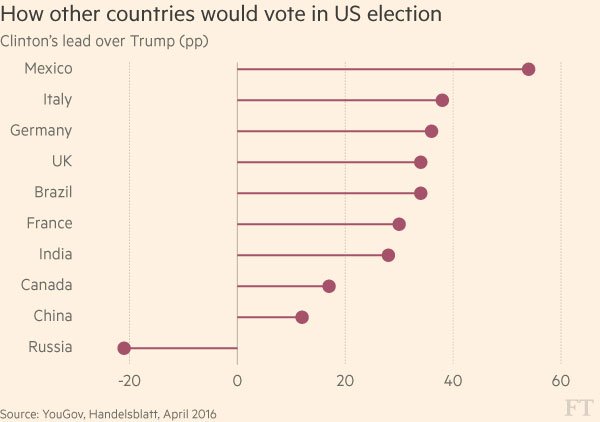
Record lows in support for the @realdonaldtrump

Image

Crooked @HillaryClinton versus volatile @realdonaldtrump

Image

@TheAusInstitute @BenOquist wrong to say every economist agrees on effects of company tax cut

Source: Company tax cut won’t help Australian economy, jobs – Crikey.

It is unfortunate that the Australia Institute today misspoke when it claimed that every economist agrees that the effect of a company tax rate cut is small.

The top economists in the field of public economics disagree. Their views are freely available on the Internet. They are easiest to find by googling the words abolish the corporate tax. Optimal rate of tax on capital is zero are other good words to Google.

Source: Abolish the Corporate Income Tax – The New York Times.

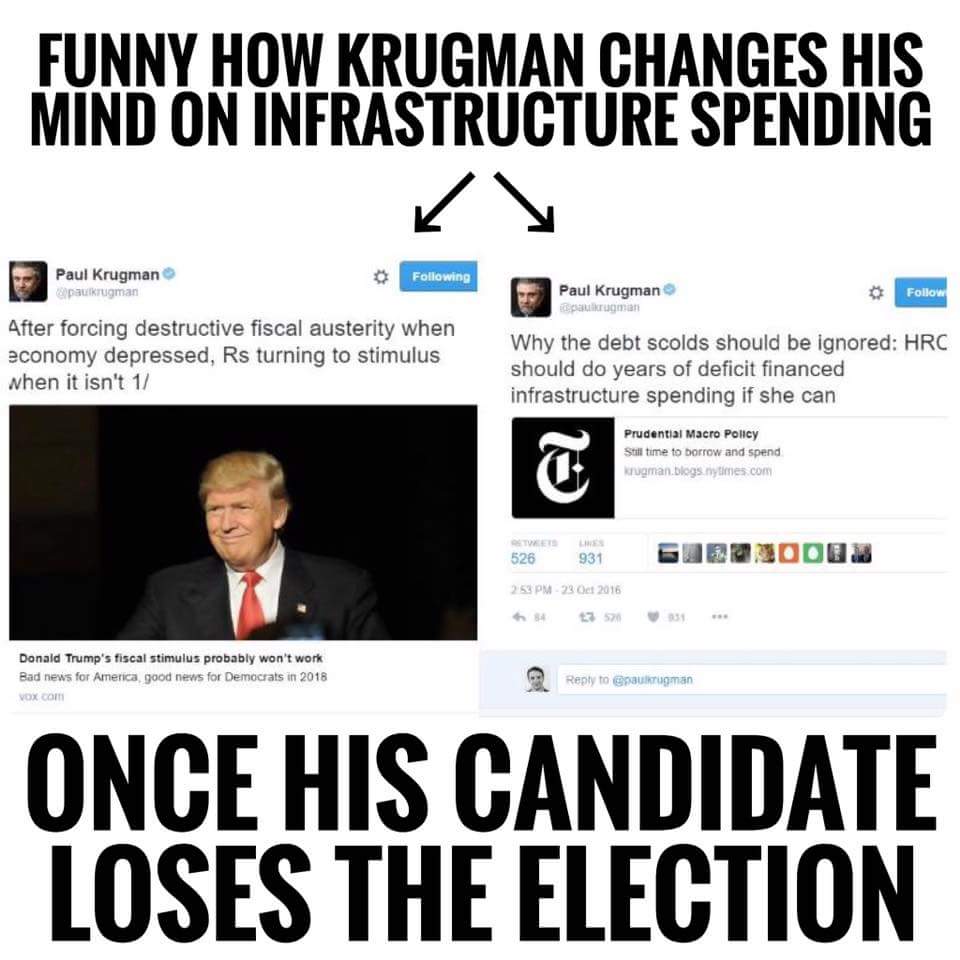
It has been well known for decades of the optimal rate of tax on income from capital and from capital gains are zero. The Australia Institute has joined with Paul Krugman in not reporting this as Greg Mankiw explains

Paul Krugman responds to my post about a recent column of his.  He is correct that not all economists agree that low capital taxation is desirable; he appropriately cites Diamond and Saez, who are on the high-capital-tax side of this debate. FYI, here is another recent paper, written in part as a response to Diamond and Saez, which finds that optimal rates of capital taxation, while positive, are quite low.

But that is not really the issue. If Paul had said “reasonable economists disagree, here are the arguments, and here is why I tend to favor one side rather than the other” I would not have objected.

Instead, in his original column, he wrote as if there were no reasonable arguments for the policy pursued by the Bush administration, and he attributed the most vile motives to those who advanced the policy.

This episode illustrates a fundamental difference between Paul and me.  I try not to assume the worst in other people, just because they disagree with me.

Taxes on incomes from capital should be much lower because capital migrates from high-tax to low-tax locations, reducing capital-to-labour ratios in the higher company tax countries.

The low-tax on income from capital countries experience higher capital-to-labour ratios, a higher marginal product of labour, and higher wages. Robert Lucas described abolishing taxes on income from capital is one of the few genuinely free lunches out there in applied welfare economics.

Mankiw and Weinzierl “Dynamic Scoring: A Back-of-the-Envelope Guide,” Journal of Public Economics (September 2006): 1415-1433 argue that, in the long run, about 17% of a cut in individual income taxes is recouped through higher economic growth. For a cut in company taxes, their figure is 50%.

The Australia Institute manages to put itself in the contradictory position of saying a company tax rate just means more revenue for the IRS in the USA but Google, Facebook and other multinationals managed to avoid tax on a massive stale through tax havens. If the former is correct, their less company tax in Australia means more company tax paid in the USA means multinationals must be rather unsuccessful at avoiding tax through tax havens.

Multinationals are both avoiding company tax in Australia and offshore and paying it in full in the USA if Australia’s company taxes cut if the Australian Institute is to be believed today.

The Australia Institute obviously has not picked up on the relentless bullying that Ireland was subject to by the rest of the European Union over its 12.5% company tax.

The Irish company tax rate of 12.5% was initially on export profits. To finesse European Union member state complaints about that 12.5% company tax rate on discrimination grounds, the Irish government extended that low rate to all companies in 1995.

I am yet to see a minister of finance welcoming a company tax cut in a competing jurisdiction, rubbing his hands in anticipation of greater tax revenues on the foreign profits of multinationals that are headquartered in his country.

If there is an ounce of sense in what the Australia Institute said about foreign taxmen benefiting from low company taxes in Australia, high corporate tax rate countries such as Germany, France and the USA should welcome low company tax rates in destination countries for foreign investment originating in those countries but they do not.

Rather than seek tax harmonisation, high tax country should welcome low company taxes in competing investment destinations but they do not. Why is this so if the Australia Institute is making sense?

The Nordic countries follow optimal tax theory and have high but flat taxes on labour income, low taxes on business income and a high, broad-based consumption tax. That is the only way they can fund their welfare states.

The Nordics are alert to not killing the goose that laid the golden egg. Company taxes are relatively low in Scandinavian countries as compared to the USA so that businesses do not flee to other jurisdictions.

A large welfare state such as those in the Nordic countries require a significant amount of revenue, so the tax base in these countries must be broad. This  also means higher taxes on consumption through the VAT or GST and higher taxes on middle-income taxpayers.

Business taxes are a less reliable source of revenue because of capital flight and disincentives to invest. Thus, the Nordics do not place above-average tax burdens on capital income and focus taxation on labour and consumption. All those nuances are lost if you are to believe the Australia Institute today.

#YesPrimeMinister approach of @jamespeshaw 2 fighting #ISIS

The Greens this week has decided to offer every support short of real help to those being massacred and brutalised by ISIS

“The NZDF deployment to Iraq does not make us safer, but puts New Zealand troops at risk and makes New Zealanders unnecessary targets of ISIL.

“We condemn the horrific violence of ISIL. New Zealand should be using its leverage as a member of the UN Security Council to curb ISIL’s access to funding and arms, not keeping our troops in danger for another year and a half,” said Mr Shaw.

This is straight out of the Yes Prime Minister episode on how the Foreign & Commonwealth Office explains how it helps foreign nations in trouble from invasion and tyranny. A 4 stage plan on how to do nothing.

In his recent speech before the House of Commons on further assistance to those fighting ISIS since Syria, Labour Party foreign office spokesman Hilary Benn described this as walking to the other side of the road.


Does abolishing bureaucracy save the #UBI? Avoid a great big new tax?

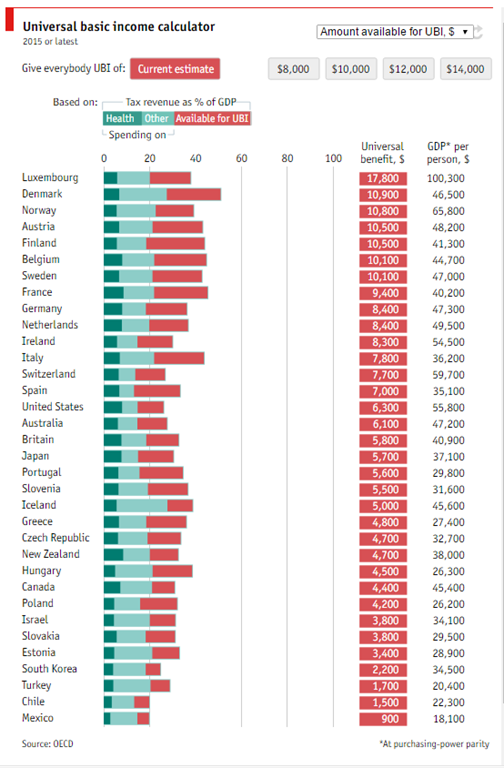
Firing the entire welfare state bureaucracy does not save the day for a universal basic income as Robert Greenstein explains

Suppose UBI provided everyone with $10,000 a year.  That would cost more than $3 trillion a year — and $30 trillion to $40 trillion over ten years.

This single-year figure equals more than three-fourths of the entire yearly federal budget — and double the entire budget outside Social Security, Medicare, defense, and interest payments.  It’s also equal to close to 100 percent of all tax revenue the federal government collects…

Where would the money to finance such a large expenditure come from?  That it would come mainly or entirely from new taxes isn’t plausible.

We’ll already need substantial new revenues in the coming decades to help keep Social Security and Medicare solvent and avoid large benefit cuts in them.  We’ll need further tax increases to help repair a crumbling infrastructure that will otherwise impede economic growth.  And if we want to create more opportunity and reduce racial and other barriers and inequities, we’ll also need to raise new revenues to invest more in areas like pre-school education, child care, college affordability, and revitalizing segregated inner-city communities.

A UBI that’s financed primarily by tax increases would require the American people to accept a level of taxation that vastly exceeds anything in U.S. history.  It’s hard to imagine that such a UBI would advance very far, especially given the tax increases we’ll already need for Social Security, Medicare, infrastructure, and other needs.

Source: Romney’s Charge That Most Federal Low-Income Spending Goes for “Overhead” and “Bureaucrats” Is False | Center on Budget and Policy Priorities

The industrial organisation of presidential campaigns

Image

Maybe the @realdonaldtrump has run out of money?

image

Image

@billmaher at his best on Social Justice Warriors In Defense of Recklessness ‪#‎PCPolice‬

Every American presidential election since 1796

Previous Older Entries Next Newer Entries

Fardels Bear

A History of the Alt-Right

Vincent Geloso

Econ Prof at George Mason University, Economic Historian, Québécois

Bassett, Brash & Hide

Celebrating humanity's flourishing through the spread of capitalism and the rule of law

Truth on the Market

Scholarly commentary on law, economics, and more

The Undercover Historian

Beatrice Cherrier's blog

Matua Kahurangi

Celebrating humanity's flourishing through the spread of capitalism and the rule of law

Temple of Sociology

Celebrating humanity's flourishing through the spread of capitalism and the rule of law

Velvet Glove, Iron Fist

Celebrating humanity's flourishing through the spread of capitalism and the rule of law

Why Evolution Is True

Why Evolution is True is a blog written by Jerry Coyne, centered on evolution and biology but also dealing with diverse topics like politics, culture, and cats.

Down to Earth Kiwi

Celebrating humanity's flourishing through the spread of capitalism and the rule of law

NoTricksZone

Celebrating humanity's flourishing through the spread of capitalism and the rule of law

Homepaddock

A rural perspective with a blue tint by Ele Ludemann

Kiwiblog

DPF's Kiwiblog - Fomenting Happy Mischief since 2003

The Dangerous Economist

Celebrating humanity's flourishing through the spread of capitalism and the rule of law

Watts Up With That?

The world's most viewed site on global warming and climate change

The Logical Place

Tim Harding's writings on rationality, informal logic and skepticism

Doc's Books

A window into Doc Freiberger's library

The Risk-Monger

Let's examine hard decisions!

Uneasy Money

Commentary on monetary policy in the spirit of R. G. Hawtrey

Barrie Saunders

Thoughts on public policy and the media

Liberty Scott

Celebrating humanity's flourishing through the spread of capitalism and the rule of law

Point of Order

Politics and the economy

James Bowden's Blog

A blog (primarily) on Canadian and Commonwealth political history and institutions

Science Matters

Reading between the lines, and underneath the hype.

Peter Winsley

Economics, and such stuff as dreams are made on

A Venerable Puzzle

"The British constitution has always been puzzling, and always will be." --Queen Elizabeth II

The Antiplanner

Celebrating humanity's flourishing through the spread of capitalism and the rule of law

Bet On It

Celebrating humanity's flourishing through the spread of capitalism and the rule of law

History of Sorts

WORLD WAR II, MUSIC, HISTORY, HOLOCAUST

Roger Pielke Jr.

Undisciplined scholar, recovering academic

Offsetting Behaviour

Celebrating humanity's flourishing through the spread of capitalism and the rule of law

JONATHAN TURLEY

Res ipsa loquitur - The thing itself speaks

Conversable Economist

In Hume’s spirit, I will attempt to serve as an ambassador from my world of economics, and help in “finding topics of conversation fit for the entertainment of rational creatures.”

The Victorian Commons

Researching the House of Commons, 1832-1868

The History of Parliament

Articles and research from the History of Parliament Trust

Books & Boots

Reflections on books and art

Legal History Miscellany

Posts on the History of Law, Crime, and Justice

Sex, Drugs and Economics

Celebrating humanity's flourishing through the spread of capitalism and the rule of law

European Royal History

Exploring the Monarchs of Europe

Tallbloke's Talkshop

Cutting edge science you can dice with

Marginal REVOLUTION

Small Steps Toward A Much Better World

NOT A LOT OF PEOPLE KNOW THAT

“We do not believe any group of men adequate enough or wise enough to operate without scrutiny or without criticism. We know that the only way to avoid error is to detect it, that the only way to detect it is to be free to inquire. We know that in secrecy error undetected will flourish and subvert”. - J Robert Oppenheimer.


STOP THESE THINGS

The truth about the great wind power fraud - we're not here to debate the wind industry, we're here to destroy it.

Lindsay Mitchell

Celebrating humanity's flourishing through the spread of capitalism and the rule of law

Alt-M

Celebrating humanity's flourishing through the spread of capitalism and the rule of law