The power of coincidence
22 Aug 2015 Leave a comment
in economic history, politics - USA Tags: Abraham Lincoln, coincidence, conspiracy theories, conspiracy theorists, JFK
Poverty in America
22 Aug 2015 Leave a comment
in economic history, labour economics, politics - USA, poverty and inequality, welfare reform Tags: 1996 U.S. welfare reforms, child poverty, family poverty
Half as many blacks in the U.S. today are living in poverty as in 1960. buff.ly/1KTT5Sz http://t.co/PKK5REXr0P—
HumanProgress.org (@humanprogress) August 07, 2015
Taxes on dividend income across the OECD
21 Aug 2015 Leave a comment
The U.S. places a high #tax on corporate income: tax.foundation/1Jf0ytp http://t.co/6inEfqftpQ—
Tax Foundation (@taxfoundation) August 18, 2015
The U.S. has the highest corporate income #tax rate in the developed world: tax.foundation/1WlGhIf http://t.co/Cp35sRwHjo—
Tax Foundation (@taxfoundation) August 13, 2015
The U.S. corporate #tax rate is out of line with our trading partners: tax.foundation/1UO4gy5 http://t.co/FzWDDTNrvC—
Tax Foundation (@taxfoundation) August 17, 2015
Why do unilateral actions to combat global warming fail in Congress?
21 Aug 2015 Leave a comment
in economics of regulation, energy economics, environmental economics, global warming, politics - USA Tags: climate alarmism, evidence-based policy, expressive politics, expressive voting, global warming, rational irrationality
Why did @jeremycorbyn never split from @UKLabour despite 30 years on the outer? #torysforcorbyn
21 Aug 2015 1 Comment
in constitutional political economy, politics - Australia, politics - New Zealand, politics - USA, Public Choice, rentseeking Tags: British general election, British politics, Leftover Left
If you think equality and fairness in Britain is important you should do this: labour.tw/1MH6f4M http://t.co/7gCDkX7fj5—
The Labour Party (@UKLabour) August 06, 2015
Jeremy Corbyn had 30 years to split from the Labour Party, which he voted against 25% of the time, establish his own party and receive the same reception presumably he would have got without needing to have to run for leader of the Labour Party.
Conservatism and nationalism destroy the Labour Party nickcohen.net/2015/06/02/con… http://t.co/ue0XzXTEFo—
Nick Cohen (@NickCohen4) June 02, 2015
The reasoning Corbyn never split from the Labour Party, and the reason why the left never splits from the Labour Party, is the left knows that it would get far fewer votes on its own rather than piggybacking on the right wing of that party.
The right split from the British Labour Party in the early 1980s to form the Social Democratic party. The right-wing split from the Australian Labor Party at least four times over its history.
The left is never split from the New Zealand Labour Party because it knows that it could never get anywhere even under proportional representation without the image of being part of the traditional Labour Party, centre-left, social democratic, not socialist. Jeremy Corbyn and the rest of the left of British Labour are practising mild mannered entryism. By stealing the brand of the Labour Party, the left obtains far more power than it ever could standing on its own two feet as true believers.
Our vision is of an economy that works for all, provides opportunity for all and invests in all. #jeremy4leader http://t.co/59Gk9AN7Xf—
JeremyCorbyn4Leader (@Corbyn4Leader) July 22, 2015
The working hypothesis of the far left everywhere is if the Labour Party were to adopt hard left policies is many more votes.
Fabulous scenes wherever we go, but this picture of the Opera House in Newcastle is quite something. #voteCorbyn http://t.co/GzB96CjB7d—
JeremyCorbyn4Leader (@Corbyn4Leader) August 18, 2015
Labour would win many more votes because the offer of a genuine socialist alternative would shake voters loose of their false consciousness.

The left of the Labour Party never went out on its own to test that hypothesis because they knew in their hearts be lucky to not to lose their deposits.

This is despite the strong rise in third parties in British politics despite first past the post.

The remnants of the communist parties do well at elections in countries such as France, Germany (Linke or Left Party) and Japan and are in government in Greece.
- 53 communist and anti-capitalist parties have been elected worldwide to freely elected parliament in 39 countries.
- The Trots regularly get 4% in French presidential elections while the British SWP is still in the same league as the monster raving loony party.

The right wing of the Labour Party was willing to take its chances under first past the post voting in the House of Commons because it knew that a large part the electorate would vote for it in preference to the remnant of a left-wing run Labour Party.
The combination of these splitters from the British Labour Party and the Liberal party won 25% of the vote, two percentage points behind the British Labour Party.
Marginal tax rate of average earners in USA, UK, Australia and New Zealand since 2000
21 Aug 2015 Leave a comment
in applied price theory, business cycles, economic growth, economic history, labour economics, labour supply, macroeconomics, politics - Australia, politics - New Zealand, politics - USA, public economics Tags: Australia, British economy, productivity shocks, real business cycles, taxation and labour supply
Interesting to notice that in New Zealand and the USA after these increases in marginal tax rates on single taxpayers, their economies slowed down. What appears to have happened is a number of people reached the next income tax marginal tax rate threshold.
Source: OECD StatExtract.
Best 2 Minimum Wage Cartoons
21 Aug 2015 Leave a comment
in labour economics, minimum wage, politics - Australia, politics - New Zealand, politics - USA Tags: antimarket bias, expressive voting, Leftover Left, offsetting behaviour, rational ignorance, rational irrationality, The fatal conceit, The pretense to knowledge, unintended consequences
Best 2 Minimum Wage Cartoons Ever, from Henry Payne, Updated for Seattle's $15 "Economic Death Wish" @HenryEPayne http://t.co/vatUzkHMss—
Mark J. Perry (@Mark_J_Perry) August 18, 2015
Some tax cuts for families! Average tax rates on married couple with one income, 2 kids in USA, UK, Australia and New Zealand since 2000
20 Aug 2015 Leave a comment
in economic history, labour economics, labour supply, politics - Australia, politics - New Zealand, politics - USA, public economics Tags: Australia, British economy, taxation and labour supply
More evidence of mass kidnappings of #occupywallstreet activists
20 Aug 2015 Leave a comment
in applied price theory, human capital, income redistribution, labour economics, labour supply, politics - USA, poverty and inequality, Public Choice, rentseeking, sports economics Tags: expressive voting, Left-wing hypocrisy, Leftover Left, mass kidnappings, Occupy Wall Street, rational ignorance, rational irrationality, superstar wages, superstars, top 0.1%, top 1%
Ratio of Median Salary of Top 25 Highest Paid MLB Player to Avg. Worker Pay Increased from 100:1 to 700:1 Since 1988 http://t.co/5zLktBXS3D—
Mark J. Perry (@Mark_J_Perry) August 18, 2015
No tax cuts for you? Net personal average tax rate of single American, British, Australian and New Zealander on average earnings, no children, since 2000
19 Aug 2015 Leave a comment
in economic history, labour economics, labour supply, politics - Australia, politics - New Zealand, politics - USA Tags: Australia, British economy, taxation and labour supply
Trends in congressional political polarisation
19 Aug 2015 Leave a comment
in politics - USA Tags: political polarisation
Over-qualification rates in jobs in the USA, UK and Canada
19 Aug 2015 2 Comments
in economics of bureaucracy, economics of education, human capital, job search and matching, labour economics, labour supply, occupational choice, politics - USA, Public Choice Tags: British economy, Canada, compensating differentials, job shopping, offsetting behaviour, on-the-job training, search and matching, The fatal conceit, The pretense to knowledge
In the UK, foreign-born are much more likely to be over qualified than native born highly educated not in education with less difference between men and women. More men than women are overqualified for their jobs in the UK. Over qualification is less of a problem in the UK than in the USA and Canada.
Source: OECD (2015) Indicators of Immigrant Integration 2015: Settling In.
In the USA and Canada, there are few differences between native and foreign born men in over-qualification rates. Foreign-born women tend to be more over-qualified than native born women in the USA and more so in Canada. Many more workers are overqualified for their jobs in the USA and Canada as compared to the UK.
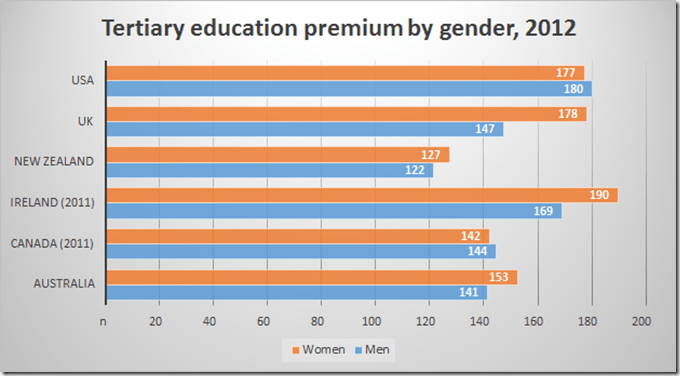
There are large differences in the percentage of people with tertiary degrees and the education premium between these three countries that are outside the scope of this blog post. These trends may explain differences in the degree of educational mismatch.
It goes without saying that the concept of over-qualification and over-education based mismatch in the labour market is ambiguous, if not misleading and a false construct.
To begin with, under human capital theories of labour market and job matching, what appears to be over-schooling substitutes for other components of human capital, such as training, experience and innate ability. Not surprisingly, over-schooling is more prominent among younger workers because they substitute schooling for on-the-job training. A younger worker of greater ability may start in a job below his ability level because he or she expects a higher probability to be promoted because of greater natural abilities. Sicherman and Galor (1990) found that:
overeducated workers are more likely to move to a higher-level occupation than workers with the required level of schooling
Investment in education is a form of signalling. Workers invest so much education that they appear to be overqualified in the eyes of officious bureaucrats. The reason for this apparent overinvestment is signalling superior quality as a candidate. Signalling seems to be an efficient way of sorting and sifting among candidates of different ability. The fact that signalling survives in market competition suggests that alternative measure ways of measuring candidate quality that a more reliable net of costs are yet to be discovered.
A thoroughly disheartening chart if you're a graduate in the UK i100.io/mpDbJAl http://t.co/mv9izA0mbc—
i100 (@thei100) August 20, 2015
Highly educated workers, like any other worker, must search for suitable job matches. Not surprisingly, the first 5 to 10 years in the workforce are spent in half a dozen jobs as people seek out the most suitable match in terms of occupation, industry and employer. Some of these job seekers who are highly educated will take less suitable jobs while they search on-the-job for better matches. Nothing is free or instantly available in life including a good job match.
A more obvious reason for over qualification is some people like attending university and other forms of education for the sheer pleasure of it.
Anyone who encounters the words over-qualified and over-educated should immediately recall concepts such as the pretence to knowledge, the fatal conceit, and bureaucratic busybodies. As Edwin Leuven and Hessel Oosterbeek said recently:
The over-education/mismatch literature has for too long led a separate life of modern labour economics and the economics of education.
We conclude that the conceptional measurement of over-education has not been resolved, omitted variable bias and measurement error are too serious to be ignored, and that substantive economic questions have not been rigorously addressed.
The track record on banking on solar energy innovation becoming cost competitive
18 Aug 2015 Leave a comment
in economic history, energy economics, entrepreneurship, environmental economics, global warming, politics - USA, Public Choice, rentseeking Tags: Big Solar, creative destruction, green rent seeking, renewable energy, renewable resources, solar energy
John F. Kennedy’s speech in Berlin
17 Aug 2015 Leave a comment
in politics - USA, war and peace Tags: Berlin, Cold War, JFK, nuclear deterrence
Only American political junkies remember the early poll leaders from previous presidential primaries season
17 Aug 2015 Leave a comment
in politics - USA Tags: 2016 presidential election
Can an early poll leader win the US election? ab.co/1W0vinm #GOPDebate http://t.co/JkVqEMluva—
ABC Fact Check (@ABCFactCheck) August 07, 2015
Recent Comments