https://twitter.com/ianbremmer/status/653888723034222592/photo/1
14 years after US invasion, the Taliban are back in control of large parts of Afghanistan. bit.ly/afghan-maps http://t.co/c2W7NQ46Yy—
NYT Graphics (@nytgraphics) October 16, 2015
Celebrating humanity's flourishing through the spread of capitalism and the rule of law
17 Oct 2015 1 Comment
in politics - USA, war and peace Tags: Afghanistan, Taleban, war on terror
https://twitter.com/ianbremmer/status/653888723034222592/photo/1
14 years after US invasion, the Taliban are back in control of large parts of Afghanistan. bit.ly/afghan-maps http://t.co/c2W7NQ46Yy—
NYT Graphics (@nytgraphics) October 16, 2015
17 Oct 2015 Leave a comment
in politics - USA, war and peace Tags: Afghanistan, war on terror
16 Oct 2015 Leave a comment
16 Oct 2015 Leave a comment
in applied welfare economics, economic history, politics - USA Tags: 2016 presidential election, expressive voting, gender wage gap, Leftover Left, middle class stagnation, reversing gender gap, top 1%, Twitter left, wage stagnation
The Typical Male U.S. Worker Earned Less in 2014 Than in 1973: blogs.wsj.com/washwire/2015/… http://t.co/PmTmmfsfbE—
Demos Action (@DemosAction) September 21, 2015
For the first time ever, women are more likely to have bachelor's degrees than men. vox.com/2015/10/13/951… http://t.co/ffK7iiU2Kq—
Demos (@Demos_Org) October 14, 2015
16 Oct 2015 Leave a comment
in economics of crime, economics of regulation, law and economics, liberalism, politics - Australia, politics - New Zealand, politics - USA Tags: Jeff Morin, marijuana decriminalisation, war on drugs
16 Oct 2015 Leave a comment
in politics - USA, Public Choice Tags: 2016 presidential elections, campaign finance, campaign finance reform
One-time front runner Scott Walker pulled out with large debts. Given that the debates start so much sooner than before, some people will exhaust their donor base and will be forced out by the prospect of excessive debt before anyone votes.
Scott Walker dropped out with his campaign owing $1.6 million nyti.ms/1G8iBSZ via @maggienyt http://t.co/vrTng6XCGC—
NYT Politics (@nytpolitics) October 15, 2015
There are only a few serious candidates in the Republican race anyway. Ben Carson and Donald Trump are silly season candidates but have raised a lot of money.
Trump and Carson will lose support sooner or later. Carly Farina, Jeb Bush and Marco Rubio in the main serious contenders of the rest. My tip is Farina and Rubio will win in the end but I am not sure which one of those two will be the vice presidential nominee. I suspect Rubio.
Here's @pollsterpolls avg since 6/1, w/ less smoothing. 2-pt drop for Trump. Not yet clear whether there's a trend. http://t.co/vrwXNC6hlo—
The Monkey Cage (@monkeycageblog) September 24, 2015
Key pt: Trump's share of coverage matters more than its tone (cc @mattyglesias @jackshafer) washingtonpost.com/blogs/monkey-c… http://t.co/zl8iu2Q21x—
The Monkey Cage (@monkeycageblog) September 29, 2015
Fascinating that GOP activists see no trade-off between conservatism and electability: washingtonpost.com/blogs/monkey-c… http://t.co/uXHHHnFKWp—
The Monkey Cage (@monkeycageblog) October 13, 2015
Here's a new graph of Trump's poll numbers and share of news coverage. For more see: washingtonpost.com/blogs/monkey-c… http://t.co/sdJCQCs5O5—
The Monkey Cage (@monkeycageblog) August 28, 2015
Massive correlation b/t news coverage of GOP candidates & poll #s. Is it causation? See: washingtonpost.com/blogs/monkey-c… http://t.co/sCCvma2uYR—
The Monkey Cage (@monkeycageblog) August 28, 2015
Ben Carson's decline and then surge in the polls tracks media attention. washingtonpost.com/blogs/monkey-c… http://t.co/mrddJMMAc0—
The Monkey Cage (@monkeycageblog) September 03, 2015
Here's some actual evidence on whether voter anger is helping "outsider" candidates. washingtonpost.com/blogs/monkey-c… http://t.co/RaragjjStV—
The Monkey Cage (@monkeycageblog) September 16, 2015
16 Oct 2015 Leave a comment
in politics - USA, Public Choice Tags: political polarisation, Republican Party, U.S. Congress
The most conservative House Republicans 25 years ago would be the most liberal members now: 53eig.ht/1FwIOu5 http://t.co/Dw8PVm3TGm—
(@FiveThirtyEight) September 29, 2015
15 Oct 2015 Leave a comment
in applied welfare economics, politics - Australia, politics - New Zealand, politics - USA, poverty and inequality
Australia does far better than any other country in targeting its welfare state to the bottom of the income distribution. Having an old age pension that is asset tested and income tested has a lot to do with that. New Zealand has an old age pension that is not income tested or asset tested. The USA has a contributory social insurance system that also ensures a considerable amount of its public social benefits are paid to the well off because they paid in Social Security taxes.
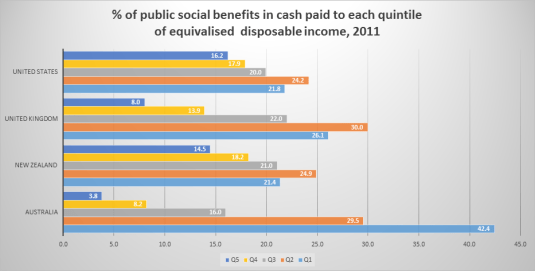
Source: OECD Income Distribution database, via http://oe.cd/idd
15 Oct 2015 4 Comments
in discrimination, economic history, gender, human capital, labour economics, politics - Australia, politics - New Zealand, politics - USA Tags: asymmetric marriage premium, compensating differentials, gender wage gap, marriage and divorce
It seems that the top 10% of men are so busy oppressing the top 10% of women that they forgot to keep up the violence inherent in the capitalist system against the bottom 10% of women. The gender pay gap at the bottom of the economic strata closed quite dramatically and consistently since 1970 or as far back as data was available in Australia, New Zealand, the UK and USA. Much of the closing of the gender pay gap for the low-paid was under the scourge of Reagan, Thatcher, Hawke and Keating and Rogernomics.
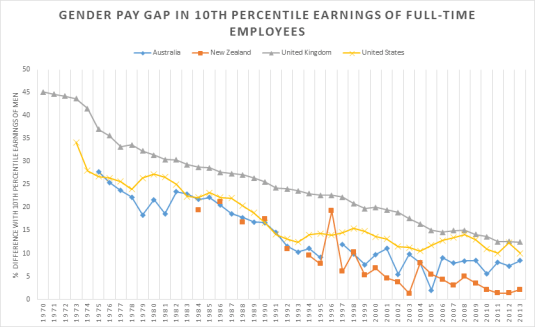
Source and Notes: OECD Employment Database. The gender gap plotted below is unadjusted. It is calculated as the difference between the 10th percentile earnings of men and the 10th percentile earnings of women relative to the 10th percentile earnings of men. Estimates of earnings used in the calculations refer to gross earnings of full-time wage and salary workers. However, this definition may slightly vary from one country to another.
By comparison to this dramatic liberation of women from the gender pay gap at the bottom, the gender pay gap for full-time employees has not really tapered down that much at the top of the income distribution and has been pretty flat for coming on 20 years. It seems the class war is over and has been won by women at the bottom but not at the top?
Younger, more educated women delay having families and can earn as much as their partners. bit.ly/1jw98Ky http://t.co/BaDIlBIBA2—
Ninja Economics (@NinjaEconomics) October 14, 2015
Rather than up the workers, the battle cry of the Posh Trots is up the managers, liberate them from insidious pay inequities imposed upon them by a vast sexist conspiracy of male managers.
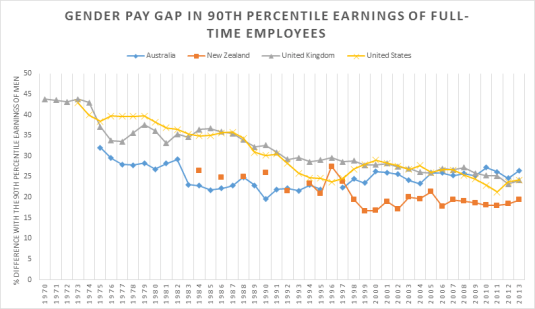
Source and Notes: OECD Employment Database. The gender gap plotted below is unadjusted. It is calculated as the difference between the 10th percentile earnings of men and the 10th percentile earnings of women relative to the 10th percentile earnings of men. Estimates of earnings used in the calculations refer to gross earnings of full-time wage and salary workers. However, this definition may slightly vary from one country to another.
This failure to close the gender pay gap at the top requires more investigation. The available of reliable contraceptives in the late 1960s led to an explosion of investment by women in long duration professional education and in careers where absences because of motherhood in their 20s and 30s was penalised in terms of human capital depreciation and promotional opportunities.

The reason for the endurance of the gender pay gap at the top of the income distribution is compensating differentials. Women at the top were able to have it all.

Professional women could invest in a career and a family and mix-and-match according to their own preferences for career and family and timing of births rather than the preferences of others who looked upon them as some sort of pathfinder for their gender. It is at the top of the income distribution where short absences from the workplace can has very large consequences for wages and promotion.

15 Oct 2015 Leave a comment
in politics - USA Tags: 2016 presidential election
Different worlds http://t.co/4pfbNJMseb—
Roberto Ferdman (@robferdman) October 14, 2015
14 Oct 2015 Leave a comment
in economic history, politics - USA, Public Choice
14 Oct 2015 Leave a comment
in economics of crime, economics of regulation, health economics, law and economics, politics - USA Tags: crime and punishment, marijuana decriminalisation, war on drugs
Marijuana arrests by Presidential administration http://t.co/pJPHVfNaas—
Charts and Maps (@ChartsandMaps) April 04, 2015
13 Oct 2015 Leave a comment
in economic history, economics of crime, law and economics, occupational choice, politics - USA Tags: crime and punishment, crime statistics, criminal deterrence, law and order
Violent crime fell again in 2014. So much for the "Ferguson effect."
washingtonpost.com/news/wonkblog/… http://t.co/h2a6b746qS—
Christopher Ingraham (@_cingraham) September 29, 2015
Celebrating humanity's flourishing through the spread of capitalism and the rule of law
Celebrating humanity's flourishing through the spread of capitalism and the rule of law
Celebrating humanity's flourishing through the spread of capitalism and the rule of law
Celebrating humanity's flourishing through the spread of capitalism and the rule of law
Celebrating humanity's flourishing through the spread of capitalism and the rule of law
Celebrating humanity's flourishing through the spread of capitalism and the rule of law
Celebrating humanity's flourishing through the spread of capitalism and the rule of law
Celebrating humanity's flourishing through the spread of capitalism and the rule of law
A History of the Alt-Right
Econ Prof at George Mason University, Economic Historian, Québécois
Celebrating humanity's flourishing through the spread of capitalism and the rule of law
Scholarly commentary on law, economics, and more
Beatrice Cherrier's blog
Celebrating humanity's flourishing through the spread of capitalism and the rule of law
Celebrating humanity's flourishing through the spread of capitalism and the rule of law
Celebrating humanity's flourishing through the spread of capitalism and the rule of law
Why Evolution is True is a blog written by Jerry Coyne, centered on evolution and biology but also dealing with diverse topics like politics, culture, and cats.
Celebrating humanity's flourishing through the spread of capitalism and the rule of law
A rural perspective with a blue tint by Ele Ludemann
DPF's Kiwiblog - Fomenting Happy Mischief since 2003
Celebrating humanity's flourishing through the spread of capitalism and the rule of law
The world's most viewed site on global warming and climate change
Tim Harding's writings on rationality, informal logic and skepticism
A window into Doc Freiberger's library
Let's examine hard decisions!
Commentary on monetary policy in the spirit of R. G. Hawtrey
Thoughts on public policy and the media
Celebrating humanity's flourishing through the spread of capitalism and the rule of law
Politics and the economy
A blog (primarily) on Canadian and Commonwealth political history and institutions
Reading between the lines, and underneath the hype.
Economics, and such stuff as dreams are made on
"The British constitution has always been puzzling, and always will be." --Queen Elizabeth II
Celebrating humanity's flourishing through the spread of capitalism and the rule of law
Celebrating humanity's flourishing through the spread of capitalism and the rule of law
WORLD WAR II, MUSIC, HISTORY, HOLOCAUST
Undisciplined scholar, recovering academic
Celebrating humanity's flourishing through the spread of capitalism and the rule of law
Res ipsa loquitur - The thing itself speaks
In Hume’s spirit, I will attempt to serve as an ambassador from my world of economics, and help in “finding topics of conversation fit for the entertainment of rational creatures.”
Researching the House of Commons, 1832-1868
Reflections on books and art
Posts on the History of Law, Crime, and Justice
Celebrating humanity's flourishing through the spread of capitalism and the rule of law
Exploring the Monarchs of Europe
Cutting edge science you can dice with


Recent Comments