Violent crime fell again in 2014. So much for the "Ferguson effect."
washingtonpost.com/news/wonkblog/… http://t.co/h2a6b746qS—
Christopher Ingraham (@_cingraham) September 29, 2015
The continued decline of violent crime in America
13 Oct 2015 Leave a comment
in economic history, economics of crime, law and economics, occupational choice, politics - USA Tags: crime and punishment, crime statistics, criminal deterrence, law and order
Increase in the Cost of Housing in the US 1901-2002
12 Oct 2015 Leave a comment
in economic history, politics - USA, urban economics Tags: housing affordability, housing prices, land prices, land supply, land use planning, zoning
Increase in the Cost of Housing in the US 1901-2002 bit.ly/195NbKb http://t.co/kt7pmOFPVi—
Catherine Mulbrandon (@VisualEcon) August 25, 2014
A 20 year period of polling Hillary Clinton
12 Oct 2015 Leave a comment
in politics - USA Tags: 2016 presidential election, voter demographics
A 20 year period of polling Hillary Clinton washingtonpost.com/blogs/plum-lin… http://t.co/1LGSKCXNiG—
Political Line (@PoliticalLine) September 02, 2015
Candidate Lessig’s Bad Example
11 Oct 2015 Leave a comment
in comparative institutional analysis, constitutional political economy, economic history, politics - USA, Public Choice, rentseeking Tags: campaign finance reform, campaign finance regulation
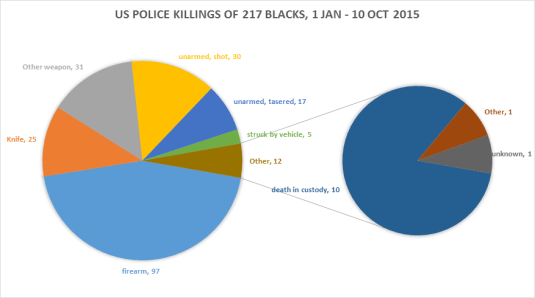
@thecounted US police killings of 217 blacks by cause, 1 Jan – 10 Oct 2015 @radleybalko
10 Oct 2015 1 Comment
in economics of crime, politics - USA
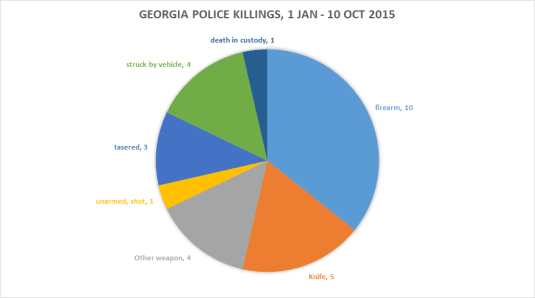
@thecounted beats up on Georgia state police killings @radleybalko @Mark_J_Perry
10 Oct 2015 Leave a comment
in economics of crime, politics - USA
Georgia police shot one unarmed suspect this year. He was a crazy naked guy charging at police. Would you let a crazy naked guy get your gun?


Will Auckland become like San Francisco?
10 Oct 2015 1 Comment
in economic history, economics of regulation, environmental economics, politics - New Zealand, politics - USA, urban economics Tags: Auckland, housing affordability, land supply, land use planning, RMA, San Francisco, zoning
https://twitter.com/JoshZumbrun/status/652517712070082561/photo/1
"Your neighborhood could be next." San Francisco-wide mailer in support of Prop I, the Mission housing moratorium. http://t.co/PtN38JTaUM—
Jed Kolko (@JedKolko) October 10, 2015
@sival84 @MarketUrbanism @SFyimby More for thought: Permits vs prices for top ten tech hubs trulia.com/blog/trends/pr… http://t.co/yRvjVWDova—
Ralph B. McLaughlin (@housingnomix) October 01, 2015
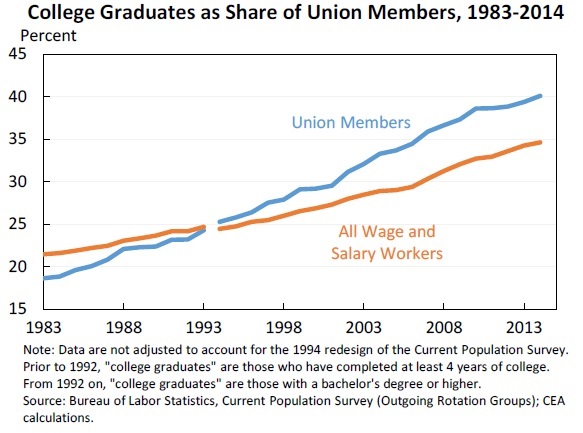
The withering away of unions as a working class movement @nzlabour @FairnessNZ
09 Oct 2015 Leave a comment
#TPA more popular among democrats
09 Oct 2015 Leave a comment
in income redistribution, international economics, politics - New Zealand, politics - USA, Public Choice, public economics, rentseeking Tags: TPA, voter demographics
What will it take to finish the Last Mile in ending extreme poverty
09 Oct 2015 Leave a comment
in development economics, economic history, growth disasters, growth miracles, politics - Australia, politics - New Zealand, politics - USA, poverty and inequality Tags: capitalism and freedom, The Great Escape, The Great Fact
What will it take to finish the “Last Mile” in ending extreme #poverty? brook.gs/1LiFT8E http://t.co/YxSZ36VCSW—
Brookings (@BrookingsInst) October 07, 2015
Why did the Democrats become the favourites of the rich?
08 Oct 2015 Leave a comment
in economic history, politics - USA, Public Choice
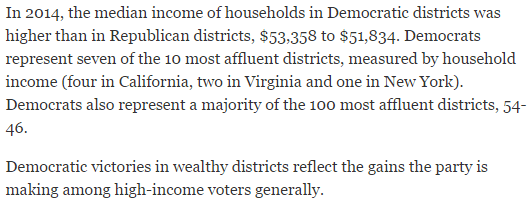
Thomas Edsall is one of the smartest op-ed writers at the New York Times. His latest op-ed is about how well-to-do people are contributing to and voting for the Democrats as much as the poor these days. The Democratic Party now holds the majority of the most affluent congressional districts in America.
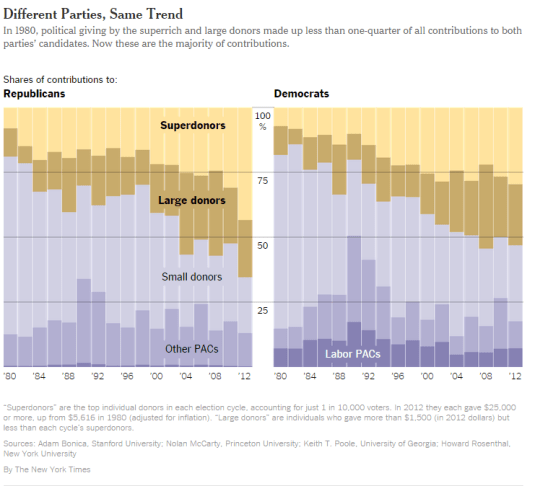
Source: How Did the Democrats Become Favorites of the Rich? – The New York Times.
The median income of Republican districts is slightly less than that of Democratic Party congressional districts. The Republicans are no longer the party of the well-off albeit by a whisker on average. Both the Democrats and the Republicans are doing their best as predicted by the Directors’ Law. They service the swinging voter who is a middle-class voter.
Source: How Did the Democrats Become Favorites of the Rich? – The New York Times.
I first noticed this trend in in the best TV soapy of 2008. In the 2008 presidential primaries campaign, Hillary Clinton just talked all the time about the struggles of the middle class and will again in her 2016 campaign. Obama was no different.
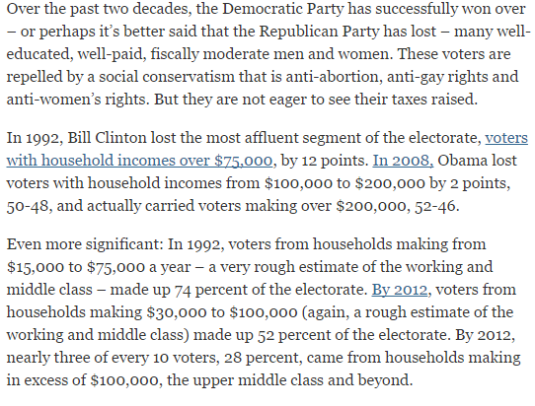
A key reason for the withering away of the proletariat in Democratic Party campaign rhetoric is too many of the swinging voters are not in the working class and there are many more many members of the middle classes. One consequence of the withering away of the proletariat is parties that claim to represent the working class are representing a shrinking electorate. They must adapt or face permanent opposition.
Source: The Problem With Middle-Class Populism – The New York Times.
The Democrats do well among the college educated voters. Obama won this over Romney in 2012 by 10 percentage points. This may explain why the Democrats are slightly conflicting: they must win the working class vote as well as the college educated vote to win. The risk for the Democratic party of basing its support in the middle-class is this middle-class is fiscally conservative and rather unwilling to pay for any large-scale redistribution of wealth because it will come out of their very own pockets.
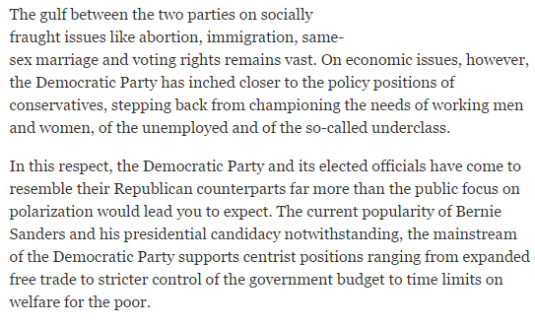
One reason that the Democratic Party and many parties on the centre-left moved into the politics of identity is that allows them to better target their policies towards people who might switch their vote to them all this at the expense of the welfare of the working class. By targeting race, gender, sexual orientation and ethnicity, the policies of the Democratic Party moved away from promoting the general welfare towards servicing their specific voting constituencies. The social liberalism of the Democratic Parties is part of this servicing of their constituencies.
Source: How Did the Democrats Become Favorites of the Rich? – The New York Times.
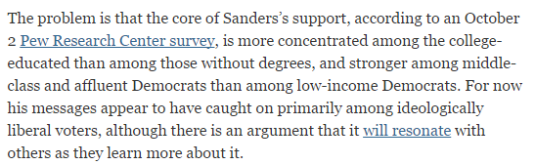
Do not get your hopes up with Bernie Sanders. He too is the favourite of the middle class and college students – expressive voters all. The working class and minorities do not actually have much time for him. Bernie Sanders has terrible polling among black Democratic voters and about 90% of blacks vote Democrat.
Source: How Did the Democrats Become Favorites of the Rich? – The New York Times
There is certainly a lot of straight median voter theorem in the Democratic Party being co-opted by the middle-class but there is more than that. There is the issue of smart political communication in the era of The Great Enrichment. Andrew Cherlin showed some insight into both the basics of political communication about identity and expressive politics when he observed that:
Politicians may prefer to call working-class families by the class position they aspire to rather than the one they hold.

Creative destruction in car prices
07 Oct 2015 Leave a comment
in applied welfare economics, economic history, entrepreneurship, politics - USA, technological progress, transport economics Tags: creative destruction
CHART: Since 1995 the CPI for new vehicles has been flat, while the CPI (and wages) increased 60%. What a bargain! http://t.co/DOdlQn8pcK—
Mark J. Perry (@Mark_J_Perry) July 01, 2015
Jane Kelsey oppose handcuffs on the democratic choices of future governments! Does she opposes labour and environmental standards in trade agreements too?
06 Oct 2015 Leave a comment
in development economics, international economic law, international economics, International law, politics - New Zealand, politics - USA Tags: colonialism, GATT, Leftover Left, preferential trading agreements, TPA, TPPA
What's in the #TPP? Robust enforceable environmental protections. Get the facts ustr.gov/tpp #LeadOnTrade http://t.co/hzapJwGaCa—
USTR (@USTradeRep) October 05, 2015What's in the #TPP? Protections for American workers. Get the facts: ustr.gov/tpp #MadeInAmerica http://t.co/VPeV70zaPT—
USTR (@USTradeRep) October 05, 2015https://twitter.com/JimRose69872629/status/651230008875220992
One of my policy essays for my Masters of Public Policy Degree in Japan was on the social clauses of the GATT. I described the labour and environmental clauses is a new form of colonialism.
My classmates were government officials from all around Asia, more than 20 countries. As they spoke English as a second language, they were pleased to learn of a new way of describing social clauses in trade agreements in English.
A Filipino friend had a blunter way of referring to social clauses in trade agreements: “the whites are back, telling us what to do”.
Environmentalists are praising wildlife measures in the Trans-Pacific Partnership trade deal nyti.ms/1hlu7hS http://t.co/ZLYarL9QE7—
The New York Times (@nytimes) October 05, 2015

Jane Kelsey in a television interview said she opposes the reductions in sovereignty in trade agreements that result from investor-state dispute settlement (ISDS) provisions because they limit the democratic choices of future governments.
If so, she must oppose environmental and labour standards in trade agreements and, more importantly, binding the hands of future governments with climate treaties. All international treaties are about restrictions on sovereignty.
Environmental and labour clauses in trade agreements and climate treaties all limit the powers of governments to legislate on environmental and employment law in accordance with the will of the people as expressed in the most recent election and change of government. Power to the people.
https://twitter.com/rorymccourt/status/625540621457960960
Jane Kelsey would do better focusing on those parts of the TPPA deal that lowers the net value of the deal such as those extending the term of patents over the drugs. All international treaties are about trade-offs.
View original post 212 more words


Recent Comments