
World War I – the initial Australian response was expressed in its September 1914 general election
25 Apr 2015 Leave a comment
In another neo-liberal victory, health and welfare spending shares have doubled in the last 50 years
24 Apr 2015 Leave a comment
in income redistribution, politics - USA, Public Choice, public economics Tags: Director's Law, Leftover Left, median voter theorem, neoliberalism, tax reform, welfare state
The impact of the top tax rate in the depth and severity of the great depression
24 Apr 2015 Leave a comment
in business cycles, fiscal policy, great depression, macroeconomics, politics - New Zealand, politics - USA, public economics Tags: capital taxation, New Zealand, taxation and the labour supply, top tax rate
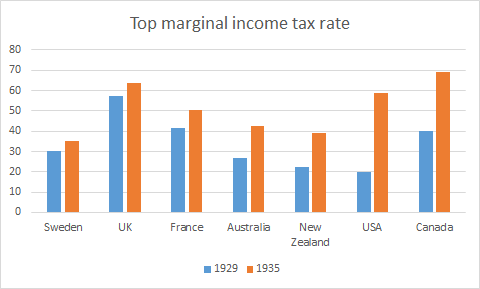
Source: Ellen McGrattan.
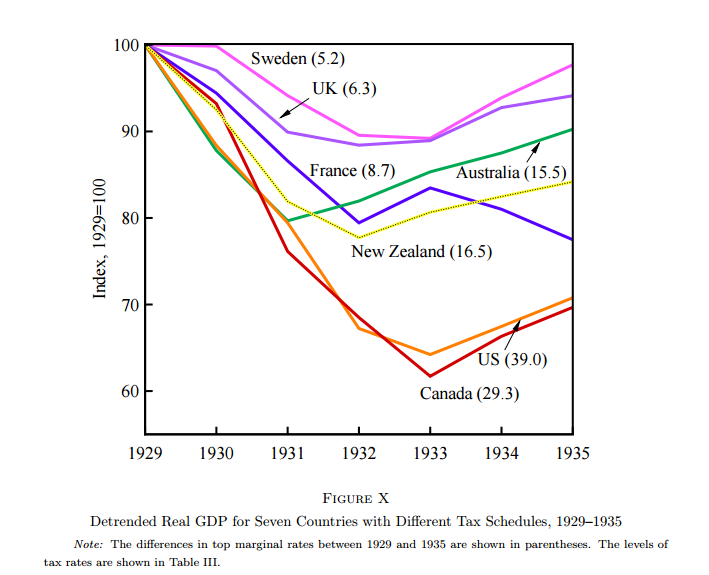
There were large differences in increases in the 1930s in the top marginal income tax rate between Sweden, the UK, France with Australia and New Zealand and between the USA and Canada and the rest as McGrattan explains:
These data show that there is a strong negative correlation, roughly −94%, between the change in the top income tax rates and the deviation in per capita real GDP relative to trend in 1933.
Why don’t GOP presidential candidates address climate change? Because they want to win.
24 Apr 2015 Leave a comment
in environmental economics, global warming, politics - USA, Public Choice Tags: 2016 presidential election, climate alarmism, global warming, median voter theorem
Republicans furthest to the right are also most likely to reject the scientific consensus that human activity is to blame.
Why does this matter for 2016? Because conservative voters turn out heavily in primaries.
In 2012, two-thirds of the Republican primary electorate identified itself as conservative or very conservative in exit polling. Only one-third identified itself as being moderate or liberal Republicans.
When two-thirds of voters overlaps with the group that’s most likely to reject the idea that we should address climate change, that’s a strong disincentive to hold your ground on the subject.

Company tax rates around the world
24 Apr 2015 Leave a comment
in international economics, politics - Australia, politics - New Zealand, politics - USA, Public Choice, public economics Tags: company tax rate, tax competition
The role of new taxes in the Great Recession
24 Apr 2015 Leave a comment
in economic growth, fiscal policy, great recession, labour economics, labour supply, macroeconomics, politics - USA Tags: great recession, obama, Obamacare, taxation and entrepreneurship, taxation and investment, taxation and labour supply


.
Presidential voting demographics
23 Apr 2015 Leave a comment
in politics - USA Tags: 2016 presidential election
Could the 2016 presidential race change typical demographic voting trends? brook.gs/1GHP69t http://t.co/lfMt72MHFJ—
Brookings (@BrookingsInst) April 15, 2015
The economic and educational psychology case against making Te reo Māori compulsory in NZ schools
23 Apr 2015 1 Comment
in discrimination, economics of education, human capital, labour economics, politics - USA, poverty and inequality Tags: do gooders, economics of languages, Maori economic development, network economics, Te reo Māori
The Race Relations Commissioner Dame Susan Davoy has called for Te Reo Māori to be compulsory in New Zealand schools. She said being bilingual would be “a real added advantage” to young Kiwis and more people knowing Te reo Māori would help race relations.
Learning another language is not a priority for the Pākehā children or Māori mokupuna when you consider the poor literacy rates among Māori, Pasifika and Pākehā. The priority for children in an English speaking country is to master English. Too many children leave school with inadequate reading and writing skills.
Figure 1: Prose literacy by ethnicity, 2011
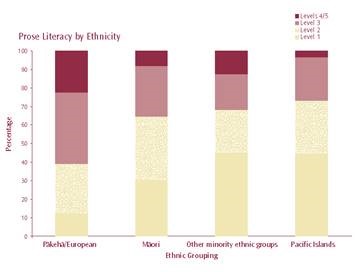
Source: Literacy skills of young adult New Zealanders | Education Counts.
Lower levels of literacy and numerously are much higher among Māori and Pasifika children. Pākehā consistently having a larger proportion in the higher levels of prose literacy.
Figure 2: Prose literacy rates by ethnicity, 1996 and 2006
Source: Indicator 9: Literacy rates — Office of the Auditor-General New Zealand.
60%of Pākehā are above the minimum level of competence to meet the prose literacy requirements of a knowledge society. This contrasts with the majority of Māori and Pasifika who are below the minimum level of competence.
Furthermore, requiring children who do not have an aptitude for language or school in general to learn a language will reinforce in those who are not doing well that they are not very smart. This will give them more reasons to hate school and leave as soon as possible and never go back.
The key to helping children who do not have an aptitude to succeed greatly at school is to find the subjects where they do do well so they can get a good start to life. If students are not good at academic subjects, requiring them to do more academic studies such as study language is fool-hardy.
Taking resources, and more importantly, students learning time away from basic literacy skills will do little for a Māori economic development and race relations. This is because this taking resources and student learning time away from literacy and basic education will slow the closing of income gaps between Māori and others.
Language is a network good. It pays to join the largest network so you can communicate and do business with more people. The wage premium for immigrants learning English in English-speaking’s countries is about 15%.

Learning Te reo Māori will not help children in their other subjects. The psychology of the transfer of learning was founded 100 years ago to explore the hypothesis that learning Latin gave the student muscle to learn other subjects, both other languages and generally learn faster.
Educational psychologists found that Latin does not help much in studying other languages and other subjects. No significant differences were found in deductive and inductive reasoning or text comprehension among students with 4 years of Latin, 2 years of Latin or no Latin at all.
The looming fiscal crisis in the USA
22 Apr 2015 Leave a comment
in fiscal policy, global financial crisis (GFC), great recession, macroeconomics, politics - USA Tags: ageing society
US, UK and Japanese inflation adjusted for new good and quality bias, 1994-2014
22 Apr 2015 Leave a comment
in econometerics, inflation targeting, macroeconomics, politics - USA Tags: CPI bias
All agree that the consumer price index (CPI) is biased and overstates inflation. In 1996, economists hired by the Senate Finance Committee estimated that the U.S. CPI overstates annual inflation by 1.1% (Boskin et al. 1996). That estimated CPI bias has not gotten smaller with time. It is now up to 1.5%, even 2%.
The main biases in the consumer price index everywhere come from how to handle changes in the quality of goods and services and how to deal with completely new goods and services.
I thought I might see what happened if I took account of this one and a half percentage point annual bias because of new goods, quality variation and other known biases in the CPI estimates for the USA, UK and Japan in the relevant OECD StatExtract database for annual CPI inflation.

Source: OECD StatExtract.
Taking into account new good and quality bias, Japan is been in serious deflation for quite some time now – at least 20 years. Japanese inflation went positive in the last year or two because I believe they increased their consumption tax.
The USA has a low inflation for about 20 years. The UK had no inflation for about seven years from 1997 then it started to rise again until 2012.
People get hot and bothered with deflation. Breathless journalism aside, fears of inflation are just a legacy of the great depression in the 1930s.
The only depression where deflation was accompanied by mass unemployment was the Great Depression. Mild deflation with good growth is a common phenomenon as Atkinson and Kehoe found:
Are deflation and depression empirically linked? No, concludes a broad historical study of inflation and real output growth rates. Deflation and depression do seem to have been linked during the 1930s. But in the rest of the data for 17 countries and more than 100 years, there is virtually no evidence of such a link.

Earth Day activists are now victims of the mass kidnappings
22 Apr 2015 Leave a comment
in environmental economics, politics - Australia, politics - New Zealand, politics - USA Tags: Earth Day
Mass kidnappings is the only charitable explanation for their failure to be dancing in the streets by Eart Day activists over the greening of the planet courtesy of capitalism since Earth Day 1970?

The first Earth Day was celebrated 45 years ago today. nyti.ms/1IDVPyC http://t.co/Zpg7zJc8V6—
NYT Archives (@NYTArchives) April 22, 2015
High school seniors are drinking less, smoking less, and barely using cocaine
22 Apr 2015 Leave a comment

George Carlin on Global Warming
22 Apr 2015 Leave a comment
in energy economics, environmental economics, politics - New Zealand, politics - USA Tags: George Carlin, global warming
The role of unions in prolonging the Great Depression
20 Apr 2015 1 Comment
in business cycles, fiscal policy, great depression, labour economics, labour supply, macroeconomics, politics - USA, unemployment, unions Tags: capital taxation, FDR, Herbert Hoover, Leftover Left, Leo Ohanian, New Deal, union power, union wage premium, unionisation
Our friends on the left at the Economic Policy Institute were good enough to remind us of the link between rapid unionisation of the US labour market in the early and mid-1930s and the petering out of the recovery from the great depression. That recession within a depression is the Roosevelt recession.
New blog on Mind The Gap: on labour #unions and income #inequality
oxfamblogs.org/mindthegap/201… http://t.co/FyrOboCaRk—
Ricardo FuentesNieva (@rivefuentes) April 17, 2015
Harold Cole and Lee Ohanian analysed in depth this double-dip depression in the USA in a paper in the Journal of Political Economy titled “New Deal Policies and the Persistence of the Great Depression: A General Equilibrium Analysis” about 10 years ago:
The recovery from the Great Depression was weak… Real gross domestic product per adult, which was 39 percent below trend at the trough of the Depression in 1933, remained 27 percent below trend in 1939. Similarly, private hours worked were 27 percent below trend in 1933 and remained 21 percent below trend in 1939.
The weak recovery is puzzling because the large negative shocks that some economists believe caused the 1929–33 downturn—including monetary shocks, productivity shocks, and banking shocks—become positive after 1933. These positive shocks should have fostered a rapid recovery, with output and employment returning to trend by the late 1930s.
The focus of the paper by Cole and Ohanian in explaining the weak recovery – the double-dip depression in the 1930s – are the New Deal cartelisation policies designed to limit competition and increase labour bargaining power through extensive unionisation of workforce.

The recovery from the depths of the Great Depression was weak but real wages in several sectors rose significantly above trend despite mass unemployment.

The view that limiting competition in product markets and the labour market was essential for economic prosperity was influential in the 1920s and 1930s. Both FDR and Hoover believed high wages were the key to prosperity.
FDR’s recipe for economic recovery from the great depression when he came to office in 1933 was raising prices and wages and the promotion of unions:
Union membership rose from about 13 percent of employment in 1935 to about 29 percent of employment in 1939, and strike activity doubled from 14 million strike days in 1936 to about 28 million in 1937.
The result of this suppression of market competition and the encouragement of unions was real wages increase despite the weak recovery:
The coincidence of high wages, low consumption, and low hours worked indicates that some factor prevented labour market clearing during the New Deal.
The combination of government interference with competition and strong unions stifled the recovery from the great depression rather than speed it up as was the plan of FDR:
New Deal labour and industrial policies did not lift the economy out of the Depression as President Roosevelt had hoped.
Instead, the joint policies of increasing labour’s bargaining power and linking collusion with paying high wages prevented a normal recovery by creating rents and an inefficient insider-outsider friction that raised wages significantly and restricted employment.
Not only did the adoption of these industrial and trade policies coincide with the persistence of depression through the late 1930s, but the subsequent abandonment of these policies coincided with the strong economic recovery of the 1940s.
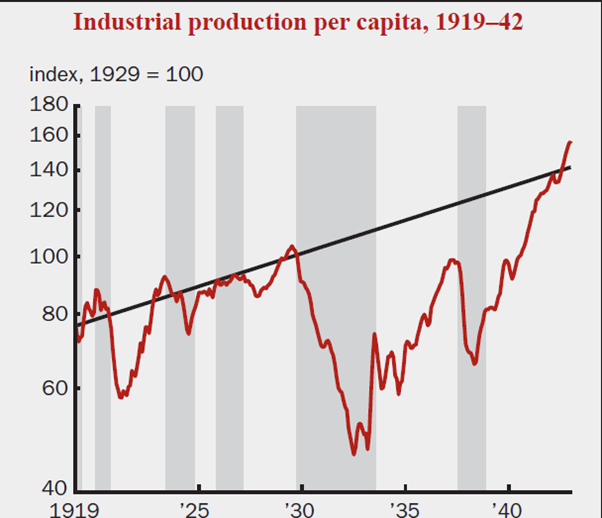
U.S. unemployment fell from 22.9% in 1932 to 9.1% in 1937, a reduction of 13.8%, but was back up to 13% by 1938. The Social Security payroll tax debuted in 1937 on top of tax increases in the Revenue Act of 1935. In 1937, the economy fell into recession again. Cooley and Ohanian argue that:
The economy did not tank in 1937 because government spending declined. Increases in tax rates, particularly capital income tax rates, and the expansion of unions, were most likely responsible.
The Great Depression in the USA was unique in the fact that it was so long and the recovery, so weak:
Total hours worked per adult in 1939 remained about 21% below their 1929 level, compared to a decline of 27% in 1933… Per capita consumption did not recover at all, remaining 25% below its trend level throughout the New Deal, and per-capita non-residential investment averaged about 60% below trend.
After 1933, productivity growth was rapid, the banking system was stabilized, deflation was eliminated and there was plenty of demand stimulus as the Fed more than doubled the monetary base between 1933 and 1939. As Lee Ohanian noted:
Depressions are periods of low employment and low living standards. The normal forces of supply and demand should have reduced wages, which would have lowered business costs and increased employment and output. What prevented the normal forces of supply and demand from working?
Central to the faltering of this recovery by 1937 was the regime change when the Supreme Court finally upheld revised laws promoting unionisation:
The downturn of 1937-38 was preceded by large wage hikes that pushed wages well above their NIRA levels, following the Supreme Court’s 1937 decision that upheld the constitutionality of the National Labor Relations Act. These wage hikes led to further job loss, particularly in manufacturing.
The "recession in a depression" thus was not the result of a reversal of New Deal policies, as argued by some, but rather a deepening of New Deal polices that raised wages even further above their competitive levels, and which further prevented the normal forces of supply and demand from restoring full employment.
Lee Ohanian argues that the defining characteristic of the Great Depression was this failure of real wages to fall in the face of mass unemployment:
The defining characteristic of the Great Depression is a substantial and chronic excess supply of labour, with employment well below normal, and real wages in key industrial sectors well above normal.
Policies of Hoover and of FDR of propping up wages and encouraging unions and work sharing were the most important factors in precipitating and prolonging the Great Depression. The Great Depression was the first time U.S. wages did not fall in that you were administered a period of significant deflation.
The manufacturing sector, where unions and the threat of unionisation was much stronger which was much harder hit initially than the agricultural sector both in terms of loss of jobs and wages not falling. The Great Depression did not start as an ordinary garden variety recession, as argued by Milton Friedman. It was immediately severe and sector specific with industrial production declining by about 35% between late 1929 and the end of 1930.
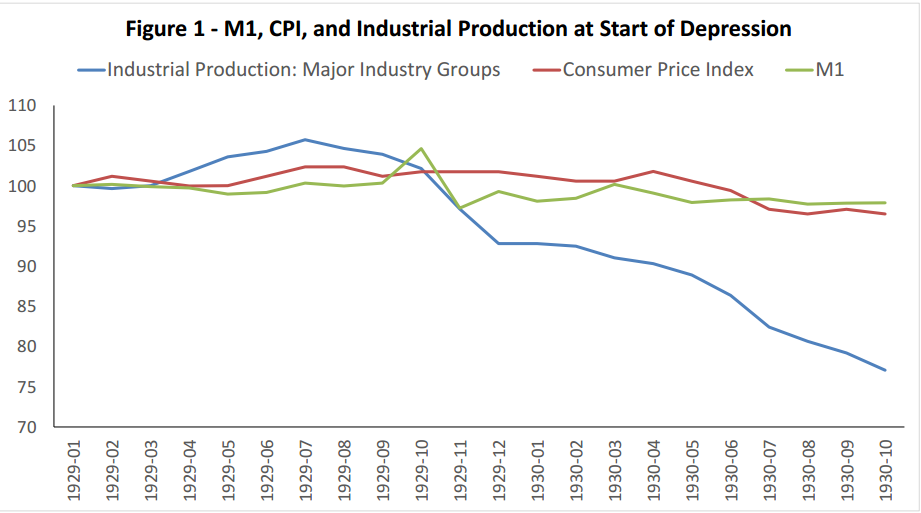
This decline in industrial production occurs before any banking crises. Despite this sector specific nature of the onset that Great Depression, monetary policy might have some role in explaining the start of the Great Depression but not in its prolongation:
any monetary explanation of the Depression requires a theory of very large and very protracted monetary non-neutrality. Such a theory has been elusive because the Depression is so much larger than any other downturn, and because explaining the persistence of such a large non-neutrality requires in turn a theory for why the normal economic forces that ultimately undo monetary non-neutrality were grossly absent in this episode.

Source: A different view of the Great Depression’s cause | VOX, CEPR’s Policy Portal.


Recent Comments