https://twitter.com/SeanMcElwee/status/572831648238211072


HT: How Poor Are America’s Poor? Examining the “Plague” of Poverty in America.
Celebrating humanity's flourishing through the spread of capitalism and the rule of law
12 Apr 2015 Leave a comment
12 Apr 2015 Leave a comment

12 Apr 2015 Leave a comment
in income redistribution, politics - New Zealand, politics - USA, welfare reform
The Treasury modelled a Guaranteed Minimum income (GMI) at the request of the Welfare Working Group in 2010. A GMI paying $300 per week – the mean benefit income among those on benefits – would cost $44.5 billion (model 1) or $52.6 billion if we extended it to super annuitants as a replacement for NZ Superannuation or old age pension (model 2). The former could be covered by a flat personal income tax rate of 45.4%; the latter, 48.6%.
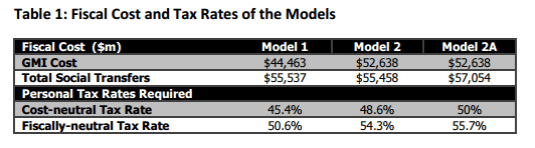
Full fiscal neutrality would require tax rates of 50.6% and 54.4% – the lower tax rates would be just enough to cover the transfers, but income tax revenues are currently also used to fund more than just transfers.
If we recognize that most parents are beneficiaries via Working for Families and compensate them for their loss with a $86 per child per week payment (model 3), we get a $57.1 billion fiscal cost and a personal tax rate of 50% (or 55.7% for fiscal neutrality).
Treasury noted that many beneficiaries (including the disabled, carers and sole parents) currently receive more than $300 per week and would be made financially worse off under a GMI scheme.
Treasury also warned about potential adverse labour supply responses to the necessary higher personal income tax rates. The large gap between company and personal tax rates would increase IRD’s enforcement costs.
In 1987, Finance Minister Roger Douglas announced a Guaranteed Minimum Family Income Scheme to accompany a new 22% flat income tax. The idea did not go ahead.
Richard Nixon also proposed a guaranteed minimum family income plan in 1969 to replace the Aid to Families with Dependent Children (AIDC) scheme at the behest of future Senator Daniel Patrick Moynihan. This was based on the negative income tax proposals of Milton Friedman and George Stigler. Nixon’s plan passed the House but not the Senate after 3 years of infighting.
The final outcome was the earned income tax credit (EITC) in 1975 that was expanded significantly in the 1990s to become the largest single federal income transfer programme. One attraction of the EITC is that because its benefits rise positively with earnings up to the phase-out point, so it can have a positive rather than negative effect on work incentives for workers on a low wage.
11 Apr 2015 Leave a comment
10 Apr 2015 Leave a comment
in politics - USA Tags: 2016 presidential election
10 Apr 2015 2 Comments
in politics - Australia, politics - New Zealand, politics - USA, poverty and inequality, welfare reform Tags: welfare state
In Mexico, most cash-based public social benefits go to households in the highest income quintile, per OECD. http://t.co/xykkPkDVZs—
Catherine Rampell (@crampell) November 24, 2014
10 Apr 2015 Leave a comment
in politics - USA Tags: American Civil War
09 Apr 2015 Leave a comment
in energy economics, environmental economics, politics - USA Tags: fracking, peak oil
"Hydraulic fracturing has unleashed vast new quantities of crude oil and natural gas." on.wsj.com/19Gj92Y http://t.co/a2hzPq0i7e—
I Love Fossil Fuels (@ILoveFossilFuel) April 08, 2015
09 Apr 2015 Leave a comment
in economic history, economics of education, human capital, labour economics, occupational choice, politics - USA Tags: educational attainment
08 Apr 2015 1 Comment
in politics - USA, population economics Tags: China, economics of immigration, India
The distribution (in millions) of the Indian (and Chinese) diaspora across the world (via @TheEconomist) http://t.co/IXtLnZIYqL—
India in Pictures (@indiainpix) July 29, 2014
08 Apr 2015 Leave a comment
in environmental economics, environmentalism, international economic law, international economics, International law, law and economics, politics - Australia, politics - New Zealand, politics - USA Tags: green hypocrisy, ozone layer
/cdn0.vox-cdn.com/uploads/chorus_asset/file/3577778/ozone_composite.0.png)
Why aren’t they in the streets celebrating the recovery of the ozone layer, pursuant to an international treaty negotiated by the Reagan administration that banned CFCs as soon as they were not required any longer in developed countries:
International efforts to control the gases, particularly among developed countries, began to occur in the mid-1980s as new information appeared that strengthened the link between CFCs and the deterioration of stratospheric ozone. This increased the expected benefits of international action.
At the same time, domestic political opposition began to diminish when Du Pont announced they would no longer make CFCs. A reason for Du Pont’s attitude change was that European firms had increased their share of the CFC market, and in response Du Pont had developed CFC substitutes.
Accordingly, since international controls on CFCs provided them a competitive advantage, Du Pont announced that they would no longer make CFCs and the company lobbied the U.S. Congress for international regulation.
Under the 1987 Montreal Protocol, world leaders agreed to phase out CFCs, and eventually the hole in the ozone layer stopped expanding. In 2014, a UN assessment found that the ozone layer is just now starting to heal — and should be back to its 1980 levels by 2050 or so.
07 Apr 2015 Leave a comment
in economics of crime, law and economics, politics - USA, transport economics Tags: air piracy, Cuba, hijacking
Airline hijackings were so common in the late 60s that every passenger aircraft included in its standard kit the landing instructions for the Havana airport. Many of hijackings were simply to get to Havana with not much more of a political agenda. Many hijackers were common criminals fleeing justice.
Anti-hijacking ideas from the American public, 1968. Number 4 is my favorite, but I guess we went with Number 6. http://t.co/yNqm2qdGA8—
Brendan I. Koerner (@brendankoerner) June 17, 2014
07 Apr 2015 Leave a comment
in politics - USA, war and peace Tags: World War I
Americans enter World War I on this day in 1917. timesmachine.nytimes.com/timesmachine/1… http://t.co/CDoFZMzJUw—
NYT Archives (@NYTArchives) April 06, 2015
Celebrating humanity's flourishing through the spread of capitalism and the rule of law
Celebrating humanity's flourishing through the spread of capitalism and the rule of law
Celebrating humanity's flourishing through the spread of capitalism and the rule of law
Celebrating humanity's flourishing through the spread of capitalism and the rule of law
Celebrating humanity's flourishing through the spread of capitalism and the rule of law
Celebrating humanity's flourishing through the spread of capitalism and the rule of law
A History of the Alt-Right
Econ Prof at George Mason University, Economic Historian, Québécois
Celebrating humanity's flourishing through the spread of capitalism and the rule of law
Scholarly commentary on law, economics, and more
Beatrice Cherrier's blog
Celebrating humanity's flourishing through the spread of capitalism and the rule of law
Celebrating humanity's flourishing through the spread of capitalism and the rule of law
Celebrating humanity's flourishing through the spread of capitalism and the rule of law
Why Evolution is True is a blog written by Jerry Coyne, centered on evolution and biology but also dealing with diverse topics like politics, culture, and cats.
Celebrating humanity's flourishing through the spread of capitalism and the rule of law
A rural perspective with a blue tint by Ele Ludemann
DPF's Kiwiblog - Fomenting Happy Mischief since 2003
Celebrating humanity's flourishing through the spread of capitalism and the rule of law
The world's most viewed site on global warming and climate change
Tim Harding's writings on rationality, informal logic and skepticism
A window into Doc Freiberger's library
Let's examine hard decisions!
Commentary on monetary policy in the spirit of R. G. Hawtrey
Thoughts on public policy and the media
Celebrating humanity's flourishing through the spread of capitalism and the rule of law
Politics and the economy
A blog (primarily) on Canadian and Commonwealth political history and institutions
Reading between the lines, and underneath the hype.
Economics, and such stuff as dreams are made on
"The British constitution has always been puzzling, and always will be." --Queen Elizabeth II
Celebrating humanity's flourishing through the spread of capitalism and the rule of law
Celebrating humanity's flourishing through the spread of capitalism and the rule of law
WORLD WAR II, MUSIC, HISTORY, HOLOCAUST
Undisciplined scholar, recovering academic
Celebrating humanity's flourishing through the spread of capitalism and the rule of law
Res ipsa loquitur - The thing itself speaks
In Hume’s spirit, I will attempt to serve as an ambassador from my world of economics, and help in “finding topics of conversation fit for the entertainment of rational creatures.”
Researching the House of Commons, 1832-1868
Articles and research from the History of Parliament Trust
Reflections on books and art
Posts on the History of Law, Crime, and Justice
Celebrating humanity's flourishing through the spread of capitalism and the rule of law
Exploring the Monarchs of Europe
Cutting edge science you can dice with
Small Steps Toward A Much Better World


Recent Comments