The origin of immigrants to the US since 1820
Source: bit.ly/1xjTubs http://t.co/km98cdAvTO—
Max Roser (@MaxCRoser) March 19, 2015
Immigration to the USA since 1820
06 Apr 2015 Leave a comment
in economic history, international economics, labour economics, labour supply, politics - USA Tags: economics of immigration
Recent New Zealand economic growth
06 Apr 2015 Leave a comment
in business cycles, economic growth, fiscal policy, global financial crisis (GFC), macroeconomics, politics - USA Tags: GFC, great recession, recessions and recoveries
This year’s GOP presidential field is crowded at the top, unlike past years
04 Apr 2015 Leave a comment
in politics - USA Tags: 2016 presidential election
This year's GOP presidential field is crowded at the top, unlike past years pewrsr.ch/1P3awQw http://t.co/tv3Ak5R2lD—
Pew Research Center (@pewresearch) April 02, 2015
Why Did Wal-Mart Raise Its Wages?
03 Apr 2015 Leave a comment
in industrial organisation, labour economics, labour supply, minimum wage, politics - USA, survivor principle Tags: Paul Krugman, supply and demand, Walmart
Why Did Walmart Raise Its Wages?
forbes.com/sites/realspin… http://t.co/0LRQQcKGKm—
Benn Steil (@BennSteil) April 02, 2015
The retail sector quits rate, the number of people quitting jobs as a per cent of total employment, is also considerably higher than the quits rate in the private sector broadly: 2.9% versus 2.2%.
Not surprisingly, Gap and Ikea have made wage-hike announcements similar to Wal-Mart’s. Retailers are clearly having more and more trouble finding and keeping workers at the federal minimum wage.
In short, Krugman’s story of Wal-Mart raising wages in response to political pressure simply flies in the face of the evidence. Wal-Mart is just being Wal-Mart: making a rational decision to lure and retain workers in a tightening retail labour market through greater compensation.
The problem with ignoring this evidence is that it encourages the notion that we can make wages, in Krugman’s words, “a political choice,” with no concern for its effect on employment.
Bryan Caplan on being down and out in America
02 Apr 2015 Leave a comment
in applied welfare economics, politics - USA, poverty and inequality
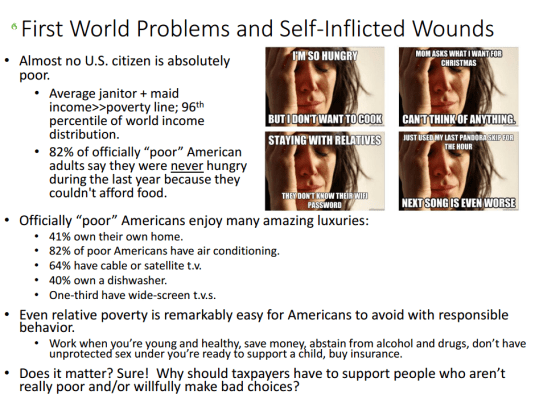
Via Are We Stuck With the Great Society?, Bryan Caplan | EconLog | Library of Economics and Liberty.
Who has the smallest Anglo-Saxon welfare state of them all?
02 Apr 2015 1 Comment
in income redistribution, labour economics, politics - Australia, politics - New Zealand, politics - USA, welfare reform Tags: social insurance, social safety nets, welfare reform, welfare state
I have reanalysed data published by the Peterson Institute on the true levels of social expenditure across the industrialised countries for the Anglo-Saxon countries.
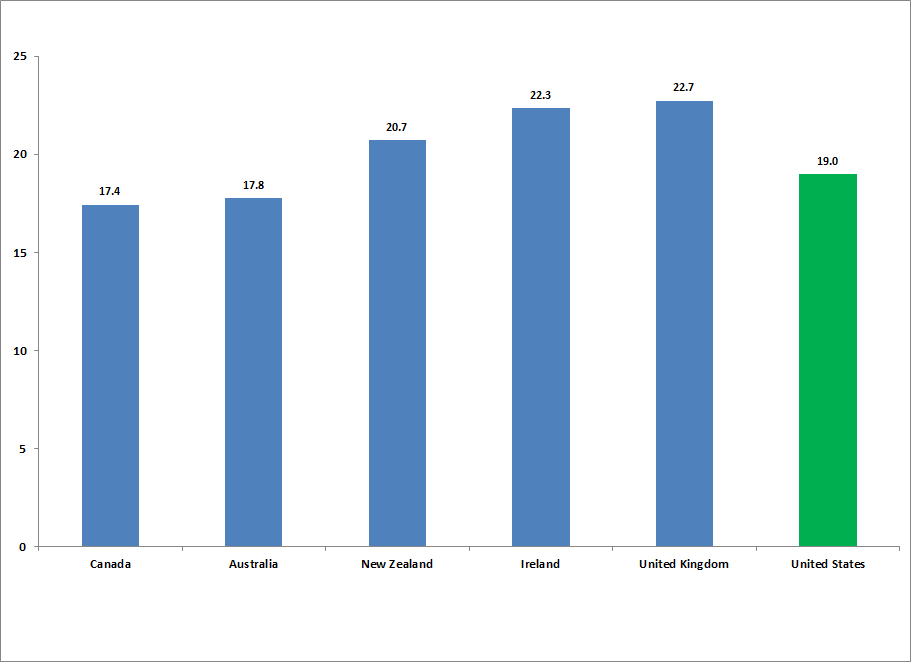
Figure 1: gross public social expenditures in OECD countries, 2011
Source: POLICY BRIEF 15-4: The True Levels of Government and Social Expenditures in Advanced Economies.
When you just look at gross public social expenditure, New Zealand is in the middle of the pack with the United Kingdom having the largest spending. There are not particularly large differences across social spending in the Anglo-Saxon welfare states.
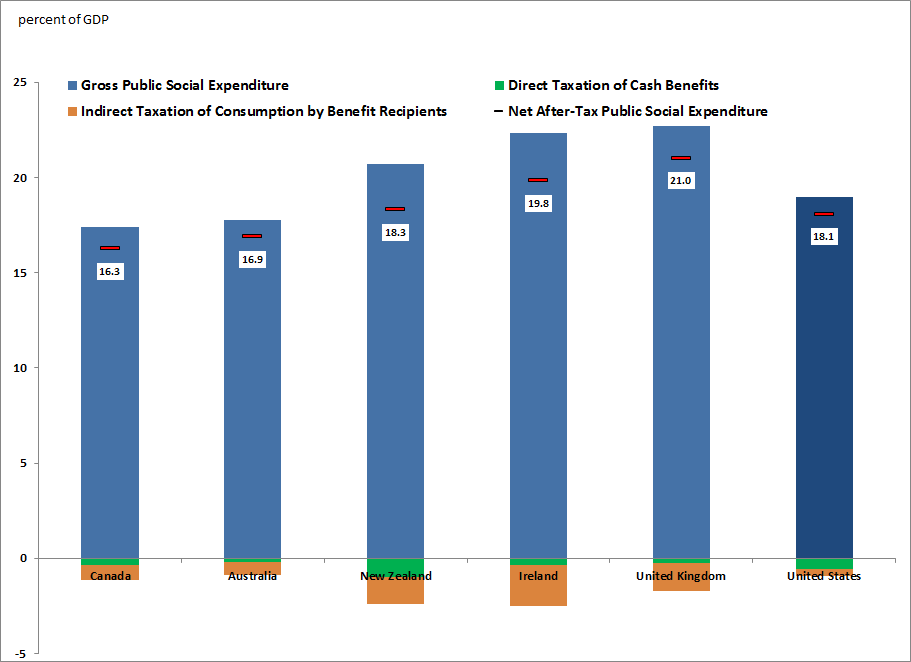
Figure 2: Gross public social expenditure and the effects of taxation in OECD countries, 2011
Source: POLICY BRIEF 15-4: The True Levels of Government and Social Expenditures in Advanced Economies.
There is not much change when you include the effects of taxation on consumption by benefit recipients.
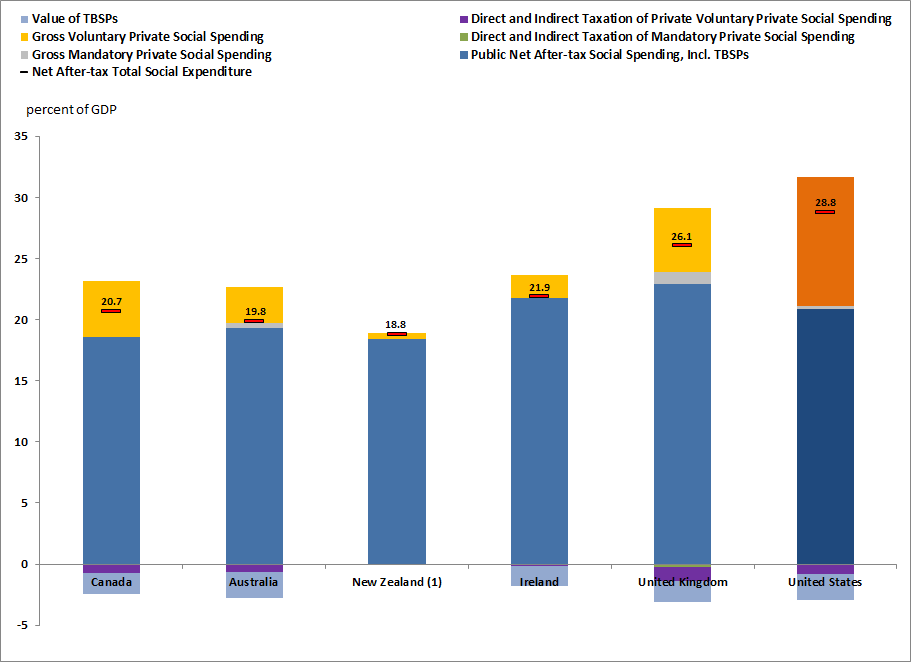
Figure 3: Net after-tax public and private social expenditure in OECD countries, 2011
Source: POLICY BRIEF 15-4: The True Levels of Government and Social Expenditures in Advanced Economies.
When private mandatory social spending is included, such as employer sponsored health cover, there is considerable change with United States leaping to the front and New Zealand dropping to the bottom. The USA has the largest and most expensive is health sector in the world so they are leaping of the front, either because healthcare is expensive in United States or people in the United States are not constrained by government rationing to spend less than they would prefer on their own healthcare. Let’s leave that war of ideas for another day.
Figure 4: Net after-tax total social expenditures in OECD countries, 2011
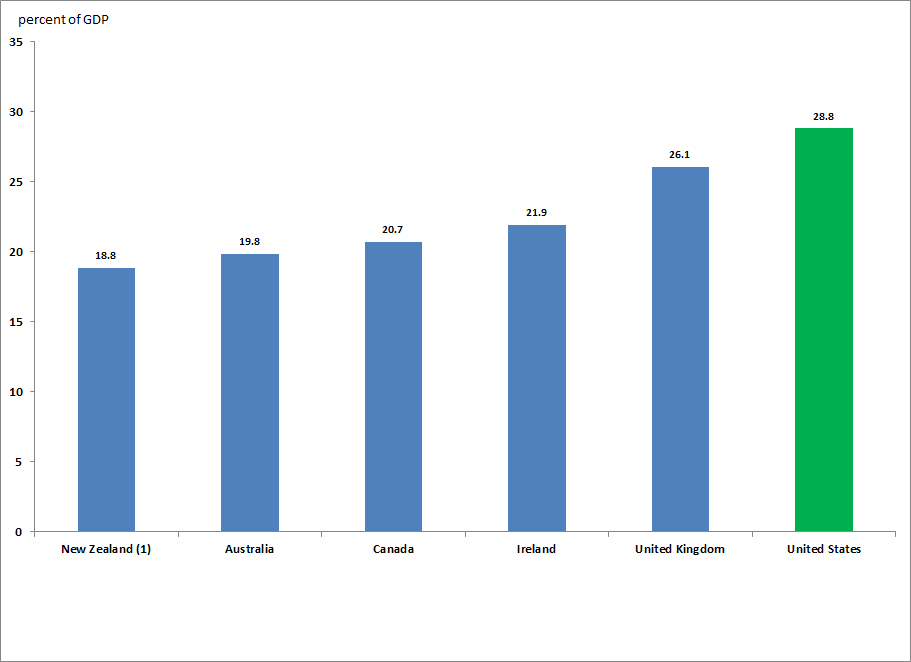
Source: POLICY BRIEF 15-4: The True Levels of Government and Social Expenditures in Advanced Economies.
On the face of it, New Zealand has the smallest Anglo-Saxon welfare state while the United States has the largest. A more accurate measure of the relative sizes of these Anglo-Saxon welfare states would require the wisdom of Solomon in measuring waste and underfunding in the respective systems and more trust than you should have in services sector in purchasing power parity adjustments.
For those that are interested, the OECD-wide gross social spending and net after-tax total social spending are reproduced below in figures 5 and 6.
Figure 5: Net after-tax total social expenditures in OECD countries, 2011
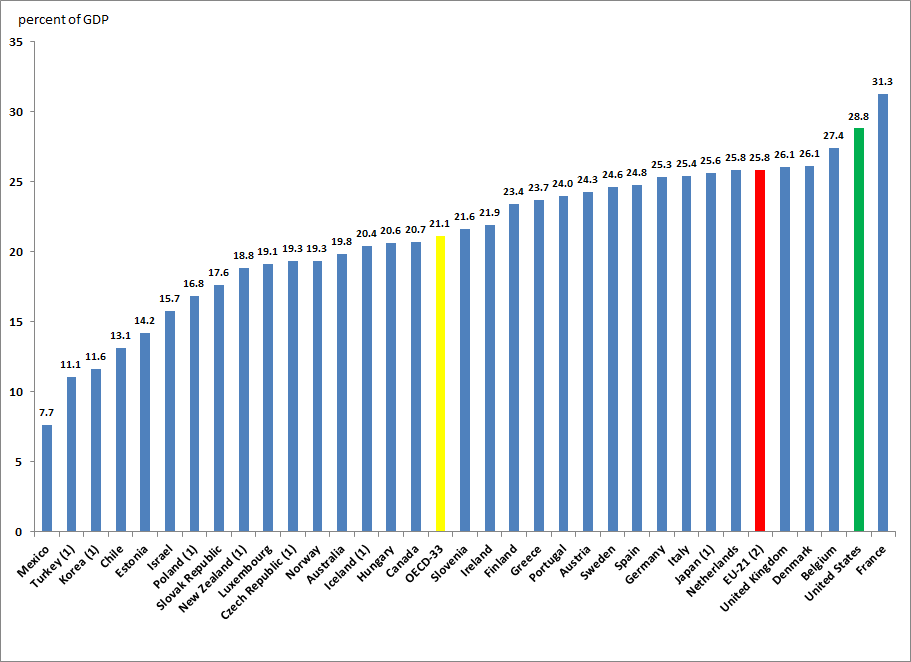
Source: POLICY BRIEF 15-4: The True Levels of Government and Social Expenditures in Advanced Economies.
The Figure 5 data on the OECD wide welfare state sizes shows that when you add private spending, including social spending mandated by law, the US has the second largest OECD social safety net as Kirkegaard said in his Peterson Institute paper:
Taking the full effects of tax systems and social spending from both private and public sources into account, the United States is seen to be devoting more resources toward social purposes than is generally acknowledged. In fact, only the French spend more than Americans, while the alleged welfare-addicted Scandinavians and Europeans spend less on average.
Figure 6: Gross public social expenditures in OECD countries, 2011
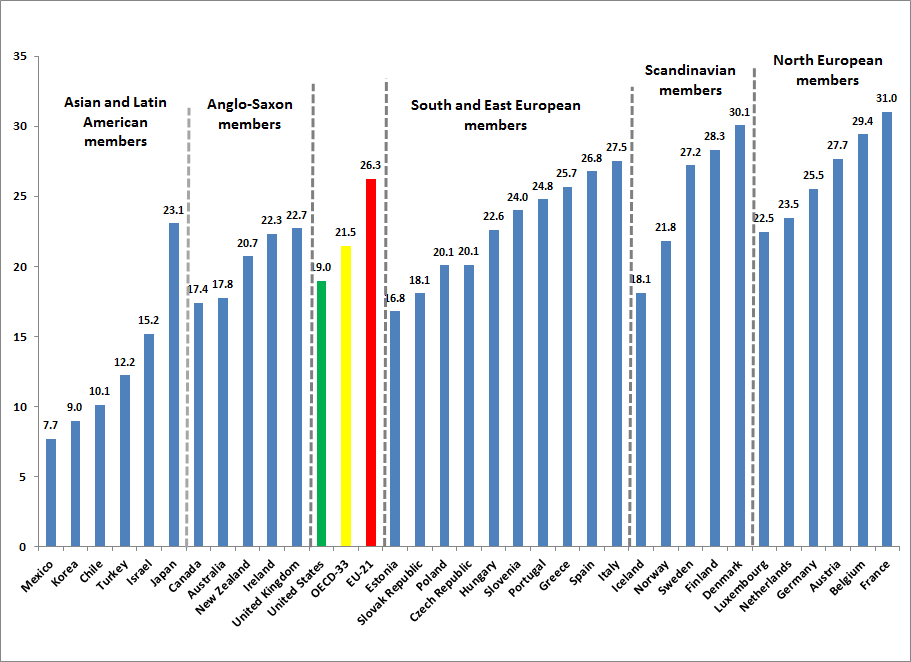
Source: POLICY BRIEF 15-4: The True Levels of Government and Social Expenditures in Advanced Economies.
Via The US welfare state and safety net are bigger than you think. But who are they helping? – AEI | Pethokoukis Blog » AEIdeas and POLICY BRIEF 15-4: The True Levels of Government and Social Expenditures in Advanced Economies
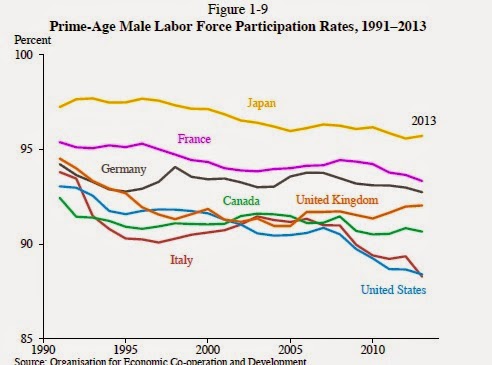
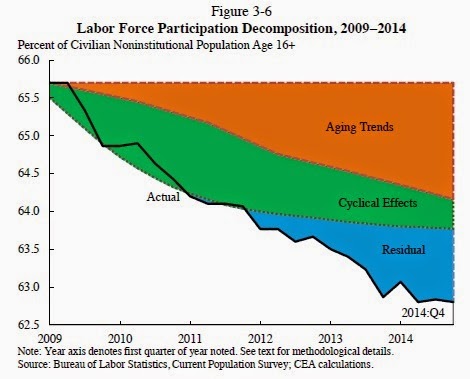
Putting U.S. Labor Force Participation in Context
02 Apr 2015 Leave a comment
in gender, labour economics, labour supply, politics - USA Tags: cross-country comparisons, female labour force participation, labour force participation, male labour force dissipation



Rand Paul on marijuana decriminalisation by target audience
01 Apr 2015 Leave a comment
in economics of crime, law and economics, liberalism, libertarianism, politics - USA Tags: 2016 presidential election, Rand Paul
The causes of housing unaffordability
01 Apr 2015 Leave a comment
in politics - New Zealand, politics - USA, urban economics Tags: Don Brash, land supply, Resource Management Act, zoning
The relative political importance of climate change
01 Apr 2015 Leave a comment
in environmental economics, global warming, politics - Australia, politics - New Zealand, politics - USA Tags: 2014 congressional elections, climate alarmism, global warming, opinion polls, voter demographics
Desperately seeking a neoliberal conspiracy to slash taxes to the bone in Australia and New Zealand
31 Mar 2015 Leave a comment
in politics - New Zealand, politics - USA, public economics Tags: neoliberalism, Rogernomics, tax reform
If our friends on the Left are to be believed, governments fell under the spell of a flying visit by Milton Friedman and his local neoliberal cronies and slashed taxes to the bone from about the mid-1980s in Australia and New Zealand.
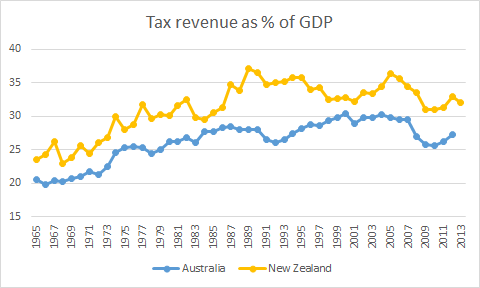
Source: Revenue Statistics – Comparative tables.
In Australia’s case, the only time tax revenue as a percentage of GDP fell prior to the election of a Labour government in 2007 was during a deep recession in 1991. This was a recession bought on by irresponsible monetary policy by Paul Keating– the Keating recession.
As for New Zealand, the tax take increase quite considerably under tax reforms of the Labour Government of the 1980s. Roger Douglas, far from being a neoliberal plant, seemed to be a double secret agent of a tax maximising Leviathan. Little wonder the New Zealand economy was sluggish in the late 1980s because of this large increases in the tax take.
Osborne won't rule out tax cut for top earners ind.pn/1JaeId4 http://t.co/LvO7vgmmX0 http://t.co/YU3600Sk5s—
Marcus Chown (@marcuschown) April 05, 2015
Putin’s popularity ratings of late
31 Mar 2015 Leave a comment
in politics - USA, war and peace Tags: Putin, Russian politics
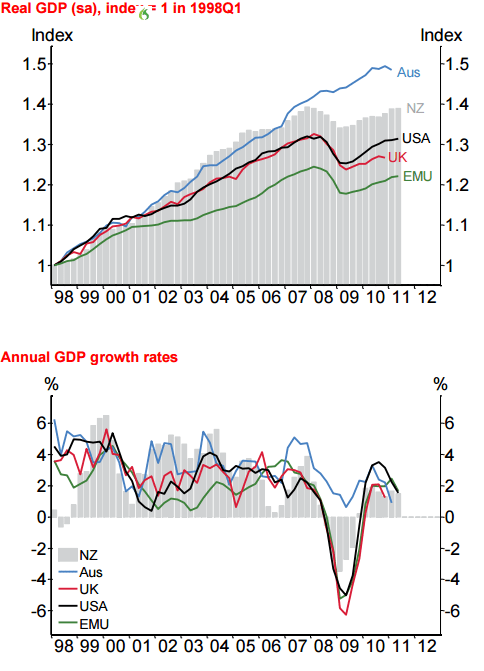
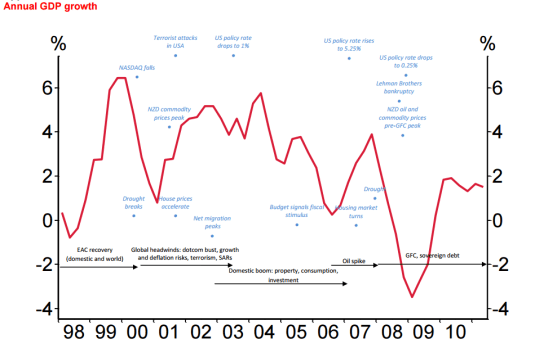
Recent New Zealand economic growth compared
31 Mar 2015 Leave a comment
in economic growth, macroeconomics, politics - Australia, politics - New Zealand, politics - USA


Recent Comments