Percentage of people around the world who own smartphones, via @conradhackett. Note #China. http://t.co/wAOmIklVbW—
Legatum Institute (@LegatumInst) May 30, 2015
Extreme poverty is not the same thing as digital poverty
01 Jul 2015 Leave a comment
The Puerto Rican sovereign default explained
30 Jun 2015 Leave a comment
in economic growth, fiscal policy, international economic law, politics - USA, population economics Tags: ageing society, economics of immigration, Puerto Rica, sovereign defaults
Puerto Rico's debt is nearly half that of California for a population one-tenth the size on.wsj.com/1Kj5XPZ http://t.co/nM2aM8kWtP—
Nick Timiraos (@NickTimiraos) June 29, 2015
Fastest-growing economies and fastest-growing populations
28 Jun 2015 Leave a comment
in development economics, growth disasters, growth miracles, population economics Tags: ageing society, labour demographics
Food is now much smaller share of the average family’s budget than in the 60s
28 Jun 2015 Leave a comment
in applied welfare economics, labour economics, population economics, welfare reform Tags: child poverty, family poverty, poverty line, poverty measurement, statistics
The success of Indian migrants
27 Jun 2015 Leave a comment
Indians have become an extraordinarily successful minority in America. A burgeoning new elite econ.st/1cgD0GN http://t.co/XxwcclHpDJ—
The Economist (@EconEconomics) May 26, 2015
Japan’s population distribution by age – 1950, 2007, and 2050
26 Jun 2015 Leave a comment
Japan's population distribution by age – 1950, 2007, and 2050.
(from: wapo.st/153trI8) http://t.co/vt9z9NQDFs—
Max Roser (@MaxCRoser) June 22, 2015
P.T. Bauer on overpopulation
24 Jun 2015 Leave a comment
in development economics, human capital, labour economics, P.T. Bauer, population economics Tags: economics of fertility, endogenous growth theory, overpopulation, population bomb

.
The median age in each country
24 Jun 2015 Leave a comment
in population economics Tags: ageing society, labour demographics
The median age in each country http://t.co/nUHGzTpwFc—
Amazing Maps (@Amazing_Maps) March 10, 2015
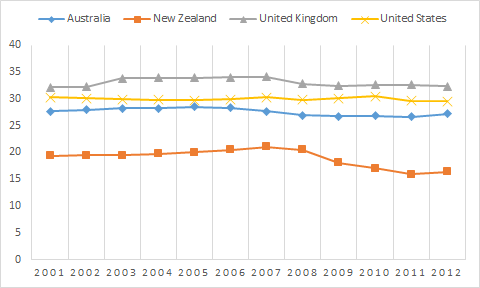
Who taxes average workers most out of Australia, New Zealand, the USA and UK?
23 Jun 2015 Leave a comment
in fiscal policy, macroeconomics, politics - Australia, politics - New Zealand, politics - USA, population economics, public economics Tags: Australia, British economy, New Zealand, taxation and the labour supply
Figure 1: Direct taxes on the average worker in Australia, New Zealand, USA and UK, 2001 – 2012
Source: OECD Factbook 2014
Taxes on the average worker measure the ratio between the amount of taxes paid by the worker and the employer on the country average wage and the corresponding total labour cost for the employer. This tax wedge measures the extent to which the tax system on labour income discourages employment.
The taxes included in the measure are personal income taxes, employees’ social security contributions and employers’ social security contributions. For the few countries that have them, it also includes payroll taxes. The amount of these taxes paid in relation to the employment of one average worker is expressed as a percentage of their labour cost (gross wage plus employers’ social security contributions and payroll tax).
An average worker is defined as somebody who earns the average income of full-time workers of the country concerned in Sectors B-N of the International Standard Industrial Classification (ISIC Rev. 4). The average worker is considered single without children, meaning that he or she does not receive any tax relief in respect of a spouse, unmarried partner or child.
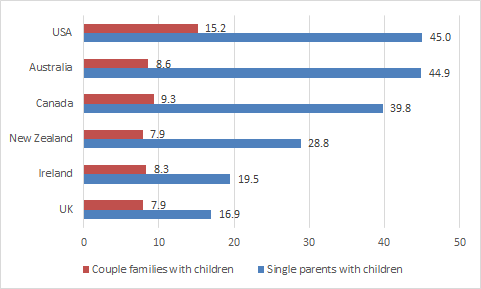
Child poverty rates in single parent and couple families, Anglo-Saxon countries
22 Jun 2015 Leave a comment
in labour economics, politics - Australia, politics - New Zealand, politics - USA, population economics, poverty and inequality, welfare reform Tags: Australia, British economy, Canada, child poverty, economics of the family, family poverty, Ireland, single mothers, single parents
Figure 1: Child poverty rates by family type, Anglo-Saxon countries, 2010
Source: OECD Family Database; Poverty thresholds are set at 50% of the median income of the entire population.
The Quantity and Quality of Australian, New Zealand, Canadian, American and English & Welsh Lives, 1965 to 1995
21 Jun 2015 Leave a comment
in applied welfare economics, economic history, Gary Becker, politics - Australia, politics - New Zealand, politics - USA, population economics, technological progress Tags: Australia, British economy, Canada, life expectancy, lost decades, New Zealand, The Great Enrichment
Figure 1: increase in real GDP and increase in real GDP plus life expectancy GDP increase equivalent, Australia, New Zealand, Canada, USA and England & Wales, 1965 to 1995
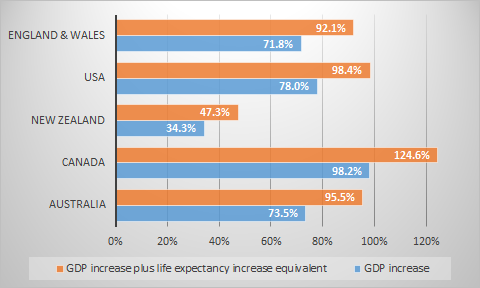
GDP per capita is usually used to proxy for the quality of life of individuals living in different countries. Becker and his co-authors computed a "full" growth rate that incorporates the gains in health and life expectancy.
Figure 1 shows that New Zealand was way behind the other countries in improvements in the quantity and quality of life between 1965 and 1995. This brings new meaning to the two decades of lost growth between 1973 and 1995. Canada should refer to 1965 to 1995 as its golden era.
Would you rather make $50,000 in today’s New Zealand or $100,000 in the 1980s before neo-liberalism?
21 Jun 2015 1 Comment
in applied welfare economics, economic history, politics - New Zealand, population economics, technological progress Tags: good old days, left-wing fantasies, Leftover Left, life expectancies, neoliberalism, The Great Enrichment, time machine, welfare state
Ezra Klein and Matt O’Brien posed an interesting variation of Brad De Long’s Time Machine question. O’Brien asked:
Try this thought experiment. Adjusted for inflation, would you rather make $50,000 in today’s world or $100,000 in 1980’s? In other words, is an extra $50,000 enough to get you to give up the internet and TV and computer that you have now? The answer isn’t obvious.
And if $100,000 isn’t enough, what would be? $200,000? More? This might be the best way to get a sense of how much better technology has made our lives—not to mention the fact that people are living longer—the past 35 years, but the problem is it’s particular to you and your tastes. It’s not easy to generalize.
This doesn’t mean, though, that the middle class is doing well or even as well as it should be. Just that it’s doing better than the official numbers say it is.
Let them have iPhones is the new let them eat cake.
The same questions are asked in New Zealand in a different way when people go on about how much more unequal New Zealand is compared to the 1980s and how bad things have got because of that rise in inequality.
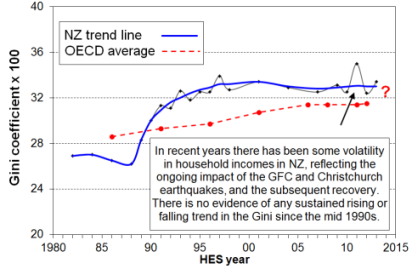
Would it better to be on the welfare benefit in the 1980s than on a benefit today in a less equal New Zealand than in the 1980s? It is certainly the case that the Gini coefficient is worse than it was in the 1980s – see figure 1.
Figure 1: Gini coefficient New Zealand 1980-2015
Source: Bryan Perry, Household incomes in New Zealand: Trends in indicators of inequality and hardship 1982 to 2013. Ministry of Social Development (July 2014).
But household incomes on a real basis increased across the border in New Zealand – see figure 2 – including for Maori and Pasifika. As shown in figure 2 below, between 1994 and 2010, real equivalised median New Zealand household income rose by 47%; for Māori, this rise was 68%; for Pasifika, the rise in real equivalised median household income was 77%.
Figure 2: Real equivalised median household income (before housing costs) by ethnicity, 1988 to 2013 ($2013)
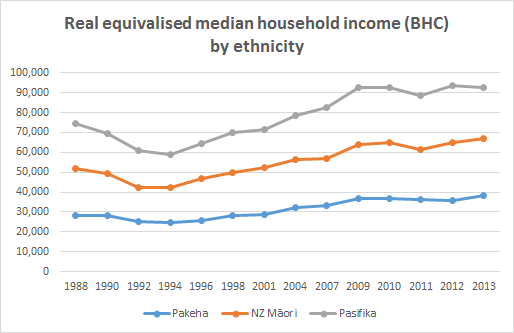
Source: Bryan Perry, Household incomes in New Zealand: Trends in indicators of inequality and hardship 1982 to 2013. Ministry of Social Development (July 2014).
The biggest worry for anyone longing to be on a welfare benefit or to be otherwise working back in the good old days in the 1980s on the more equal incomes of back then is instant death.

Stepping into that Time Machine to go back to the more equal, more egalitarian 1980s shaves about five years off your life expectancy, if not more! Death certainly is the great leveller when it comes to Left over Left fantasies about the good old days before the economic reforms of the 1980s. Indeed, the 1980s was a period where life expectancies started to increase again after a hiatus in the 1960s and 1970s.

Time travel back to the good old days in the 1980s before neoliberalism would be particularly grim from Maori because of their much lower life expectancies of Maori back in the 1980s – see figure 3.
Figure 3: Life expectancy at birth, Maori and non-Maori by sex
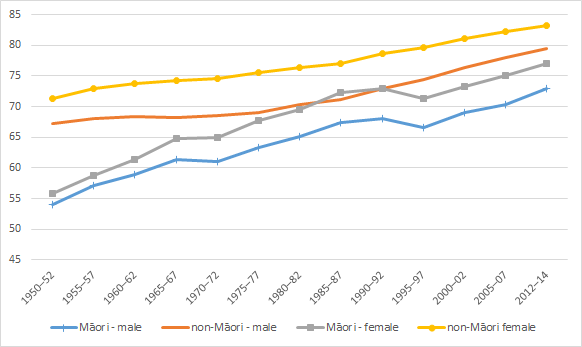
Source: Statistics New Zealand.
The most apt summary of how bad it was in the 1980s compared to today is by veteran left-wing grumbler Max Rashbrooke. To paint pre-1984 New Zealand, pre-neoliberal New Zealand as an egalitarian paradise, he had to ignore the economic progress of two thirds of the population and the inequalities they suffered:
New Zealand up until the 1980s was fairly egalitarian, apart from Maori and women, our increasing income gap started in the late 1980s and early 1990s.
The impact of parental employment on child poverty in couple families, Anglo-Saxon countries
21 Jun 2015 Leave a comment
in economics of love and marriage, labour economics, labour supply, law and economics, politics - Australia, politics - New Zealand, politics - USA, population economics, poverty and inequality, welfare reform Tags: Australia, British economy, Canada, child poverty, economics of families, family poverty, Ireland, labour force participation, single parents
Figure 1: child poverty rates in couple families by employment status, Anglo-Saxon countries, 2010
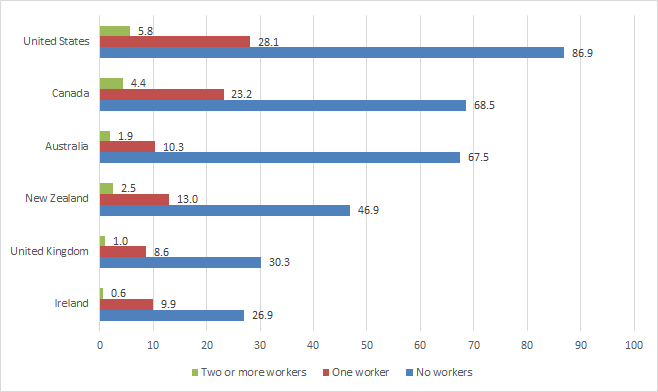
Source: OECD Family Database; Poverty thresholds are set at 50% of the median income of the entire population.
Proportion of births out of wedlock, 2011, Anglo-Saxon countries
20 Jun 2015 Leave a comment
in gender, labour economics, labour supply, occupational choice, politics - Australia, politics - New Zealand, politics - USA, population economics Tags: economics of fertility, economics of the family, single mothers, single parents
Figure 1: Proportion of births out of wedlock, 2011, Anglo-Saxon countries
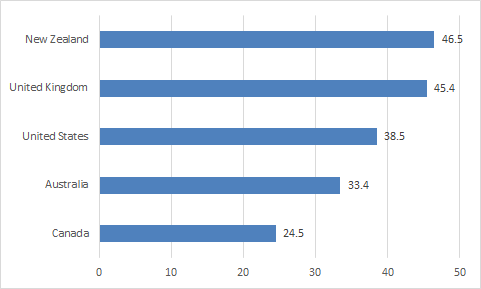
Source: OECD family database; no data for Ireland.
 Utopia, you are standing in it!
Recent Comments