Was Moynihan, right? The role of prospective success in assortative mating in family poverty
19 Dec 2014 1 Comment

Men (No Longer) At Work
19 Dec 2014 Leave a comment
in human capital, labour economics, labour supply, politics - USA, population economics
by Dish Staff
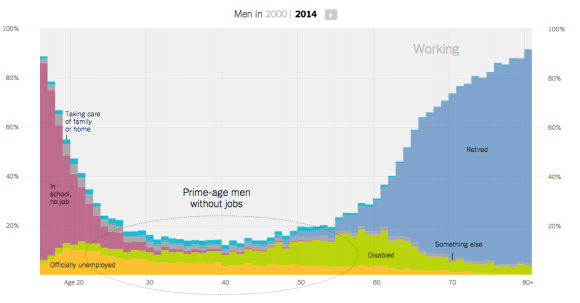
Binyamin Appelbaum looks into the causes of the decline in America’s male work force:
Working, in America, is in decline. The share of prime-age men — those 25 to 54 years old — who are not working has more than tripled since the late 1960s, to 16 percent. … Many men, in particular, have decided that low-wage work will not improve their lives, in part because deep changes in American society have made it easier for them to live without working. These changes include the availability of federal disability benefits; the decline of marriage, which means fewer men provide for children; and the rise of the Internet, which has reduced the isolation of unemployment. …
The resulting absence of millions of potential workers has serious consequences not just for the men and their families but for the nation as a whole. A smaller work force is likely to…
View original post 372 more words
Japan’s demographic challenge
17 Dec 2014 Leave a comment
in labour economics, labour supply, population economics Tags: ageing society, demographics, Japan
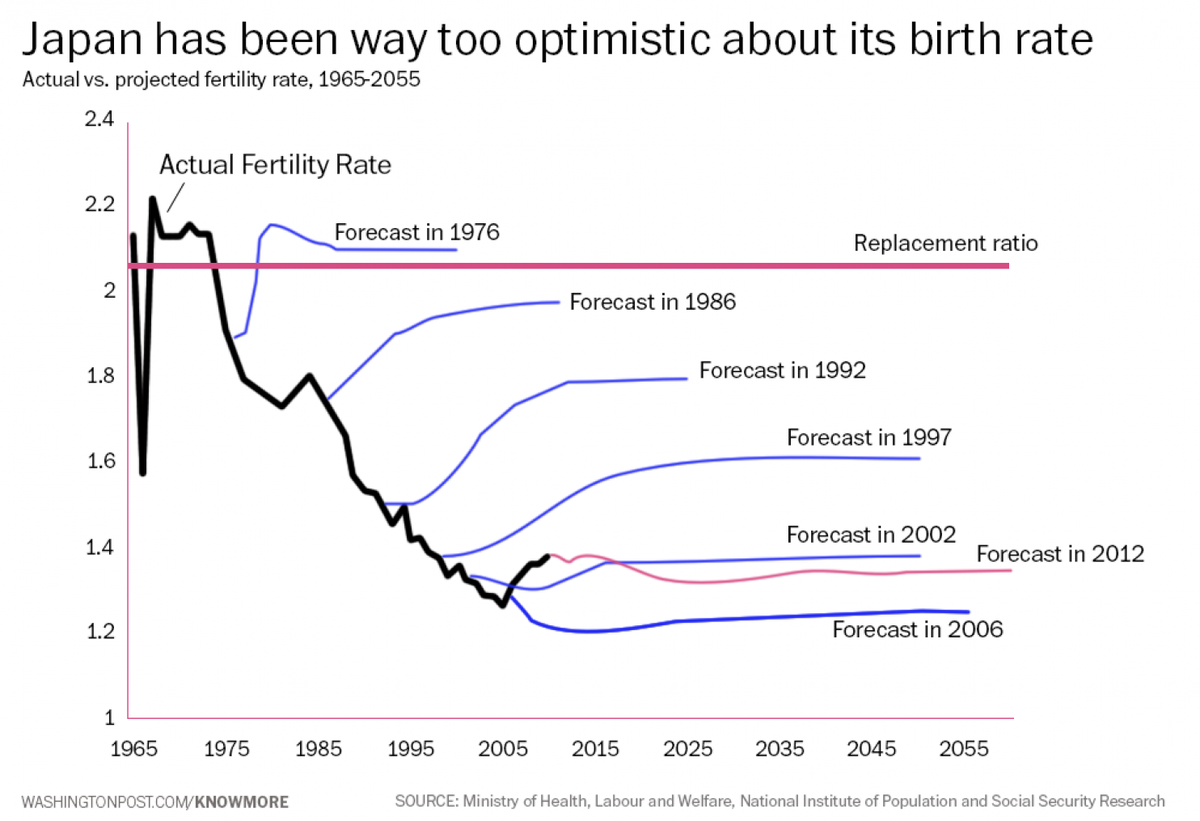
As its new parliament comes in, here's a look at Japan's longer-term economic challenges pewrsr.ch/1pjgZx5 http://t.co/StGWEGdNfi—
PewResearch FactTank (@FactTank) December 16, 2014
Global Warming Was Worth It – And if we had to, we’d do it again
13 Dec 2014 Leave a comment
in climate change, development economics, environmental economics, global warming, growth disasters, growth miracles, history of economic thought, liberalism, population economics, technological progress Tags: capitalism and freedom, The Great Enrichment, The Great Escape, The Great Fact
Now, my conception (read: European) of progress and a better standard of living would place many advances above composting, organic farming, or even urban chicken coops.
- Higher incomes that allow people to make livings that afford them more than merely survival or avoiding starvation.
- A low poverty rate.
- High quality and diversity of employment opportunities. Rather than the choice of being a farmer or being a blacksmith, the average citizen should have an array of careers to choose from, and the ability to be industrious and take risks for profit.
- The availability of housing. On an average night in the United States, a country with a population of somewhere around 350 million, fewer than one million people are homeless.
- Consistent GDP growth.
- Access to quality health care.
- The availability of quality education. (I suppose we could quibble over the word “quality,” but certainly there is widespread free education availability.)
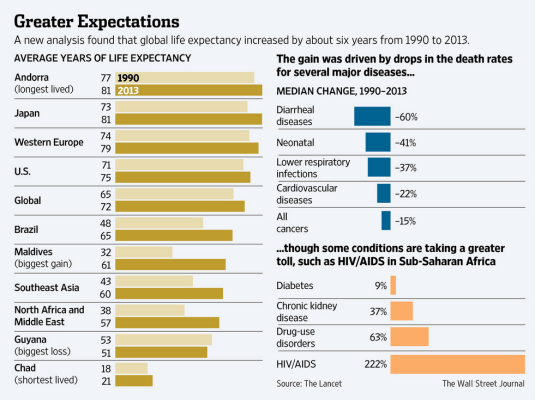
- High life expectancy. Worldwide life expectancy has more than doubled from 1750 to 2007.
- Low frequency of deadly disease.
- Affordable goods and services.
- Infrastructure that bolsters economic growth.
- Political stability.
- Air conditioning.
- Freedom from slavery, torture and discrimination.
- Freedom of movement, religion and thought.
- The presumption of innocence under the law.
- Equality under the law regardless of gender or race.
- The right to have a family – as large as one can support. Maybe even larger.
- The right to enjoy the fruits of labor without government – or anyone else – stealing it.
There’s much more, of course. If the “sustainability movement” had its way, many of these advances would be degraded.
And since Caradonna offered a few charts highlighting climate change and population growth (a bad thing), I too was assembling a number of graphs that could offer visual examples of the rise of positive developments since the Industrial Revolution. I also soon noticed that all of them looked virtually identical.
So below is what a graph encompassing nearly every one of my bullet points looks like:

Darwin Awards ‘winners’ are overwhelmingly male, analysis reveals
13 Dec 2014 Leave a comment
in economics of media and culture, health economics, liberalism, population economics, technological progress Tags: Darwin awards
- Darwin Awards is an annual review of most foolish way people have died
- Nominees improve the gene pool by eliminating themselves from the human race using foolish methods
- Scientists were surprised to discover 90% of award ‘winners’ were male
- Worthy candidates include a terrorist who opened his own letter bomb
- Another man attempted to travel by hitching a shopping trolley to a train

According to “male idiot theory” (MIT) many of the differences in risk seeking behaviour, emergency department admissions, and mortality may be explained by the observation that men are idiots and idiots do stupid things…
In addition, alcohol may play an important part in many of the events leading to a Darwin Award. It is conceivable that the sex difference is attributable to sociobehavioural differences in alcohol use.
Anecdotal data support the hypothesis that alcohol makes men feel “bulletproof” after a few drinks, and it would be naïve to rule this out.
For example, the three men who played a variation on Russian roulette alternately taking shots of alcohol and then stamping on an unexploded Cambodian land mine.
HT: dailymail.co.uk and The Darwin Awards: sex differences in idiotic behaviour | The BMJ.
The economics of parenting | VOX, CEPR’s Policy Portal
10 Dec 2014 Leave a comment
in economics of education, economics of love and marriage, human capital, labour economics, liberalism, population economics Tags: inequality and poverty, nature versus
across OECD economies parents in more unequal countries place more emphasis on hard work, and consider imagination and independence to be less important.


Chinese electricity production is based on fossil fuels
08 Dec 2014 Leave a comment
in development economics, growth disasters, growth miracles, politics - USA, population economics Tags: China
Who chooses to be a vegetarian?
06 Dec 2014 Leave a comment
in applied welfare economics, development economics, economics of media and culture, growth disasters, growth miracles, population economics, technological progress Tags: food snobs, growth disasters, growth miracles, The Great Escape, The Great Fact
New Zealand national labour force projections – the invasion of the 65+ worker
03 Dec 2014 Leave a comment
in labour economics, labour supply, population economics Tags: ageing workforce, demographics, labour economics, labour force projections, older workers, population ageing
Figure 1: National labour force projections by age group, 2006-2041
Source: Statistics New Zealand, cyclical migration scenario
Not that many years time, about 2035, there will be almost as many workers as there are young workers – those between 15 and 24. About 400,000 workers in each age bracket.
Not that long ago all, in the early 1990s, there were about 25,000 workers in New Zealand were over 65 – they could fit in a football stadium. Soon, they will equal the population of the national capital: Wellington.
Workers aged 65+ moved from accounting for 1.5 per cent of workers in 1991 to 5 per cent in 2011 and 9 per cent in 2021!
Some economics of immigration and other forms of labour force and population growth
26 Nov 2014 1 Comment
in labour economics, population economics Tags: economics of immigration, labour economics, lump of labour fallacy, population economics
One of my puzzles about immigration is the claim that they take jobs from natives. This is the lump of labour fallacy: that there is a fixed amount of work to be done in the world, so any increase in the amount each worker can produce reduces the number of available jobs.

Immigration is population growth. The other method of population growth is natives of the country having children and these children growing up to enter the workforce.

No one complains about new work force entrants taking the jobs of existing workers. Somehow, no matter how fast or how slow the population may be, jobs are always available.
The baby boom may have slightly increased the natural unemployment rate simply because there were more young people entering the workforce for the first time and job shopping.
This job shopping is when newcomers to the workforce move around a lot more as they find the specific jobs, employers, occupations and industries that suit their talents and inclinations. After about 10 to 15 years of job shopping, the majority workers settle down into a particular job and occupation for a long time.
Labour supply increases through teenagers entering the workforce and migrants entering the workforce differ only in respect of the local taxpayer didn’t have to pay for their schooling.

All through human history, the labour market has been able to cope with population increases with very little drama.
The large increase in female labour force participation since the mid-20th century was handled with ease despite the predictions of the odd, angry misogynist.
Indeed, is there any difference between the arguments against more immigration and the arguments in the mid-20th century against more married women working? Both are about taking jobs are of of existing workers, who will then be thrown on the scrapheap of society and never find another job.

This massive increase in female labour force participation is a good example of how labour force surges can be handled with ease by the labour market, be they domestic in origin or through immigration. The labour market was able to absorb millions of additional married women re-entering or staying on in the workforce to work full-time.
Inequality and Web Search Trends – NYTimes.com
21 Aug 2014 Leave a comment
in liberalism, politics - USA, population economics
Too few good men – rational behaviour and the causes of teen pregnancies
21 Aug 2014 Leave a comment
in applied price theory, applied welfare economics, economics of love and marriage, labour economics, labour supply, population economics Tags: teen pregnancies
Teenage pregnancy rates have been cut in half in the past 20 years. buff.ly/1PnIpdN http://t.co/1SIJeTeZjj—
HumanProgress.org (@humanprogress) August 14, 2015
The causes of teen pregnancies are well described in Kathryn Edin and Maria Kefalas’s Promises I Can Keep: Why Poor Women Put Motherhood Before Marriage and Jason DeParle’s American Dream: Three Women, Ten Kids, and a Nation’s Drive to End Welfare. See Amy Wax’s superb book review Too few good men.
Women on a low social trajectory see no reason to wait before having a baby and they look down upon those women that wait.
People now regard marriage as a luxury good rather than as a necessity. They refuse to tie the knot unless they have first achieved economic success. A house, a well-paying job, and enough money for a nice wedding are now needed before considering a trip to the altar.
These young women put motherhood first and have no intention of marrying the layabouts that often father their children, most of all, because of repeated and open infidelity.
The women do not complain of men’s failure to earn enough, but rather of their unwillingness to grasp opportunities, work steadily, and spend wisely. The objection is not to modest earning power, but to financial profligacy, defiant attitudes, and lack of work discipline…
The most vociferous complaints are reserved for men’s chronic criminal behaviour, drug use, violence, and, above all, repeated and flagrant sexual infidelity.
Most men made no effort to hide their frequent liaisons, which were often carried on simultaneously. More often than not, those relationships produced babies
Having a baby changes these young women from extras on the stage of life to a mother and all the community respect and social standing that commands.
Babies need not await the achievement of an elevated position in life, because childbearing is a fundamental hallmark of female adulthood that is central to poor women’s dignity and identity.
In the authors’ words, “women rely on their children to bring validation, purpose, companionship, and order to their often chaotic lives — things they find hard to come by in other ways.” In a perverse inversion of old values, these woman have come to regard lone motherhood as the ultimate heroic act, the proving ground of their responsible devotion to others.
These new mothers try and clean up their act. They stop drinking and taking drugs. For the first time in their lives they have a purpose, which is to raise a child.

Far too many social commentators see a teen pregnancy through their own lens as a middle class parent and the despair they would fell because their daughter will not go to university and all that brings including a better class of husband.
University educated couples are not called power couples for nothing – their earning power is this stunning compared to going it on your own. The emergence of power couples means that less educated women may prefer to stay single and raise children on their own rather than marry what is left in the marriage pool.
The politics of ethnicity-based research in New Zealand
30 Jul 2014 Leave a comment
in applied price theory, discrimination, human capital, income redistribution, labour economics, labour supply, politics - New Zealand, population economics, Public Choice, rentseeking Tags: employment discrimination, inequality, Maori economic development, poverty, Simon Chapple, The Great Enrichment, The Great Fact
When Simon Chapple in 2000 wrote “Māori Socio-Economic Disparity”, which showed that disadvantage in New Zealand is more closely tied to age, marital status, education, skills, and geographic location than it is to ethnicity, broadly conceived, such as Māori ethnicity:
- He was summoned before the Māori Affairs Committee of parliament to defend his paper! His chief executive at the Ministry of Social Policy went along with him to defend what he wrote while employed as a senior analyst at the Department of Labour. Staff at his new ministry launched a petition to have Simon fired.
- The head of the Māori Affairs Ministry accused Simon of breaching the public service code of conduct.
Chapple also found that there are important differences in socio economic development by Māori self-identity. Those who identified only as Māori did worse than those that are identified as Māori and another ethnicity. Identifying only as Māori also correlated with living in rural New Zealand.
In terms of employment discrimination, employers would not know whether a Māori job applicant identified as only as Māori or also with another ethnicity, so discrimination is not a good explanation of Māori disadvantage because of this counterfactual. A major driver of Māori disadvantage, which is identifying on the Census form solely as Maori, is simply unknown to discriminating employers as a basis for discrimination in hiring and promotion.
There were editorials in the Dominion Post, which I cannot find online, and in the New Zealand Herald. The latter said:
The Government is being prodded to recognise that Maori deprivation has more to do with socio-economic factors than ethnicity.
This was the conclusion of a report by the Labour Department’s senior research analyst, Simon Chapple. Helen Clark might well have had that finding partly in mind when she referred to a lot of water having gone under the bridge since the Government first formulated legislation.
Mr Chapple said, in essence, that place of residence, age, education and skills had more to do with poverty than race. In areas such as South Auckland, Northland and the central North Island, there were poor Maori, but there were also poor Pākehā and poor Pasifika.
The Minister attacked him and the paper as well for contradicting the Minister’s claim during the election campaign that everything got worse for Maori in the 1990s.
Real equivalised median household income rose 47% from 1994 to 2010; for Māori, this rise was 68%; for Pasifika, 77% (Perry July 2014)
See Karen Baehler’s Ethnicity-based research and politics: snapshots from the United States and New Zealand for more information and a comparison with the similar response to Daniel Patrick Moynihan’s The Negro Family: A Case for National Action in 1965.
About a quarter of Negro families are headed by women. The divorce rate is about 2 1/2 times what it is [compared with whites],” Moynihan said. “The number of fatherless children keeps growing. And all these things keep getting worse, not better, over recent years.”
Moynihan, now retired from the United States Senate, was a senior official in LBJ’s Labor Department in 1965. He wrote his report on a typewriter over a few weeks and had the publications office in the basement of the Labor Department print 100 of them, marked “For Official Use Only.”
- He warned about the breakdown of the African-American family where deprivation and disorganisation had formed their own vicious circle.
- Many civil rights leaders had labelled Moynihan’s report a subtle form of racism because of its unflattering portrayal of the black family (Wilson 1987).
- These accusations of racism helped make the breakdown of the family a taboo subject in social policy in the USA
see The Moynihan Report Revisited: Lessons and Reflections after Four Decades for a review by the best and the brightest in American economics and sociology on Daniel Patrick Moynihan’s prophetic warnings. Holzer says, for example:
Moynihan was extremely insightful and even prescient in arguing that the employment situation of young black men was a “crisis . . . that would only grow worse.”
He understood that these trends involve both limits on labour market opportunities that these young men face as well as skill deficits of and behavioural responses by the young men themselves.
More children are growing-up without a working father living in the home and glean the awareness that work is a central expectation of adult life (Wilson 1987, 1996).
Single-parent households increased from 13 per cent of all Māori households in 1981 to 24.4 per cent in the 2006 Census. In the 2006 Census, 70 per cent of Māori single parent households were on a low income compared to 15 per cent of other Māori one family households (Kiro, Randow and Sporle 2010).
Most of the skill gaps that are present at the age of 18 – skill gaps which substantially explain gaps in adult earnings and employment in all groups – are also present at the age of five (Cunha and Heckman 2007). There is much evidence to show that disadvantaged children have lower levels of soft skills (non-cognitive skills): motivation, persistence, self-discipline, the ability to work with others, the ability to defer gratification and plan ahead, etc. (Heckman 2008). Most of the skills that are acquired at school build on these soft skills that are moulded and reinforced within whānau.
When I started working on labour economics in 2007 I found that the labour economics of Māori was very narrowly written and stayed well clear of the minefield that Simon braved about how ethnicity does not matter that much to Māori social disadvantage.


Recent Comments